
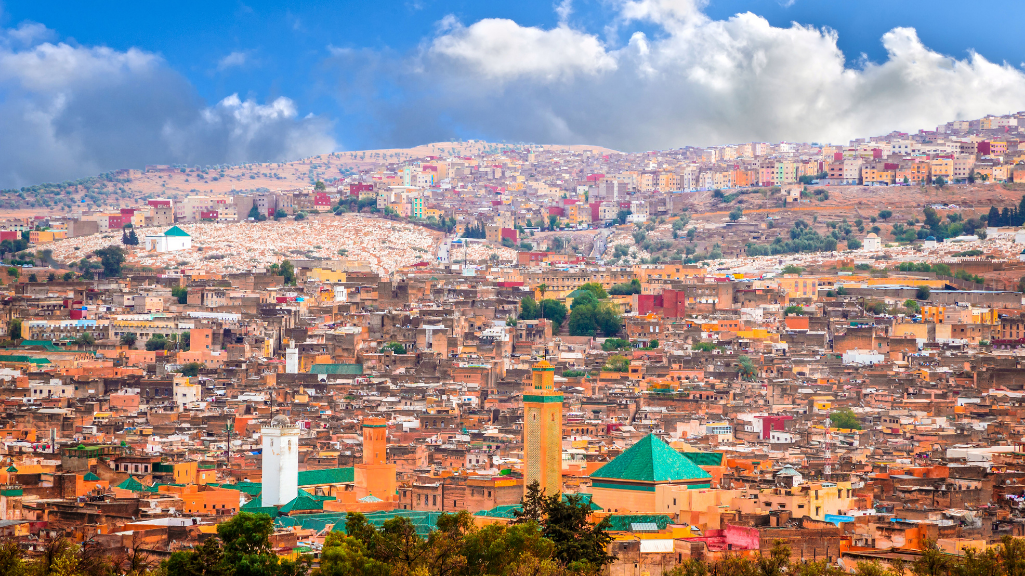
There is a moment that happens to almost every traveler who enters Fes el-Bali for the first time: you step off a main street into a narrow alley, the city swallows you whole, and suddenly 1,200 years of history press in from every whitewashed wall. Donkeys brush past with loads of fresh bread. The sound of a Quranic school drifts from somewhere overhead. The copper hammers of a tinsmith ring ahead. You are not visiting Fes — you are inside it.
Morocco’s second-largest city is often overshadowed by Marrakech’s global fame, but among seasoned travelers, Fes carries a different reputation: the country’s true cultural capital, a living medieval city that the modern world somehow left mostly intact. It is home to the world’s oldest operating university, the world’s largest car-free urban area, and some of the most intricate Islamic architecture on Earth. For anyone serious about understanding Morocco — its history, its craft traditions, its intellectual soul — Fes is essential.
This guide covers everything you need to plan your trip: the medina’s must-see landmarks, lesser-known corners worth hunting down, where to eat and sleep, and how to navigate the labyrinth with confidence.
Fes: Morocco’s Intellectual and Spiritual Capital
Founded in the early 9th century by Idris II, Fes grew rapidly into one of the Islamic world’s great cities of learning. At its height, the city rivaled Cairo and Baghdad as a center of scholarship, trade, and theology. Merchants, scholars, and craftspeople poured in from Andalusia after the fall of Muslim Spain, and from Kairouan in modern-day Tunisia — each community leaving indelible marks on the city’s architecture, cuisine, and culture.
Today, Fes is divided into three distinct zones: Fes el-Bali (the ancient medina, UNESCO-listed since 1981), Fes el-Jdid (the “new Fes” built by the Merenid dynasty in the 13th century, home to the old Mellah or Jewish quarter), and the modern Ville Nouvelle built under French colonial rule in the 20th century. Most travelers spend the majority of their time in Fes el-Bali — and for good reason.
Fes el-Bali: Inside the World’s Largest Car-Free City
Declared a UNESCO World Heritage Site in 1981, Fes el-Bali covers approximately 300 hectares and contains around 9,400 alleys — making it the world’s largest car-free urban area. No cars, no motorcycles (in most of the medina), no right angles. The streets were not planned; they evolved over twelve centuries of organic growth, following water channels, property lines, and the logic of a pre-industrial city built for people and pack animals.
Navigation is genuinely challenging, and that is part of the experience. A few practical pointers before you venture in:
- Hire a licensed guide for your first day. The medina has over two dozen fondouks, 186 mosques, 82 drinking fountains, and countless artisan workshops. A knowledgeable local guide won’t just help you find landmarks — they’ll interpret what you’re looking at. Moratra’s local guides can navigate the medina’s 9,400 lanes so you focus on the magic rather than the map.
- Download an offline map. Maps.me and Google Maps both have reasonable medina coverage. Your GPS signal will drop, but waypoints still help.
- Remember: getting lost is not failure. Some of the most memorable encounters in Fes happen when you abandon the planned route entirely and follow curiosity.
Must-See Landmarks in Fes
Al-Qarawiyyin University — The Oldest University in the World
In 859 AD, a woman named Fatima al-Fihri used her inheritance to found a mosque and school in the heart of the Fes medina. That institution — Al-Qarawiyyin — never stopped teaching. UNESCO and Guinness World Records both recognize it as the oldest continuously operating educational institution in the world, a record it has held for over eleven centuries.
Fatima’s family had emigrated from Kairouan, Tunisia (hence the name al-Qarawiyyin — “from Kairouan”), and her act of founding the university was extraordinary not just in its longevity but in its origin: built by a Muslim woman using her own inherited wealth. The university’s alumni include medieval cartographer Mohammed al-Idrisi, whose world maps helped guide European exploration during the Renaissance. The library preserves more than 4,000 rare manuscripts, including ancient Quranic texts and volumes on astronomy, medicine, and philosophy.
Non-Muslims cannot enter the mosque itself, but the entrance courtyard and surrounding neighborhood are deeply atmospheric. The adjacent Attarine Souk — one of the medina’s finest spice markets — fills the air with cumin, cinnamon, and argan oil.
Bou Inania Madrasa
Built between 1350 and 1357 by the Merenid Sultan Abu Inan Faris, the Bou Inania Madrasa is one of the few religious buildings in Fes that non-Muslims can enter — and it rewards the modest admission fee many times over. The level of decorative ambition is staggering: the lower third of every interior wall is covered in geometric zellige tilework; above that rises intricately carved stucco in arabesques; above that, carved cedarwood screens and corbels frame the upper galleries where students once slept in small rooms.
Stand in the central courtyard and tilt your head back — the building feels like a geometric poem made physical. The madrasa also housed a famous water clock on the street outside, of which only the wooden beam structure survives.
Chouara Tanneries
The Chouara Tanneries have been operating continuously since the 11th century, making them among the oldest tanneries in the world. From street level, you would never suspect they were there. But climb to one of the leather goods shops overlooking the complex — most offer free terrace access to browsing visitors — and you are confronted with one of the most visually arresting sights in all of Morocco.
Below you: a grid of stone vats filled with natural dyes — saffron yellow, poppy red, indigo blue, mint green, and the chalky white of pigeon droppings used to soften the hides. Workers in the vats tread the leather by foot, using essentially the same techniques that have been employed here for nearly a thousand years. The smell is formidable (shops provide sprigs of mint to hold under your nose). Go in the morning, when light falls east into the pits and the colors are at their most vivid.
Dar Batha Museum
Set in a restored 19th-century palace near the medina’s western edge, the Dar Batha Museum houses one of Morocco’s finest collections of traditional Fassi arts: zellige tilework, embroidered textiles, carved cedarwood doors, antique Andalusian musical instruments, and the famous blue-and-white ceramics for which Fes is renowned throughout the Arab world. If you want to understand the craft traditions you will see practiced in the medina’s workshops, Dar Batha is the ideal starting point — visit it before, not after, the souk.
Al-Attarine Madrasa
Adjacent to Al-Qarawiyyin and built in 1323–1325, the Al-Attarine Madrasa takes its name from the neighboring spice market (attarine means “perfume sellers”). It is smaller than Bou Inania but arguably even more refined, with some of the most exquisite carved plasterwork in all of Morocco. The cedarwood lattice screens of the upper floor galleries are particularly beautiful. Visit in the late morning when the courtyard skylight casts the best light onto the tilework.
Hidden Gems: Fes Beyond the Tourist Trail
The Merenid Tombs at Sunset
On the hilltop directly above the northern medina, the ruined Merenid Tombs offer the finest panoramic view of Fes el-Bali — and remain largely overlooked by mainstream tourism. Built in the 14th century as royal mausoleums, the tombs themselves are evocative ruins. But the real reason to make the climb is the view at golden hour: the medina’s minarets, the rooftop terraces, the green hills of the surrounding valley, all bathed in amber light. Arrive an hour before sunset, bring water, and claim a spot on the low walls. Small café terraces nearby serve mint tea with the same view, for a few dirhams.
The Fondouks of Fes
A fondouk is a historic caravanserai — a merchant inn built around a central courtyard, once used for storing goods and sheltering traveling traders and their animals. Fes el-Bali has dozens of them, many still in use as workshops or storage, some crumbling gracefully. The Fondouk Nejjarine near Nejjarine Square is the most celebrated — beautifully restored, now housing a woodworking museum, its carved cedar fountain one of the medina’s great ornamental objects. But simply peering through the heavy wooden doors of lesser-known fondouks as you walk gives a vivid sense of how the medieval trade city functioned.
The Andalusian Quarter
Most visitors spend all their time in the main (Kairouan) part of Fes el-Bali, overlooking the Andalusian quarter on the medina’s eastern bank. Founded by refugees from Córdoba in the 9th century, it is quieter, less touristic, and contains the Al-Andalus Mosque — one of the oldest in the city — as well as the Sahrij Madrasa with its enormous reflective pool, rarely crowded even at peak hours.
Fes vs. Marrakech: Which City Should You Prioritize?
It is a question every Morocco first-timer eventually asks. Both cities are essential; both are completely different experiences. Marrakech is theatrical, fast, photogenic, and set up for tourism in ways that make independent travel relatively easy. Fes is deeper, more challenging, more intellectually rewarding, and — outside the main tourist zones — more authentically Moroccan in daily life.
If you have time for only one: choose based on what moves you. Art, shopping, and desert access? Marrakech. History, craft, and an experience that genuinely disorients the senses? Fes. For most travelers, the ideal itinerary includes both — Moratra’s 5-Day Marrakech-Sahara-Fes tour threads the two cities together with a Sahara desert stop in between, which many guests describe as the perfect introduction to Morocco’s range.
Where to Stay in Fes
Staying inside the medina, in a riad, is the right choice for most visitors. The experience of returning to a hidden courtyard after a day in the labyrinth — hearing the call to prayer from the rooftop, having breakfast in a tiled inner garden — is part of what makes Fes memorable. Ville Nouvelle hotels are more comfortable and more predictable, but they miss the point.
- Budget: Numerous guesthouses and small riads offer clean rooms in the medina from around 200–400 MAD per night. Look around Bab Guissa and Bab Bou Jeloud for the best options in this range.
- Mid-range: Riad Laaroussa and Riad Dar Hatim are well-regarded for their location, rooftop terraces, and authentic atmosphere, typically running 600–1,200 MAD per night with breakfast included.
- Luxury: Dar Roumana and Palais Amani set the standard for high-end Fes hospitality. Dar Roumana’s restaurant, helmed by an American chef trained in France, is widely considered one of the finest dining experiences in the city. Palais Amani offers a rooftop with 360-degree medina views and chef Houssam Laassiri’s modern take on Fassi classics.
Booking tip: In every price bracket, confirm the precise location of your riad before you arrive, and ask for detailed walking directions from the nearest landmark. Taxi drivers cannot reach most riad addresses by car, and your phone’s GPS will struggle in the medina depths.
Food in Fes: The Fassi Kitchen
Fes has its own distinct culinary tradition — the Fassi kitchen — which is considered by many Moroccan food scholars to be the most refined regional cuisine in the country. It is characterized by long cooking times, complex spice combinations, and a preference for layered flavors over quick heat.
What to Eat
- Pastilla: Fes’s signature dish. Layers of wafer-thin warka pastry filled with spiced pigeon (or chicken), eggs, almonds, and a subtle sweetness from cinnamon and sugar, all baked and dusted with powdered sugar and cinnamon. It sounds unusual; it tastes extraordinary. The version made with pigeon is the traditional Fassi preparation — seek it out.
- Mechoui: Whole lamb slow-roasted in a clay oven until the meat falls apart at a touch. The best mechoui in Fes is ordered a day in advance at places like The Ruined Garden — it is a dish that cannot be rushed.
- Fassi Tagine: The Fassi version of the tagine differs from Marrakchi preparations: onions are caramelized slowly into a rich, dark sauce with saffron, ginger, and preserved lemon. The result is deeper and more aromatic than the tagines you’ll find elsewhere in Morocco.
- Street Food: Merguez sandwiches, harira soup, msemen flatbreads, and sfenj (Moroccan doughnuts) are the best street-level eating in the medina. The small alley market near Rcif Square is particularly good in the mornings.
Where to Eat
The Ruined Garden is the most atmospheric restaurant in the medina: a jungle of plants fills the courtyard, the wood fire keeps the evenings warm, and the kitchen commits to authentic Fassi ingredients and technique. The mechoui (pre-order required) is exceptional. Darori offers honest, affordable diffa-style dinners — pigeon pastilla, beef and prune tagine, Moroccan pastries — in a convivial courtyard setting. For a quick, local lunch, find a neighborhood restaurant busy at noon with workers and families: the food will be fresher and more honest than anything offered to tourists at inflated prices.
Day Trips from Fes
Volubilis Roman Ruins
About 70 km southwest of Fes (roughly 1.5 hours by road), Volubilis is Morocco’s best-preserved Roman archaeological site — a UNESCO World Heritage Site containing remarkably intact mosaic floors, triumphal arches, and house foundations dating back nearly 2,000 years. The site sits in open farmland against a backdrop of rolling hills, and the early morning light across the mosaics is spectacular. Combine it with a stop in nearby Moulay Idriss, Morocco’s holiest city, and the imperial city of Meknes (60 km from Fes) for a full day trip.
Meknes
Often bypassed in favor of its more famous neighbors, Meknes rewards the 1-hour drive from Fes. The city was built as a Versailles-like imperial capital by Sultan Moulay Ismail in the 17th century, and his ambitions left behind a city of enormous gates, grand granaries, and the vast Bab Mansour — considered one of the finest Moroccan gates in existence. The medina is far less crowded than Fes, the souks are genuine (not tourist-facing), and the whole city can be explored comfortably in half a day.
Ifrane
A 1-hour drive south into the Middle Atlas brings you to Ifrane — a town that looks entirely incongruous in Morocco: Swiss chalet-style architecture, pine forests, a river running through the center, and in winter, actual snow. It is a jarring and delightful contrast after the medina’s density. Ifrane is also the gateway to cedar forests where wild Barbary macaques roam freely — a family-friendly detour worth planning.
Getting to Fes
- By Air: Fes-Saïss Airport (FEZ) receives direct flights from several European cities, including Paris, Brussels, Amsterdam, and London, on Royal Air Maroc and various low-cost carriers. A taxi or bus transfer into the city center takes 20–30 minutes.
- By Train: ONCF (Morocco’s national rail) runs regular, comfortable services between Casablanca and Fes (approximately 4 hours) and between Marrakech and Fes via Casablanca (approximately 8 hours). The Fes train station is in the Ville Nouvelle, with easy taxi connections to the medina.
- By Bus: CTM and Supratours operate reliable coach services from most Moroccan cities. The Chefchaouen-to-Fes route (approximately 4 hours) is a popular first step on a northern Morocco circuit.
- By Car: Fes is well connected by highway from Casablanca (3.5 hours) and Tangier (4 hours). Note that driving inside Fes el-Bali is not possible — park in the Ville Nouvelle or at Bab Bou Jeloud and walk in.
Fes connects naturally into longer Morocco itineraries. Moratra’s 7-Day Morocco tour and 8-Day Signature tour both include Fes as a key destination, pairing it with the Sahara, Marrakech, and the imperial cities in a way that gives the city the time it deserves — generally a minimum of two nights to begin to feel its depth.
Practical Tips for Visiting Fes
Best Time to Visit
Spring (March–May) and autumn (September–November) are ideal: temperatures are comfortable (18–26°C), the light is beautiful, and the medina is active without the crushing heat of summer. Summer in Fes can reach 38–42°C, which makes long medina walks taxing but not impossible if you start early and rest during midday. Winter is cool and occasionally wet, but the medina is at its most peaceful and uncrowded.
What to Wear
Fes is a conservative Muslim city. Shoulders and knees should be covered for both men and women when walking the medina — this is not a strict rule enforced by authorities, but it is a mark of basic respect and will make your experience more comfortable. A light scarf is useful for women when visiting religious sites.
Money
The Moroccan dirham (MAD) is a closed currency — bring cash from an ATM in Fes rather than trying to exchange currency at home. ATMs are plentiful in the Ville Nouvelle and near Bab Bou Jeloud. Most medina vendors, riads, and restaurants operate on cash; larger establishments may accept cards.
Guides and Touts
At major medina entrances, you will be approached by unofficial “guides” offering to show you around. The safest approach is to book a licensed guide through your riad or a reputable agency before arriving. This avoids the commission-based shop tours that unofficial guides typically run. Moratra can connect you with certified local guides as part of any tour planning.
Two Nights Minimum
One day in Fes is not enough. Two nights gives you two full days: one to orient yourself with a guide, one to return independently to the places that captured you. Three nights is ideal. The medina has a way of giving up its secrets slowly — the more time you allow, the richer the experience.
Frequently Asked Questions About Fes
Is Fes safe for tourists?
Yes. Fes is a safe city for travelers, including solo women. As with any densely populated urban area, standard precautions apply: keep valuables out of sight, be aware in crowded souks, and trust your instincts in unfamiliar alleys after dark. The medina’s main arteries are well-traveled throughout the day and early evening.
How many days should I spend in Fes?
A minimum of two nights (two full days) is needed to cover the main landmarks and begin to feel the city. Three nights is ideal for travelers who want to explore beyond the tourist circuit — the Andalusian quarter, the Merenid hilltop, a day trip to Volubilis. If you are combining Fes with a broader Morocco itinerary, Moratra’s guided tours are structured to give Fes the time it deserves without rushing the rest of the trip.
Can non-Muslims visit Al-Qarawiyyin University?
Non-Muslims cannot enter the mosque or the main university building, which remains an active place of worship and study. However, the library was opened to the public in recent years (by prior arrangement with the Ministry of Culture) and the surrounding neighborhood — including the Attarine Souk and adjacent Al-Attarine Madrasa — is fully accessible.
What is the best way to see the Chouara Tanneries?
The tanneries are viewed from the terraces of surrounding leather shops. You will be invited in and shown the view for free with no obligation to purchase, though of course the shops hope you will buy. The best time to visit is weekday mornings (approximately 9–11 AM) when the workers are active and the light is good. Friday mornings are often slower as this is the main prayer day.
How does Fes compare to Marrakech?
Marrakech is more accessible, more internationally polished, and easier to navigate independently. Fes is more historically layered, more challenging, and — for travelers drawn to authenticity — ultimately more rewarding. Marrakech is an experience; Fes is an education. Most travelers who visit both agree they complement each other well. Moratra’s 5-Day Marrakech-Sahara-Fes tour is designed around this pairing.
Is it worth hiring a guide in Fes?
Yes — at least for your first day. The medina’s 9,400 alleys are genuinely disorienting, and a good guide does far more than navigate: they explain the social history of the neighborhoods, connect you with craftspeople willing to show their process, and help you understand what you are seeing. After a guided first day, many travelers find independent exploration far more meaningful because they have a framework for the city’s logic.
Plan Your Fes Visit with Moratra
Fes is one of those cities that rewards patience and rewards expertise — knowing which alley leads to the tanner’s quarter, which riad’s rooftop has the best view of the minarets at dusk, which restaurant pre-orders its mechoui three days in advance. These are the things a good travel partner knows.
Whether you are planning a standalone Fes city break or weaving it into a longer Morocco circuit, the Moratra team offers free personalized itinerary advice — no pressure, no sales pitch, just honest recommendations from people who know this city well. Reach out and we’ll help you plan a trip that does Fes justice.
