
Ask ten travelers in Morocco whether Casablanca is worth visiting and you will get ten different answers. Some will tell you to skip it. Others will insist you stay a week. The truth sits somewhere in between, and once you know what the city actually offers (and doesn’t), the decision becomes simple.
Casablanca is not Marrakech. It is not Fes. It is Morocco’s economic engine, a coastal metropolis of around 3.8 million people, and the country’s most modern, outward-looking city. If you come expecting narrow souks and snake charmers, you will be disappointed. If you come curious about the Morocco that Moroccans actually live in today, you will leave impressed.
Here is an honest answer to the question every first-time traveler asks.
Is Casablanca Worth Visiting? The Short Answer
Yes — for one or two days. Casablanca is absolutely worth a stop for the Hassan II Mosque alone. Add the Art Deco downtown, the Corniche at sunset, and a plate of grilled fish at the port, and you have a memorable short visit that complements (rather than competes with) the imperial cities.
What Casablanca is not is a destination where you base yourself for a week. Most travelers land at Mohammed V International Airport, spend a night, explore for a day, and move on to Fes, Marrakech, or Chefchaouen. That rhythm works beautifully.
The Case FOR Visiting Casablanca
1. The Hassan II Mosque Is Genuinely Breathtaking
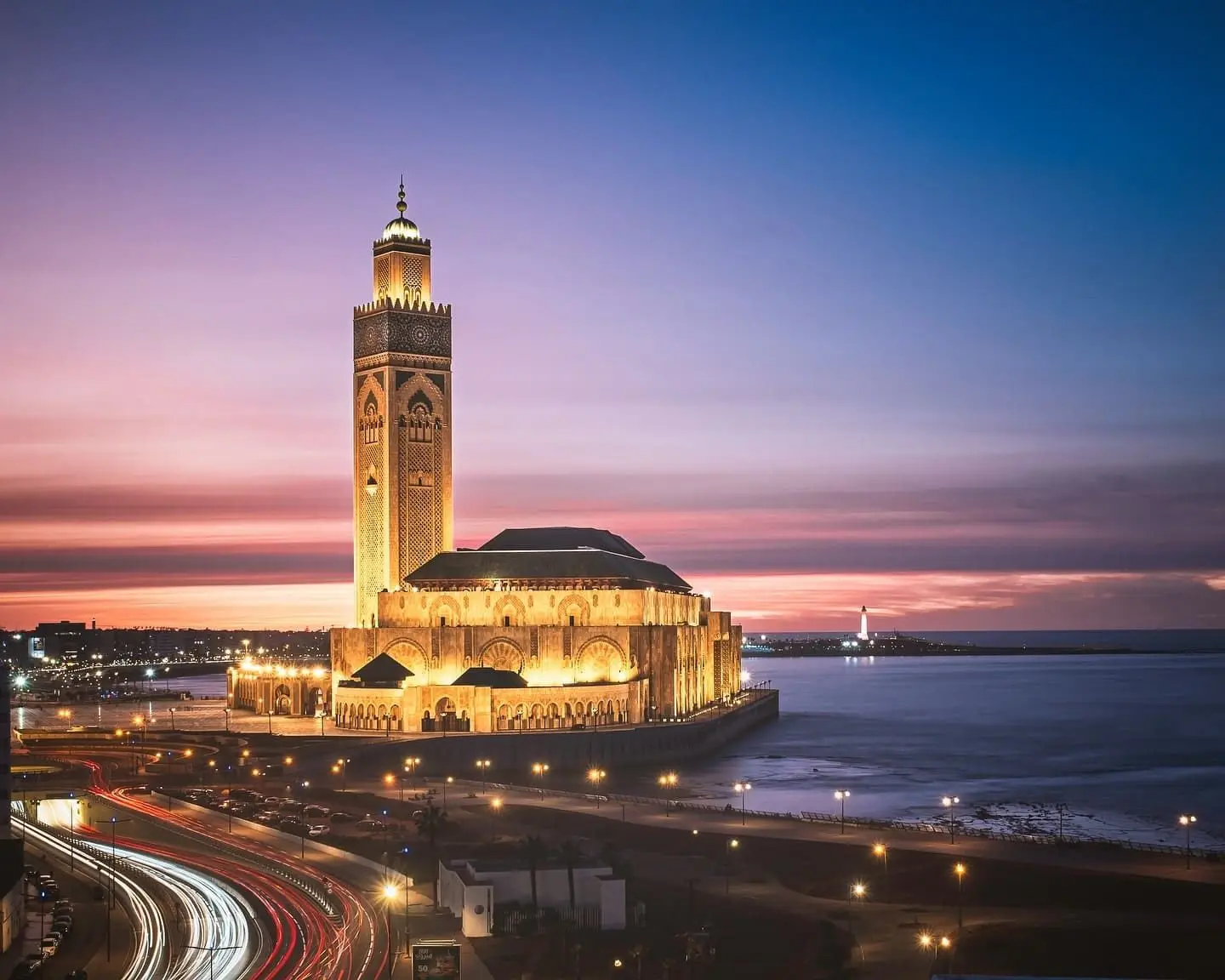
This is the single reason most visitors come, and it is reason enough. Completed in 1993 and designed by French architect Michel Pinseau, the Hassan II Mosque sits on a platform that extends over the Atlantic — the only major mosque in the world built partly above the sea.
If you would like us to arrange it for you, see our 10-day Morocco tour from Casablanca.
The numbers are staggering. The minaret rises 210 meters (689 feet), making it Africa’s tallest and the second tallest in the world. A laser beam at its peak points toward Mecca with a range of about 30 kilometers. The prayer hall accommodates 25,000 worshippers inside, with another 80,000 on the surrounding plaza — around 105,000 in total.
Crucially for travelers: the Hassan II Mosque is one of the very few mosques in Morocco open to non-Muslim visitors. Guided tours run in English, French, Arabic, and Spanish and last roughly 45 minutes. You will see hand-carved cedar ceilings, intricate zellige tilework, a retractable roof, and the hammam and ablution hall beneath the prayer floor. Book the first or last tour of the day for better light and smaller groups.
2. Art Deco Architecture You Will Not See Anywhere Else in Africa
Between 1912 and 1956, under the French protectorate, Casablanca became a laboratory for European modernist architects. The result is one of the world’s largest concentrations of Art Deco and modernist buildings, much of it blended with Moorish motifs in a style sometimes called “Mauresque.”
Walk around Place Mohammed V and Boulevard Mohammed V and you will pass a remarkable inventory of facades, wrought-iron balconies, and geometric details. The Villa des Arts and the restored Cinema Rialto are good anchors for a self-guided walk. Bring comfortable shoes and look up.
3. The Atlantic Coast, Sunsets, and Seafood
The Corniche of Ain Diab stretches along the ocean west of the city center. It is Casablanca’s Miami: cafés, beach clubs, joggers at sunset, families on weekends. The seafood here is the best in Morocco. Le Cabestan is the famous choice for a special meal with ocean views; the unfussy fish grills near the central market (Marché Central) are perfect for lunch at a fraction of the price.
4. Rick’s Café and the Movie Myth
The 1942 film Casablanca was shot entirely in Hollywood — not a single frame was filmed in the city. But in 2004, former American diplomat Kathy Kriger opened Rick’s Café at 248 Boulevard Sour Jdid, near the port, in a restored 1930s mansion. It is a theme restaurant, yes, but a very good one — live piano, decent Moroccan-French cuisine, and an atmosphere that leans into the legend with charm rather than cheese. Book ahead.
5. The Habous Quarter
Built by the French in the 1930s to evoke a traditional medina without the chaos, the Habous Quarter (Quartier des Habous) is a calmer alternative to the medinas of Marrakech or Fes. The arches are organized, the alleys navigable, the shopping genuine. It is a good place to buy olives, spices, and books about Morocco without feeling overwhelmed.
The Case AGAINST Spending Too Long in Casablanca
Being honest: Casablanca will not deliver the postcard Morocco most first-time visitors are chasing.
- The old medina is modest. It exists, but it is small and less atmospheric than those of Fes, Marrakech, or Essaouira.
- Traffic and noise are real. This is a working commercial capital, with all that implies.
- Two full days is usually enough. After the mosque, the Corniche, and a walk through the Art Deco streets, the city has done its job.
None of this makes Casablanca bad. It just means you should plan it as a stop, not a destination.
How to See Casablanca in One Perfect Day
If you only have a single day — say, before an evening flight or en route to Marrakech — here is a plan that works.
Morning (9:00–12:00): Hassan II Mosque
Arrive for the 9:00 or 10:00 guided tour. Admission is around 140 MAD for adults (about $14), cheaper for students and children. Give yourself 90 minutes on site, including time for photos on the ocean-facing plaza.
Midday (12:30–14:30): Lunch Downtown
Head to Marché Central or the surrounding streets for fresh seafood. A filling tagine or mixed grill lunch costs 80–150 MAD. Afterward, walk 15 minutes through Place Mohammed V to admire the Art Deco civic buildings.
Afternoon (15:00–17:30): Habous Quarter and Royal Palace Exterior
Tour the New Medina (Habous). The Royal Palace of Casablanca is next door; you cannot enter, but the gates and gardens are worth a look.
Evening (18:00–22:00): Corniche and Dinner
Catch sunset on the Ain Diab Corniche. Walk, have coffee, then dinner — either Le Cabestan for the splurge or Rick’s Café for the atmosphere. End the day feeling like you made the most of a city that surprises most people.
Casablanca vs. Marrakech: Which Should You Prioritize?
If you only have time for one, choose Marrakech. Marrakech delivers the sensory Morocco of the imagination — the Jemaa el-Fnaa square, the labyrinth souks, the riads, the palm groves, the gateway to the Atlas Mountains and the Sahara.
Casablanca is a complement, not a substitute. It is where you go to understand modern Morocco; Marrakech is where you go to feel the country’s historical soul. The ideal trip includes both, usually with Casablanca bookending the start or end of the journey because of the airport.
Best Neighborhoods to Stay In
- Anfa — upscale residential area west of downtown, quieter, near the Corniche. Best for a calmer base.
- Gauthier/Maarif — central and walkable, restaurants and shopping, good mix of hotels and apartments.
- Ain Diab — beachfront, resort feel, great for families and travelers wanting ocean views.
- City Center (around Place Mohammed V) — closest to Art Deco landmarks and the old medina, practical for short stops.
Getting to and Around Casablanca
From Mohammed V International Airport (CMN): The airport sits about 30 km south of the city. The easiest option is the ONCF commuter train to Casa-Voyageurs or Casa-Port station — around 43 MAD, runs every hour, takes 35–50 minutes. Taxis are plentiful; insist on the meter or agree on a price (roughly 250–300 MAD to downtown).
From Tangier: The Al Boraq high-speed train, Africa’s first high-speed service and inaugurated in November 2018, runs the 323-kilometer route between the two cities in about 2 hours 10 minutes, reaching 320 km/h on the dedicated track. It is a genuine highlight in its own right.
From Marrakech or Fes: Standard ONCF trains connect daily (3 hours to Marrakech, 3h30 to Fes). First-class tickets are comfortable and affordable.
In the city: Petit taxis (red in Casablanca) are cheap and metered. The Casablanca tramway is clean, cheap, and useful for covering longer distances.
Practical Tips Before You Go
- Dress code: Casablanca is more cosmopolitan than other Moroccan cities, but modest dress is still respectful. For the Hassan II Mosque, shoulders and knees must be covered; scarves are not required for women but appreciated.
- Language: Arabic and French dominate. English is less common than in Marrakech but increasingly present in hotels and tourist areas.
- Currency: Moroccan Dirham (MAD). ATMs are widely available; cards are accepted at most mid-range and upscale venues.
- Safety: Casablanca is generally safe for visitors. Use standard city precautions, especially at night around the port.
How to Fit Casablanca Into a Bigger Morocco Trip
Most of our travelers at Moratra include Casablanca as a one-day stop, usually at the start or end of a longer circuit. Our 10-Day Morocco Tour threads Casablanca into a route that also covers Rabat, Fes, Chefchaouen, the Sahara, and Marrakech — so you get the modern coastal city and the full imperial-cities experience without wasted days. If you’re still mapping out the broader trip, our Morocco Holidays Guide walks through the main regions and how to combine them.
The honest version of Casablanca — a striking mosque, elegant architecture, seafood by the ocean, and a glimpse of how the country actually lives today — is well worth one well-planned day.
Frequently Asked Questions
Is Casablanca worth visiting for one day?
Yes. One full day is the sweet spot for most travelers: a morning at the Hassan II Mosque, lunch downtown, an afternoon in the Habous Quarter and Art Deco district, and dinner on the Corniche. Beyond two days, you are better off moving on to Marrakech, Fes, or Chefchaouen.
Is the Hassan II Mosque open to non-Muslim visitors?
Yes. It is one of the very few mosques in Morocco that admits non-Muslims. Entry is only permitted on guided tours, typically offered four times daily in English, French, Arabic, and Spanish (Friday schedules are reduced). Tickets are around 140 MAD for adults.
Is Casablanca safer than Marrakech?
Both cities are generally safe for tourists who use normal precautions. Casablanca feels less touristy and therefore has fewer of the scams targeted at visitors. Petty theft can occur in any large city, so keep valuables secure and avoid deserted areas at night.
How do I get from Casablanca airport to the city?
The ONCF commuter train from Mohammed V Airport to Casa-Voyageurs or Casa-Port station is the most reliable option — roughly 43 MAD and 35–50 minutes. Taxis cost around 250–300 MAD to downtown; always confirm the fare or insist on the meter before departure.
Can I see Casablanca as a day trip from Marrakech?
It is possible but not ideal. The train takes roughly three hours each way, so a day trip means nearly six hours of travel for six hours on the ground. A better approach is to include Casablanca as an overnight stop on a broader itinerary rather than a same-day round trip.
Is Casablanca or Marrakech better for first-time visitors?
Marrakech, without hesitation. Marrakech delivers the medinas, souks, palaces, and gateway access to the desert and Atlas Mountains that most first-time Morocco travelers come for. Casablanca is best appreciated as a short complementary stop, not as a primary base.
Still Planning Your Trip?
Casablanca works best when it slots cleanly into a bigger Morocco itinerary — not too much time, not too little. If you are not sure how to fit it in with Marrakech, Fes, or the Sahara, the Moratra team is happy to help. Our travel planners offer free personalized advice, whether you are weighing a one-day stopover or building a two-week grand circuit. Just reach out and tell us what you are hoping to see.
Plan Your Morocco Trip with Moratra
Ready to turn the ideas in this guide into a real trip? Browse Moratra’s most-booked private experiences across Morocco — handpicked itineraries, luxury riads and local guides:
- Luxury Morocco Tours — multi-day private itineraries across Marrakech, the Sahara, Fes and the imperial cities.
- Morocco Sahara Desert Tours — VIP private journeys from Marrakech to Erg Chebbi and Merzouga.
- Agafay Desert Day Trips — luxury camps and dinner-under-the-stars experiences just 30 minutes from Marrakech.
- Activities and Day Tours in Marrakech — cooking classes, hammams, walking tours and hot air balloon flights.
Need help choosing? Reach out anytime — our local team offers free, no-obligation Morocco trip advice.
