
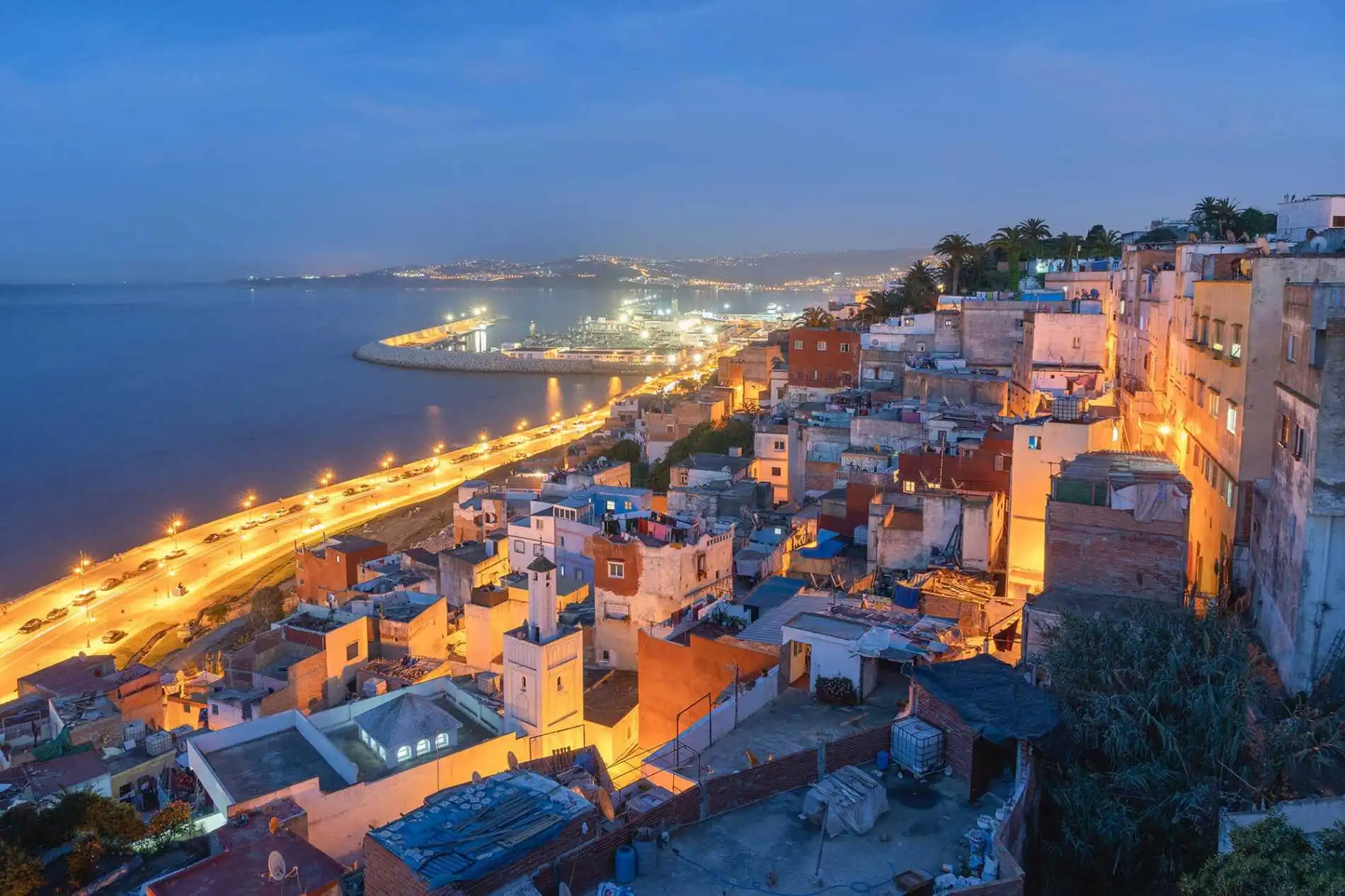
Stand at the northern tip of Africa and look north: Spain is just 14 kilometres away, close enough on a clear day to make out the white buildings climbing the hills above Tarifa. This is Tangier — a city that has never quite belonged to one world alone. It is African and European, Arab and Andalusian, ancient and strikingly modern. It is the place where two continents exhale into each other across the Strait of Gibraltar, and it may be the most cinematically charged city in all of Morocco.
For centuries, every empire worth its salt coveted Tangier: Phoenicians, Romans, Vandals, Arabs, Portuguese, British, and French all ruled here in turn. That layered history left an urban fabric unlike anything else in North Africa — a labyrinthine medina draped over hills above a bay, a kasbah with panoramic views of two seas, a palm-lined boulevard that could belong to the French Riviera, and a literary mythology that still perfumes every café on the Petit Socco. If you are planning a trip to Morocco and wondering where to begin, Tangier is an answer worth considering seriously.
A City That Made Its Own Rules: The International Zone
Tangier’s most unusual chapter ran from 1923 to 1956, when the city was governed as an International Zone under a joint European administration involving Britain, France, Spain, and later the United States. No single country controlled it. There was no income tax, no tight currency controls, no morality police. Diplomats, spies, artists, exiles, and adventurers poured in from every corner of the world, drawn by the city’s strategic location and its atmosphere of delicious lawlessness.
It was this Tangier that became a magnet for some of the 20th century’s most restless literary minds. The American writer Paul Bowles arrived in 1947 and never really left, writing The Sheltering Sky in its smoky cafés and spending the rest of his life translating Moroccan oral literature. His presence drew a parade of Beat Generation writers: William S. Burroughs arrived in 1953, assembling the scattered pages of Naked Lunch on his Tangier rooftop. Allen Ginsberg, Jack Kerouac, and Gregory Corso all passed through, drawn by the city’s reputation as a place where the rules of polite society did not apply.
To book this with a local team, see our 15-day Morocco tour from Tangier.
Morocco regained full independence in 1956, Tangier’s special status was dissolved, and the international bohemia gradually dispersed. But the city never entirely shed its cosmopolitan mystique. You can still feel it in the layered architecture of the medina, in the French and Spanish phrases that slip into conversations alongside Darija Arabic, and in the elegant decay of villa gardens behind wrought-iron gates.
Must-See Attractions in Tangier
The Kasbah and Dar el Makhzen
At the highest point of the medina, the kasbah is both a fortress and a neighbourhood. Its whitewashed walls enclose a maze of quiet streets, small squares, and restored riads that feel removed from the bustle below. At its heart stands Dar el Makhzen, the former Sultan’s Palace, which now houses the Kasbah Museum. The collection spans prehistoric artefacts, Roman bronzes and mosaics from nearby Volubilis and Lixus, Moroccan ceramics, weapons, and a remarkable Manueline window from the Portuguese period — a reminder of the 17th century when Tangier was gifted to the British crown as part of Catherine of Braganza’s dowry to Charles II. From the kasbah’s ramparts, on a clear morning, you can see across the Strait to the mountains of Andalucia.
The Grand Socco and Petit Socco
The Grand Socco — officially Place du 9 Avril 1947, the date King Mohammed V spoke here — is the animated gateway between the modern city and the old medina. Its terraced café and flower sellers, its mix of Riffian women in striped wool fouta skirts and suited city professionals, make it one of the great people-watching squares in Morocco. Step through the arch and descend into the medina to reach the Petit Socco, the intimate inner square that was once the spy-and-writer social hub of the International Zone. Order a mint tea at one of the old café terraces and imagine Burroughs and Ginsberg at the next table arguing about literature.
The American Legation Museum
One of Tangier’s most singular attractions is also one of its least visited. The American Legation Museum holds the distinction of being the only United States National Historic Landmark on foreign soil — a five-storey Moorish mansion gifted to the United States by Sultan Moulay Suleyman in 1821. The reason it exists at all is historically significant: Morocco was the first nation in the world to recognise American independence, doing so in 1777. The museum houses historical maps, paintings, a dedicated wing on Paul Bowles, and an excellent research library. Entry is inexpensive and the building itself is breathtaking.
Cap Spartel and the Caves of Hercules
About 14 kilometres west of the city centre, Cap Spartel is the north-westernmost point of continental Africa — the exact spot where the Atlantic Ocean and the Mediterranean Sea meet. The lighthouse here has guided ships safely through the strait since 1864, and the cape rises to 326 metres above sea level, offering sweeping views over the water in both directions. A short distance further south, the Caves of Hercules are a natural and mythological landmark: sea caves carved partly by waves and partly by ancient Berber millstone-cutters, famous for their Africa-shaped opening onto the Atlantic. The caves were inhabited in prehistoric times, and the Phoenicians left markings on the walls. They make for an easy half-day excursion combined with Cap Spartel.
Modern Tangier: A City Reinventing Itself
Tangier today is not the faded, slightly melancholic city it was in the 1990s. Substantial investment over the past two decades has transformed it. The new marina is sleek and walkable, lined with restaurants and café terraces overlooking boats. The Tangier Med port, opened in 2007 some 40 kilometres east of the city, is now the largest port in Africa and the Mediterranean — a symbol of Tangier’s re-emergence as a major commercial hub.
The city’s arts scene has quickened with new galleries and cultural spaces, many concentrated around the Corniche and the former Villa Harris. A younger generation of Tangerines — architects, designers, musicians — are restoring old medina properties and opening businesses that blend Moroccan craft traditions with contemporary design sensibilities. This is a city with genuine forward momentum, and it shows in the energy on the streets.
Food in Tangier: Mediterranean Meets Moroccan
Tangier’s cuisine reflects its geography and history. Being closer to Spain than to Marrakech, the cooking here has a distinctly Mediterranean character — lighter and more herb-forward than the rich tagines of the south, with more use of fresh fish and olive oil. The city’s position on the Atlantic and Mediterranean means that fresh seafood is a cornerstone of the local table: grilled red mullet, sea bass with chermoula sauce, and fried squid straight from the morning’s catch.
The classic Tangier café experience unfolds on the terraces of the Petit Socco or the Grand Socco: atay (sweet mint tea poured from a height), freshly squeezed orange juice, msemen flatbread with argan oil and honey, and the ambient theatre of the square. For a proper sit-down meal, the restaurants in and around the kasbah serve good traditional cooking, while the Corniche has reliable options for grilled fish. The city’s Spanish heritage means you will also find tapas-style bars and bocadillo sandwiches — a small reminder of decades of cross-strait influence.
Day Trips from Tangier
Asilah
Some 46 kilometres south of Tangier, the walled Atlantic town of Asilah is one of Morocco’s most charming small coastal destinations. Its Portuguese-built ramparts overlook the ocean, and its medina walls are covered in large-scale murals refreshed each year during the Asilah Arts Festival in August. The town is relaxed, walkable, and beautiful — an easy and deeply rewarding half-day or full-day trip from Tangier.
Tetouan
An hour south-east along the Rif foothills, Tetouan has one of the best-preserved medinas in Morocco, a UNESCO World Heritage Site that few tourists bother to visit. The city carries a strong Andalusian heritage — it was largely built and settled by Muslims and Jews expelled from Spain in 1492 — and its architecture retains a distinctly Spanish-Moorish character. If you want to experience a functioning Moroccan medina without the crowds of Fes or Marrakech, Tetouan is the answer.
Ferry to Tarifa or Algeciras, Spain
One of the great travel pleasures of being in Tangier is the ease of crossing to Europe. The ferry to Tarifa takes just 35 minutes; to Algeciras, about 90 minutes. Both ports are well connected to the rest of Andalucia by bus and train. If your itinerary allows for a day or overnight in southern Spain, the crossing is an experience in itself — watching Africa and Europe trade places on the horizon.
Getting to Tangier
By ferry from Spain: The most atmospheric arrival. Regular crossings operate from Tarifa (35 minutes) and Algeciras (90 minutes) to Tangier Ville port, right in the city centre. FRS and Baleàrea operate the Tarifa route; multiple operators serve Algeciras. Book ahead in summer and around Spanish and Moroccan public holidays.
By high-speed train: Tangier’s Tanger Ville station is the northern terminus of Al Boraq, Africa’s first and fastest high-speed rail line. Built by the same manufacturer as the French TGV and capable of 320 km/h, Al Boraq connects Tangier to Casablanca in around 2 hours 10 minutes, with stops including Kenitra and Rabat. From Casablanca there are onward connections to Marrakech and Fes. It is comfortable, affordable, and a pleasure to ride.
By air: Ibn Batouta Airport serves Tangier with direct flights from major European cities (Madrid, Paris, Brussels, Amsterdam) as well as domestic routes from Casablanca and Marrakech. The airport is around 15 kilometres south-west of the city centre.
Tangier makes an excellent starting point for a wider Morocco itinerary. Moratra’s 15-Day Grand Circuit and 10-Day Imperial Cities tour both pass through or begin in Tangier, threading south through Chefchaouen and Fes before heading deeper into the country. Starting in Tangier and ending in Marrakech (or vice versa) lets you enter through one gateway and exit through another — always the most satisfying way to travel.
Practical Tips for Visiting Tangier
- Best time to visit: Spring (March–May) and autumn (September–November) offer ideal temperatures — warm but not scorching. Summer is lively but crowded with visitors crossing from Spain; winter is mild and quiet.
- Getting around: The medina and kasbah are best explored on foot. For Cap Spartel and the Caves of Hercules, take a petit taxi (agree a price before setting off) or organise a half-day excursion.
- Currency: The Moroccan dirham (MAD). ATMs are widely available. Most hotels and upscale restaurants accept cards; carry cash for the medina.
- Safety: Tangier has improved enormously in recent years and is generally safe for tourists. Exercise the usual urban awareness in the medina — keep bags secure and be politely firm with persistent touts near the port and Petit Socco.
- Language: Darija (Moroccan Arabic) is the everyday language, but French and Spanish are widely spoken — more so here than anywhere else in Morocco.
Frequently Asked Questions About Tangier
Is Tangier worth visiting in Morocco?
Absolutely. Tangier is one of Morocco’s most historically rich and visually distinctive cities, often underestimated because it sits at the edges of standard tourist circuits. Its International Zone history, literary associations, proximity to Spain, and ongoing urban renaissance make it a genuinely compelling destination — not just a transit stop.
How many days do you need in Tangier?
Two full days is a comfortable minimum: one for the medina, kasbah, and key museums; a second for Cap Spartel, the Caves of Hercules, and an evening on the Corniche. If you add a day trip to Asilah or Tetouan, three days works well. As part of a longer Morocco circuit, Tangier fits naturally as a one- or two-night start or end point.
How do you get from Tangier to Chefchaouen?
The most straightforward option is a direct CTM or Supratours bus, which takes approximately 2.5 hours. Taxis and private transfers are also available. The mountain road is scenic and the journey is not difficult. Many travellers combine Tangier and Chefchaouen in a single northern Morocco loop.
Is Tangier safe for tourists?
Yes. Tangier has undergone significant improvements in tourist infrastructure and policing over the past decade. The main areas of concern are petty tourist-focused hassle near the port and the Petit Socco, which is manageable with standard travel awareness. The city is safe to walk at night in the main tourist areas.
What is the best way to travel from Tangier to Casablanca?
The Al Boraq high-speed train is by far the most comfortable and time-efficient option, covering the route in around 2 hours 10 minutes. Trains depart from Tanger Ville station several times daily. First-class seats are reasonably priced and worth the small premium for the comfort and legroom.
Can you take a day trip from Tangier to Spain?
Yes. The ferry to Tarifa takes just 35 minutes, making a day trip to southern Spain straightforwardly possible. Factor in port processing time on both sides — a realistic estimate is 1.5–2 hours door-to-door from the Tangier medina to Tarifa town. Bring your passport, as you are crossing an international border.
Tangier rewards travellers who come to it with curiosity rather than a checklist. It is a city of accumulated layers — Phoenician and Roman, Portuguese and British, international and deeply Moroccan — that never quite resolves into a single identity, and is all the richer for it. Whether you arrive by ferry with the Spanish coast receding behind you, or by high-speed train from the south, you will find a city that takes travel seriously and gives it back in full.
Thinking of starting your Morocco trip in Tangier — or weaving it into a longer circuit? Moratra’s team offers free, personalised itinerary planning. Tell us your dates, your interests, and how much ground you want to cover, and we’ll design a route that makes the most of every day. Reach out to us here — the advice is always free.
Plan Your Morocco Trip with Moratra
Ready to turn the ideas in this guide into a real trip? Browse Moratra’s most-booked private experiences across Morocco — handpicked itineraries, luxury riads and local guides:
- Luxury Morocco Tours — multi-day private itineraries across Marrakech, the Sahara, Fes and the imperial cities.
- Morocco Sahara Desert Tours — VIP private journeys from Marrakech to Erg Chebbi and Merzouga.
- Agafay Desert Day Trips — luxury camps and dinner-under-the-stars experiences just 30 minutes from Marrakech.
- Activities and Day Tours in Marrakech — cooking classes, hammams, walking tours and hot air balloon flights.
Need help choosing? Reach out anytime — our local team offers free, no-obligation Morocco trip advice.
