
Money is one of the small things that, handled well, makes a Morocco trip glide. Handled poorly, it costs you in airport-counter exchange rates, awkward tipping moments, and souk prices that suddenly feel high. This guide walks you through the Moroccan dirham, ATMs, tipping norms, the gentle theatre of haggling, and when to reach for cash versus card — written by the team at Moratra, who do this every day with travellers from around the world.
The Moroccan Dirham: A “Closed” Currency
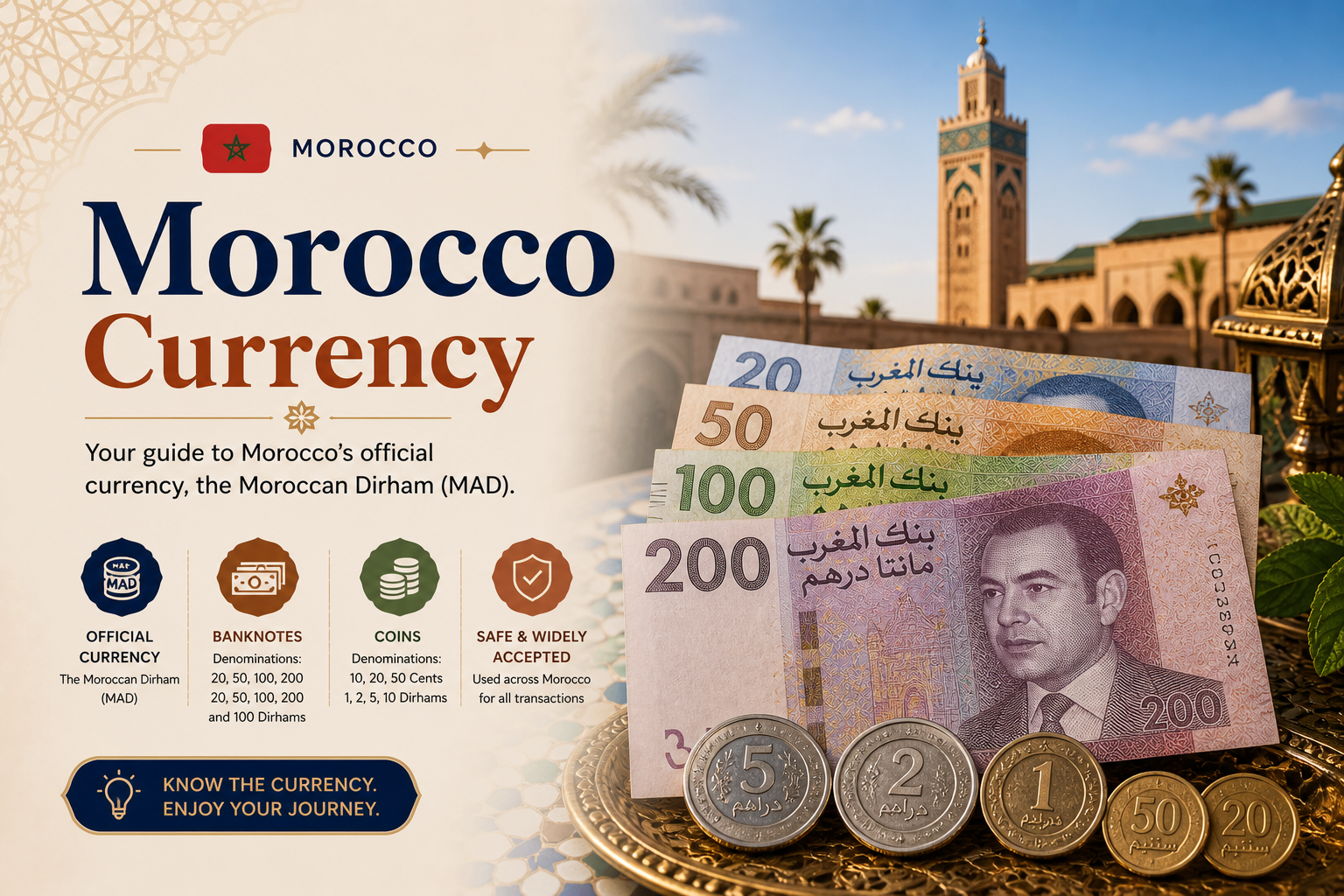
Morocco’s currency is the Moroccan dirham, written as MAD or د.م. One dirham is divided into 100 centimes, and you’ll see banknotes of 20, 50, 100, and 200 dirhams, plus coins ranging from a few centimes up to 10 dirhams.
As of early 2026, approximate exchange rates are:
- 1 USD ≈ 9.2 MAD
- 1 EUR ≈ 10.8 MAD
- 1 GBP ≈ 12.5 MAD
The dirham is what’s called a closed currency, which has one practical consequence: you can’t easily buy or sell it outside Morocco, and you’re legally limited to importing or exporting only 2,000 MAD. Plan to arrive with a small float of euros, dollars, or pounds — or simply use an ATM on day one.
If you bring foreign cash
You can bring in any amount of foreign currency, but anything equivalent to 100,000 MAD or more must be declared at customs on arrival. Declaring it also lets you re-export the unspent portion when you leave. For most travellers this isn’t an issue, but if you’re carrying a large sum, fill in the customs form to avoid problems on the way out.
Where to Exchange Money in Morocco
The honest ranking, from best to worst:
- ATMs — usually the best real-world rate. Your card’s network handles the conversion, often within 1% of the interbank rate.
- Licensed bureaux de change — found in city centres and tourist areas, with reasonable rates and no commission. Always ask for a receipt.
- Banks — fair rates, but limited hours and slower service.
- Hotels — convenient, but rates are usually 5–8% worse.
- Airport exchange counters — the worst rates of all. Change only what you need to reach your hotel, then use an ATM.
A small tip from our guides: keep a few small bills (20 and 50 MAD notes) for taxis and tips. Large 200 MAD notes are awkward in the medina, where vendors rarely have change.
Using ATMs in Morocco
Visa and Mastercard work in virtually every Moroccan ATM. American Express is less reliable. Major networks include Attijariwafa Bank, Banque Populaire, BMCE (Bank of Africa), and BMCI, all with thousands of machines across the country.
Two key facts to know in 2026:
- All Moroccan ATMs now charge a 35 MAD fee per withdrawal — Al Barid Bank, long the free option, introduced the fee in January 2026.
- Withdrawal limits vary. Most ATMs cap each transaction at 2,000 MAD. BMCI typically allows up to 4,000 MAD (and up to 8,000 MAD at some machines), making it the most efficient choice for travellers — fewer transactions, fewer 35 MAD fees.
On top of the local fee, your home bank may charge its own foreign-transaction or out-of-network fee. Travel-friendly cards (Wise, Revolut, Charles Schwab, certain online banks) often refund or skip these. For safety, withdraw from machines inside bank branches, hotels, or shopping centres — and avoid quiet streets late at night.
Cash or Card? A Quick Rule of Thumb
In Morocco, cash is still king in the medina. Souk vendors, small cafés, taxis, hammams, public transport, and rural guesthouses all expect dirhams in hand. Cards work reliably in:
- Mid-range and upscale hotels and riads
- Modern restaurants in Gueliz, Maarif, and the Ville Nouvelle districts
- Supermarkets (Carrefour, Marjane, BIM)
- Department stores, malls, and chain boutiques
- Train stations (ONCF) and Royal Air Maroc
A practical mix: carry 500–1,000 MAD in cash on you for daily expenses, and use a card for hotels, upscale meals, and bigger purchases.
Tipping in Morocco: How Much, and to Whom
Tipping (called pourboire in French or baksheesh informally) is part of daily life in Morocco — small, frequent, and always appreciated. It’s not aggressive or expected like in some countries, but a few coins or notes go a long way. Always tip in dirhams, not foreign currency, since changing small amounts is impossible for the recipient.
Use these as a friendly baseline:
- Restaurants: 10% for good service in mid-range and upscale places; round up the bill at cafés.
- Local guides (half-day): 50–100 MAD per person.
- Local guides (full-day): 100–200 MAD per person; up to 200–300 MAD for excellent private guides.
- Private drivers (multi-day tours): 100–200 MAD per day from the group, or roughly 400–600 MAD per day from a couple for outstanding service over a longer tour.
- Petit taxi drivers: not expected — round up the meter or leave the small change.
- Riad staff: 50–100 MAD total at the end of your stay, left in the tip box for housekeeping and breakfast staff.
- Porters and bellboys: 10–20 MAD per bag.
- Hammam attendants: 20–50 MAD after the wash, depending on service level.
- Mosque or madrasa custodians: 10–20 MAD if they show you around.
Hand the tip directly and discreetly, with a smile and a quiet “shukran” (thank you).
Haggling 101: A Conversation, Not a Battle
In the souks, prices are rarely fixed unless you see a tag. Bargaining is expected — and, done warmly, it’s one of the most enjoyable parts of shopping in Morocco. A few rules from our local team:
- Start the exchange with a greeting. “Salam alaikum” (peace be upon you) instantly changes the energy.
- Counter-offer at 30–40% of the first price. Aim to settle around 50–60% of the original ask.
- Never start haggling for something you don’t intend to buy. It’s considered disrespectful.
- Walking away is part of the dance. If the seller calls you back, you’ve found a fair price.
- If there’s a price tag, prices are fixed. Don’t haggle in cooperatives, modern boutiques, restaurants, or pharmacies.
Cash gives you a real edge — vendors prefer it, and a folded note in hand often closes a deal faster than another round of negotiation.
FAQ: Morocco Money Questions
Can I pay in euros or US dollars in Morocco?
Some larger souvenir shops and tour operators accept euros, but the exchange rate they offer is rarely in your favour. Pay in dirhams whenever possible.
Should I tip in dollars or euros?
No — always tip in Moroccan dirhams. Foreign coins and small notes can’t be exchanged at Moroccan banks, so they’re effectively worthless to the recipient.
Are ATMs widely available outside the cities?
Yes in mid-sized towns, but rare in mountain villages and the Sahara. Withdraw what you’ll need before heading to Merzouga, Imlil, or remote Atlas valleys.
Is it rude not to haggle?
Not in restaurants, cafés, hotels, or any shop with a price tag. In the souks, a bit of friendly negotiation is expected — but it should always feel like a conversation, never a fight.
How much cash should I carry per day?
For a comfortable mid-range trip, 500–1,000 MAD per person per day in cash covers meals, taxis, tips, and small souvenirs. Use cards for hotels and bigger purchases.
Can I get my unused dirhams converted back?
Yes, at airport bureaux on departure — keep your original exchange receipt. You may only carry up to 2,000 MAD out of the country in cash.
Plan With Confidence
Once you understand how money flows in Morocco, the rest of the trip gets easier — you stop second-guessing every transaction and start enjoying the experience. If you’d like a clearer picture of total trip costs, our complete Morocco cost guide breaks down typical budgets by travel style.
And if you’d rather skip the spreadsheet, every Moratra tour comes with transparent, all-in pricing — no surprise fees, with tips and cultural extras outlined in advance. Have any money questions before your trip, from currency to budgeting to tipping etiquette in a specific situation? Just reach out — our team offers free, no-obligation travel advice to anyone planning a Morocco trip.
Plan Your Morocco Trip with Moratra
Ready to turn the ideas in this guide into a real trip? Browse Moratra’s most-booked private experiences across Morocco — handpicked itineraries, luxury riads and local guides:
- Luxury Morocco Tours — multi-day private itineraries across Marrakech, the Sahara, Fes and the imperial cities.
- Morocco Sahara Desert Tours — VIP private journeys from Marrakech to Erg Chebbi and Merzouga.
- Agafay Desert Day Trips — luxury camps and dinner-under-the-stars experiences just 30 minutes from Marrakech.
- Activities and Day Tours in Marrakech — cooking classes, hammams, walking tours and hot air balloon flights.
Need help choosing? Reach out anytime — our local team offers free, no-obligation Morocco trip advice.
