
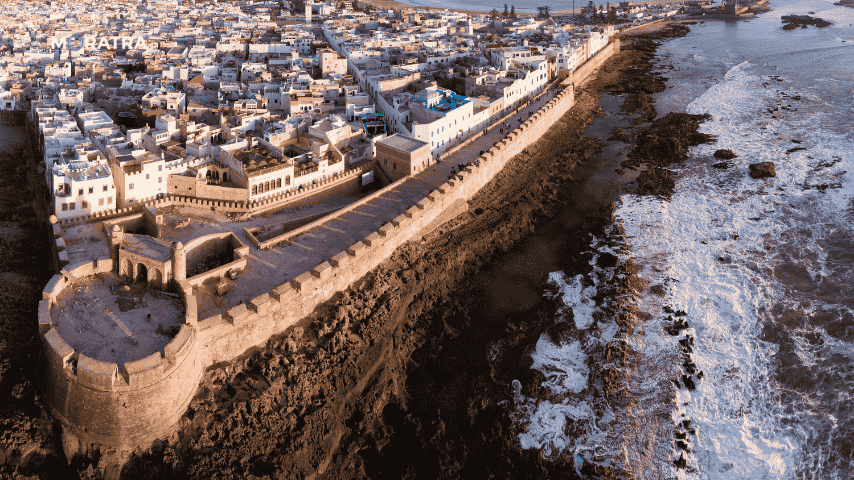
Step out of Essaouira’s ancient sea gate and the Atlantic hits you like a conversation you weren’t expecting — salt, gusts, the distant hammering of a ship’s carpenter, the smell of charcoal-grilled sardines drifting from the port. This city has always been at the edge of things: the edge of a continent, the edge of trade routes, the edge of expectations for what a Moroccan city can be.
Essaouira (pronounced es-wee-ra) is neither the most visited nor the most obvious stop on a Morocco itinerary, and that is precisely why it earns a devoted following. Where Marrakech overwhelms with noise and color, Essaouira breathes. Where Fes buries you in centuries of history, Essaouira wears its past lightly — old ramparts, a UNESCO-listed medina, and a fishing port that has been working every morning since the 18th century. Add year-round Atlantic winds that have turned the town into one of the world’s premier kitesurfing destinations, a legendary music festival, and a gallery scene that draws artists from across Morocco, and you have a city that earns far more time than the average day-tripper gives it.
This guide covers everything you need to know: the history, the landmarks, the beaches, the food, and the practical logistics of getting there from Marrakech.
From Mogador to Essaouira: A Brief History
Long before the current medina existed, the coastline here was known to Phoenician traders who called the offshore island Migdol — “small fortress” — a name that eventually evolved into Mogador. The Portuguese established a trading post on the island in the 15th century, and the site’s deep natural harbor made it strategically irresistible to successive empires.
The city you see today, however, is a deliberate creation. In the mid-18th century, the Alaouite Sultan Sidi Mohamed Ben Abdallah (reigned 1757–1790) wanted a purpose-built Atlantic port that could project Moroccan commercial power toward Europe. He commissioned a French architect, Théodore Cornut, who had absorbed the fortification principles of Vauban — the military engineer behind Saint-Malo in Brittany. The result is unique: a medina built to European military grid standards but inhabited according to Moroccan traditions, its streets filling almost immediately with Arab, Amazigh, African, and European merchants.
When you are ready to plan, browse all our coastal and city escapes.
The Jewish community that poured in became one of the city’s defining forces. At the height of Essaouira’s commercial golden age in the 19th century, the Jewish population — mostly traders, financiers, and craftspeople — constituted up to 60% of the city’s residents. The city operated as a multicultural hub that was genuinely unusual by the standards of any era. Today, the synagogues are largely quiet, but the mellah (Jewish quarter) and the layered architecture of the medina still carry the memory of that cosmopolitan past.
In 2001, UNESCO inscribed the Medina of Essaouira as a World Heritage Site, recognizing it as an exceptional example of a late-18th-century fortified Atlantic port, and noting its remarkable fusion of Moroccan, European, and African influences.
Things to Do in Essaouira
Walk the Ramparts: Skala de la Ville
The ramparts are where Essaouira announces itself most dramatically. The Skala de la Ville — the sea bastion running along the northern wall — is lined with a row of antique bronze cannons, their muzzles still pointing out over the Atlantic. Below them, waves crash against weathered stone in a rhythm that has been going on for three centuries. The bastion is free to access, and the walk along the top, with the medina to one side and open ocean on the other, is one of the finest free experiences in Morocco.
Explore the Blue Medina
Essaouira’s medina has a calmer geometry than Fes or Marrakech — a product of its grid-plan design — and yet it is no less rich. The streets are painted in two colors: white walls and blue window frames and doors, a palette that feels both deliberate and effortless. Artisan workshops line the main thoroughfares: woodcarvers working with thuya wood, a fragrant, burl-grained timber found only in the Moroccan argan heartland. Thuya boxes, chess sets, and wall panels fill the souk stalls, and watching the craftsmen work the grain is genuinely mesmerizing.
The Place Moulay Hassan is the social heartbeat of the city — a grand square where the medina’s main artery opens up, café terraces face toward the port, and locals and travelers mingle without the pressure that characterizes similar spaces in bigger Moroccan cities.
The Fishing Port
A short walk from the main square, Essaouira’s working fishing port is one of Morocco’s most photogenic — and most honest. Blue-hulled boats crowd the harbor. Seagulls wheel above trawlers unloading the morning catch. A line of informal grills at the port entrance will cook whatever fish you choose, right in front of you, for a few dirhams. This is not a tourist construct. It is simply how the port has worked for generations.
Argan Cooperatives
Essaouira sits at the edge of the Argan Forest, a UNESCO Biosphere Reserve that stretches south toward Agadir. The argan tree (Argania spinosa) exists virtually nowhere else on Earth and produces the kernels that are cold-pressed into argan oil — both for culinary use and cosmetics. Several women-run argan cooperatives on the road between Marrakech and Essaouira welcome visitors. Watching the hand-cracking of kernels and the grinding of the paste is eye-opening: producing just five liters of argan oil requires some 20 kilograms of kernels and about a week of labor. Buying directly at a cooperative ensures the price reaches the women who made it.
The Jimi Hendrix Connection
In 1969, Jimi Hendrix spent a few days in Essaouira, staying at a hotel in the medina. Local legend has long claimed he was inspired here to write Castles Made of Sand — but the timeline doesn’t hold: the track appeared on Axis: Bold as Love in 1967, two years before Hendrix set foot in Morocco. The village of Diabat, a few kilometers south, has developed an entire mythology around his visit, but Hendrix biographers dispute most of it.
None of that diminishes Essaouira’s real connection to bohemian artistic culture. The city genuinely attracted a wave of artists, writers, and musicians in the late 1960s and 70s, and that creative DNA never entirely left. The gallery scene, the music, and the atmosphere of unhurried tolerance all point to something real — even if Jimi only stayed for a long weekend.
Beaches and Water Sports
Essaouira Beach
The main beach stretches for several kilometers south of the medina, wide and flat and fully exposed to the Atlantic. In summer, the wind picks up reliably every afternoon — reaching 20–30 knots during peak season — and that same wind that makes sunbathing uncomfortable turns the beach into one of the best natural wind-sport arenas in the world. Windsurfers and kitesurfers fill the shoreline from spring through autumn. If you’re not into wind sports yourself, simply walking the beach in the late afternoon, watching the kite lines trace patterns against a darkening sky, is its own pleasure.
Sidi Kaouki
About 25 kilometers south of Essaouira, the small village of Sidi Kaouki offers an even more consistent and powerful wind window, making it the preference for advanced kitesurfers and experienced windsurfers. The beach here is wilder and less populated. A handful of surf camps and guesthouses have grown up around the village, and it’s increasingly popular for multi-day surf retreats. The drive from Essaouira along the coast road passes through argan groves and is worth doing even without a board.
Best Time for Water Sports
The Alizé trade winds that sweep Essaouira’s coast are most consistent from April through October, with July and August representing peak intensity. Outside of wind-sport season, the coast is quieter, the sea is calmer, and the beach is more hospitable for straightforward swimming and walking.
Art, Culture & the Gnaoua Music Festival
Essaouira has nurtured one of Morocco’s most distinctive arts scenes for decades. The medina contains a higher concentration of working artists — painters, sculptors, textile makers — than almost any city of comparable size in the country. Several gallery spaces on and around the Skala are worth seeking out, and the craft of thuya woodworking has elevated what might elsewhere be dismissed as souvenir-making into genuine artisanship.
The pinnacle of Essaouira’s cultural calendar is the Gnaoua World Music Festival, held every June. The Gnaoua tradition is itself a remarkable cultural inheritance: a form of music, ritual, and collective memory carried by the descendants of sub-Saharan Africans brought to Morocco via the trans-Saharan trade routes. The music is built around the guembri (a three-stringed bass lute), metal castanets called qraqeb, and powerful call-and-response vocals. At the festival, Gnaoua masters collaborate with jazz musicians, flamenco artists, and world music performers in nightly outdoor concerts across the medina’s squares. The event draws approximately 500,000 visitors over four days — remarkable for a city of Essaouira’s size — and the atmosphere is unlike anything else in Morocco.
Even outside festival time, you’ll hear Gnaoua music in the medina. Follow it.
Where to Stay
Essaouira’s medina contains some of Morocco’s finest riads, many of them restored by owners drawn to the city by its creative energy.
Budget: Guesthouses near the Skala and along the medina’s quieter lanes offer simple, clean rooms at very accessible prices. The further you get from Place Moulay Hassan, the calmer the neighborhood and the lower the rates.
Mid-range: Riads with roof terraces and sea views represent the sweet spot for most visitors — there are dozens to choose from, and competition keeps quality high and prices reasonable by Moroccan standards.
Luxury: A small number of boutique riads in the medina offer high design, courtyard pools, and exceptional service. These are small properties — rarely more than eight or ten rooms — and book up far in advance during festival season.
Booking tip: For the Gnaoua Festival in June, book at least three months ahead. The city fills completely.
Food: What to Eat in Essaouira
Essaouira’s food is shaped by its geography: Atlantic coast, argan heartland, and multicultural heritage.
Fresh grilled seafood at the port-side grills is the essential experience — choose your fish or shellfish from the display, agree on a price, and eat at a plastic table with bread and harissa while the catch is being grilled. It is unpretentious, delicious, and completely genuine.
Chermoula-marinated fish — a blend of preserved lemon, cumin, coriander, paprika, and garlic — is Essaouira’s signature preparation. It appears everywhere, on everything from sardines to monkfish.
Amlou — a paste of toasted almonds, argan oil, and honey — is served for breakfast with bread, and once tasted, it’s difficult to understand why the rest of the world doesn’t eat it daily. This is Essaouira’s most distinctive contribution to Moroccan cuisine and a product of the argan heartland that surrounds the city.
The café terraces around Place Moulay Hassan serve reliable tajines and couscous. For a more considered meal, several restaurants in the medina offer elegant Moroccan cuisine in beautifully restored dining rooms.
Visiting Essaouira from Marrakech
Essaouira sits approximately 175 kilometers west of Marrakech, and the drive along the N1 highway takes about 2.5 hours in normal conditions. The road passes through argan forest, coastal plains, and the occasional small town — it’s a scenic journey worth doing in daylight.
By organized day trip: Moratra’s Essaouira Coast Day Trip departs from Marrakech in the morning and allows around five to six hours in the city before the return drive — covering the ramparts, port, medina, and a working argan cooperative en route.
As part of a longer tour: The 7-Day Morocco Tour (Marrakech — Sahara — Essaouira) and the 8-Day Signature Escape both include Essaouira as an overnight destination — giving you the evening light over the ramparts and a morning in the medina before the crowds arrive, a much more complete experience than a day trip allows.
By public bus (CTM/Supratours): Multiple daily departures from Marrakech’s bus station. Journey time is around 3 hours. Comfortable and inexpensive.
Practical Tips
Best time to visit: March–May and September–October offer the most balanced weather — comfortable temperatures, active wind for water sports, and smaller crowds than summer. June is spectacular if the Gnaoua Festival aligns with your trip; book everything far in advance.
Weather: Essaouira is cooler than Marrakech year-round, thanks to the Atlantic influence. Even in July, evenings are fresh. Always bring a layer.
Photography: The medina’s blue-and-white palette, the cannons of the Skala at sunset, the port at dawn — there are very few wrong places to point a camera. The artisan workshops welcome photography with a word of greeting and a smile; be generous with your attention to the craft, not just the image.
Walking the medina: Unlike Fes, Essaouira’s medina is navigable without a guide — the grid plan means you’re rarely as lost as you feel. That said, a brief guided orientation on your first morning pays dividends in context and discovery.
Frequently Asked Questions
How many days do you need in Essaouira?
Two days is ideal: one to cover the ramparts, port, and medina’s main routes, and one to move more slowly — a morning at an argan cooperative, an afternoon beach walk, and dinner at a proper restaurant. One day works as a day trip from Marrakech, but you’ll leave wanting more.
Is Essaouira safe?
Very. It has a calm, relaxed atmosphere and is one of the more low-pressure medinas in Morocco in terms of hard-sell tourism. Normal urban awareness applies, but most visitors find it significantly less stressful than Marrakech or Fes.
Can you swim at Essaouira beach?
Yes, but with awareness: the currents and wave action can be strong, particularly in the afternoon when the wind is up. Mornings tend to be calmer. The beach is not patrolled like a resort beach, so exercise judgment. Sidi Kaouki is generally rougher than the main beach.
When is the Gnaoua Festival?
The festival runs over four days in late June. Dates shift slightly year to year — check the official Gnaoua Festival website for confirmed programming.
Is Essaouira worth visiting in winter?
Yes — for the atmosphere, the food, and the medina. The wind is present year-round, and even in January the days are often bright and clear. Winter draws a smaller, more local crowd, which many travelers prefer.
Essaouira rewards the traveler who is willing to slow down. It has none of Marrakech’s relentless energy and none of Fes’s overwhelming density — but it has something those cities can’t offer: the feeling of a city genuinely at ease with itself, facing the sea, in no particular hurry.
Planning a visit? Moratra’s team is happy to help you decide whether Essaouira works best as a day trip, an overnight stop within the 8-Day Signature Escape, or something tailored entirely to your pace. Reach out for free, personalized advice — no booking required, no pressure attached.
Plan Your Morocco Trip with Moratra
Ready to turn the ideas in this guide into a real trip? Browse Moratra’s most-booked private experiences across Morocco — handpicked itineraries, luxury riads and local guides:
- Luxury Morocco Tours — multi-day private itineraries across Marrakech, the Sahara, Fes and the imperial cities.
- Morocco Sahara Desert Tours — VIP private journeys from Marrakech to Erg Chebbi and Merzouga.
- Agafay Desert Day Trips — luxury camps and dinner-under-the-stars experiences just 30 minutes from Marrakech.
- Activities and Day Tours in Marrakech — cooking classes, hammams, walking tours and hot air balloon flights.
Need help choosing? Reach out anytime — our local team offers free, no-obligation Morocco trip advice.
Fancy catching a wave? Join our beginner-friendly Morocco surf camp in Essaouira — daily lessons and gear included on the Atlantic coast.
