
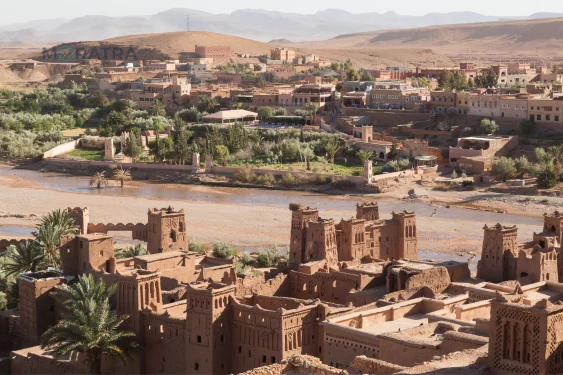
There is a place in southern Morocco where ancient earthen towers rise against an endless sky, where the same walls that sheltered Saharan traders for centuries have doubled as backdrops for Hollywood blockbusters. That place is Aït Benhaddou — and together with the nearby city of Ouarzazate, it forms one of Morocco’s most dramatic gateways between the High Atlas Mountains and the vast Sahara Desert.
Whether you are drawn by the UNESCO-listed ksar’s timeless architecture, the thrill of walking through real film sets, or the promise of adventure on the road to the desert, this guide covers everything you need to plan your visit.
Aït Benhaddou Ksar: A UNESCO World Heritage Treasure
Perched on a hillside along the Ounila River valley, the Ksar of Aït Benhaddou is a fortified village — or ksar — built entirely from rammed earth, clay, and straw. Its cluster of kasbahs, towers, and granaries has been a UNESCO World Heritage Site since 1987, recognized for preserving one of the finest examples of traditional Moroccan earthen architecture.
The site has been fortified since the 11th century during the Almoravid dynasty, though most of the surviving structures date from the 17th century onward. For hundreds of years, Aït Benhaddou served as a critical trading post on the caravan route that linked sub-Saharan Africa to Marrakech through the Draa Valley and the Tizi-n’Telouet mountain pass. Salt, gold, and enslaved people all passed through these walls.
If you would like us to arrange it for you, see our three-day Merzouga tour from Marrakech.
Today only a handful of families still live inside the ksar itself, but the village across the river remains lively. Crossing the shallow riverbed on foot — or via stepping stones — and then climbing the steep lanes to the top rewards you with sweeping panoramic views of the palm-lined valley below and the arid mountains beyond.
What to See Inside the Ksar
As you wander uphill through the narrow passages, notice how each level served a different purpose: living quarters at the base, collective granaries (agadirs) higher up for storing grain and valuables, and watchtowers at the summit for defense. The decorative brickwork near the tops of the towers — geometric patterns pressed into the clay — is a signature of southern Moroccan kasbahs.
At the very top sits a ruined fortified granary. The climb is worth every step for the 360-degree views that stretch across the valley to the Atlas foothills.
Hollywood of Africa: Films Shot at Aït Benhaddou
The ksar’s cinematic career began in 1962 when British director David Lean chose it as a location for Lawrence of Arabia, using the fortress to depict the Turkish garrison at Aqaba. Since then, more than 80 films and television productions have used Aït Benhaddou as a backdrop, earning the region its nickname: the Hollywood of Africa.
Among the most notable productions filmed here:
- Gladiator (2000) — Ridley Scott filmed Maximus’s first arena battle on the open ground just outside the ksar, with the earthen towers clearly visible in the background
- Game of Thrones — fans will recognize the ksar as Yunkai, one of the slave cities in Slaver’s Bay
- The Mummy (1999) — scenes set in ancient Egypt were filmed here
- Kingdom of Heaven (2005) — Ridley Scott returned to build elaborate crusader-era sets
- Prince of Persia (2010) and Babel (2006) also used the location
Walking through the ksar, you may notice discreet plaques or markers indicating which productions filmed in specific areas. For movie enthusiasts, visiting Aït Benhaddou is like stepping into a living film set — except the architecture is genuinely centuries old.
Atlas Film Studios: Behind the Scenes
About seven kilometers west of Ouarzazate city center, the Atlas Film Studios sprawl across 322,000 square feet, making them one of the largest film studios in the world. Founded in 1983 by Moroccan entrepreneur Mohamed Belghmi, the studios have hosted portions of over 200 productions.
Guided tours run every 20 to 40 minutes and last about an hour. You will walk through reconstructed sets — a Tibetan temple built for Martin Scorsese’s Kundun, Egyptian temples from Cleopatra, ancient Roman arenas from Gladiator, and the streets of biblical Jerusalem from The Passion of the Christ. An additional section showcases the Kingdom of Heaven sets and a small cinema museum.
Practical details: Tickets cost 80 MAD per person (free for children under 5), with an extra 30 MAD for the Kingdom of Heaven area. No advance booking is needed. The studios are best visited in the morning before the desert heat builds.
Ouarzazate City: More Than a Transit Stop
Many travelers treat Ouarzazate purely as an overnight stop on the way to the Sahara, but the city itself deserves a half-day of exploration.
Taourirt Kasbah
Right in the heart of town, the Taourirt Kasbah is an imposing rammed-earth fortress originally built in the 17th century and greatly expanded by the powerful Glaoui dynasty in the 19th century. With nearly 300 rooms and 20 riads arranged around interior courtyards, it is one of the best-preserved kasbahs in southern Morocco. The entrance fee is just 20 MAD, and the kasbah is open daily from 8:30 to 16:00.
Inside, you can explore decorated reception halls, climb to the rooftop for city views, and get a sense of how these fortified complexes functioned as self-contained communities — complete with kitchens, stables, and prayer rooms.
Cinema Museum
Directly opposite the Taourirt Kasbah, the Cinema Museum offers a compact but fascinating tribute to the region’s filmmaking heritage. Displays include vintage cameras, costumes, props, and reconstructed film sets. It is a nice complement to the larger Atlas Film Studios and can be visited in under an hour.
Fint Oasis
A short drive south of the city, the Fint Oasis is a hidden pocket of green nestled among barren hills — a palm-fringed valley where time seems to slow down. It is a wonderful spot for a quiet walk, a picnic, or simply a reminder of how dramatically the landscape shifts in this part of Morocco.
Practical Tips for Your Visit
Best Time to Visit
Spring (March to May) and autumn (September to November) offer the most comfortable temperatures. Summer can exceed 40°C, making outdoor sightseeing exhausting. Winter is mild during the day but cold at night — pack layers.
How to Get There
Ouarzazate sits at a crossroads. From Marrakech, the drive takes approximately 4 to 5 hours via the spectacular Tizi n’Tichka pass over the High Atlas. Aït Benhaddou is a 30-minute detour off this route, just 30 kilometers northwest of Ouarzazate. Most travelers visit the ksar on their way to or from Marrakech.
Ouarzazate also has a small airport with domestic flights from Casablanca, though most visitors arrive by road as part of a broader tour.
Photography Tips
The best light hits the ksar in the early morning and late afternoon, when the earthen walls glow warm amber. For the classic postcard shot, cross to the far side of the river and photograph the ksar from below with its reflection in the shallow water. The viewpoint from the top of the ksar is spectacular at any hour.
Connecting to the Sahara: The Road to Merzouga
For many visitors, Ouarzazate and Aït Benhaddou are the start of an unforgettable drive into the Sahara. The road east from Ouarzazate to Merzouga covers roughly 370 kilometers through some of Morocco’s most dramatic scenery.
Key stops along this route include the Skoura Oasis with its ancient kasbahs, the Valley of the Roses near Kelaat M’Gouna, the towering Todra Gorge near Tinghir, and the long palm-lined Draa Valley — one of the largest oases in the world, stretching over 100 kilometers. The journey culminates at the golden dunes of Erg Chebbi near Merzouga, where camel treks and desert camps await.
Most travelers visit Aït Benhaddou as part of a Sahara desert circuit. Moratra’s 3-Day Merzouga Tour includes a guided stop at the ksar, the drive through the gorges, and a night under the stars in the desert — a route that captures the full sweep of southern Morocco in a single journey. For those with more time, Moratra’s private desert tours can be customized to include extra time at Aït Benhaddou or overnight stays in the Draa Valley.
Driving it yourself instead? Our Marrakech to Merzouga self-drive guide follows the same road stage by stage, with road conditions and where to stay along the way.
Frequently Asked Questions
Is Aït Benhaddou worth visiting?
Absolutely. The ksar is one of Morocco’s most visually striking sites — a genuine UNESCO World Heritage location that has barely changed in centuries. Whether you are interested in history, architecture, photography, or cinema, it delivers a memorable experience. Most visitors spend one to two hours exploring the ksar.
Can you visit Aït Benhaddou as a day trip from Marrakech?
Yes, though it is a long day — the drive from Marrakech takes about 4 hours each way via the Tizi n’Tichka pass. Most travelers prefer to combine it with a multi-day desert tour, stopping at the ksar on the way to or from the Sahara.
What movies were filmed at Aït Benhaddou?
Over 80 productions have filmed at the ksar, including Lawrence of Arabia (1962), Gladiator (2000), Game of Thrones, The Mummy (1999), Kingdom of Heaven (2005), Prince of Persia (2010), and Babel (2006).
How much does it cost to visit Aït Benhaddou and Atlas Studios?
Entering the ksar of Aït Benhaddou is free, though you may tip a local guide. Atlas Film Studios charge 80 MAD per person for the main tour, with an optional 30 MAD supplement for the Kingdom of Heaven section. The Taourirt Kasbah in Ouarzazate costs 20 MAD.
What is the best time of year to visit Ouarzazate?
Spring (March to May) and autumn (September to November) offer pleasant temperatures for sightseeing. Summer temperatures regularly exceed 40°C, while winter days are mild but nights can be cold.
How do I get from Ouarzazate to the Sahara Desert?
The drive from Ouarzazate to Merzouga (Erg Chebbi dunes) takes approximately 6 to 7 hours via the N10 highway, passing through Skoura, Tinghir, and the Todra Gorge. Most travelers book a guided tour that handles the logistics and includes stops at key attractions along the way.
Unsure how to fit Ouarzazate into your itinerary? The Moratra team loves helping travelers plan — reach out for free, personalized advice and we will help you design the perfect route through southern Morocco, no strings attached.
Plan Your Morocco Trip with Moratra
Ready to turn the ideas in this guide into a real trip? Browse Moratra’s most-booked private experiences across Morocco — handpicked itineraries, luxury riads and local guides:
- Luxury Morocco Tours — multi-day private itineraries across Marrakech, the Sahara, Fes and the imperial cities.
- Morocco Sahara Desert Tours — VIP private journeys from Marrakech to Erg Chebbi and Merzouga.
- Agafay Desert Day Trips — luxury camps and dinner-under-the-stars experiences just 30 minutes from Marrakech.
- Activities and Day Tours in Marrakech — cooking classes, hammams, walking tours and hot air balloon flights.
Need help choosing? Reach out anytime — our local team offers free, no-obligation Morocco trip advice.
