
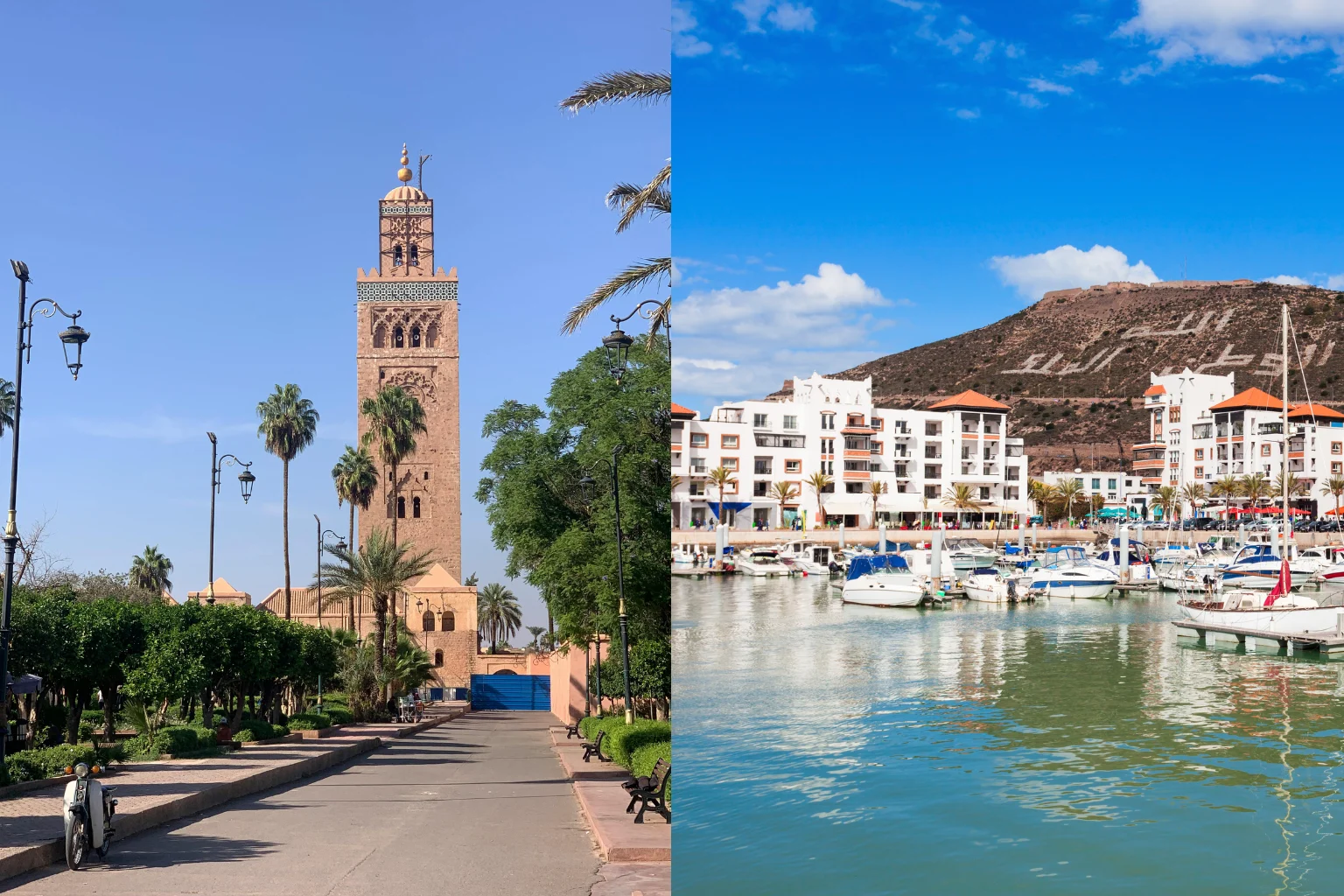
You’ve narrowed your Morocco shortlist to two names — Marrakech and Agadir — and now you’re stuck. They’re 230 km apart on the map, but they belong to two different countries in the head: one is a thousand-year-old imperial city with souks and snake charmers, the other is an Atlantic beach resort with surf breaks and palm-lined promenades.
The honest answer to “which one should I visit?” depends entirely on what you actually want from a week off. This guide compares them properly — weather, beaches, culture, cost, family-friendliness, logistics — and gives you five quick scenarios at the end so you can pick with confidence. No Marrakech-fanboy bias, no Agadir-bashing.
The 30-Second Answer
Pick Marrakech if you want culture, history, atmosphere, riads with rooftop pools, late dinners in the medina, and a base for the Sahara, Atlas Mountains, or Essaouira.
Pick Agadir if you want a beach holiday with reliable mild weather all year, lazy mornings on the sand, surfing or kitesurfing, family-friendly resorts, and a slower pace.
And here’s the underrated third option: do both. They’re three hours apart by road, and combining them in one trip is one of the best-value itineraries in Morocco.
Marrakech in Essence
Marrakech is one of Morocco’s four imperial cities, founded in 1070. Its UNESCO-listed Jemaa el-Fna square — declared a Masterpiece of Oral and Intangible Heritage in 2001 — is the gravitational centre of a walled medina that has barely changed in five centuries. Step inside the city walls and you’re in a different era: ochre walls, donkey carts, the call to prayer overlapping with the rhythm of metalworkers in the Souk Haddadine.
The medina’s souks branch into roughly 3,000 alleys, each specialising in something — leather slippers, hand-woven rugs, brass lanterns, spices, kaftans, perfumes. You’ll get lost. Everyone gets lost. That’s part of the experience.
Outside the walls, the Ville Nouvelle (the modern city) holds the Yves Saint Laurent Museum, Jardin Majorelle, sleek rooftop bars, and the upmarket Hivernage district. Beyond Marrakech, the High Atlas Mountains start an hour’s drive away, and the Sahara begins eight hours east — making Marrakech the natural launchpad for the country’s most iconic excursions.
To book this with a local team, see our 13-day tour from Casablanca to the Atlantic coast.
Marrakech suits travellers who want a sensory, slightly chaotic, deeply atmospheric city. It rewards curiosity. It does not reward people who want to sit in one place and switch off.
Agadir in Essence
Agadir is a different proposition altogether. The city was almost entirely rebuilt after the devastating 1960 earthquake, so it has none of the medieval medina texture of Fes or Marrakech. What it does have is a 10-kilometre crescent of fine sand, a sheltered bay, year-round sea breezes, and a wall of resort hotels and apartments that turned it into Morocco’s package-holiday capital.
The beach is the headline act. Wide, clean, walkable, edged by a palm-lined corniche where you can cycle, jog, drink mint tea, or watch the sunset over the Atlantic. Beyond the sand, Agadir’s region is a genuine surf destination — Taghazout, just 20 km north, is internationally known for waves with names like Anchor Point and Killer Point, and is the easiest place in the country to learn to surf.
Inland from the coast, Paradise Valley — a 45-minute drive from Agadir — offers gorges, palm groves, and natural pools for a day-trip. The Souk El Had, with over 6,000 stalls, is the largest market in Morocco and a relaxed alternative to the intensity of Marrakech’s medina.
Agadir suits travellers who want sun, sea, comfort, easy logistics, and a slower rhythm. It is not where you go for a deep cultural plunge.
Head-to-Head: The Honest Comparison
Weather and When to Visit
This is the single biggest practical difference between the two cities, and it shapes everything else.
Marrakech is inland and semi-arid. Summer is brutal: June, July, and August regularly hit 38–42 °C in the shade, and outdoor exploration becomes genuinely uncomfortable from late morning to early evening. Winters are pleasant in the day (18–19 °C), but nights drop sharply — sometimes below 5 °C. The sweet spots are mid-March to late May and mid-September to mid-November.
Agadir is moderated by the Atlantic and has one of the most reliable year-round climates in North Africa. Summer highs sit at 24–27 °C; even July and August rarely cross 30 °C. Winters stay mild — daytime averages around 20–22 °C in January, with January’s average around 15 °C overall. The trade-off: the sea is never tropical. Water temperatures range from about 17 °C in winter to 21 °C at the August/September peak, so swimming in winter is for the brave.
Practical takeaway: if you’re booking July–August, Agadir wins easily. If you’re booking November–February and want city culture and good restaurants over a swimmable sea, Marrakech wins. In spring and autumn, both work — and that’s exactly when combining them makes most sense.
Beaches and Sea
There is no contest here. Marrakech is 250 km from the nearest coast — the city has hotel pools and that’s it. Agadir is the beach.
If your priority is sand under your feet, Atlantic sunsets, beach walks, surf lessons, or a kids’ first sea swim, Agadir is the answer. Marrakech can never compete on this, and pretending otherwise would be unfair to both cities.
Culture, History, and Things to Do
The mirror image applies here. Marrakech is a UNESCO World Heritage city (inscribed 1985) with the Koutoubia minaret, the Bahia and El Badi palaces, the Saadian Tombs, the Ben Youssef Madrasa, dozens of restored riads, the Majorelle and Anima gardens, two world-class museums, a film festival, and a thousand-stall souk that took us five trips to feel half-confident navigating.
Agadir has the beach, the corniche, the kasbah ruins on the hill, a souk, and a few good museums. It’s pleasant. It’s not historically rich. If “exploring” to you means cobbled lanes and palaces, Marrakech delivers ten times what Agadir can.
Food and Dining
Both cities eat well, but the scenes are different. Marrakech is where you go for serious Moroccan dining — heritage riads with set tasting menus, modern chefs reinventing tagines and pastilla, smoky grills tucked into medina corners, and rooftop restaurants where the Atlas Mountains turn pink at sunset. Agadir leans toward grilled fish (it’s a real working port — the catch is excellent), Mediterranean and international resort dining, and family-friendly options. Marrakech wins on culinary depth; Agadir wins on fresh seafood and on never having to negotiate a price for dinner.
Nightlife and Atmosphere
Marrakech runs late and loud. Jemaa el-Fna doesn’t really begin until after dark, when food stalls, musicians, storytellers, and crowds fill the square. Beyond the medina, the Hivernage district has rooftop bars and clubs that compete with anywhere in North Africa. Agadir’s nightlife is gentler: beach bars, hotel entertainment, casinos, a few clubs, and not much that runs past 2 a.m. If you’re 25 and want a city break with energy, pick Marrakech. If you’re 55 and want a quiet glass of wine watching the surf, pick Agadir.
Family-Friendliness
For families with young children, Agadir is the easier holiday — wide pavements, prams roll, the beach occupies hours, resorts have kids’ clubs, evenings are calm, and food is predictable. Marrakech is doable with kids, but be honest: the medina is dense, hot, and full of mopeds. School-aged children often love it; toddlers and grandparents sometimes struggle. The smart compromise — and one of our most-requested itineraries — is a few days of Marrakech for the wonder, then four or five in Agadir to recover.
Cost
Both cities span budget to luxury, but the price ceilings differ. Marrakech has Morocco’s most expensive hotels — top riads run 2,000–6,000 dirhams a night, and the city is genuinely capable of competing with Paris or Marrakech-adjacent destinations at the top end. Agadir is more package-driven and tends to be cheaper for a like-for-like 4-star beach stay, especially out of peak European holiday weeks. For dining and street shopping, Marrakech is slightly cheaper than Agadir for local food but more expensive for souvenirs (because tourists tolerate higher prices). Both are excellent value compared with most European city or beach breaks.
Getting There and Getting Around
Marrakech-Menara is one of North Africa’s busiest airports — over 10 million passengers in 2025 — with direct flights from most major European cities, often daily, and on multiple low-cost carriers. Agadir Al Massira handles fewer routes (around 10% of Morocco’s air traffic) and is more weighted toward charter and package flights, especially from the UK, France, Belgium, and Germany. If you’re flying from a smaller European city, you’ll find more options to Marrakech.
Between the two cities: about 230 km of road, mostly motorway, around 2 hours 37 minutes by car, three hours by intercity bus (CTM and Supratours run the route comfortably). There are direct flights too — about 45 minutes — but on limited weekly schedules, so they’re rarely the best option compared with the bus or a private transfer.
How to Decide: Five Quick Scenarios
Scenario 1 — “I have one week and it’s my first time in Morocco.”
Marrakech, with two or three day-trips (Atlas Mountains, Essaouira, Ourika Valley). You can fly in and out of the same airport, and you’ll see what makes Morocco different from anywhere else in the world.
Scenario 2 — “I have one week and I want to relax on a beach.”
Agadir. Don’t overcomplicate it. Add one day-trip to Paradise Valley and a half-day at Taghazout for surf-watching.
Scenario 3 — “We’re a family with kids aged 4 and 8.”
Agadir as the base, with one or two nights in Marrakech mid-trip for the wonder. The kids will remember the camel ride in the palm grove and the snake charmers in Jemaa el-Fna for life — they don’t need a full week of medina chaos.
Scenario 4 — “We’re visiting in July or August and don’t want to melt.”
Agadir, full stop. Marrakech in midsummer is a sauna, and the riads with pools are wonderful but limit your daytime exploration. If you must have a taste of Marrakech, do it as a two-night side trip with most activities scheduled before 10 a.m. or after 6 p.m.
Scenario 5 — “We have ten days and want to see a real cross-section of Morocco.”
Combine. Four nights in Marrakech (medina, day-trip to the Atlas, dinner at a heritage riad), one night in Essaouira on the drive south for the breeze and grilled sardines, then four nights in Agadir to wind down. The variety is what makes the trip memorable.
The Hybrid Play: Combining Both Cities
Most of the seasoned Morocco travellers we plan trips for don’t choose one — they combine. Here’s why the hybrid works so well: the cities are different enough that the contrast itself becomes the holiday. You arrive in Marrakech jet-lagged and overstimulated, throw yourself into the souks for three days, then drive south through argan groves to Agadir and finally exhale on the beach. Or you fly into Agadir, decompress for four nights, then take the bus or a private transfer to Marrakech and end on the high of the imperial city.
A natural eight-day rhythm: Marrakech (3 nights) → Essaouira stopover (1 night, optional) → Agadir/Taghazout (3 nights) → Marrakech for the flight home (1 night). Add the Atlas Mountains or a Sahara extension and you have a properly memorable trip.
Safety, Money, and Practical Notes
Both cities are generally safe for tourists. The UK Foreign Office’s Morocco travel advice does not currently advise against travel, but it does flag two practical risks worth respecting: petty crime (pickpocketing and bag-snatching in busy tourist areas and the historic medina quarters) and quiet streets after dark. The Marrakech medina, in particular, rewards walking with awareness — keep a hand on your bag, don’t follow strangers offering “shortcuts”, and use registered taxis at night.
Currency is the Moroccan dirham. Cards work in restaurants, riads, and supermarkets; cash is essential for the souks, taxis, and tipping. ATMs are everywhere in both cities. Tipping 5–10% in restaurants is standard and appreciated.
Choosing between Moroccan cities? See Marrakech vs Fes and Marrakech vs Casablanca.
FAQ
Is Marrakech or Agadir better for a first Morocco trip?
If you’ve never been to Morocco before and you want to understand what makes the country special, Marrakech is the better first stop. The medina, the riads, the food, the proximity to the Atlas Mountains and Essaouira — it’s the densest concentration of “real” Morocco in one place. Agadir is wonderful for what it is, but it’s a beach holiday that happens to be in Morocco, rather than a Moroccan experience.
Can I do both Marrakech and Agadir in one trip?
Yes, and it’s our most-recommended combination for trips of seven days or longer. The cities are 230 km apart, about three hours by road, and the contrast between imperial city and Atlantic beach gives the holiday real variety. Most travellers we plan for split 4–5 nights in Marrakech with 3–4 nights in Agadir, sometimes with a night in Essaouira on the drive south.
Which is cheaper, Marrakech or Agadir?
For a like-for-like four-star hotel stay, Agadir is usually slightly cheaper, especially as part of a package outside European school holidays. Marrakech has Morocco’s most expensive hotels at the top end, but it also has excellent budget riads. Food is comparable; souvenirs are slightly cheaper in Agadir’s Souk El Had than in Marrakech’s tourist-heavy medina.
Is Agadir worth visiting if I don’t surf?
Yes. Surfing is one Agadir story, but the city also offers beach walking, the corniche, Souk El Had, day-trips to Paradise Valley and the Massa lagoon for birdwatching, hot-air-balloon flights over the Atlas foothills, fresh seafood restaurants, and a generally calmer pace than Marrakech. It’s particularly good for older travellers, families with very young children, and anyone who simply wants to rest.
How hot does Marrakech get in summer?
Hot enough to change your plans. June, July, and August routinely see daytime highs of 38–42 °C in the shade, with the city’s stone and concrete radiating heat well into the evening. Riads with pools are essential. Most experienced travellers either avoid Marrakech in midsummer or schedule outdoor activities for early morning and after sunset. Agadir, by contrast, rarely exceeds 30 °C even in August.
Is the sea in Agadir warm enough to swim?
It depends on the month and your tolerance. The Atlantic off Agadir ranges from about 17 °C in winter to a peak of 21 °C in August and September. That’s noticeably cooler than Mediterranean beach destinations like Marbella or Antalya. From June through October, most visitors swim comfortably; in winter, the beach is for walking, surfing in a wetsuit, and sunbathing — not swimming.
The Bottom Line
Marrakech and Agadir don’t compete — they complement. One is for the senses, the other is for the body. The best Morocco trips we plan for couples, families, and small groups almost always include both, in different proportions depending on what you most need from a holiday.
If you’d like the rest of your Morocco trip planned with the same care this comparison is written with — the right riad in Marrakech, a sea-view room in Agadir, a private driver who knows the road south, day-trips that match your pace — that’s what we do. Browse our 8-day luxury Morocco tour as a starting point, request a quote, or simply message us with a question — we’ll answer for free, no obligation. For more on the coast, our best coastal city escapes in Morocco covers Essaouira, Asilah, and El Jadida; for the imperial side, our top things to do in Marrakech guide goes deeper. Either way: take your time choosing, because Morocco rewards travellers who arrive with a clear idea of what they actually want.
