
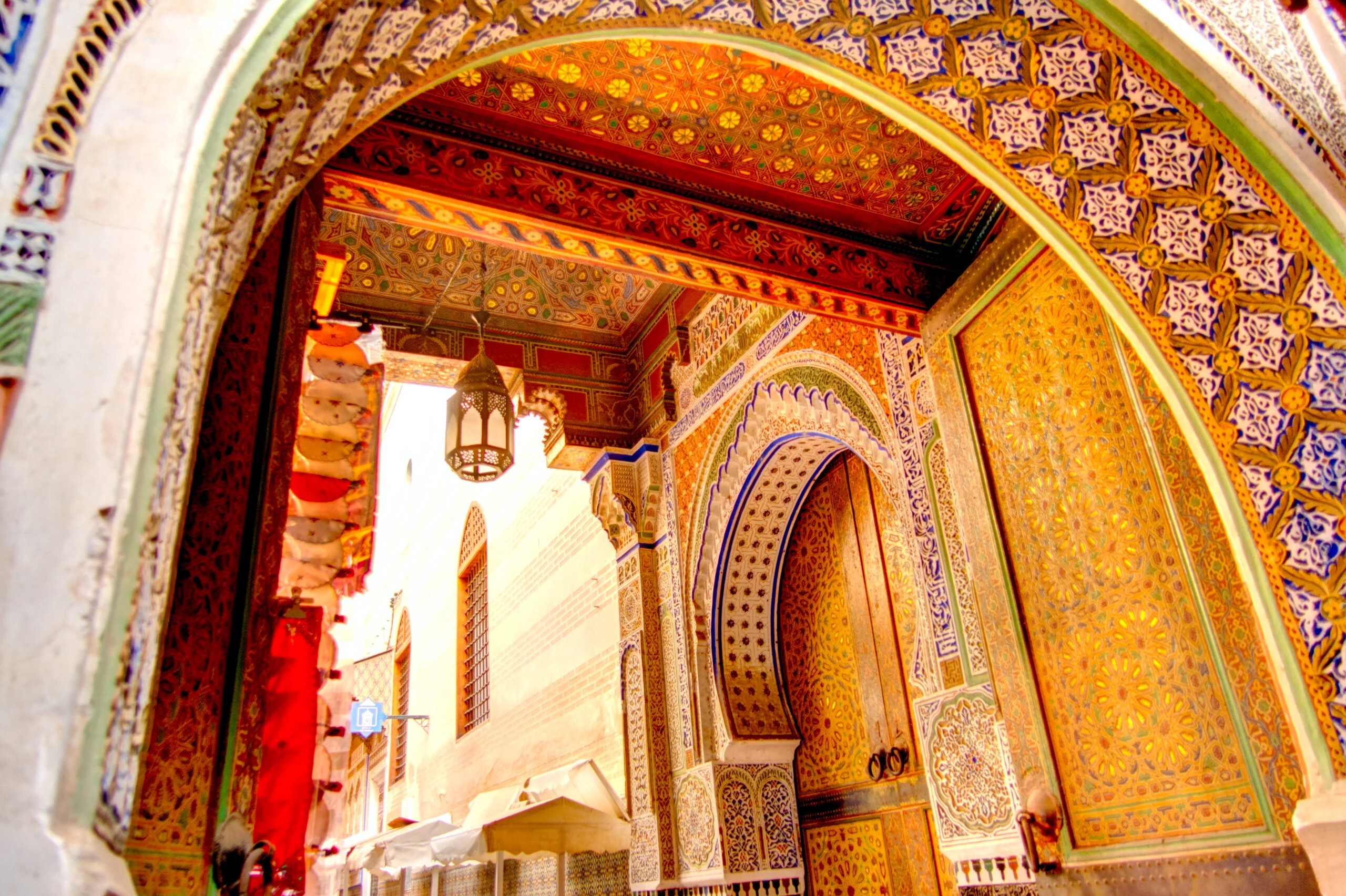
Walk through any Moroccan medina and you are walking through a building tradition that has been refined for nearly a thousand years. Berber engineering, Andalusian craft, Arab geometry, and a measured French colonial layer all sit on top of each other — sometimes in the same wall. The result is one of the most coherent and recognisable architectural languages in the world: courtyards that turn their back on the street, mud-brick fortresses that glow at sunset, and tiled walls assembled chip by chip from memorised geometric rules.
This guide unpacks how that language works. We’ll look at the three structures travellers ask about most — riads, kasbahs, and zellige — and then move on to the smaller elements that hold them together: muqarnas, mashrabiya, and tadelakt. By the end, you’ll know not just what these things are called, but why they look the way they do, and where to see the best surviving examples.
A Living Museum of Three Traditions
Moroccan architecture didn’t appear all at once. It grew through successive dynasties, each adding a layer. The Almoravids and Almohads brought refined Andalusian craft from southern Spain in the 11th and 12th centuries — carved stucco, cedar, and the first formal courtyard gardens. The Marinids of Fez perfected the madrasa as an architectural type. The Saadians, in 16th-century Marrakech, pushed ornament to its peak. The Alaouites, still ruling today, preserved and revived these forms into the modern era.
Berber (Amazigh) builders contributed something different: the practical genius of earthen architecture. The kasbahs of the south were not built by court architects but by villagers who knew their valley’s clay better than anyone else. That dual heritage — courtly Andalusi refinement above the Atlas, vernacular Amazigh engineering below it — is what gives Moroccan architecture its unusual depth.
Riads: The Architecture of Looking Inward
A riad is a traditional Moroccan house organised around a central courtyard, usually with a fountain, a four-part garden, and rooms that open onto the courtyard rather than the street. The word comes from the Arabic riyad, meaning gardens — and the design philosophy is exactly that: build a private paradise, and turn the rest of the world out.
The earliest known true riad garden in Morocco — with the classic four-part symmetrical division — was unearthed in the Almoravid palace built by Ali ibn Yusuf in Marrakech in the early 12th century. The model was perfected through the Almohad, Marinid, Saadian, and Alaouite dynasties, and became the standard for elite urban housing across the country.
Why courtyards? Three reasons, layered on top of each other:
- Climate. A central courtyard creates a thermal chimney. Hot air rises out of the open top while cooler air settles around the fountain, keeping the lower rooms 5–10°C cooler than the street outside in summer.
- Privacy. Islamic domestic tradition values the protection of family life. Riads have no street-facing windows on the lower floors, and entrances zigzag to prevent passers-by from seeing in.
- Spiritual symbolism. The four-part garden echoes the Quranic image of paradise as a garden divided by four rivers. The fountain at the centre is the meeting point. Walking into a riad is, architecturally, walking into an idea.
The classic riad has two storeys arranged around the courtyard, a roof terrace for evening tea, and walls treated with three layers of decoration: zellige tile up to about chest height, carved stucco above that, and painted cedar at the ceiling. Each layer corresponds to where the eye lands as you sit, stand, and look up.
Kasbahs: Earth, Defence, and the Sahara
Kasbahs are the architecture of the south — the pre-Saharan valleys, the High Atlas foothills, the Drâa and Dadès gorges. While the riad was the elite house of the imperial cities, the kasbah was a fortified rural family compound, often expanded into a whole fortified village (a ksar, plural ksour).
The construction technique is what makes them remarkable. Builders use pisé — also called rammed earth — which is a mixture of local earth, clay, straw, and water, packed into wooden formwork and pounded down until it sets like soft stone. The lower floors carry the load with thick pisé walls. Upper floors switch to lighter sun-dried adobe brick to reduce weight. Cedar and palm wood serve as roof beams and lintels. Almost every material comes from within walking distance of the site.
The most famous example is Aït Benhaddou, the ksar on the old caravan route between Marrakech and the Sahara. UNESCO inscribed it on the World Heritage List in 1987, recognising it as an outstanding example of southern Moroccan earthen construction and a record of a way of life increasingly threatened by modernity. The ksar is a stack of red-ochre towers rising out of a riverbed; films from Lawrence of Arabia to Gladiator to Game of Thrones have used its walls as a stand-in for ancient cities.
What’s easy to miss is how clever pisé is as a desert material. The thick walls store the day’s heat and release it slowly through cold desert nights. They breathe — earthen walls regulate humidity in a way concrete cannot. And they fail gracefully: when a wall is damaged, you don’t replace a beam; you patch the earth.
Zellige: Geometry by Hand
If one element has come to symbolise Moroccan design, it is zellige — the hand-cut mosaic tilework that covers fountains, floors, riad walls, and madrasa courtyards. From a distance, zellige reads as a pattern. Up close, it is hundreds of individually chiselled ceramic pieces, fitted together edge to edge with no spaces between them.
The process is deliberately slow. Clay (traditionally sourced near Fez, the historic centre of the craft) is shaped into square tiles, fired, glazed in one of the traditional palette colours — white, black, green, yellow, blue, and a deep cobalt-and-brown — and fired again. A master craftsman called a maâlem then chisels each tile by hand into the small geometric shapes the pattern requires: stars, polygons, half-moons, slivers as thin as a fingernail. The pieces are laid face-down according to a memorised plan and bonded into a panel.
The geometry is not decorative noise. Islamic geometric tradition is built on rotational symmetry — most often eightfold and twelvefold — that radiates out from a central star and tiles infinitely. A common Moroccan pattern uses interlocking six-pointed and twelve-pointed stars with eight-pointed stars filling the gaps. The mathematics is precise enough that scholars at the University of Granada and Princeton have spent decades formally analysing what Moroccan and Andalusi craftsmen worked out by hand centuries ago.
After the 15th century, the labour-intensive mosaic technique fell out of fashion almost everywhere except Morocco — which is why a tradition that is technically Maghrebi and Andalusi is now so closely associated with the country. A small, intricate zellige panel can take a master and an apprentice several weeks to complete.
The Smaller Vocabulary: Muqarnas, Mashrabiya, Tadelakt
Three more elements appear so often that they’re worth knowing by name.
Muqarnas
Muqarnas is the honeycomb vaulting you see above doorways in madrasas, in domes, and tucked into the corners of palace ceilings. Tier on tier of small niche-like cells project over each other to create a transition between a flat wall and a curved dome. Architects sometimes call it stalactite ornament. Its original purpose was structural — it solves the geometric problem of joining a square room to a round dome — but in Moroccan and Andalusi hands it became almost purely decorative. The Hall of Twelve Columns inside the Saadian Tombs in Marrakech (1590s) features carved cedar muqarnas gilded with 24-karat gold leaf, and is regarded as one of the high points of the form.
Mashrabiya
Mashrabiya is the carved wooden lattice screen used over windows, balconies, and harem galleries. Atlas cedar is cut into small geometric pieces and assembled into screens that let air and light through but block the view from outside. The principle is the same as the riad’s blank street wall: you can see out, but no one can see in. Practically, mashrabiya also cools rooms by breaking up direct sunlight while allowing breezes to pass.
Tadelakt
Tadelakt is a polished lime plaster — waterproof, dense, and finished by rubbing with a smooth river stone and treating with black soap until it takes on a soft sheen. It was originally developed for hammams and bathrooms because it resists water and mildew, but it’s now used throughout high-end riads as a finish for whole walls. The colour comes from natural pigments mixed into the lime; the texture is unlike any modern plaster, with subtle cloud-like variation that shifts with the light.
Where to See the Best Moroccan Architecture
If you want to study these elements in person, four sites do most of the heavy lifting.
Ben Youssef Madrasa, Marrakech. Commissioned in 1564–65 by the Saadian sultan Abdallah al-Ghalib, this was the largest Islamic college in the Maghreb at its height — 130 student rooms housing up to 800 students. The central courtyard is a textbook of Moroccan ornament: zellige below, deeply carved stucco panels above, and a cedar arcade at the top. After a long restoration, it reopened to visitors in 2022 and is now arguably the single most rewarding building to visit in the medina.
Bahia Palace, Marrakech. A late-19th-century palace built between the 1860s and 1900 by Si Musa and his son Ba Ahmed. About 150 rooms wind around a series of courtyards and riad gardens. The Bahia is the place to see painted cedar ceilings — almost every room has a different one, and they are some of the finest in Morocco.
Saadian Tombs, Marrakech. The 16th-century royal necropolis of Sultan Ahmad al-Mansur and the Saadian dynasty. The complex was sealed by Moulay Ismail in the 17th century and only rediscovered in 1917. It now holds the remains of 66 princes and more than 100 chancellors and wives, and the Hall of Twelve Columns is the architectural showpiece.
Aït Benhaddou, near Ouarzazate. The clearest place in Morocco to read kasbah architecture in its landscape. Cross the river at sunrise, climb to the top of the ksar, and look down at how the buildings step up the hillside in earth-coloured tiers.
Honourable mentions: the Bou Inania Madrasa in Fez (Marinid, 14th century), the Hassan II Mosque in Casablanca (modern but technically masterful), the kasbah of Telouet on the road to Aït Benhaddou, and any thoughtfully restored riad in the Mouassine quarter of Marrakech, where you can usually wander into a few during the afternoon.
How to Appreciate It on the Ground
A few habits make the architecture more legible while you’re standing in front of it. Look up — most travellers miss the ceilings, which are often the best part of the room. Read the wall in three layers: tile, stucco, wood. Notice how the geometry of one zellige panel rhymes with the carving above it. Stand in a courtyard at solar noon and feel the temperature difference. And take the time to sit; these spaces were designed for slow occupation, not for walk-throughs.
If you want a guided architecture-focused walk, Moratra‘s medina tours can be tailored around buildings rather than the standard sightseeing loop, and our guides can put you in front of master craftsmen — zellige cutters, tadelakt finishers, cedar carvers — who still work the way their grandparents did. A guided medina walking tour or a hands-on pottery workshop is one of the most direct ways to understand how these buildings were actually made.
FAQ: Moroccan Architecture
What is the difference between a riad and a dar?
Both are traditional Moroccan houses, but a true riad has an interior garden divided into four parts by walkways, usually with a central fountain. A dar is a smaller traditional house organised around a central courtyard but without the formal four-part garden. In practice, hotels often call any traditional courtyard guesthouse a “riad,” even when it’s technically a dar.
Why is zellige so expensive?
Because it’s still made by hand. Each small piece is individually chiselled by a master craftsman from a fired and glazed tile, then assembled face-down into a panel. A single bathroom wall can take weeks. Machine-cut imitations exist but lack the slight variation in size and glaze that gives traditional zellige its life under changing light.
How old is Aït Benhaddou?
The site has been inhabited since at least the 11th century, though most of the existing earthen buildings are more recent — typical pisé structures last a few hundred years before being rebuilt on the same footprint using the same techniques. UNESCO inscribed it on the World Heritage List in 1987.
Are riads still being built today?
New riads in the historic medinas are very rare because there’s no empty land left inside the walls. What happens instead is restoration: an old riad is bought, structurally stabilised, and rebuilt using traditional materials and techniques. Modern Moroccan architects also adapt riad principles — courtyards, zellige, mashrabiya — into contemporary villas in the new cities.
What are the traditional zellige colours?
The classical palette is white, black, green, yellow, blue, and brown, made from natural pigments and mineral oxides. Cobalt blue and emerald green are particularly associated with the Fez tradition. Modern workshops produce a wider range of colours, but a strictly traditional panel will use only the historical six.
Can you visit working zellige and tadelakt workshops?
Yes — Fez is the centre of zellige production and several large workshops (notably in the Aïn Nokbi industrial area) welcome visitors. In Marrakech, smaller artisan studios in the medina demonstrate tadelakt and stucco carving. A local guide makes a real difference here, both for access and for translation.
Planning a Trip Built Around Morocco’s Architecture
If you’re the kind of traveller who would happily spend an hour in one courtyard, a Morocco trip can be designed to slow down at the buildings that reward that attention rather than racing through a checklist. Have questions about what to see, in what order, and how to combine architecture with the rest of the country? The Moratra team offers free, no-obligation trip planning advice — just tell us what you’d like to see, and we’ll help you put together an itinerary that makes sense.
