
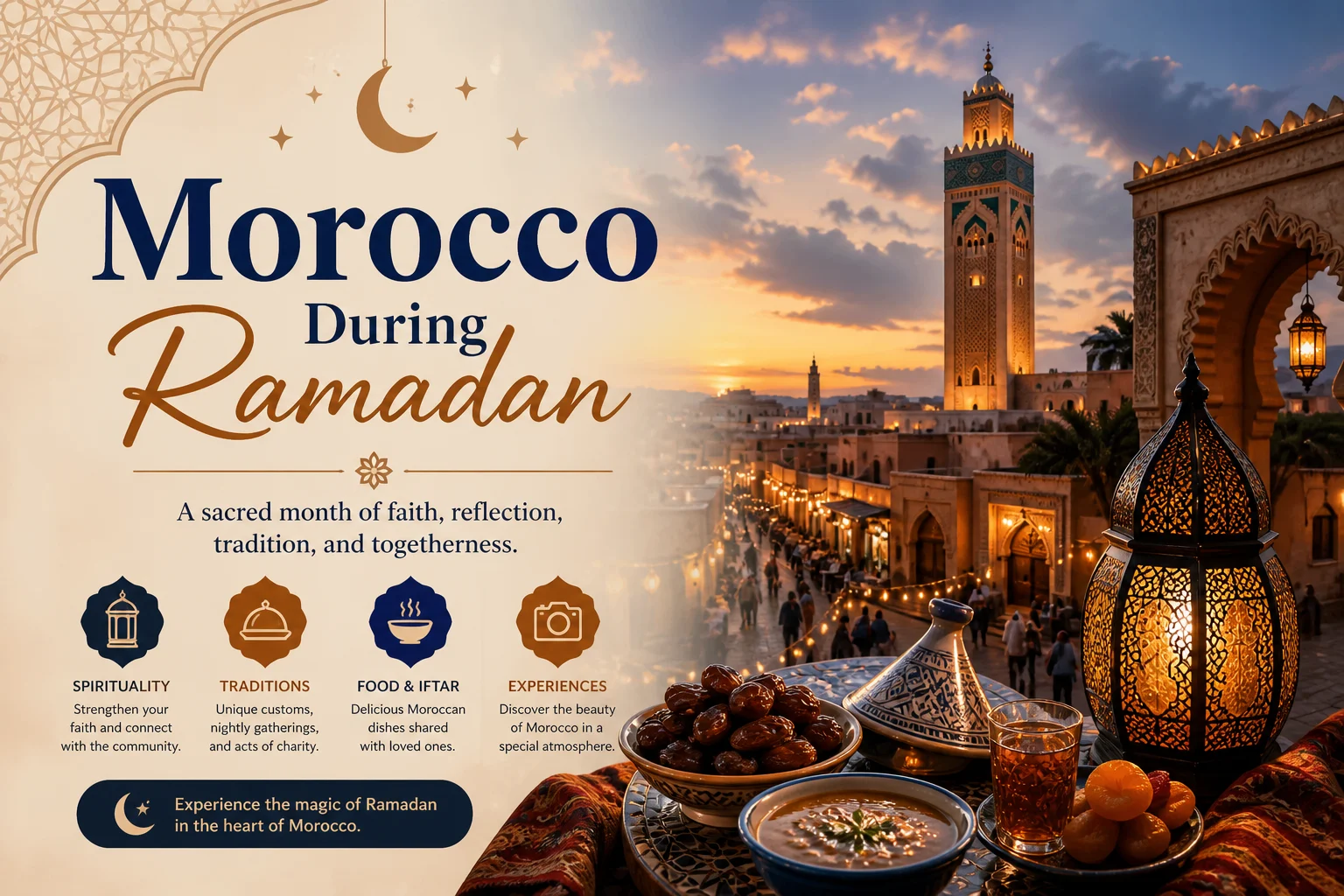
Short answer: yes, you can absolutely visit Morocco during Ramadan — and for many travelers, it ends up being the most memorable part of their trip. The country doesn’t shut down. Tourist restaurants, hotels, monuments, and tours operate normally. What changes is the rhythm: quieter mornings, a slow afternoon hush, and a city that comes alive after sunset in a way you won’t see at any other time of year.
This guide explains exactly what shifts, what doesn’t, and how to travel respectfully so the experience is good for you and good for the people around you.
What is Ramadan, briefly
Ramadan is the ninth month of the Islamic lunar calendar and the holiest month for Muslims worldwide. From dawn to sunset, observant Muslims abstain from food, drink, smoking, and intimate relations — a practice rooted in the Qur’an and intended to cultivate patience, gratitude, generosity, and spiritual focus. The fast is broken each evening with iftar, a meal that begins at sunset, and resumes the next morning before dawn after a pre-fast meal called suhoor.
In Morocco, Ramadan is more than a religious obligation. It’s a national mood. Streets empty in the late afternoon, cannons fire to mark iftar in some cities, and families crowd around shared plates of harira soup the moment the muezzin signals sunset. Witnessing it is a privilege.
When is Ramadan in Morocco — 2026 and 2027 dates
Because Ramadan follows the Islamic lunar calendar, the dates shift back roughly 11 days each year on the Gregorian calendar. Morocco’s official start date is announced by the Ministry of Habous and Islamic Affairs after the moon is sighted, which means published estimates can move by a day in either direction.
When you are ready to plan, browse all our multi-day Morocco tours.
- Ramadan 2026: approximately February 17 or 18 – March 19 or 20, 2026. Eid al-Fitr (the celebration that ends Ramadan) falls in late March.
- Ramadan 2027: approximately February 7 or 8 – March 8 or 9, 2027. Eid al-Fitr falls a day or two later.
If you’re booking close to the dates, double-check Morocco’s official announcement closer to the time. For longer-range planning, treating the second half of February through mid-March as “Ramadan period” in 2026 and the first half of February through early March in 2027 is accurate enough.
What actually changes for travelers
Here’s the honest, on-the-ground reality.
Daytime energy is lower. Mornings start late. By mid-afternoon, you’ll notice fewer people on the streets, especially outside the medinas. Workplaces often shift to a continuous schedule (commonly 9am to around 3pm), and people tend to head home as sunset approaches.
Many local cafés and restaurants close during fasting hours. This is the most visible change. Smaller neighborhood spots that cater to locals will be shuttered or curtained between dawn and sunset. They reopen for iftar and stay open late.
Banks and government offices keep shorter hours. Expect roughly 9am to 3pm, Monday to Friday, with no afternoon reopening.
Museums, monuments, and palaces shift their hours. Many open later (often around 10–11am) and close earlier in the afternoon. Always check on the day — schedules can vary year to year.
Alcohol is harder to find. Most supermarkets pause sales for the month. Many local restaurants remove it from the menu. Licensed hotel bars and certain tourist restaurants continue serving discreetly to non-Muslim guests, but expect a quieter scene.
There’s a “magic hour” you should plan around. From roughly 30 minutes before sunset until about an hour after, the country pauses. Streets empty. Taxis disappear. Restaurants are full of staff and family preparing for iftar, not customers. Don’t try to travel, eat out, or sightsee in that window — settle in somewhere with a view, or join the iftar yourself.
What stays exactly the same
This is the part that surprises first-time visitors.
Hotels, riads, and guesthouses run normally. They serve breakfast, lunch, and dinner to guests, and most maintain their usual rooms, pools, and services. Tourist-oriented restaurants in Marrakech, Fes, Essaouira, Chefchaouen, Tangier, Casablanca, and Agadir stay open through the day for visitors — sometimes with curtains partly drawn out of courtesy to passers-by, but very much serving food. Major monuments, museums, and gardens remain open (with adjusted hours). Tour operators, drivers, guides, and desert camps run their full programs. Trains, buses, and flights operate on regular schedules.
In other words: the infrastructure of travel doesn’t pause. Only the daily rhythm shifts.
The genuine upside of visiting in Ramadan
If your itinerary is flexible, Ramadan offers experiences you simply can’t have any other time of year.
Iftar is one of the warmest hospitality traditions on Earth. Riads, restaurants, and hotels often serve special iftar menus — usually beginning with dates (the traditional first food, eaten in odd numbers), followed by harira, a fragrant tomato-and-lentil-based soup with chickpeas, herbs, and sometimes lamb that nearly every Moroccan family makes during the month. Then come chebakia, intricate sesame-and-honey pastries fried specifically for Ramadan; briouats, small savory pastries; msemen or baghrir flatbreads; and dense, energy-packed sellou (toasted flour, almonds, sesame, honey); and tall glasses of milk or fresh juice. It is, without exaggeration, one of the great meals of the Arab world.
Night markets become electric. Once the fast is broken, cities transform. Jemaa el-Fnaa in Marrakech runs later and louder. Fes’s medina alleys glow with lanterns. Pastry shops fill with chebakia, and families come out to walk, shop, and visit. The first hour or two after iftar is when you’ll see Morocco at its most joyful.
Mornings are unusually peaceful. With locals fasting and starting work later, monuments and souks are quieter than at any other time of year. If you’ve ever wanted Bahia Palace nearly to yourself, this is the month.
Hospitality goes up another notch. Generosity is a core value of Ramadan, and visitors frequently get invited to break the fast in family homes — especially in smaller towns and the Atlas. Accept gracefully if you can.
Traveler etiquette: the simple rules
You don’t need to fast yourself, and no one expects you to. But a few small choices make a meaningful difference.
Eat, drink, and smoke discreetly during daylight. That doesn’t mean hiding — it means using indoor restaurant tables, hotel terraces, and your riad rather than walking through a busy souk with a wrapped sandwich and a coffee. A water bottle in your bag is fine; chugging from it on a crowded bus is not.
Dress slightly more modestly than you might in other months. The same general rule for Morocco applies — shoulders, chest, and knees covered in public — but Ramadan is felt as a more devotional time, so this matters a little more in traditional neighborhoods.
Don’t film or photograph people breaking their fast without explicit permission. Iftar is intimate. A camera shoved into that moment lands badly. If you’re invited into a home or a community iftar, ask before you take any photo at all.
Save alcohol for licensed venues. If you’d like a drink, it’s still possible at hotel bars and certain tourist restaurants — just keep it indoors and discreet.
Tip a little more generously this month. People are working through long fasts, and acknowledgment goes a long way.
Honest pros and cons
| Pros of visiting during Ramadan | Cons |
|---|---|
| Quieter monuments, fewer crowds | Fewer local cafés open during the day |
| Lower prices on flights and many riads | Some shops shift to late-day hours |
| Iftar dinners and chebakia season | Alcohol harder to find |
| Magical evening atmosphere in medinas | Iftar window (sunset) requires planning |
| Higher chance of being invited to a family iftar | A sense of slowed pace some travelers find unfamiliar |
| Excellent weather (February–March is mild and pleasant) | Last-day Eid al-Fitr can pause some services |
Should you visit Morocco during Ramadan?
If you want a quiet, slower-paced trip with a strong cultural undercurrent, the answer is yes — enthusiastically. Ramadan in Morocco is not a barrier to a great trip; it’s a different kind of great trip. You’ll see the country at its most reflective and at its most exuberant, often within the same day.
If you want long lazy lunches at sidewalk cafés, easy access to alcohol, or a packed nightlife, you’d be happier in October or April. That’s a perfectly fine choice — see our deeper best time to visit Morocco guide for a month-by-month breakdown of weather, crowds, and festivals.
FAQ
Can I eat in public as a tourist during Ramadan in Morocco?
Yes — there are no laws against it for non-Muslims, and tourist restaurants stay open. The polite norm is to eat, drink, and smoke discreetly: indoors, on hotel terraces, or in clearly tourist-oriented venues, rather than visibly in the street or on public transport. A water bottle in your bag is fine; sipping respectfully out of view is the standard.
Are restaurants open during Ramadan in Morocco?
Tourist-oriented restaurants in cities like Marrakech, Fes, Essaouira, Chefchaouen, Tangier, Casablanca, and Agadir remain open throughout the day. Many local neighborhood spots close during fasting hours and reopen for iftar. Hotels and riads serve full meals to guests around the clock.
Do tours and desert trips run during Ramadan?
Yes. Private tours, day excursions, and Sahara desert trips all operate normally. Drivers and guides are typically fasting themselves, which is worth a quiet note of acknowledgment, but the itinerary doesn’t change. Some travelers actively choose Ramadan because of the calmer pace and the chance to share iftar in a desert camp.
Is alcohol available during Ramadan in Morocco?
Limited but available. Most supermarkets pause sales for the month, and many local restaurants take alcohol off the menu. Licensed hotel bars and certain tourist restaurants continue to serve it discreetly to non-Muslim guests indoors. Don’t expect to drink in public.
What’s the best part of Morocco during Ramadan?
For most travelers, it’s iftar — the moment the sun sets and the country exhales together. The first dates, the bowl of harira, the smell of chebakia, the sudden energy in medinas. Even visitors who came nervous about the timing usually leave saying it was the highlight of the trip.
Is Eid al-Fitr a good or bad time to travel?
Eid al-Fitr — the holiday that ends Ramadan — is a major family celebration, similar to Christmas Day in tone. Many shops and some museums close on the first day or two. Travel is possible but quieter, and tour services run on adjusted schedules. If your trip overlaps with Eid, build in a relaxed day or two and let the country celebrate.
Plan your Ramadan trip with confidence
Ramadan in Morocco rewards travelers who arrive curious and respectful. The pace is different, but the welcome is, if anything, warmer — and the food, music, and evening light during this month are unlike anything you’ll find another time of year.
If you’re considering a Ramadan-period trip, Moratra’s team can help you build an itinerary around the season — recommending riads with on-site iftar experiences, scheduling tours around the sunset hour, and suggesting which cities show the month at its most beautiful. Reach out for a free, no-obligation chat and we’ll help you plan a trip that feels both effortless and meaningful.
Plan Your Morocco Trip with Moratra
Ready to turn the ideas in this guide into a real trip? Browse Moratra’s most-booked private experiences across Morocco — handpicked itineraries, luxury riads and local guides:
- Luxury Morocco Tours — multi-day private itineraries across Marrakech, the Sahara, Fes and the imperial cities.
- Morocco Sahara Desert Tours — VIP private journeys from Marrakech to Erg Chebbi and Merzouga.
- Agafay Desert Day Trips — luxury camps and dinner-under-the-stars experiences just 30 minutes from Marrakech.
- Activities and Day Tours in Marrakech — cooking classes, hammams, walking tours and hot air balloon flights.
Need help choosing? Reach out anytime — our local team offers free, no-obligation Morocco trip advice.
