
Morocco is one of the most rewarding countries to travel through — and one of the easiest, once you understand how its transport system actually works. Between Africa’s first high-speed train, two reliable national bus networks, color-coded city taxis, shared Mercedes “grand taxis” running every intercity route, and a domestic airline that reaches the Sahara, you have more options than most first-time visitors realize.
This is the practical, no-nonsense Morocco transportation guide we wish every traveler had before landing. We’ll walk through each option, compare them honestly on price, comfort and time, and tell you when each one actually makes sense.
Morocco’s transport options at a glance
Before we go deep on each mode, here is how the main options stack up. Use this as your decision-making shortcut.
- ONCF trains — Best for the imperial cities corridor (Tangier–Rabat–Casablanca–Fes–Marrakech). Comfortable, on time, scenic, and the high-speed Al Boraq is world-class.
- CTM & Supratours buses — Best for places trains do not reach (Chefchaouen, Essaouira, Merzouga, the Atlas, the south). Modern, air-conditioned and cheap.
- Grand taxis — Best for short shared intercity hops where buses are inconvenient, or for privatizing a ride between nearby towns.
- Petit taxis — The default way to move around any city. Always metered, cheap, color-coded.
- Rental car — Best for the Atlas mountains, the Atlantic coast and remote desert routes where you want to stop on your own schedule.
- Domestic flights — Best when you need to cross the country fast, especially north–south to Dakhla or Laayoune.
- Private transfer — Best when comfort, time and door-to-door service matter more than saving 200 dirhams.
Trains in Morocco: ONCF and Al Boraq
Morocco’s national railway, ONCF, runs one of the most reliable and pleasant train networks in Africa. Trains are punctual, clean, air-conditioned, and dramatically more comfortable than the equivalent bus. If your itinerary follows the Tangier–Rabat–Casablanca–Marrakech axis, the train is almost always the right choice.
Al Boraq — Africa’s first high-speed train
Launched in 2018, Al Boraq was the first high-speed line on the African continent. It connects Tangier to Casablanca via Kenitra and Rabat in around 2 hours and 10 minutes, with trains running on a dedicated high-speed line at up to 320 km/h between Tangier and Kenitra, then on an upgraded mainline through Rabat down to Casa Voyageurs.
Departures run roughly hourly from early morning until evening. On board, you get reclining seats, free Wi-Fi (speeds vary when the train is full), power outlets, and a café car serving sandwiches, coffee and cold drinks. First class adds a 1+2 seating layout, more legroom and a quieter atmosphere.
Standard ONCF lines
Beyond Al Boraq, conventional ONCF trains link Casablanca with Marrakech (around 3 hours), Fes and Meknes with Casablanca and Rabat, and Oujda in the far east. Most long-distance trains offer first and second class. First class is reserved seating in a six-seat compartment; second class is open seating and noticeably busier.
Sample 2026 train fares
- Tangier → Casablanca (Al Boraq, 2nd class): from 149 MAD
- Tangier → Casablanca (Al Boraq, 1st class): from 229 MAD
- Marrakech → Fes (1st class, ~7 hours): around 250 MAD
- Casablanca → Marrakech (1st class, ~3 hours): around 140–200 MAD
Fares use dynamic pricing, so they climb closer to departure. Book on oncf.ma a few days ahead for the cheapest seats and to lock in a quiet 1st class compartment, especially on weekends and holidays.
Train booking tips
- Book Al Boraq 1st class on Friday afternoon and Sunday evening trains — they sell out.
- Save your e-ticket QR code offline; Wi-Fi at stations is unreliable.
- Arrive 20 minutes early. Platform numbers post late.
- Watch your bag in 2nd class; pickpocketing is rare but happens during boarding scrums.
Buses: CTM vs. Supratours vs. local lines
Where the train doesn’t go, a bus almost certainly does. Two operators handle the vast majority of intercity travel for tourists.
If you would like us to arrange it for you, see our private driver and transfer service.
CTM — the national network
CTM (Compagnie de Transports au Maroc) is the largest, most established intercity operator. The fleet is modern, air-conditioned, and runs from dedicated CTM stations rather than the chaotic main bus terminals (gares routières). You can book online in English at ctm.ma with foreign cards. Luggage costs an extra 5–10 MAD per bag, paid in cash at boarding.
Supratours — the train company’s bus arm
Supratours is operated by ONCF, the railway. It exists mainly to extend the train network into places without rail service — most famously, Marrakech to Essaouira, where there is no train line. Comfort is similar to CTM, often with newer buses. The website (supratours.ma) is mostly French. Tickets are also available at any ONCF train station.
Local and regional buses
Cheaper local lines exist on every route, but for travelers we don’t usually recommend them. Comfort is unpredictable, schedules are loose, and the time savings rarely justify the loss of air conditioning and reserved seats.
CTM vs. Supratours — quick decision guide
- Going to Essaouira, Agadir or Tan-Tan from Marrakech? Supratours is usually the most direct option.
- Long-haul north–south or Chefchaouen? CTM has more frequent departures and an easier English-language site.
- Need to leave at a specific hour? Check both — schedules complement rather than overlap on most routes.
Sample 2026 bus fares
- Marrakech → Essaouira (Supratours, ~3 hours): around 80–100 MAD
- Casablanca → Chefchaouen (CTM, ~7 hours): around 200 MAD
- Marrakech → Merzouga (Supratours, overnight): around 300 MAD
- Fes → Chefchaouen (CTM, ~4 hours): around 100 MAD
Grand taxis: Morocco’s shared Mercedes
Grand taxis are old, indestructible Mercedes sedans (or, increasingly, minivans) that run fixed intercity routes. They wait at a designated taxi stand near the gare routière, fill up to six passengers — yes, six, including four squeezed in the back — and leave when full. There is no schedule. When the last seat sells, you go.
How grand taxis actually work
Each route has a fixed price per seat. You pay one of those seats, get in, and wait. If you don’t want to wait or can’t bear the seating arrangement, you can privatize the taxi by paying for all six seats at once — usually around 5–6× the per-seat price.
Grand taxis are unbeatable on short routes that fall awkwardly between cities, like Tangier to Asilah, or Marrakech out to Ourika Valley. On long-distance routes, the bus or train is almost always more comfortable.
Negotiation tips
- Ask the price first, before you sit down. The fixed seat price is widely known by locals — confirm with a hotel concierge before you head to the stand.
- For private hires, start your offer below your maximum and meet in the middle.
- Don’t pay until you arrive — or at most, half on departure.
- Pay in small bills. Drivers rarely have change for a 200 MAD note on a 30 MAD ride.
Petit taxis: getting around inside cities
Petit taxis are the small, color-coded city taxis you’ll use every day. They are required by law to use the meter for trips inside city limits, and the rates are very low.
City colors
- Casablanca — red
- Marrakech — beige (sometimes called “khaki”)
- Rabat — blue
- Fes — red
- Tangier — light blue / turquoise
- Chefchaouen — light blue
- Agadir — orange
How to use a petit taxi
Flag one down on the street with a wave. Petit taxis carry up to three passengers and may pick up additional passengers along the route — that’s normal, not a scam. Daytime fares typically start at 5–7 MAD with most rides falling between 10–25 MAD across town. After dark (usually 8 or 9 PM, depending on the city), a 50% night surcharge applies on the meter.
Meter or no meter?
Always insist on the meter (“le compteur, s’il vous plaît”). If a driver refuses, politely get out and take the next one. Outside major hotels, airports and tourist sites, drivers will sometimes propose a fixed price — it’s almost always 2–3× the metered fare. The meter is your friend.
Renting a car in Morocco
A rental car transforms certain trips and ruins others. It’s perfect for the High Atlas, the Atlantic coast from Casablanca down to Essaouira and Sidi Ifni, the Anti-Atlas valleys, and the long road from Ouarzazate through the Draa Valley toward the dunes. It’s a poor choice if your trip stays inside the medinas of Marrakech, Fes or Chefchaouen, where you can’t drive in and parking is a headache.
Requirements
- Driver age 21+ with most agencies (some require 23+); license held for at least 1 year.
- A credit card is essential for the security deposit hold.
- Carry your driving license, passport, rental contract and insurance papers in the car at all times. An International Driving Permit is recommended and sometimes required.
Road conditions
The toll motorways (autoroutes) connecting Tangier, Rabat, Casablanca, Marrakech, Agadir and Fes are excellent — wide, well-marked, lightly trafficked. National roads (“N” routes) are generally good. Mountain roads in the Atlas can be narrow, winding and lack guardrails, and rural roads can develop sudden potholes. Driving in big cities — especially Casablanca and central Marrakech — is intense and unforgiving for newcomers.
Speed limits and rules
- Motorways: 120 km/h
- National roads: 100 km/h
- Regional roads: 60 km/h
- Urban areas: 40–60 km/h
- Seatbelts compulsory for all passengers ; children under 10 in the back.
Police speed checks are frequent on national roads. Slow down well before towns — speed limits drop fast, and on-the-spot fines are common.
Fuel
Expect roughly 13–15 MAD per liter for petrol and 11–13 MAD per liter for diesel in 2026. Diesel is cheaper and far more common in rentals. Stations are plentiful on main routes; in remote areas (south of Zagora, east of Merzouga), top up whenever you see one.
Don’t drive at night
This is the single most repeated piece of advice from anyone who knows Moroccan roads. Outside cities there are no streetlights, road markings can vanish, and you may share the road with unlit donkey arts, scooters without headlights, stray dogs and pedestrians. Plan to arrive at your destination before sunset.
Domestic flights with Royal Air Maroc
For most travelers, domestic flights only make sense over long distances — typically anything south of Agadir. Royal Air Maroc and its regional arm RAM Express connect Casablanca with Agadir, Marrakech, Fes, Tangier, Oujda, Nador, Errachidia, Ouarzazate, Laayoune and Dakhla, among others.
The most useful domestic routes for visitors are:
- Casablanca ↔ Dakhla — the only sane way to reach the southern Atlantic without losing two full days to driving.
- Casablanca ↔ Laayoune — gateway to the deep south.
- Casablanca ↔ Ouarzazate — handy for travelers heading straight to the desert.
- Casablanca ↔ Marrakech / Agadir — useful for connections, less so as a standalone trip versus the train.
Book directly on royalairmaroc.com. Fares vary widely depending on season and how early you book.
Private transfers: when to splurge
A private driver-guide isn’t always the cheapest option, but on certain routes it pays for itself in time, comfort and stress. Consider it for:
- Marrakech → Sahara via Aït Benhaddou and the Dades Valley (a road trip, not a transfer)
- Fes → Chefchaouen with a stop in Volubilis
- Airport pickups after a long-haul flight, especially with luggage and kids
- Day trips into the Atlas where public transport simply doesn’t reach the trailhead
Prefer to skip the logistics entirely? Moratra‘s tours include private, air-conditioned transport with experienced drivers who know every road, every shortcut and every safe spot to break the trip. For independent travelers, our team also offers free transport routing advice — tell us your itinerary and we’ll tell you whether the train, the bus or a driver makes the most sense for each leg.
Putting it all together: a sample mixed-mode itinerary
Most well-planned Morocco trips combine modes. Here’s a realistic 10-day example:
- Day 1–2: Casablanca → Rabat — Al Boraq train (~50 minutes).
- Day 3–4: Rabat → Fes — ONCF train (~3 hours, 1st class).
- Day 5–6: Fes → Chefchaouen — CTM bus or private transfer with Volubilis stop.
- Day 7: Chefchaouen → Tangier — CTM bus, then Al Boraq south to Casablanca or Marrakech.
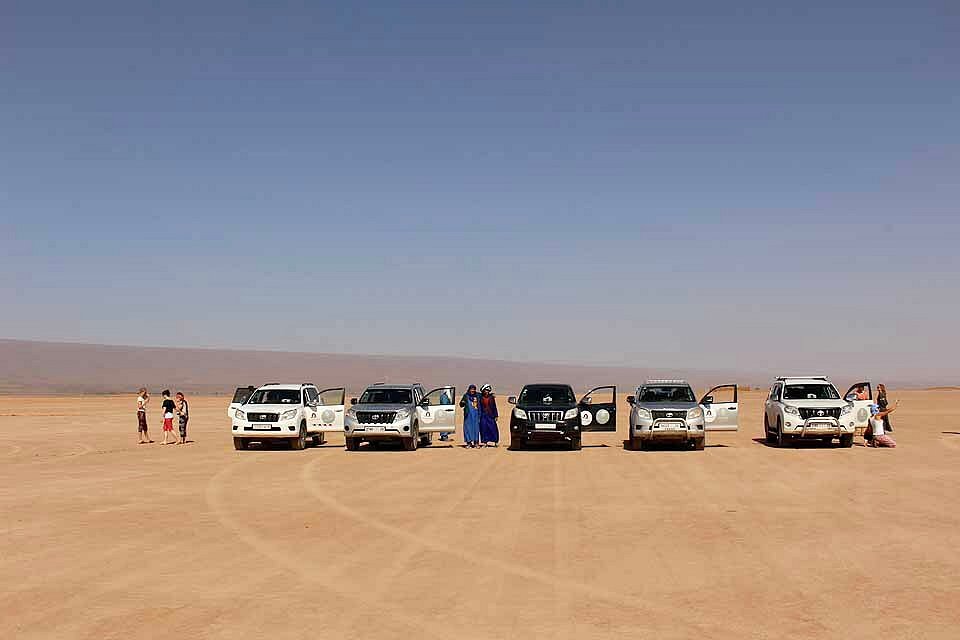
- Day 8–10: Marrakech + Sahara — Marrakech base with a 3-day private 4×4 tour to Merzouga and back.
For the Sahara leg, almost everyone ends up in a private vehicle — the Atlas passes, the desert pistes, and the timing of sunrise dunes are not realistic on public transport.
FAQ: Morocco transportation
Is it safe to take taxis in Morocco as a tourist?
Yes. Petit taxis are metered by law and very cheap; insist on the meter and you’ll pay the local rate. Grand taxis are also safe but require knowing the per-seat price in advance. Avoid unmarked cars at airports — use the official taxi rank.
What’s the best way to get from Marrakech to the Sahara desert?
There’s no train and the Supratours overnight bus to Merzouga is the budget option (~12 hours). Most travelers join a 3-day private 4×4 tour because the journey itself — Aït Benhaddou, the Dades and Todra gorges — is the point.
Should I rent a car or use trains and buses in Morocco?
If your trip is mainly imperial cities (Casablanca, Rabat, Fes, Marrakech, Tangier), trains and buses are faster, cheaper and less stressful. If you want the Atlas mountains, the Atlantic coast or remote desert routes on your own schedule, rent a car — but never plan to drive at night.
How fast is the Al Boraq high-speed train?
Al Boraq runs at up to 320 km/h on its dedicated high-speed track between Tangier and Kenitra, then continues on upgraded mainline through Rabat to Casablanca. The full Tangier–Casablanca journey takes about 2 hours 10 minutes.
Do I need to book Moroccan trains and buses in advance?
For Al Boraq 1st class, weekends, school holidays and any CTM bus on a popular tourist route — yes, book at least a few days ahead. Standard ONCF 2nd class and most weekday buses, you can usually buy the same day at the station.
What apps work for getting around Morocco?
Google Maps works well for driving, walking and city taxi navigation. Careem and, in some cities, InDrive and Heetch operate as ride-hailing alternatives. The official ONCF and CTM apps are the cleanest way to book trains and buses.
Plan your transport with Moratra
Getting around Morocco well is mostly about matching the right mode to the right leg of your trip. The train for the imperial cities, a CTM or Supratours bus where the train ends, a grand taxi for the awkward in-between hops, a petit taxi on arrival, and a private 4×4 the moment you head into the Atlas or the dunes.
If you’d rather hand over the planning, take a look at Moratra’s multi-day Morocco tours — every itinerary includes private, air-conditioned transport, an experienced driver who knows the routes, and the flexibility to stop wherever the trip surprises you. Or just message our team for free, honest routing advice on the legs you’d like to plan yourself.
For the rest of the practical pre-trip work, see our Morocco visa guide and the upcoming Morocco currency guide.
Plan Your Morocco Trip with Moratra
Ready to turn the ideas in this guide into a real trip? Browse Moratra’s most-booked private experiences across Morocco — handpicked itineraries, luxury riads and local guides:
- Luxury Morocco Tours — multi-day private itineraries across Marrakech, the Sahara, Fes and the imperial cities.
- Morocco Sahara Desert Tours — VIP private journeys from Marrakech to Erg Chebbi and Merzouga.
- Agafay Desert Day Trips — luxury camps and dinner-under-the-stars experiences just 30 minutes from Marrakech.
- Activities and Day Tours in Marrakech — cooking classes, hammams, walking tours and hot air balloon flights.
Need help choosing? Reach out anytime — our local team offers free, no-obligation Morocco trip advice.
