
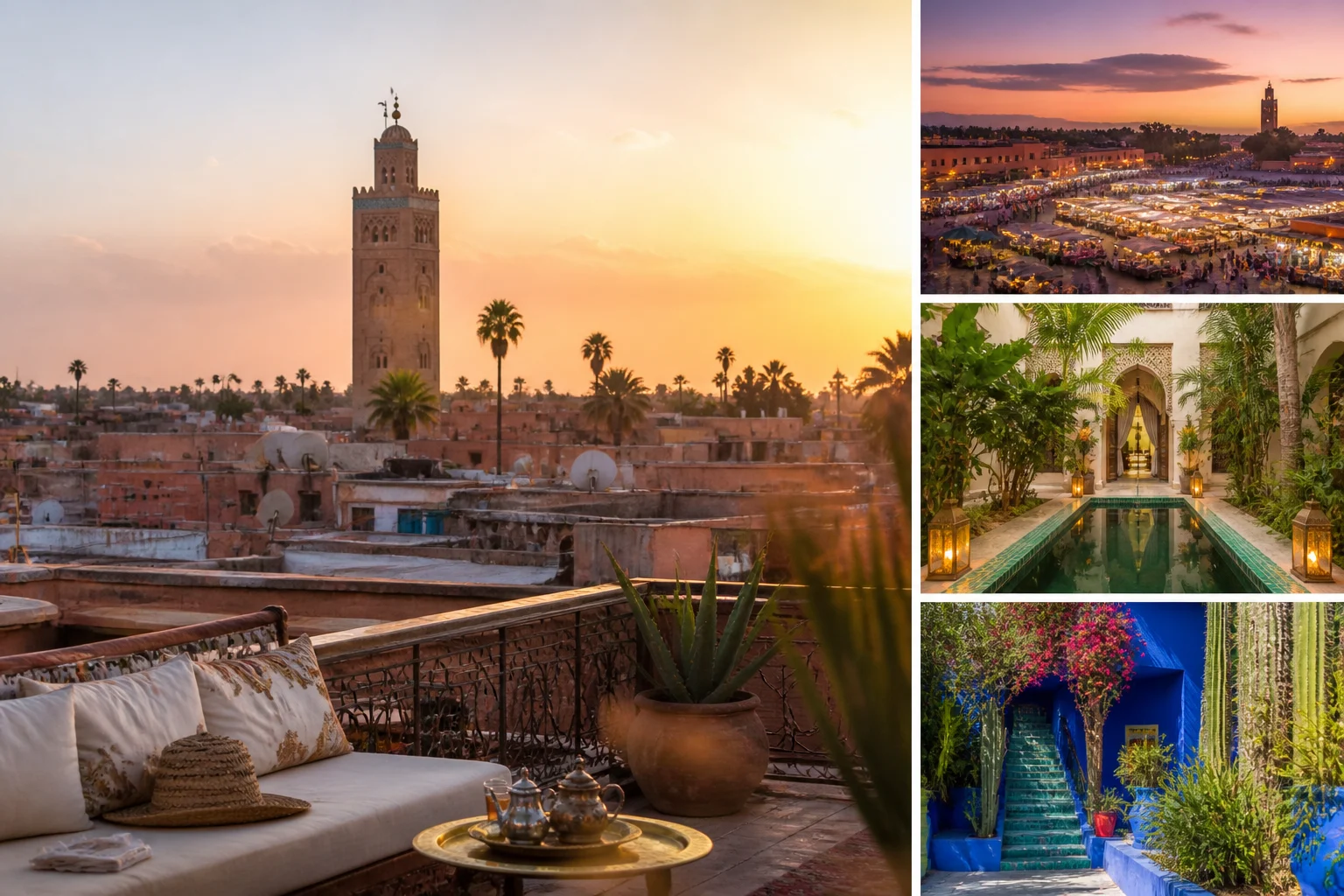
Three days in Marrakech is the sweet spot. Long enough to slow your pulse, short enough that every hour feels intentional. You arrive expecting chaos and leave remembering scents — orange blossom on a riad rooftop, charcoal smoke over the square, mint tea poured from a great height. This itinerary is built so you don’t waste a single one of those hours. It pairs the medina’s must-sees with quieter corners, gives you time to wander, and finishes with a morning above the Atlas. Use it as a blueprint, then tweak it to your pace.
Before You Start: A Few Practical Notes
Most travelers fly into Menara International Airport (RAK), about 15 minutes from the medina by taxi. Settle on a fare before you climb in — 100–150 MAD is standard for a daytime ride to the medina; airport taxis are the only ones that legitimately use a fixed tariff system. If your riad is deep in the medina, your driver will drop you at the nearest gate (Bab Doukkala, Bab Laksour, or Bab Agnaou are common) and a porter from the riad will meet you with a handcart for the bags.
Stay inside the medina if you can. A traditional riad — a courtyard house turned guesthouse — puts you within walking distance of nearly everything in this itinerary, and the architectural experience is worth the price of admission alone. Mouassine, Kasbah, and Bab Doukkala are the three medina pockets most travelers favor: Mouassine for atmosphere, Kasbah for calm, Bab Doukkala for easy taxi access.
One last note before we start the clock: the medina is mapped less by streets than by landmarks. Save your riad’s location offline in Google Maps, take a screenshot of the route from the nearest gate, and accept that you will get a little lost. That is part of it.
To book this with a local team, see our half-day Marrakech city tour.
Day 1 — Palaces, Souks, and the Square at Dusk
Morning (9:00 – 12:30): Bahia Palace and El Badi
Begin at Bahia Palace (open daily, entry around 70 MAD). Built in the late 19th century by Grand Vizier Si Moussa and expanded by his son Bou Ahmed, Bahia is a study in restraint and detail — carved cedar ceilings, zellige tile mosaics, and small private courtyards where you can hear birdsong over the city. Arrive at opening (typically 9:00 AM) to beat the tour groups. Allow about an hour.
From Bahia it’s a 10-minute walk south to El Badi Palace (open daily 9:00–17:00, around 10 MAD). Built by Sultan Ahmad al-Mansur after the Saadians’ victory at the Battle of the Three Kings in 1578, El Badi was once one of the most lavish palaces in the Islamic world — and was systematically stripped by Sultan Moulay Ismail in the late 17th century to build Meknes. What’s left is a vast, atmospheric ruin: sunken orange gardens, towering pisé walls, nesting storks. The contrast with Bahia is the point. Visit Bahia first, then El Badi, and you feel the full sweep — preservation against decay, ornament against absence.
If time allows, the Saadian Tombs are a five-minute walk from El Badi and worth a quick stop for the breathtaking Hall of Twelve Columns.
Lunch (12:30 – 14:00): A Medina Terrace
Walk fifteen minutes north toward the Kasbah quarter or the area around the souks. Naranj (Lebanese-Moroccan), Café Clock (camel burgers and live music nights), and Le Jardin (a green oasis tucked into Souk el-Jeld) are dependable lunch picks. Budget 150–250 MAD per person.
Afternoon (14:00 – 17:30): The Souks
The souks are not one market — they are a constellation of forty or so guild-organised lanes radiating north from Jemaa el-Fnaa, where over 2,600 craftsmen still work. Souk Semmarine (textiles, slippers), Souk el-Attarine (spices and perfumes), Souk des Teinturiers (the dyers’ alley with its hanging skeins of wool), and Souk Haddadine (metalworkers) each have their own rhythm.
A few rules to enjoy them: start your counter-offer at 30–40% of the asking price, smile, walk slowly, and never feel rushed into buying. If you don’t intend to purchase, “la, shukran” (no, thank you) said warmly is the correct phrase. Drop into Le Jardin Secret on Rue Mouassine — restored and opened to the public in 2016, its two adjacent gardens (one Islamic, one exotic) are a quiet oxygen break in the middle of the bustle. Climb the tower for a rooftop view over the medina.
Evening (18:00 onward): Jemaa el-Fnaa at Sunset
Jemaa el-Fnaa has been the heart of Marrakech since the city was founded by the Almoravids in 1062. UNESCO inscribed it as a Masterpiece of the Oral and Intangible Heritage of Humanity in 2001 — a recognition of the storytellers, musicians, henna artists, and Gnawa dancers who fill the square each evening. Arrive around 18:00 to watch the daytime juice stalls give way to smoking food carts, oil lamps, and circles of audience around hlaiqia (storytellers).
For dinner, climb to one of the rooftop cafés along the square’s western edge — Café de France, Le Grand Balcon, or Kessabine — and order a tagine while the muezzin’s call drifts across the rooftops. It is touristy. It is also one of the great evening views in North Africa.
Day 2 — Gardens, Madrasas, and a Modern Detour
Morning (8:30 – 12:30): Jardin Majorelle and the YSL Museum
Take a petit taxi (or walk 30 minutes from the medina) to the Gueliz district for Jardin Majorelle — the cobalt-blue villa and botanical garden created by French painter Jacques Majorelle in 1923 and rescued from ruin by Yves Saint Laurent and Pierre Bergé in 1980. It opens at 8:00 AM (last entry 18:00). Buy timed-entry tickets in advance from the official site (tickets.jardinmajorelle.com) — walk-up queues during peak season can swallow an hour.
Next door, the Musée Yves Saint Laurent Marrakech opens at 10:00 (closed Wednesdays). The earth-toned brick building, by Studio KO, is itself an architectural pilgrimage. Inside, a permanent gallery rotates the designer’s most iconic work and a temporary space hosts photography and fashion exhibitions. Combined tickets covering both sites and the Berber Museum are the best value if you want the full experience.
Lunch (12:30 – 14:00): Gueliz
Stay in Gueliz for lunch — the new town has a thriving café scene that surprises first-time visitors. Plus 61 (Australian-Moroccan), Nomad (a sister property of the medina favorite), and Le Trou au Mur all serve modern Moroccan cooking. Budget 200–350 MAD per person.
Afternoon (14:30 – 18:00): Ben Youssef and the Northern Medina
Taxi back to the medina (around 30 MAD) and head to Ben Youssef Madrasa. Founded by the Marinid Sultan Abu al-Hasan in the 14th century and rebuilt in 1564–65 by the Saadian sultan Abdallah al-Ghalib, Ben Youssef once housed up to 800 students in 130 small cells around an extraordinary central courtyard. After a major restoration, it reopened to the public in April 2022 — and the photography opportunities are some of the best in the medina, particularly in late afternoon when sunlight strikes the carved cedar above the prayer hall.
Five minutes’ walk away sits the Maison de la Photographie, a four-floor museum opened in May 2009. Its collection traces Moroccan life from the 1860s to the 1960s through more than 4,500 prints, glass plates, and stereoscopes. The rooftop café is another quiet sunset spot, with views all the way to the Atlas on a clear day.
Evening (18:30 onward): A Cooking Class or Hammam
Pick one. A traditional Moroccan hammam — black soap, kessa glove scrub, ghassoul clay mask — is part bathing ritual, part mild ego death, and you will sleep better than you have in months. La Mamounia Spa and Royal Mansour are the storied luxury options; smaller riad hammams (such as Les Bains de Marrakech) offer the ritual at a quarter of the price.
Alternatively, sign up for a hands-on cooking class at La Maison Arabe, Café Clock, or a riad-based atelier. You’ll buy ingredients in the souks, learn a tagine and a salad or two, and then sit down to eat what you’ve made. Three hours, around 600–800 MAD per person, and you’ll leave with a recipe you can actually replicate at home.
Day 3 — Rise Above the City, Then Wander Slow
Sunrise to Mid-Morning: Hot Air Balloon over the Jbilet Hills
Set the alarm. A hotel pickup roughly an hour before sunrise (from about 5:30 AM in early summer to about 7:30 AM in midwinter), a short drive past the Palmeraie to the Jbilet hills north of Marrakech, and you’ll be lifting off as the sky shifts from violet to peach. The High Atlas — many peaks above 4,000m, the tallest of them Jbel Toubkal at 4,167m — fills the southern horizon, snow-capped well into May. Most flights last about an hour, ending with a Berber breakfast in a tent. Book in advance; see our guide to the best balloon companies in Marrakech for current operators.
If pre-dawn flights aren’t your thing, swap this morning for a half-day in the Ourika Valley. It’s roughly 60 km south of Marrakech (about a 90-minute drive), with Berber villages, a small Saturday souk in Tnine, and the Setti Fatma waterfalls at the head of the valley. Spring is the most beautiful season here — almond blossoms in February, wildflowers through April.
Late Morning (11:00 – 13:00): Koutoubia and the Menara Gardens
Back in town, walk to the Koutoubia Mosque — the city’s tallest minaret at 77m, built by the Almohads between 1147 and 1199. The mosque itself is closed to non-Muslims, but the gardens around it are a graceful place to sit. From there it’s a fifteen-minute taxi to the Menara Gardens, the 12th-century olive grove with its iconic pavilion mirrored in a vast irrigation basin. It is more peaceful than photogenic — a place for a slow walk rather than a rushed tick-box.
Afternoon (14:00 – 17:30): Last Wanders or a Day-Trip Detour
Two options, depending on what you’re craving:
- Slow Marrakech. Lunch at Nomad (try the lemon chicken and the carrot-cumin starter), then drift through the spice souk one last time for saffron, ras el hanout, dried rosebuds, and a small cone of orange-blossom water. End the afternoon at a riad rooftop with a glass of mint tea.
- Beyond the City. If you still have energy, swap the afternoon for the Agafay Desert — only about 45 minutes from the city, this rocky moonscape at the foot of the Atlas hosts sunset camel rides and dinners under the stars at curated camps.
Farewell Dinner
For a final meal, splurge on a palace restaurant. Dar Yacout (a 1920s villa with a tasting menu), Le Tobsil (intimate, set menu, no signage), or La Grande Table Marocaine at the Royal Mansour are the three classic choices. Dress smart-casual; reserve a couple of days ahead.
Three-Day Itinerary at a Glance
- Day 1: Bahia Palace → El Badi → Saadian Tombs → Souks → Le Jardin Secret → Jemaa el-Fnaa rooftop dinner.
- Day 2: Jardin Majorelle → YSL Museum → Gueliz lunch → Ben Youssef Madrasa → Maison de la Photographie → hammam or cooking class.
- Day 3: Hot air balloon (or Ourika Valley) → Koutoubia → Menara Gardens → final souk wander or Agafay sunset → palace dinner.
Practical Tips for Three Days
- Cash: Carry a mix of small notes (20, 50, 100 MAD). Most souk stalls are cash-only; restaurants and riads usually take cards.
- Dress: Modest is comfortable. Lightweight long sleeves and trousers protect from sun and respect local norms in the medina.
- Walking: Real walking shoes, not sandals. The medina’s stones eat flip-flops.
- Pace: Don’t try to add Essaouira or Aït Benhaddou to a three-day trip — both deserve more time than a long round-trip leaves you. Save them for the next visit.
- Best months: March–May and September–November are ideal. June through August can hit 40°C+ in midday — if you’re visiting then, plan an afternoon siesta into your schedule.
Frequently Asked Questions
Is three days enough for Marrakech?
Yes — three days lets you cover the medina, Gueliz, and one out-of-town highlight (a balloon flight, Ourika Valley, or Agafay) without exhausting yourself. If you want to add the Atlas Mountains for a hike or a desert overnight to Merzouga, plan for at least five to seven days total.
What’s the best neighborhood to stay in for three days?
Mouassine and Kasbah are the two medina quarters most travelers prefer. Mouassine puts you minutes from the souks and Le Jardin Secret. Kasbah is calmer, closer to Bahia and El Badi, and a good fit for light sleepers. Both offer the full courtyard-house riad experience. Our team has reviewed dozens of properties — see our best riads in Marrakech guide for picks across budgets.
How much does a three-day Marrakech trip cost?
Excluding flights, a comfortable three-day budget is roughly 350–600 USD per person — covering a mid-range riad (around 80–150 USD per night), three meals a day, attraction entries, taxis, and one experience like a hammam or balloon flight. Luxury travelers can easily spend triple that; backpackers can do it on half.
Should I hire a guide for the medina?
For at least one half-day, yes. The medina’s logic — guild-organised souks, hidden fondouks, residential alleys — is invisible to a self-guided wanderer. A licensed guide for three to four hours (around 300–500 MAD) earns its keep many times over. After that, you’ll have the confidence to explore on your own.
Is Marrakech safe for first-time visitors?
Yes. Petty scams (unofficial guides, “the souk is closed today” routines, overpriced taxis) are far more common than anything serious. Keep your bag zipped, agree on taxi prices upfront, and use a polite-but-firm “la, shukran” with anyone offering unsolicited help.
Can I extend this itinerary into a longer Morocco trip?
Easily. Marrakech pairs beautifully with the Sahara (3–4 days via Aït Benhaddou, Dades, and Merzouga), Essaouira (a 2.5-hour drive west), or Fes and Chefchaouen for an imperial-cities loop. Our team builds custom routes around this 3-day base every week.
A Final Word
This itinerary is a starting point, not a script. The best Marrakech moments are the unscripted ones — a teapot offered by a shopkeeper, a wrong turn that opens onto a quiet courtyard, the call to prayer at exactly the right time. Leave room for those.
If you’d like this plan tailored to your dates, your interests, or your travel style — adding a hammam at the right pace, swapping a museum for a cookery class, or extending into the Atlas or the desert — the Moratra team builds itineraries like this every day, and the planning advice is always free. Just tell us what you love and we’ll design the rest.
Want this itinerary organised for you? Explore the full list of Marrakech excursions and private tours and weu2019ll handle the logistics.
