
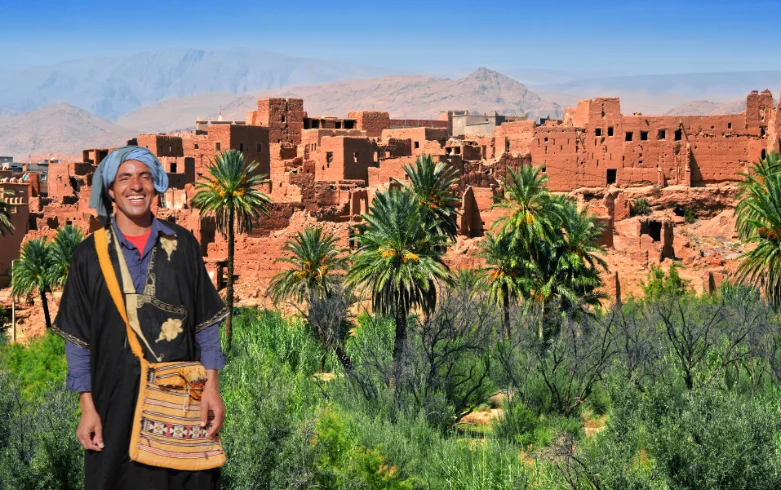
Long before Morocco was Morocco, the people who built its first villages, walked its first trade routes, and named its first mountains called themselves Imazighen — “the free people.” Their language, music, weaving, and warm sense of hospitality still pulse through every valley, kasbah, and desert camp you’ll visit today. To understand Morocco, you have to understand the Amazigh.
This guide is a deep, respectful introduction to Berber culture in Morocco: who the Amazigh are, where they came from, what they speak, what they make, and how to experience their world without reducing it to a postcard. Whether you’re planning a trek through the High Atlas, a night in a Sahara camp, or simply want richer context for your trip, you’ll find the essentials here — and a few details that even guidebooks tend to miss.
Who Are the Berbers? Meet the Amazigh of Morocco
The word “Berber” comes from the Greek barbaros, used by outsiders for people who didn’t speak Greek. The community’s own name is Amazigh (singular) or Imazighen (plural), which translates as “free people” or “noble people.” Today, “Amazigh” is the preferred term in Morocco, even though “Berber” is still widely used internationally and isn’t considered offensive in most travel contexts.
The Amazigh are the indigenous people of North Africa, with a continuous presence stretching back thousands of years across what is now Morocco, Algeria, Tunisia, Libya, Mauritania, and parts of the Sahel. In Morocco, estimates of how many people identify as Amazigh vary widely. Morocco’s 2024 census found that around 24.8% of the population reported speaking an Amazigh language at home, while Amazigh cultural associations argue the share of people with Amazigh heritage is far higher when ancestry — rather than language — is counted.
You can also do this with us on our Berber village experience.
That tension between language statistics and lived identity is one of the most important things to grasp: in Morocco, almost everyone has Amazigh roots somewhere in their family tree, even if they primarily speak Darija (Moroccan Arabic) today.
A Long History: From Antiquity to the Almoravids and Beyond
Amazigh history in North Africa predates the arrival of Phoenicians, Romans, Vandals, Byzantines, and Arabs. Ancient sources mention Amazigh tribes as early as the second millennium BCE. The kingdoms of Numidia and Mauretania, the Roman city of Volubilis (near present-day Meknes), and even the figure of Saint Augustine of Hippo all trace back to this North African substrate.
For Morocco specifically, two Amazigh-led empires shaped the country we visit today:
The Almoravids (c. 1040–1147)
The Almoravid dynasty grew out of nomadic Sanhaja tribes — the Lamtuna, Gudala, and Massufa — from what is now Mauritania and the Western Sahara. Around 1070, they founded Marrakech as their capital. At their height, the Almoravids ruled an empire that united the western Maghreb with al-Andalus (Muslim Spain), making them the first major Berber-led Islamic empire of the western Mediterranean.
The Almohads (1147–1269)
The Almohads emerged from the Masmuda confederation in the High Atlas Mountains, led initially by the religious reformer Ibn Tumart. Under his successor Abd al-Mu’min, they overthrew the Almoravids and built what became the largest Amazigh empire in African history, stretching from the Iberian Peninsula to modern-day Libya. The Koutoubia Mosque in Marrakech and the Hassan Tower in Rabat both date from this era.
Later dynasties (Marinids, Saadians, Alaouites) layered Arab and Andalusian influences on top of this Amazigh foundation, but the rural backbone of the country — the Atlas valleys, the Rif, the southern oases — remained, and largely remains, Amazigh.
Language: Tamazight, Tifinagh, and the Three Dialect Families
For most of the 20th century, Amazigh languages had no official status in Morocco. That changed in 2011, when a constitutional reform recognized Tamazight as an official language of the state alongside Arabic. The Royal Institute of Amazigh Culture (IRCAM), founded in 2001, has since worked to standardize the language and produce textbooks, signage, and media.
What we call “Tamazight” is actually a family of related languages. In Morocco, three main varieties dominate:
- Tarifit (Riffian) — spoken in the Rif Mountains and northern regions around Al Hoceima, Nador, and parts of Chefchaouen province.
- Central Atlas Tamazight — spoken in the Middle Atlas and parts of the High Atlas, in cities and villages such as Khenifra, Azilal, and Midelt.
- Tashelhit (Shilha) — spoken in the Souss Valley, the western High Atlas, the Anti-Atlas, and southern oases. Tashelhit is the largest single Amazigh language in Morocco by number of speakers.
The script you’ll see on official buildings, road signs, and the IRCAM logo is Tifinagh. A modernized form, Neo-Tifinagh, was adopted as the official orthography for Standard Moroccan Amazigh in 2003. Its angular geometric letters descend from an ancient North African script and feel, to most travelers, beautifully alien — a reminder that Amazigh culture is not a regional dialect of Arab Morocco, but its own deep tradition.
A few useful Tamazight expressions to try:
- Azul — hello
- Tanemmirt — thank you
- Manik antgit? — how are you? (Tashelhit)
- Bismillah before eating — widely used across Amazigh and Arab homes alike
Even a single word of Tamazight will brighten a host’s face in a mountain village. It signals respect for an identity that, for generations, was kept alive almost entirely at home.
Traditions: Carpets, Silver, Henna, and Stories Woven by Hand
Amazigh material culture is one of the world’s most expressive folk traditions. Each region has its own visual language, but a few crafts appear nearly everywhere.
Carpets and Weaving
Amazigh carpets are not just decoration. Women weave family stories, prayers, blessings, and even tribal maps into geometric symbols passed down through generations. The famous Beni Ourain rugs from the Middle Atlas — ivory wool with minimalist black diamonds — are now icons of global interior design, but their patterns originally referred to fertility, protection, and the mountain landscapes the weavers knew by heart.
Other regional styles include the bright, narrative Boucherouite rag rugs of the Atlas; the dense, deeply colored Azilal carpets; and the heraldic, diamond-rich rugs of the High Atlas and Anti-Atlas.
Silver Jewelry
Amazigh aesthetics favor silver over gold. Cool, luminous, and traditionally associated with protection, silver was used for ceremonial fibulae, large pectoral necklaces, anklets, and forehead diadems often combined with coral, amber, and enamel. The southern Tiznit region is still one of Morocco’s great silver-working centers.
Tattoos and Henna
For centuries, women in some Amazigh communities wore facial and hand tattoos — symbols marking lineage, marital status, or spiritual protection. Permanent tattooing has largely faded over the past few generations, but the same symbols live on in henna, applied at weddings, before pilgrimages, and on holidays.
Architecture
The earthen kasbahs and fortified villages (ksour) of southern Morocco — including UNESCO-listed Aït Benhaddou — are Amazigh architecture par excellence. Built from rammed earth (pisé) using techniques refined over centuries, they stay cool in summer, warm in winter, and harmonize completely with the landscape. You can see this living tradition along the desert road covered in our Aït Benhaddou and Ouarzazate guide.
Music, Festivals, and Community Life
Amazigh music is participatory, communal, and rooted in the rhythms of agricultural and pastoral life.
- Ahidous — a Middle Atlas group dance and song tradition. Men and women form circles or parallel lines, swaying and singing in call-and-response over the beat of bendir frame drums.
- Ahwash — the High Atlas and Souss equivalent, with poetry recited by a lead poet (amyaz), choral response, and percussion.
- Rways — itinerant Amazigh poet-musicians of the Souss, somewhat like North African troubadours.
The most famous Amazigh gathering is the Imilchil Marriage Festival, held each September in the High Atlas. Couples meet, families negotiate, and engagements are announced in a centuries-old tradition that gives unusual agency to women, who can accept or refuse matches in public. It’s not the staged tourist show some sources describe; it’s a real social institution that visitors are welcome to observe respectfully.
Other markers of the Amazigh year include Yennayer, the Amazigh New Year (celebrated around January 13–14), and the Almond Blossom Festival in Tafraoute each spring. Amazigh New Year is now an official public holiday in Morocco — another sign of the cultural revival of recent years.
Where to Experience Berber Culture in Morocco
You don’t need to plan a special “Amazigh tour” to encounter this culture — if you spend time in rural Morocco, you’re already in it. That said, certain regions reward travelers who slow down and look closely.
The High Atlas Mountains
Villages like Imlil (1,740 m, gateway to Mount Toubkal), Aroumd, and the valleys around Setti Fatma are deeply Amazigh. You’ll see terraced barley fields, mule-only paths, communal bread ovens, and stone houses almost indistinguishable from the slopes around them. A guided 2-day Toubkal trek typically includes nights in family-run guesthouses where Tamazight is the first language at the dinner table.
The Ourika Valley
Just an hour from Marrakech, the Ourika Valley is the most accessible window into High Atlas Amazigh life. Tafza village hosts a small Berber ecomuseum where you can learn about pottery, weaving, and traditional medicine in context, not behind glass. For a half-day or full-day visit, see our Ourika Valley guide or join an Ourika Valley & Atlas Mountains day tour from Marrakech.
The Sahara and Pre-Saharan Oases
South of the Atlas, the desert belongs to a long tradition of nomadic and semi-nomadic Amazigh tribes — the Ait Atta, the Ait Khabbash, and others. Spending a night in a desert camp near Merzouga or Zagora often means dinner cooked by Amazigh hosts, music played around a fire, and conversations about the seasonal movements still practiced by some families. Most of our Sahara desert tours and private desert routes are led by Amazigh guides who grew up in these landscapes.
The Rif Mountains
In the north, the Rif is home to Tarifit speakers and a more mountainous, rain-fed version of Amazigh life. Chefchaouen is the most-visited gateway, but quieter villages reward travelers who venture beyond the medina.
Traveling Respectfully in Amazigh Communities
Most rural Amazigh families are extraordinarily generous with strangers, but a few small choices make a real difference:
- Always ask before photographing people, especially women and elders. A smile and a gesture are usually enough; sometimes a polite “no” comes back — honor it without negotiation.
- Dress modestly in mountain villages. Shoulders and knees covered is a good baseline for both men and women.
- Buy directly from artisans and cooperatives when you can. Women’s weaving cooperatives in the Atlas and argan cooperatives in the Souss return income directly to local families.
- Learn a few words of Tamazight — even one. It’s the single fastest way to be welcomed beyond the surface.
- Don’t reduce people to a caricature. Amazigh Moroccans are farmers, doctors, engineers, students, artists, app developers, and parents — just like anyone else. The traditions described above are alive precisely because they live alongside modern life, not in opposition to it.
Frequently Asked Questions
Are “Berber” and “Amazigh” the same thing?
Yes. “Amazigh” (plural Imazighen, meaning “free people”) is the community’s own name and is now widely preferred. “Berber” is the older external term, derived from the Greek word for “non-Greek speaker.” Both are used in Morocco, but if in doubt, “Amazigh” is the more respectful choice.
What language do Berbers speak in Morocco?
They speak Tamazight, a family of closely related Amazigh languages. The three main varieties in Morocco are Tarifit (Rif), Central Atlas Tamazight (Middle and parts of High Atlas), and Tashelhit (Souss and southern regions). Tamazight has been an official language of Morocco since the 2011 constitutional reform.
Is Tifinagh script used in everyday life?
Tifinagh is now used on official road signs, government buildings, school textbooks, and IRCAM publications. In daily life, most Moroccans still write Tamazight using Latin or Arabic letters, but Tifinagh’s visibility has grown significantly since 2011 and continues to expand in education and public signage.
What percentage of Moroccans are Amazigh?
Estimates vary depending on whether you measure language or ancestry. The 2024 census reported that about 25% of Moroccans speak an Amazigh language at home. Cultural associations argue that, by ancestry, the share is much higher — possibly a majority of the population — since centuries of Arabization have shifted everyday language use without erasing heritage.
Can travelers attend the Imilchil Marriage Festival?
Yes, respectful visitors are welcome to observe. The festival usually takes place in September in the village of Imilchil, in the High Atlas. Plan accommodation well in advance, dress modestly, ask before taking photos, and remember that the engagements you may witness are real, not staged for tourists.
Where is the easiest place to experience Berber culture on a short trip?
For travelers based in Marrakech with limited time, the Ourika Valley is the most accessible option. A day trip can include a Berber village walk, a visit to the Tafza ecomuseum, and a meal in a family home, all within about an hour of the city. For a deeper experience, a 2–3 day stay in Imlil or a Sahara desert camp adds significantly more depth.
Plan a Trip That Honors the Real Morocco
Amazigh culture isn’t a stop on an itinerary — it’s the soil the rest of Morocco grew in. The best trips weave it through everything: a morning in a mountain village, an afternoon learning to weave or cook, an evening of Ahidous around a fire, a guide who can tell you what the symbols on the kasbah walls actually mean.
If you’re not sure how to thread these experiences into your dates, regions, and budget, the Moratra team is happy to help. Many of our guides are themselves Amazigh, and we can quietly build authentic encounters into any route — mountain treks, desert circuits, or shorter day trips from Marrakech. Free, friendly trip-planning advice is always available; just send us a note with what you’re hoping to see, and we’ll respond like a local friend, not a sales pitch.
For a practical look before you go, see our guide to what a Berber village day trip from Marrakech is really like — where to go, the etiquette, and how to spot an authentic visit.
Want to experience this culture first-hand? Join our private Berber village experience from Marrakech — share mint tea, bread-baking and a homemade lunch with an Amazigh family in the High Atlas.
