
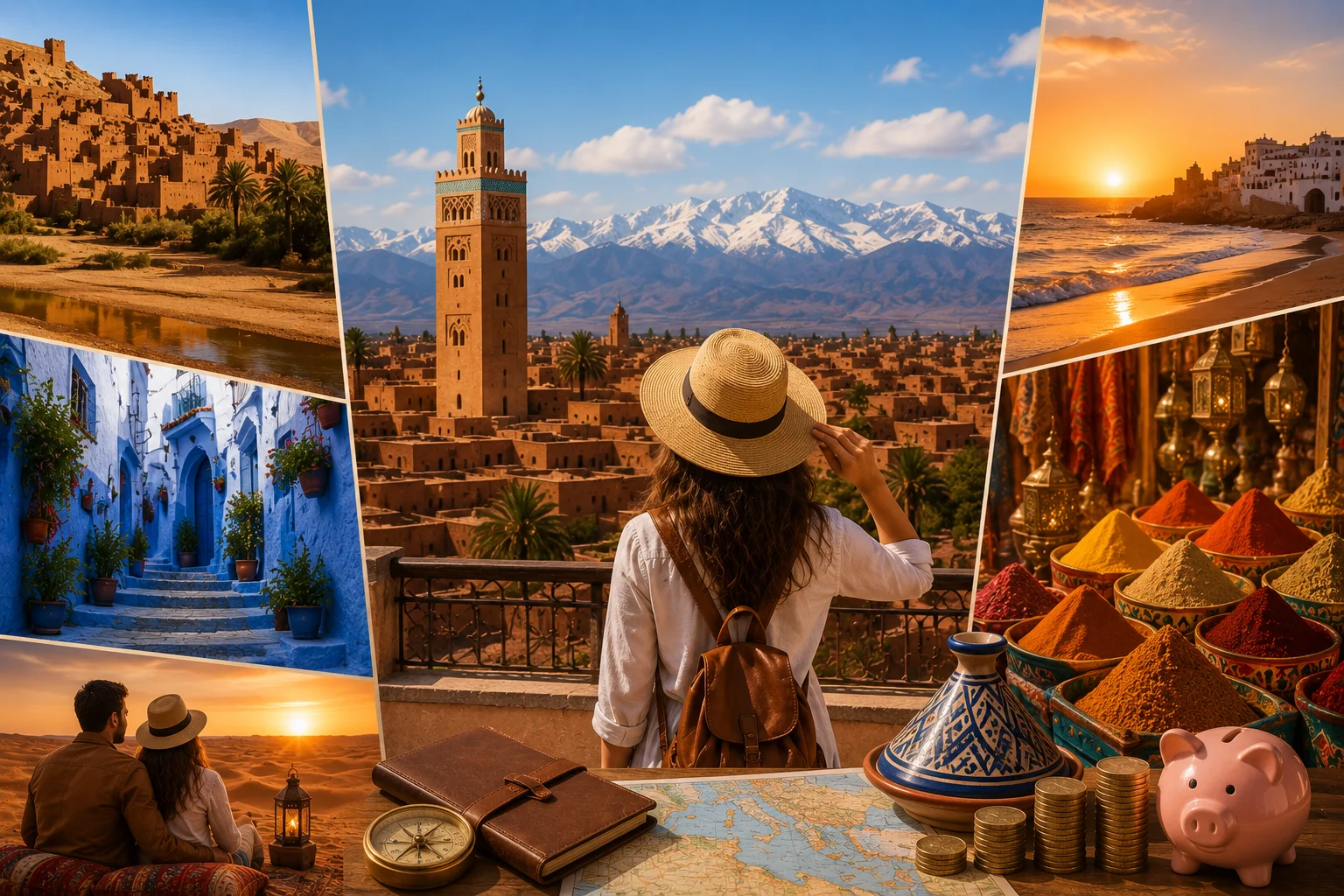
Short answer: the cheapest time to visit Morocco in 2026 falls in three distinct windows — mid-January to early March, mid-June to late August (inland), and mid-November to mid-December (excluding the Christmas/New Year spike). In those weeks you can comfortably cut 30 to 55 per cent off the price of a riad room, a Sahara tour and even an international flight compared with peak spring or autumn rates. But “cheapest” doesn’t always mean “best value”, and a few of these windows come with weather, cultural or logistical trade-offs you’ll want to weigh before you book.
This guide breaks the year down month by month, shows you the typical price swing for each major travel cost (riads, tours, transport), and flags the hidden traps that erase your savings — like booking a desert tour the week temperatures hit 47 °C, or arriving in Marrakech mid-Ramadan without knowing what’s open.
The quick answer: peak, shoulder, off-peak by month
Morocco has three weather seasons that quietly drive travel prices: a long shoulder/peak block in spring and autumn when the climate is gentle countrywide, a hot summer where inland cities empty out and coastal cities fill up, and a cool winter that’s still pleasantly mild in the south. Here’s how that maps to your wallet.
| Month | Price tier | Why |
|---|---|---|
| January (after the 5th) | Off-peak (cheapest) | Holidays over, cool but dry south, snowy Atlas. |
| February | Off-peak | Cool, almond blossoms, very quiet riads. |
| March (early) | Off-peak → shoulder | Ramadan overlap in 2026; prices stay low. |
| Late March – May | Peak | Best weather; spring break + Easter. |
| June | Shoulder → off-peak (mid-month) | Inland heat starts; coast still reasonable. |
| July – August | Off-peak inland / Peak coastal | Marrakech and Fes very hot; Essaouira packed. |
| September (mid → late) | Shoulder → peak | Heat eases, autumn season begins. |
| October – early November | Peak | Arguably the perfect month countrywide. |
| Mid-November – mid-December | Off-peak | Quiet riads, mild south, snowy peaks. |
| Late Dec – early Jan | Peak (highest spike) | Christmas / New Year holiday surge. |
If your only goal is the lowest possible price, target the second half of January or all of February. If you also care about weather, mid-November is the sweet spot — sunny days in Marrakech, mild evenings, no crowds, and prices a fraction of October’s.
When you are ready to plan, browse all our Morocco tour packages.
The three cheapest windows, explained
Window 1: Mid-January to early March — the quietest weeks of the year
Once the New Year crowd leaves around the 4th or 5th of January, Morocco effectively empties out for two full months. Marrakech medina riads that asked for 1,400 dirhams a night in October will quietly list rooms at 500 to 700 dirhams. Mid-range Fes riads slide to around 400 to 600. International flights from London, Paris and Madrid drop in price too, particularly mid-week. The Atlas Mountains turn properly snowy — Oukaïmeden ski resort opens its lifts most winters — and the south, including Ouarzazate and the Draa valley, stays dry and comfortable at around 18 to 22 °C in the daytime.
What’s the catch? Evenings get cold (riads with thick stone walls can feel chilly without a working fireplace), some pool-heavy resort hotels in Marrakech don’t heat their pools, and you’ll want a jacket for the desert at night where temperatures can drop close to 0 °C. Pack layers, ask whether your riad has heating, and you’ll have one of the loveliest, most affordable Morocco trips on record.
Window 2: Mid-June to late August — cheap inland, with one big warning
By mid-June, inland Morocco starts cooking. Marrakech and Fes routinely hit 40 to 45 °C in July and August, and the deep south can break 47 °C. The result: riads in Marrakech and Fes drop their prices sharply — sometimes more than the January discount — and the medinas feel almost private after 11 am, when locals retreat indoors. If you can handle the heat (or you plan to spend your afternoons by a shaded riad pool), this is the cheapest inland Morocco gets all year.
The warning: do not book a multi-day Sahara tour in July or August. Daytime camel rides become genuinely dangerous, and even Morocco’s national tourism office quietly steers visitors toward the cooler months for desert excursions. If you want a desert experience in summer, swap Merzouga for the high-altitude Atlas (Imlil, Ouirgane) where temperatures stay around 25 to 30 °C and the savings on a mountain riad are real.
Coastal cities — Essaouira, Asilah, Tangier and the Atlantic stretch — invert the equation. They become peak destinations in July and August because Moroccans themselves go there on holiday. Expect crowds, higher hotel prices, and a much harder time finding a last-minute room. If you want both cheap and cool in summer, the Atlas Mountains are your best bet.
Window 3: Mid-November to mid-December — the savvy traveler’s secret
Of the three windows, mid-November to mid-December is the one we recommend most often. Daytime temperatures in Marrakech sit around 19 to 23 °C, Sahara nights are cool but not freezing, the autumn rains are usually finished, and the high-season crowds have packed up. Riad prices drop 30 to 45 per cent from October, mid-range desert tours dip into more comfortable price ranges, and flights from Europe ease back to off-peak levels. It’s also when many riad owners do their quiet renovation work, so you may find newly redone rooms at low-season rates.
This window closes hard around the 20th of December, when Christmas and New Year arrivals push prices to their annual peak — sometimes double what you’d have paid two weeks earlier. If your dates are flexible, lock in arrival by December 17 or 18 at the latest, and depart before the 22nd.
Why Morocco’s prices swing so sharply by season
The price spread between peak and off-peak in Morocco is steeper than in many Mediterranean destinations, and there are three reasons worth understanding before you book.
First, the country’s tourism is heavily concentrated in two short windows: roughly mid-March to mid-May and late September to early November. Hotels and riads — most of them family-run and small (under 15 rooms) — depend on those weeks for the bulk of their annual revenue, so peak pricing is aggressive. The flip side is that they discount deeply in the quiet weeks just to keep rooms filled and staff working.
Second, Sahara tours have a hard climate gate. Camp operators near Merzouga and Mhamid simply can’t run the same camel ride or overnight bivouac product in July as they do in October. Off-peak tour prices fall not because the operator is being generous, but because demand falls and they need to keep their guides employed.
Third, international flight pricing into Morocco follows European school holidays more than Moroccan demand. Easter, May half-term, October half-term and the Christmas break dominate the year’s most expensive flight weeks. Travel between those holiday periods — mid-January, late November, mid-June — and you’ll often find return fares from London, Paris or Madrid 30 to 50 per cent below the school-holiday norm.
The Ramadan question: cheap, but read this first
In 2026, Ramadan falls roughly from mid-February to mid-March (the exact dates are confirmed by moon sighting in the days before it begins). For travelers, Ramadan is one of the cheapest possible windows — sometimes the single quietest weeks of the year for riads in Marrakech, Fes and Chefchaouen. But the experience is genuinely different.
During Ramadan, many local restaurants, cafés and food stalls close during the day, opening only around sunset for iftar. Tourist-oriented restaurants in main medinas usually stay open, so you won’t go hungry — but the everyday rhythm of the souks changes noticeably, with shorter opening hours and a quieter mid-afternoon. Sunset becomes magical: the call to prayer, family tables filling with dates, msemen and harira, a sudden rush in the streets after dark. If you arrive curious and respectful, the experience can be one of the most moving of your trip.
Don’t try to dodge Ramadan if your only reason is “I don’t want to feel awkward eating in public” — non-Muslim travelers eat openly during the day with no issue. Do think twice if your trip is heavily focused on long, lingering medina lunches and busy daytime market life. For more on what to expect, our Ramadan travel guide for 2026 goes into the timing, the manners and the practical adjustments.
The hidden costs that quietly erase your off-peak savings
“Cheapest month” is a useful starting point, but the real total cost of a Morocco trip turns on three things that aren’t always obvious from a booking page.
The first is internal transport. Off-peak hotel savings vanish quickly if you book private transfers for every leg. The ONCF national rail network connects Tangier, Rabat, Casablanca, Marrakech and Fes at modest fares — second-class one-way from Casablanca to Marrakech typically sits in the 100 to 150 dirham range — and the high-speed Al Boraq line from Tangier to Casablanca cuts a four-hour drive to roughly two. Use the train where you can; reserve private cars only for the routes trains don’t serve (Merzouga, Chefchaouen, Imlil).
The second is the desert tour. A 3-day shared Merzouga tour from Marrakech can be found in the 800 to 1,300 dirham per person range in off-peak weeks. Private tours, by contrast, run two to four times that even out of season. The shared option is excellent if you don’t mind sharing a vehicle with five or six other travelers; the private upgrade is worth it for families, couples on honeymoon, or anyone with a meaningful mobility consideration. Don’t assume the cheapest tour wins — read recent reviews, check that the camp has running water, and confirm the itinerary doesn’t skip the long Ait Ben Haddou stop you actually wanted.
The third is shopping and souk fatigue. Plenty of travelers arrive in Marrakech determined to keep their budget tight, then walk out of the souk with a rug, a lamp and a leather bag. None of that is wrong — it’s part of being here — but build a small “Morocco treats” line into your budget so the splurge feels intentional, not accidental.
Best off-peak picks by region
Marrakech
Best cheap window: mid-January to late February, and mid-November to mid-December. Riad rooms in the medina at 400 to 700 dirhams a night, daytime sun, terrace breakfasts, the Atlas snowline visible from rooftop pools in winter. Pair this with our deeper best time to visit Marrakech guide for week-by-week detail.
Fes
Best cheap window: February (cool but dry, perfect for medina walking), or July and August if you can handle 38 °C+. Mid-range riads slide to 400 to 550 dirhams a night in February, and the medina is at its most local — fewer day-trippers, fuller artisan workshops, lower-pressure souks.
The Sahara (Merzouga / Mhamid)
Best cheap window: mid-November to mid-December, then again late January to early March. Shared 3-day tours from Marrakech in the 800 to 1,300 dirham range; cleaner camps available at the mid-tier price point because peak crowds aren’t there to fill the premium camps.
Atlantic coast (Essaouira, Asilah, Tangier)
Best cheap window: mid-November to early April. The coast is windy in winter — surfers love it, casual swimmers don’t — and prices are sometimes the lowest in the country. Avoid July and August unless you’ve booked very far in advance.
High Atlas (Imlil, Ouirgane, Ait Bougmez)
Best cheap window: spring (just after the snow peak) and autumn. Counter-intuitively, summer in the high Atlas is cool, green and excellent value compared with the inland furnace of Marrakech, but accommodation is more limited so book ahead.
How to actually lock in off-peak prices
Three habits separate travelers who pay off-peak rates from travelers who think they did but didn’t.
First, book your riad directly when possible. Many small Marrakech and Fes riads list higher prices on aggregator sites to absorb the platform commission. A polite email to the riad — in English or French — asking for their best direct rate for your dates will, in our experience, beat the public booking-site price by 10 to 20 per cent on average, especially in low season.
Second, decouple your flight from your accommodation booking. Bundled Morocco packages sold by European tour operators often look attractive but quietly assume peak-season hotel pricing. Booking a low-cost return flight (the Casablanca and Marrakech airports both receive direct flights from a dozen European hubs) and pairing it with a separately booked riad can save 20 to 35 per cent on the same number of nights.
Third, build your itinerary around the cheap window rather than against it. If you’re going in February, plan a Marrakech medina week with a 3-day Sahara loop and a couple of days in the Atlas — all priced down. If you try to bend an off-peak budget around a peak-season activity (an Atlas trek in January when half the gîtes are closed, a coastal beach week in February when it’s windy and grey), you’ll feel the friction. For a full pricing picture across all months and travel styles, see our companion guide on how much a trip to Morocco actually costs.
FAQ
What is the single cheapest month to visit Morocco?
February is reliably the cheapest month overall — international flights are at their lowest, riads are deeply discounted, and there are no major holidays driving demand. The trade-off is cool evenings (around 8 to 12 °C in Marrakech after dark) and limited Atlas trekking.
Is summer cheaper than winter in Morocco?
Inland, yes — July and August in Marrakech and Fes are often cheaper than January because of the extreme heat. Coastal cities are the opposite: summer is their peak season because Moroccan families holiday there. If you want cheap and pleasant, target winter inland or autumn shoulder.
Is Ramadan a good time to visit Morocco?
It can be wonderful — quieter medinas, low prices, beautiful sunset rituals — provided you arrive informed. Daytime cafés are reduced, tourist-oriented restaurants stay open, and evenings come alive. We’d recommend it for repeat visitors or curious first-timers; less ideal if your trip is built around long, sociable daytime meals.
How far in advance should I book an off-peak Morocco trip?
For winter and late autumn, 6 to 10 weeks ahead is usually plenty for riads, and 8 to 12 weeks for flights. Last-minute (under 3 weeks) often produces excellent riad deals but limited flight choice from Europe.
Are Sahara tours cheaper in winter or summer?
Winter — specifically November, January and February. Summer tours either don’t operate or run with serious heat warnings; demand drops, but reputable operators don’t slash prices because the experience itself is compromised.
Will I still find restaurants open in low season?
Yes. The Marrakech, Fes and Chefchaouen medinas have year-round tourism; restaurants there stay open through winter. Smaller mountain villages and some coastal towns reduce their hours from December to February, so research before relying on a specific spot.
Is January or February safer for weather?
February is marginally drier and slightly warmer in the daytime, but the difference is small. Both months are reliably sunny in Marrakech and the south, with occasional brief rain showers in the north (Tangier, Chefchaouen, Fes).
If you’d like the rest of your Morocco trip planned with the same care — riad shortlists matched to your dates, a Sahara tour vetted for cost and quality, and a region-by-region itinerary built around your budget — that’s what we do. Browse our 2026 Morocco tours collection, request a quote, or simply message us with a question — we’ll answer for free, no obligation. Either way: travel slow, eat the msemen warm, and bring layers in February.
