Marrakech rewards travellers who plan a little and haggle a lot. With the dirham trading around 9.2 MAD to the US dollar and 10 MAD to the euro in mid-2026, the Red City remains one of the most affordable major destinations in the Mediterranean basin — if you know where locals eat, sleep, and catch the bus. This 2026 cost guide walks through real prices for accommodation, food, transport, monuments and day trips, with honest ranges rather than the suspiciously round numbers you see on aggregator sites. Every figure here was cross-checked against operator websites, official tourism notices and on-the-ground reports in the spring of 2026. Use it to build a daily budget you can actually hit when you land at Menara airport.
How Much Does a Week in Marrakech Really Cost in 2026?
Three honest tiers cover most travellers. A frugal backpacker who stays in dorms, eats at street stalls and walks everywhere can live on roughly 300 to 400 dirhams per day — about USD 33 to 44. A mid-range visitor in a small riad with a couple of restaurant meals and a guided day trip looks at 650 to 900 dirhams, or USD 70 to 100. Comfortable travellers in a 4-star riad with private transfers and one premium experience usually land between 1,500 and 2,500 dirhams per day, USD 165 to 275.
A full week therefore ranges from about 2,100 MAD at the absolute backpacker end to 17,500 MAD for soft luxury, before flights. Couples typically pay less than 2x a solo budget because riad rooms are usually priced per room, not per person. Families benefit from triple and quad rooms in dars (traditional houses) that cost barely more than a double. The figures below break each category down in detail so you can build a realistic spending plan rather than a hopeful one.
Getting to Marrakech: Flights, Trains and Buses on a Budget
Marrakech Menara Airport (RAK), operated by the national airport authority ONDA, is served by low-cost carriers including Ryanair, easyJet, Wizz Air, Transavia and Air Arabia from across Europe. Return fares from London, Paris and Madrid frequently dip under EUR 80 in shoulder season (April–May and October–November) if you book six to ten weeks ahead and travel mid-week. From the US and Canada, the cheapest path is usually a budget transfer through Lisbon, Madrid or London rather than a single-ticket itinerary.
When you are ready to plan, browse all our activities in Marrakech.
From the airport into the medina, the official ONDA taxi tariff is published at the rank — daytime fares of around 100 dirhams and night fares of around 150 are normal, but you must agree the price before getting in. The far cheaper option is city bus line 19, the dedicated airport shuttle that runs roughly every 20 to 30 minutes to Jemaa el-Fnaa for 30 MAD one way or 50 MAD return. Coming from Casablanca, Tangier or Fes? ONCF intercity trains are usually the best value: second-class fares from Casablanca run about 140 MAD for the 3-hour ride, with first class around 200 MAD. CTM and Supratours coaches connect cities not on the rail network at similar prices. Booking online directly at oncf.ma or ctm.ma costs the same as the counter and locks in your seat.
Where to Sleep Cheap: Hostels, Dars and Budget Riads
Marrakech has one of the densest concentrations of cheap, characterful lodging in North Africa. Expect to pay 80 to 150 MAD for a hostel dorm bed in the medina, with rooftop hostels near Jemaa el-Fnaa or Mouassine charging slightly more in peak season. Private rooms in small dars usually go for 250 to 450 MAD per night including breakfast, and budget-friendly riads with plunge pools and rooftop terraces typically fall between 500 and 900 MAD.
Three habits keep accommodation costs honest. First, book directly with the riad by email or WhatsApp once you’ve found it on a major platform — owners almost always offer 5 to 15 percent off the listed rate to skip the commission. Second, ask whether airport pickup is included; many family-run riads include it free if you stay three nights or more, which alone saves 100 MAD. Third, prefer the medina over Gueliz unless you specifically want chain-hotel familiarity. The medina is cheaper, more atmospheric, and walking distance to nearly everything you came for. If you’re booking a longer stay, our 3-days-in-Marrakech itinerary shows which neighbourhoods make sense night by night.
Eating Well in Marrakech for Under 100 Dirhams a Day
Marrakech food is the area where modest budgets feel luxurious. At the Jemaa el-Fnaa night food stalls — a UNESCO-recognised cultural space since 2001 — a hearty plate of grilled meats, salads and bread comes in at 40 to 80 MAD, with snail soup at the famous stalls 1 or 2 going for around 15 MAD. Tagine in a local-favoured restaurant in the medina averages 50 to 80 MAD; couscous, traditionally served on Fridays, costs about the same. A glass of fresh orange juice on Jemaa el-Fnaa is roughly 10 MAD, and a pot of mint tea anywhere outside a tourist café sits around 15 to 25 MAD.
For under 100 dirhams a day you can comfortably eat a stuffed msemen pancake or harcha for breakfast (5–10 MAD from a street bakery), a bowl of harira soup and a sandwich for lunch (around 20 MAD total), and a full tagine dinner. Supermarket-bought yoghurt, fruit and bread cut costs further. Tipping is appreciated but modest — rounding up by 5 to 10 MAD at casual places, 10 percent at sit-down restaurants. Tap water in Marrakech is officially potable per the city’s water utility RADEEMA, but most visitors stick to bottled (5 MAD for 1.5L) to avoid stomach adjustment.
The Best Free and Almost-Free Things to Do
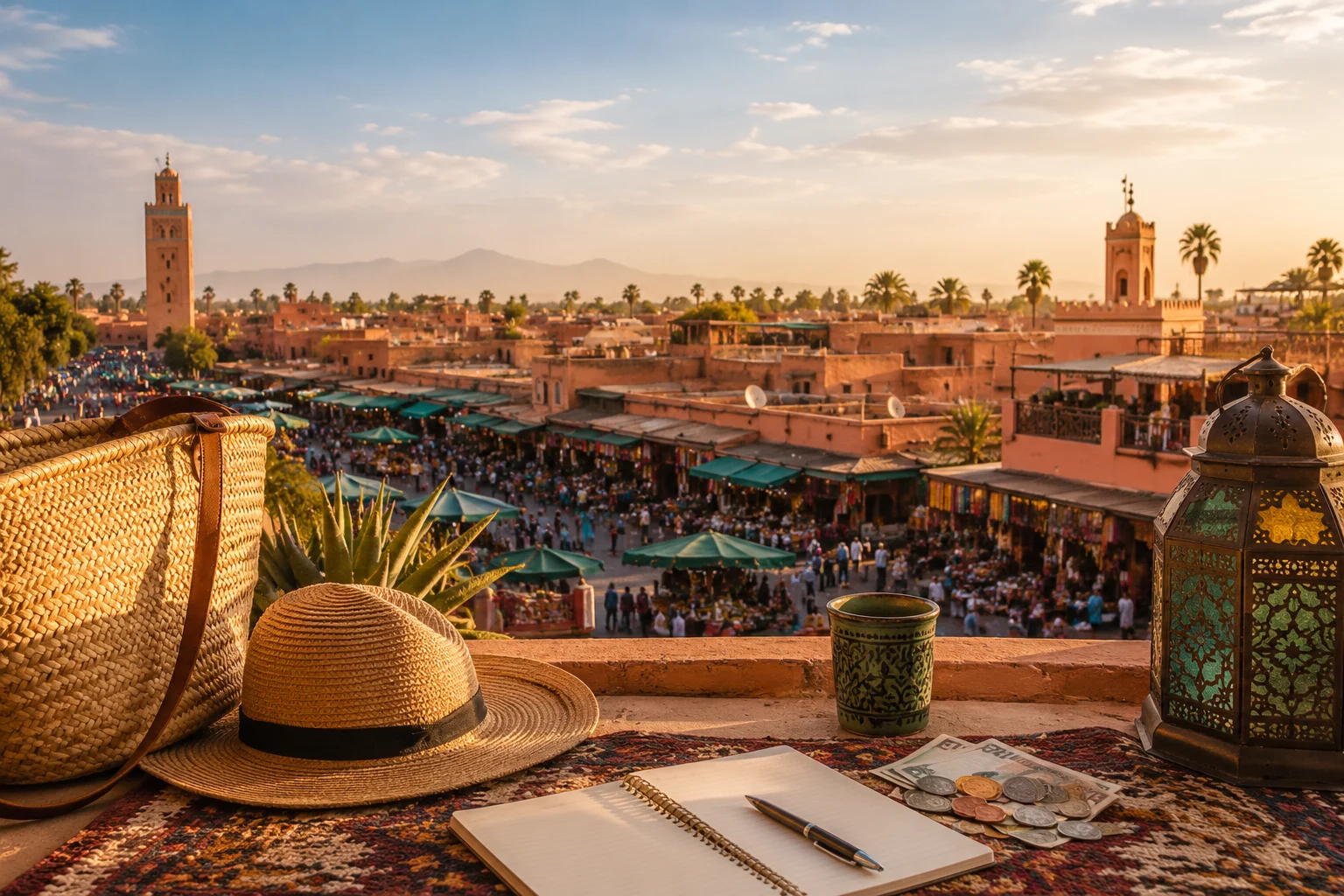
The single greatest experience in Marrakech costs nothing: an evening on Jemaa el-Fnaa as it shifts from afternoon orange-juice carts to night-time storytellers, musicians, fortune-tellers and food stalls. Sit on a low stool, accept the mint tea, and watch the city perform itself. The exterior of the 12th-century Koutoubia Mosque and its lit minaret, the medina’s 3,000-plus alleys of souks, and the Mellah (the historic Jewish quarter) are all free to wander. The ramparts of the medina, more than 19 km of red-earth walls, make a striking walking circuit around sunset.
Other almost-free pleasures include people-watching in Cyber Park (Arsat Moulay Abdeslam) for 0 dirhams; a public hammam visit at 10 to 15 MAD entry plus 10 MAD for a kessa scrub (bring your own soap and towel); a sunrise photography walk at the Saadian Tombs exterior wall in the Kasbah; and an afternoon at the small Maison de la Photographie, often included in low-cost city passes. Even the famous orange-juice carts on Jemaa el-Fnaa double as a free entertainment perch.
Museum and Site Entry Fees: What’s Worth Your Dirhams
Most Marrakech monuments now charge foreign visitors around 70 to 150 MAD per site, with prices nudging upward year over year. As a working 2026 guideline: Bahia Palace sits at about 100 MAD; the Saadian Tombs around 70 MAD; El Badi Palace roughly 70 MAD; Ben Youssef Madrasa 50 to 70 MAD; the Marrakech Museum in Dar M’nebhi around 50 MAD. The Jardin Majorelle bought by Yves Saint Laurent costs 150 MAD for the garden alone, with the optional Berber Museum and Pierre Bergé Museum of Berber Arts each adding roughly 100 MAD; the standalone YSL Museum Marrakech next door is around 150 MAD.
If your time is short, prioritise Bahia Palace for the courtyards, Ben Youssef Madrasa for the geometric tile work after its 2020 restoration, and Jardin Majorelle for the cobalt-blue architecture and rare cactus collection. Skip a paid visit to the Koutoubia interior — non-Muslims aren’t admitted to most active mosques in Morocco — and admire it from the gardens instead. Verify each ticket price at the door on the day, because individual sites adjust their own fees and there is no single citywide schedule.
Getting Around Marrakech Without Overpaying
Within the medina, the only practical way to get around is on foot — the alleys are too narrow for cars and only motorbikes and donkey carts squeeze through. From the medina to Gueliz, Hivernage or Majorelle, take a petit taxi (small beige or ochre cabs that carry up to three passengers). The legal requirement is that drivers use the meter; insist politely with “compteur svp” before you set off. A metered ride from Jemaa el-Fnaa to Gueliz averages 15 to 25 MAD, to Majorelle Garden 20 to 30 MAD, and to the airport 70 to 100 MAD.
For longer hops or excursions, grands taxis (older Mercedes sedans, shared, white or beige) connect Marrakech to nearby towns like Ourika and Setti Fatma at fixed per-seat fares of around 30 to 50 MAD. Buses run by Alsa cover the city for a flat 4 MAD; the airport line 19 is the famous exception at 30 MAD. Skip ride-hailing apps in Marrakech — Uber and Careem do not operate there, and most “rideshare” claims are unofficial drivers asking 3 to 5x the metered fare.
Day Trips From Marrakech That Won’t Break Your Budget
The best Marrakech day trips on a budget combine shared transport with included meals. A shared minivan to the Ourika Valley with a Berber-village lunch usually runs 150 to 250 MAD per person; the Atlas Mountains and Imlil day trip with a short hike costs about the same. A long day to Essaouira on the Atlantic coast — 2.5 hours each way — is typically 200 to 350 MAD per person in a small group. Adding a private guide multiplies costs by 3 to 5x but is worth it for first-time hikers in the Atlas if you’re not used to altitude.
Camel rides at Palmeraie just outside the city cost 200 to 400 MAD for a one-to-two-hour outing, including transfers. A half-day quad-biking experience runs roughly 400 to 700 MAD per person. For travellers building a longer itinerary that combines the imperial cities with a desert leg, our 7-day Morocco budget trip guide ($2,000–$3,000) walks through exactly how to keep a full circuit affordable. If your dates flex, the cheapest day-trip month is typically February, when fewer European visitors are around and operators discount empty seats.
Hammam, Souvenirs and Souks: Negotiating Like a Local
Marrakech has three hammam tiers. Public neighbourhood hammams charge a 10 to 15 MAD entry, with a kessa scrub from a self-employed attendant another 30 to 60 MAD — bring your own towel, sandals, soap and a change of underwear. Mid-range tourist hammams with steam, gommage and a short massage cost 200 to 400 MAD. Luxury riad spa packages with rhassoul clay, argan massage and tea ceremony run 600 to 1,500 MAD. The middle tier is the sweet spot for first-timers.
In the souks, the rule is simple: nothing has a fixed price unless it has a printed price tag. Walk away from anyone who shouts a number at you, decide what an item is worth to you before the discussion starts, and counter their first quote with roughly 30 to 40 percent of what they ask. Expect to land between 50 and 60 percent of the original ask for most goods — Berber rugs, leather slippers (babouches), lanterns and ceramics included. Argan oil should be sold from a labelled bottle in a women’s cooperative for around 150 to 300 MAD per 100 ml; anything cheaper is usually diluted with other oils.
Five Money Traps to Avoid
First, the “taxi without meter” trap: drivers quote 100 MAD for a 20 MAD ride. Politely insist on the meter or step out and flag the next one. Second, henna-tattoo pushers on Jemaa el-Fnaa who grab your hand and start applying before naming a price; some use synthetic black henna that triggers skin reactions. Third, “free” snake photographers who then demand 100 to 200 MAD per phone in your group — agree a price for the whole group, in writing, before any photo. Fourth, anyone offering to “guide” you to a tannery for free; you’ll end up in a shop expected to make a purchase. Fifth, gemstone and “antique” sellers in side alleys whose prices are 5x what a proper artisan in the medina charges.
The good news: Marrakech is a city where polite firmness goes a long way. A smile, a steady “non merci”, and a willingness to walk away will defuse 90 percent of these moments. The UK Foreign, Commonwealth & Development Office Morocco travel advice page lists current scams worth scanning before you fly — see “Safety and Security: Morocco” for the latest official guidance. The US State Department maintains a parallel Morocco country information page with similar advice for North American travellers.
If you’d like a personalised dirham budget for your exact dates and traveller mix — backpacker, couple, family or small group — we’d be glad to help. Browse our complete 2026 Morocco tours guide for sample itineraries at every price point, or just tell us your plan and we’ll send back a one-page cost sheet for free. Ready to book a guided segment that pairs with the budget legs above? Start at our booking page and we’ll match you to the right operator partner.
For more options, browse all our Marrakech tours and excursions.
Frequently Asked Questions
What is the cheapest month to visit Marrakech?
February is generally the cheapest month, with airfares from Europe at their lowest and riads discounting heavily after the holidays. Late November to early December and the first three weeks of January are close behind. Avoid the Easter period, Christmas and New Year, and the second half of October, when rates are at their highest and availability tightens significantly.
Can I really see Marrakech on 400 MAD a day in 2026?
Yes, if you stay in a hostel dorm, eat at Jemaa el-Fnaa food stalls and local sandwich counters, walk the medina, take a single petit taxi a day, and choose two or three paid monuments rather than five. That budget covers a bed, three modest meals, transport and one or two entries. It does not include alcohol, paid spas, guided day trips or shopping, so add room in your daily total if those matter to you.
Is it safe to drink the tap water in Marrakech?
The city’s water utility RADEEMA treats and certifies the municipal supply as potable, and locals drink it daily. Most visitors prefer bottled water (around 5 dirhams for 1.5 litres) for the first few days to give their digestion time to adjust to new mineral content and food, then switch back. Brush your teeth with tap water without worry, and avoid ice only at very informal stalls if you have a sensitive stomach.
How much should I tip in Marrakech?
Tipping is appreciated but modest by US standards. At sit-down restaurants, round up by 10 percent if service was good. At cafés and food stalls, round up by 5 to 10 MAD. For petit taxi rides, locals round up to the nearest 5 dirhams. For a half-day guide or driver, 50 to 100 MAD is a fair gesture, and a riad housekeeper or porter appreciates 10 to 20 MAD per service. Tipping isn’t expected at the level it is in North America.
What’s the best way to exchange money for Marrakech?
Use bank ATMs inside the medina or in Gueliz with your home debit card — Attijariwafa Bank, Banque Populaire and BMCE all charge modest local fees and give the official mid-market rate. Skip the airport bureau de change, whose spreads are typically 5 to 8 percent worse. Carry small notes (20s and 50s) for taxis and tips, because drivers and stallholders rarely make change for 200 MAD bills. Most riads and mid-range restaurants accept Visa and Mastercard, but the souks are firmly cash-only.
Do I need to budget for tipping a tour guide separately from the tour price?
Yes — even on “all-inclusive” private tours, the guide and driver gratuity is almost always extra. A reasonable gratuity is 100 to 200 MAD per day per traveller for a private guide, and 50 to 100 MAD per day for a driver. For shared group tours, a 50 MAD contribution per person at the end of the day is standard. Add this line to your daily budget so it doesn’t surprise you on a four- or five-day desert tour.