
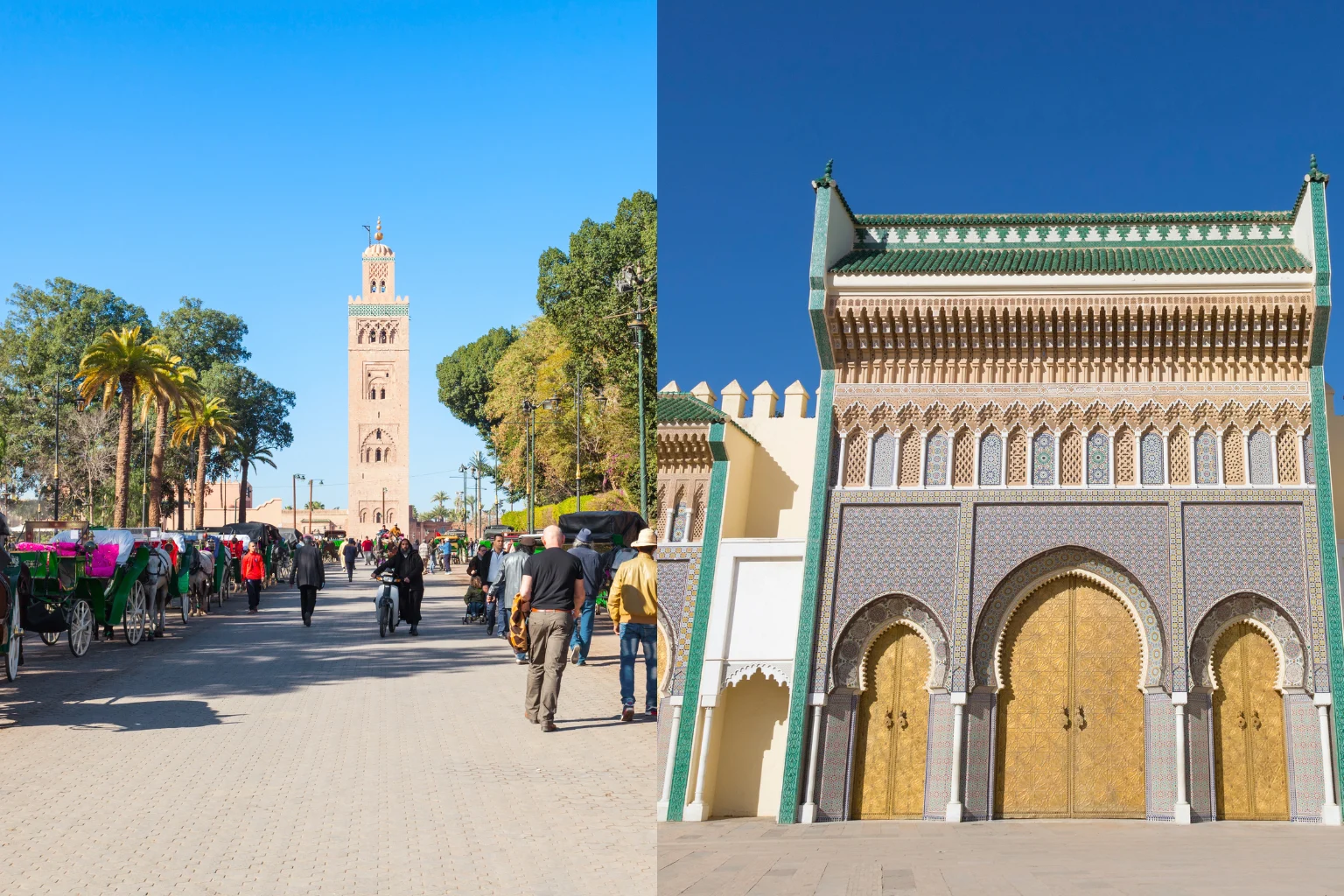
Choosing between Marrakech and Fes for a first trip to Morocco is one of the questions we hear most often at our office in the Marrakech medina. Both cities are imperial capitals, both have medinas inscribed on the UNESCO World Heritage list since 1981, and both will change the way you think about Moroccan culture — but they go about it in completely different ways. Marrakech moves fast, hums with theatre, and gives you the photogenic Morocco of magazine covers. Fes is older, quieter, more inward-looking, and rewards the patient traveler with what is arguably the best-preserved medieval city in the Arab world.
This guide compares the two cities the way a Moroccan would — not as a list of attractions, but as the real question: what kind of trip do you actually want to take? We cover the founding history, the on-the-ground atmosphere, the food, the climate, 2026 costs, and the practical logistics of pairing them on a single itinerary. By the end you’ll know which one to start with — and whether the second is worth the detour.
The short answer: Marrakech or Fes at a glance
If you only have three minutes: start with Marrakech if it’s your first time in Morocco, if you want direct flights from Paris, London, Lyon, Marseille, or Brussels, if you’re traveling with children or hesitant companions, or if you plan to extend toward the Sahara or the High Atlas. Commencez par Fès if you already know Morocco, if you care deeply about Islamic art and craftsmanship, if you want a quieter and more authentic medina, or if you’re a serious foodie. The two cities are 385 kilometers apart and roughly 6.5 to 7 hours by direct train, so doing both on a single trip is very doable — and for most first-time travelers, it’s the combination we recommend.
L'histoire fondatrice : 200 ans d'écart qui expliquent tout
Pour comprendre pourquoi Marrakech et Fès dégagent une énergie si différente, commencez par leurs dates de naissance. Fès a été fondée en 789 par la dynastie idrisside et a servi de première véritable capitale du royaume. Elle a connu son âge d'or aux XIIIᵉ et XIVᵉ siècles sous les sultans mérinides, lorsqu'elle a remplacé Marrakech comme siège du pouvoir et est devenue l'une des grandes capitales intellectuelles du monde musulman.
Marrakech est la cadette — fondée vers 1070 par le chef almoravide Youssef ibn Tachfin et son cousin Abou Bakr ibn Omar comme poste de commandement méridional d'un empire qui s'étendrait du Sénégal à l'Espagne. La ville a été pensée dès le premier jour comme un lieu de pouvoir, de jardins et de commerce, pas de savoir. Cette différence se sent encore. Fès pense. Marrakech se montre.
Both medinas have been UNESCO World Heritage Sites since 1981, but for different reasons. The Medina of Fes is recognized as one of the most extensive and best-conserved historique Arab-Muslim cities anywhere in the world. The médina of Marrakech is celebrated as a major political, economic, and cultural capital of the Muslim west — the public-facing side of Moroccan civilization.
Marrakech or Fes: the comparison table
| Facteur | Marrakech | Fès |
|---|---|---|
| Fondation | vers 1070 (Almoravides) | 789 (Idrissides) |
| Population (2024 census) | ~1,57 million (préfecture) | ~1,26 million |
| Taille de la médina | Large, open, scooters tolerated in places | Plus grande zone urbaine sans voiture du monde (~9 400 ruelles) |
| Attraction emblématique | Jemaa el-Fna (patrimoine oral immatériel UNESCO, 2001) | Université Al-Quaraouiyine (fondée en 859, la plus ancienne encore en activité) |
| Ambiance | Théâtrale, sensorielle, économie touristique polie | Calme, pieuse, dominée par les artisans, moins « mise en scène » |
| Aéroport international | Ménara (RAK) — 9,3 M de passagers en 2024, 7ᵉ d'Afrique | Fes–Saiss (FEZ) — Europe-only, ~126 flights/week |
| Hiver | Mild days, cool evenings, reliable sun | Cold, rainy, possible snow in the nearby Middle Atlas |
| Idéal pour | First-timers, couples, familles, combinés désert | Seconde visite, gourmets, amateurs d'histoire et d'artisanat |
Atmosphère : théâtre contre recueillement
Walking onto Jemaa el-Fnaa for the first time at sunset is the closest thing modern travel still offers to time-travel. Snake charmers, gnaoua musicians, henna artists, orange-juice sellers, storytellers — they all fill the square in a rhythm that hasn’t really changed in centuries. UNESCO recognized this open-air performance as a Masterpiece of the Oral and Intangible Heritage of Humanity in 2001 — the inaugural list — and added it to the formal Representative List in 2008. The square is loud, fast, occasionally pushy, and far and away the most photographed place in Morocco.
Fès el-Bali, c'est l'inverse. L'ancienne médina compte environ 9 400 ruelles, la plupart larges de 1,5 à 3 mètres — soit moins qu'une petite voiture, ce qui explique précisément qu'aucun véhicule motorisé n'y est jamais entré. Vous entendrez l'appel à la prière courir sur des murs en pierre plus anciens que la plupart des cathédrales européennes, le claquement du cuir battu à la tannerie Chouara, et le pas des mulets transportant des bonbonnes de gaz. Le tourisme existe à Fès, mais il n'a pas redessiné la ville comme il a redessiné Marrakech. Dans la majorité des quartiers, les habitants restent largement plus nombreux que les visiteurs.
Si Marrakech est un spectacle, Fès est une ville médiévale en activité qui accepte simplement qu'on la visite. Aucune n'est meilleure que l'autre. Elles répondent à des questions différentes.
Ce que vous y faites vraiment
In Marrakech, your top experiences are sensory and largely outdoors. You’ll wander the souks of the medina, drink mint tea on a rooftop overlooking Jemaa el-Fnaa, visit the Bahia Palace and the restored Saadian Tombs, breathe in cobalt blue at the Yves Saint Laurent–restored Jardin Majorelle, take a half-day in the High Atlas or the Agafay desert, and ride out the heat at a hammam. Two to three full days is enough for most first-time visitors. Our itinéraire de 3 jours à Marrakech walks through a balanced version of this loop.
In Fès, the experiences are quieter and more cerebral. You’ll spend hours getting deliberately lost inside Fes el-Bali, stop at the Bou Inania and Al-Attarine madrasas to study the green-tiled Marinid geometry up close, view (but not enter, as a non-Muslim) the Al-Qarawiyyin mosque-university founded in 859 by Fatima al-Fihri — recognized by UNESCO and Guinness as the world’s oldest continually operating educational institution — and look down on the colored leather pits of the Chouara Tannery from a balcony. Add a half-day excursion to Volubilis or Meknes if you have a fourth day. Our guide de voyage de Fès walks through the neighborhoods and where to actually stay.
Y aller : aéroports et train entre les deux villes
Marrakech l'emporte sur l'accessibilité. L'aéroport Ménara (RAK) a accueilli plus de 9,3 millions de passagers en 2024 et figure au 7ᵉ rang des aéroports africains les plus fréquentés. On y vole en direct depuis la plupart des capitales européennes, plusieurs hubs du Moyen-Orient et — depuis 2024 — quelques portes nord-américaines. La ligne Marrakech–Paris-Orly a transporté à elle seule 64 343 passagers sur un seul trimestre, ce qui en fait la liaison internationale la plus chargée de tous les aéroports marocains.
Fes–Saiss (FEZ) is smaller and more European. Roughly 32 airports operate direct flights to Fes, almost all of them within Europe, totaling about 126 flights per week. Ryanair, Air Arabia Maroc, and Transavia dominate the schedule. Paris-Orly, Marseille, and Paris-Beauvais are the most popular routes. If you’re flying from North America, Asia, or the Gulf, you’ll almost certainly transit through Casablanca to reach Fes.
The train between the two cities is operated by ONCF, runs 385 km, and typically goes via Casablanca or Rabat. Expect 6.5 to 7 hours for the standard route. Most travelers do this exact journey on a Marrakech-first itinerary, often with a Sahara detour in the middle. First class is comfortable and cheap by European standards — book 24 to 48 hours ahead on oncf-voyages.ma to guarantee your seat in high season (October–November, March–April, the Christmas window).
Climat : le critère qui tranche pour beaucoup de voyageurs
C'est ici que les deux villes divergent le plus nettement. Fès se situe à une altitude plus élevée, avec un climat méditerranéen qui produit de vrais hivers — moyennes de janvier autour de 15 °C en journée et 2 °C la nuit, pluies régulières et neige occasionnelle dans le Moyen Atlas voisin. L'été est rude : juillet et août montent couramment entre 35 et 40 °C, à peine tempérés par les ruelles étroites en pierre de la médina.
Marrakech is hotter and drier across the board but more predictable. Winters are pleasant for sightseeing, with days in the 18 to 22 °C (65 to 72 °F) range and crisp nights. Summers are equally brutal as Fes but feel different because the city is more open and most riads have plunge pools. If you have to pick one weather window for a first trip combining both cities, March–May and September–November are nearly perfect for both. Avoid August everywhere unless heat is genuinely no issue for you.
Cuisine et culture : là où Fès gagne en silence
Marrakech a la scène gastronomique haut de gamme — tables citées par les guides internationaux, rooftops gastronomiques, menus dégustation avec vue sur l'Atlas — et l'on mange très bien dans le Guéliz, le quartier nouvelle ville. Mais demandez à n'importe quel cuisinier marocain où se trouve la vraie cuisine, et la réponse est Fès. La ville est largement considérée comme la capitale gastronomique du Maroc. La pastilla (la fameuse tourte feuilletée au pigeon ou au poulet, saupoudrée de cannelle et de sucre) y est la plus authentique. Les tajines mijotés, la seffa, la trid, la harira pendant le Ramadan — Fès les traite comme des recettes vivantes, pas comme des accessoires touristiques.
Côté artisanat, Fès est aussi la source. Le cuir, les céramiques au célèbre bleu cobalt de Fès, le laiton, le cuivre martelé et la zellige tile cutting all originated in Fes workshops and continue there. Many Marrakech souk goods are made in Fes and shipped south. If you want to buy one serious piece on your Morocco trip, do it in Fes — and have it shipped directly, since Fes-Saiss has limited cargo options compared to Casablanca.
Coût et hébergement : presque équivalents, à une nuance près
Day-to-day prices are close. Mid-range riads run 800–1,500 MAD per night in both cities (roughly €75–€140 at 2026 dirham rates), with one exception: Marrakech has a much larger le luxe ceiling. Five-star palaces like the Royal Mansour or La Mamounia push above 8,000 MAD per night, while Fes tops out lower. Taxis, food, and souvenirs cost about the same in both cities — except artisan goods, which are cheaper at the source (Fes).
The twist is volume. Marrakech has roughly five times more riads on the major booking platforms, so prices flex more with demand. In peak season (October–November, March–April, the Christmas/NYE window), Marrakech can spike fast while Fes stays more stable. If you’re booking last-minute, Fes is the safer city for finding a good riad at a fair price.
Sécurité et voyage en solo
Both cities are statistically safe by global tourist-destination standards, but they require different street-smarts. Marrakech medina has more pickpocketing, more aggressive faux-guide attempts, and more confident scammers because tourism volume is much higher. Fes medina has fewer of those issues but is genuinely easier to get badly lost in — a real concern, not a stylistic one. Practical tip: in both cities, keep your riad’s written address on your phone, politely refuse spontaneous guides, and carry a closed bag in front of you in souk crowds.
Before you travel, read the UK Foreign, Commonwealth & Development Office’s Conseils aux voyageurs Maroc and the US State Department’s Page d'information Maroc — both are kept current and worth a five-minute read. Neither places Morocco above a Level 2 advisory (“exercise increased caution”) for tourist destinations.
Solo female travelers report feeling slightly more comfortable in Fes during the day (less catcalling, more residential medina) and slightly more comfortable in Marrakech after dark (lit streets, busier squares, visible tourist police).
Pour qui ? Choisir en fonction de votre profil
Commencez par Marrakech si vous : are visiting Morocco for the first time, want to combine the trip with the Sahara or the High Atlas, are bringing first-time travelers or hesitant companions, prefer warmer winter weather, need direct long-haul flights, or want a city that’s been polished for visitors.
Commencez par Fès si vous : vous connaissez déjà Marrakech et voulez aller plus loin, vous vous intéressez sérieusement à l’art islamique, à la calligraphie arabe ou à l’architecture médiévale, vous voulez l’expérience la plus authentique du souk expérience, are a foodie, prefer quieter evenings, or want to base yourself somewhere that hasn’t been entirely reshaped by tourism.
Faites les deux — dans cet ordre — si vous avez 7 jours ou plus : Marrakech (3 nights) → Sahara (2 nights via Aït Ben Haddou and the Dades Valley) → Fes (2 nights) → fly home from Fes. This is the classic loop, and it works because you progress from polished and easy to raw and historical, ending on the higher note.
Peut-on faire les deux sur un seul voyage ?
Oui, et c'est ce que nous recommandons à la plupart des voyageurs. Les combinaisons les plus simples :
5 jours (resserrés) : 2 nights in Marrakech + overnight train or driver to Fes + 2 nights in Fes. You’ll cut both cities short, but you’ll see both.
7 jours (recommandés) : 3 nights in Marrakech + 2 nights in the le désert + 2 nights in Fes. This is the version most of our travelers book.
10 à 14 jours (circuit complet) : Marrakech → High Atlas → Sahara → Fes → Chefchaouen → Casablanca. The 14-day version adds Essaouira on the Atlantic and gives you proper time everywhere instead of constantly moving.
Foire aux questions
Marrakech ou Fès, c'est mieux pour un premier voyage au Maroc ?
For most first-time visitors, Marrakech is the better starting point. It offers direct international flights from more cities (Paris, Lyon, Marseille, Brussels, Geneva, plus seasonal Montreal), a gentler learning curve for a first time in a Muslim-majority country, more French- and English-speaking staff, milder winter weather, and natural day-trip access to the Sahara and the Atlas. Fes is exceptional, but it rewards travelers who already have some Moroccan context.
Combien de jours faut-il dans chaque ville ?
Three days in Marrakech and two to three days in Fes is the sweet spot. Marrakech rewards a slightly longer stay because the day-trip options (Atlas, Agafay, Essaouira, Ouzoud) are excellent. Fes is more concentrated — the medina est the experience, and two full days of careful walking is usually enough unless you’re going deep on craftsmanship or adding Volubilis and Meknes.
Le train entre Marrakech et Fès vaut-il le coup, ou faut-il prendre l'avion ?
The train is worth it for most travelers. ONCF runs a direct route (with one connection at Casablanca for most schedules) covering 385 km in about 6.5 to 7 hours. First class is comfortable and cheap by European standards. There are no direct flights between Marrakech and Fes — flying means routing through Casablanca, which usually takes longer door-to-door than the train.
Fès est-elle plus sûre que Marrakech ?
Les deux villes sont sûres selon les standards mondiaux, mais les profils de risque diffèrent. Marrakech connaît davantage de petits vols et de tentatives d'arnaque parce que le volume touristique est bien supérieur. Fès en compte moins, mais on s'y perd nettement plus facilement, ce qui peut donner une impression d'insécurité même lorsque tout va bien. Les avis aux voyageurs français (Quai d'Orsay) et américain (Département d'État) classent l'ensemble du Maroc en vigilance modérée, sans alerte spécifique pour l'une ou l'autre ville.
Quelle ville est meilleure pour la cuisine ?
Fès est largement considérée comme la capitale culinaire du Maroc. La pastilla, les tajines classiques, la seffa et les plats mijotés y atteignent leur version la plus authentique. Marrakech possède une scène haut de gamme bien plus large, une présence internationale plus marquée et de meilleurs bars à cocktails dans la ville nouvelle. Si vous voulez apprendre la cuisine marocaine, faites le cours à Fès. Si vous cherchez un dîner gastronomique, réservez-le à Marrakech.
Les médinas sont-elles accessibles aux voyageurs à mobilité réduite ?
Honnêtement, ni l'une ni l'autre n'est facile. Les deux médinas comportent des pavés irréguliers, des ruelles étroites, des marches raides aux entrées des riads, et très peu d'infrastructures pour fauteuils. Marrakech est légèrement plus praticable parce que certaines sections autorisent les petits véhicules et que des riads avec rampes existent. Fès el-Bali est essentiellement impossible pour un fauteuil sans assistance significative. Les voyageurs à mobilité limitée s'installent souvent dans la Ville Nouvelle de l'une ou l'autre ville et visitent la médina par séquences courtes et accompagnées.
Vaut-il mieux visiter Marrakech ou Fès en hiver ?
Marrakech, comfortably. January highs in Marrakech average 18–20 °C (65–68 °F) with reliable sunshine, while Fes is roughly 8 to 10 degrees colder and gets meaningful rain. If you’re traveling in December, January, or February and want to stay warm, Marrakech is the clear winner. Save Fes for spring or autumn, when its medieval medina is comfortable for long walks.
En résumé
Marrakech and Fes are not competing cities — they are complementary chapters of the same story. Marrakech is the public face of Morocco: bold, sensory, photogenic, deliberately welcoming. Fes is the private face: scholarly, devout, craftsman-led, quietly proud. The travelers who fall most in love with Morocco are usually the ones who visit both.
Si vous souhaitez que le reste de votre voyage au Maroc soit organisé avec le même soin que ce guide — des riads choisis pour leur caractère, des chauffeurs qui connaissent vraiment les médinas, et un itinéraire qui respire — c'est précisément ce que nous faisons chez Moratra. Découvrez notre circuit Marrakech-et-Fès, browse our complete Fes travel guide, ou écrivez-nous simplement posez-nous une question — we’ll answer for free, no obligation, in English or French. Either way: take the train at least one direction. The view of the Middle Atlas as you climb out of Casablanca toward Fes is one of the quiet pleasures of Moroccan travel.
