
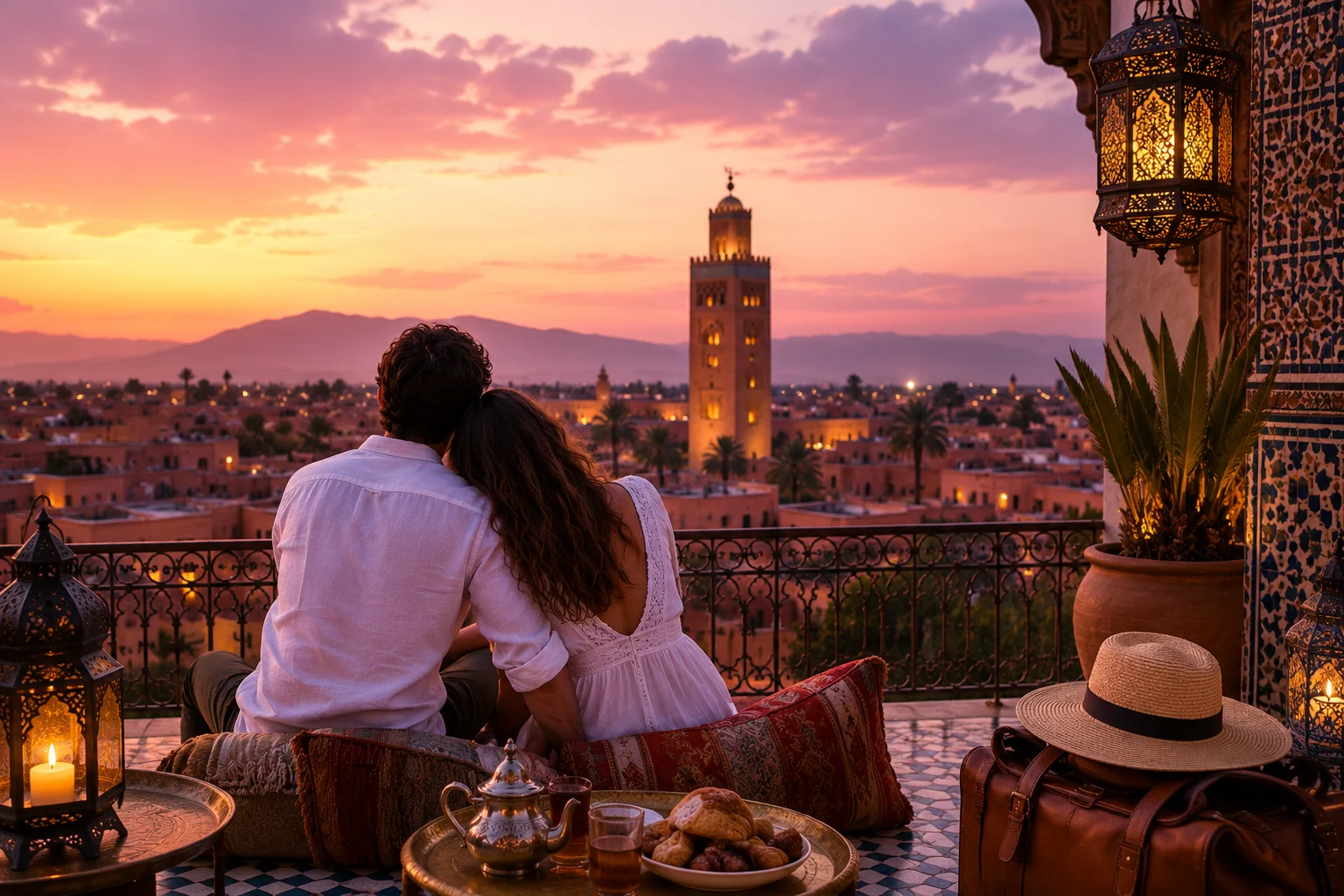
Une lune de miel au Maroc occupe une place idéale à laquelle la plupart des couples ne s’attendent pas. Vous pouvez dîner aux chandelles sur le toit d’un riad à Marrakech, faire une balade privée à dos de chameau dans le Sahara au coucher du soleil et passer quelques jours à vous détendre dans une ville côtière — le tout en un seul voyage, et pour un budget presque toujours inférieur à celui de destinations de rêve comparables comme les Maldives ou la Polynésie française. Le pays offre un vrai luxe sans vous imposer des dépenses à cinq chiffres.
La réponse honnête à la question « combien cela va-t-il coûter ? » est que tout dépend presque entièrement de trois choix : la durée de votre séjour, la catégorie de riad et de camp dans le désert que vous réservez, et le recours ou non à un chauffeur privé. Ce guide passe en revue chaque poste de dépense comme un organisateur de voyage le chiffrerait réellement, pour que vous puissiez établir un budget qui corresponde au voyage que vous voulez — et non un chiffre générique tiré d’un fil de forum.
Réponse rapide : combien coûte en général une lune de miel au Maroc en 2026
Pour une lune de miel de 7 nuits, la plupart des couples se situent dans l’une de ces trois fourchettes une fois additionnés les vols, l’hébergement, les transferts, les repas et une expérience dans le désert :
- Milieu de gamme confortable : environ 2 500 à 4 000 $ par couple – riads de charme, excursions partagées, un camp standard dans le désert.
- Milieu de gamme supérieur / luxe boutique : environ 4 500 à 7 500 $ par couple — des riads parmi les mieux notés, un chauffeur privé, un camp de luxe (et non « premium ») dans le désert.
- Grand luxe : environ 8 000 à 18 000 $ et plus par couple — La Mamounia, le Royal Mansour, les suites sous tente de l’Erg Chigaga, guides privés, chefs privés.
Ces fourchettes n’incluent pas les vols internationaux depuis l’Amérique du Nord, qui constituent la plus grande variable. Depuis l’Europe, les billets aller-retour sont souvent modestes et entrent facilement dans les montants ci-dessus.
Ce qui détermine vraiment le prix final
Huit éléments pèsent plus que tout le reste : la saison, la catégorie du riad, son emplacement (médina ou Hivernage / Palmeraie), le choix entre un camp standard ou de luxe dans le désert, le recours à un chauffeur privé ou aux trains et transferts partagés, les choix de restauration (cuisine de rue ou table raffinée sur un toit-terrasse), la fréquence des spas et hammams, et enfin les petits coûts bien réels : entrées des monuments, pourboires, taxis pour traverser la ville. Aucun n’est important en soi. Cumulés, ce sont eux qui séparent une lune de miel à 3 000 $ d’une lune de miel à 9 000 $.
Pour le réserver avec une équipe locale, découvrez notre circuit romantique de 4 jours dans le désert pour les couples.
La décision qui pèse le plus est l’étape dans le désert. Un camp standard à Merzouga n’a rien à voir avec une suite sous tente de luxe à l’Erg Chigaga, et ce seul changement peut faire varier un budget de 7 jours de 1 500 à 3 000 $.
Les vols et l’arrivée au Maroc
La plupart des jeunes mariés atterrissent à Marrakech Menara (RAK) ou Casablanca Mohammed V (CMN). Depuis la côte Est des États-Unis, comptez un itinéraire avec une escale via Paris, Madrid, Lisbonne ou Doha ; depuis la côte Ouest, prévoyez 18 à 22 heures de voyage au total. Royal Air Maroc assure des vols directs depuis New York JFK et Washington Dulles vers Casablanca, ce qui peut faire gagner plusieurs heures dans chaque sens. Depuis l’Europe de l’Ouest, des compagnies low cost comme Ryanair et easyJet relient souvent Marrakech en direct en 3 à 4 heures.
Deux remarques pratiques pour le budget des vols. D’abord, les tarifs vers RAK et CMN peuvent différer de plusieurs centaines de dollars le même jour : comparez les deux. Ensuite, si vous voulez vivre le Sahara avec un temps compté, un vol intérieur de Marrakech vers Errachidia ou Ouarzazate peut vous épargner une journée de route. Cela a un prix, mais en vaut parfois la peine pour une lune de miel de 5 nuits.
Où loger : riads, hôtels de luxe et camps dans le désert
C’est l’hébergement qui fait la réputation des lunes de miel au Maroc. Un riad est une maison traditionnelle organisée autour d’un patio et transformée en petit hôtel de charme, généralement de 5 à 12 chambres, souvent avec un bassin, une terrasse sur le toit et une attention du personnel qui n’existe tout simplement pas dans les chaînes internationales.
- Riad de charme de milieu de gamme dans la médina de Marrakech : environ 120 à 220 $ la nuit pour une chambre double avec petit-déjeuner.
- Riad de charme parmi les mieux notés (Riad Joya, Riad BE Marrakech, Karawan Riad à Fès) : environ 250 à 500 $ la nuit.
- Palaces cinq étoiles à l’Hivernage ou à la Palmeraie (Royal Mansour, La Mamounia, Selman, Amanjena) : à partir d’environ 900 $ la nuit et plus, avec des suites bien au-delà de 2 000 $.
- Camps standard dans le désert à Merzouga : environ 80 à 160 $ par personne et par nuit, dîner et balade à dos de chameau inclus.
- Camps de luxe dans le désert (Erg Chigaga Luxury Camp, Azalai Desert Lodge, Caravanserai) : environ 350 à 700 $ par personne et par nuit.
Le quartier où vous logez à Marrakech change l’expérience autant que le budget. La médina vous place au cœur battant de la ville — l’appel à la prière, les ruelles éclairées de lanternes, les marchands de pain du matin. L’Hivernage et la Palmeraie échangent cette immersion contre des piscines, du golf et des taxis plus faciles à trouver. La plupart des jeunes mariés pour qui nous organisons des voyages partagent leurs nuits : deux ou trois dans la médina, une ou deux dans une villa de la Palmeraie, puis le désert.
Repas, boissons et soins au spa
Bien manger au Maroc ne coûte pas cher. Un déjeuner de street food avec msemen, jus frais et sandwich kefta revient à 5 à 8 $ pour deux. Un dîner de milieu de gamme dans un restaurant de la médina, à table, tourne autour de 30 à 50 $ pour deux avec des cocktails sans alcool. Un menu dégustation gastronomique sur un rooftop dans des adresses comme le restaurant du Jardin Secret, Nomad, La Maison Arabe ou Pepe Nero coûte 80 à 160 $ pour deux.
L’alcool change la donne. Le Maroc est un pays à majorité musulmane, et de nombreux restaurants de la médina n’en servent pas. Là où l’alcool est disponible, attendez-vous à des prix européens, voire plus élevés. Une bouteille de rouge local correct (les gammes Volubilia et Médaillon de Meknès sont tout à fait buvables) coûte 25 à 40 $ au restaurant ; les cocktails dans les bars célèbres (Sky Bar, Le Salama, le Churchill Bar de La Mamounia) tournent autour de 14 à 22 $ le verre.
Les soins au spa comptent parmi les meilleurs rapports qualité-prix d’une lune de miel. Un hammam traditionnel — savon noir, argile ghassoul, le rituel complet de vapeur et de gommage — coûte 30 à 60 $ dans un établissement de quartier et 80 à 180 $ dans le spa d’un riad haut de gamme. Les massages en couple dans les hôtels haut de gamme coûtent 150 à 280 $. Comparé aux tarifs des spas à Bali ou aux Caraïbes, vous payez environ moitié moins pour la même heure.
Se déplacer entre les villes
Le train est le secret le mieux partagé des voyages au Maroc. Le réseau ONCF relie Casablanca, Rabat, Tanger, Fès et Marrakech avec des voitures de première classe climatisées, et la ligne Al Boraq à grande vitesse relie Tanger à Casablanca jusqu’à 320 km/h. Un Marrakech–Fès en première classe coûte environ 25 à 35 $ par personne ; un Tanger–Casablanca en Al Boraq, environ 20 à 30 $. Les couples qui font une lune de miel en plusieurs villes peuvent aller loin en train sans jamais louer de voiture.
Pour les trajets que le train ne couvre pas (Marrakech–Merzouga, Merzouga–Atlas, boucles vers Essaouira), un chauffeur privé change tout le voyage. Un chauffeur sérieux, anglophone ou francophone, avec un SUV récent et propre, coûte environ $140–$220 per day, carburant compris, et ce montant couvre généralement deux personnes, l’itinéraire de leur choix, les arrêts photo qu’elles décident et ce rythme sans hâte qu’une excursion en minibus partagé ne peut pas offrir. Pour une lune de miel, cette souplesse vaut vraiment son prix.
La nuit dans le désert : là où les lunes de miel deviennent inoubliables
S’il y a un poste où mettre un budget supplémentaire lors d’une lune de miel au Maroc, c’est le désert. Deux régions comptent : Merzouga (les dunes de l’Erg Chebbi, à l’est, plus faciles d’accès et plus aménagées) et Erg Chigaga (plus profond, plus sauvage, accessible par une piste du désert depuis M’hamid). L’Erg Chigaga est le plus isolé et le plus envoûtant des deux — moins de camps, aucun bruit de route, un ciel plus noir.
Un camp standard à Merzouga vous offre une tente avec un vrai lit, une douche chaude, un dîner rythmé par les tambours et une balade à dos de chameau au lever du soleil. Un camp de luxe comme l’Erg Chigaga Luxury Camp y ajoute une suite avec salle de bain privée, une dune privée pour le coucher du soleil, un petit-déjeuner berbère servi sur un tapis à l’aube et, si vous le demandez à l’avance, un dîner aux chandelles servi rien que pour vous. L’écart de prix est réel. Tout comme la différence entre les photos que vous rapporterez.
Trois exemples de budget pour une lune de miel de 7 jours
Le moyen le plus rapide de voir comment tout cela s’additionne est de construire trois exemples concrets. Tous les montants sont par couple, hors vols internationaux, et supposent un voyage fin mars 2026 — des tarifs typiques d’intersaison.
Exemple 1 — Milieu de gamme confortable : environ 3 200 $ par couple
- 4 nuits dans un riad de charme de la médina de Marrakech : 560 $
- 2 nuits en camp standard à Merzouga (avec transfert partagé vers le camp) : 640 $
- 1 nuit dans un riad de charme à Fès : 180 $
- Excursions partagées (journée dans l’Atlas, vallée de l’Ourika) : 180 $
- Repas et boissons pour 7 jours : 560 $
- Trains (Marrakech–Fès aller-retour) et taxis : 140 $
- Soin au spa pour deux : 180 $
- Pourboires, entrées, imprévus : 260 $
- Souvenirs et un beau dîner : 500 $
Exemple 2 — Milieu de gamme supérieur / luxe boutique : environ 6 400 $ par couple
- 4 nuits dans un riad parmi les mieux notés de Marrakech (niveau Riad Joya) : 1 400 $
- 2 nuits en camp de luxe à Merzouga ou à l’Erg Chigaga : 1 800 $
- 1 nuit dans un hôtel design à Fès : 350 $
- Chauffeur privé, 4 jours de bout en bout : 720 $
- Trains pour le reste : 80 $
- Repas (surtout milieu de gamme, deux dîners sur un rooftop) : 700 $
- Spa, hammam, massage en couple : 400 $
- Excursions et entrées : 250 $
- Pourboires et imprévus : 400 $
- Souvenirs / shopping : 300 $
Exemple 3 — Grand luxe : environ 14 600 $ par couple
- 4 nuits en suite à La Mamounia ou au Royal Mansour : 7 200 $
- 2 nuits en suite sous tente à l’Erg Chigaga Luxury Camp : 2 400 $
- 1 nuit en suite au Palais Faraj ou au Riad Fes : 700 $
- Chauffeur privé / guide privé, tout le voyage : 1 200 $
- Gastronomie et accords mets-vins : 1 200 $
- Spa et soins en couple : 600 $
- Vol privé VIP en montgolfière au lever du soleil (485 $ par personne, pour deux) : 970 $
- Pourboires, entrées, imprévus : 300 $
Les coûts cachés que la plupart des couples oublient
Quelques postes s’additionnent discrètement. Les pourboires aux chauffeurs, au personnel des riads et aux équipes des camps sont attendus et normaux — prévoyez 100 à 200 $ pour un voyage de 7 jours. Les suppléments au hammam (temps supplémentaire, enveloppement, masseuse) ne sont souvent pas inclus dans le prix affiché. Le véhicule véhicule privé pour la traversée M’hamid–Erg Chigaga est parfois facturé en plus du tarif du camp. Les ruelles de la médina de Marrakech, inscrite au patrimoine mondial de l’UNESCO, se parcourent librement, mais le palais de la Bahia, les tombeaux saadiens, le jardin Yves Saint Laurent et la médersa Ben Youssef facturent chacun une entrée de 60 à 120 dirhams par personne. Aucun de ces frais n’est cher en soi, mais ensemble ils ajoutent généralement 150 à 300 $ à une lune de miel.
Un dernier poste : une assurance voyage couvrant les activités d’aventure. De nombreux couples font du chameau, du buggy ou du quad dans le désert. Une assurance de 10 jours pour un couple incluant cette garantie coûte généralement 80 à 160 $ et en vaut largement la peine.
Où dépenser, où économiser
Si nous devions donner un seul conseil budgétaire à un couple en lune de miel, ce serait celui-ci : dépensez pour les expériences que seul le Maroc peut vous offrir, et économisez sur tout le reste. La nuit dans le désert est typiquement marocaine — c’est là qu’il faut mettre des dollars en plus. Un hammam dans le spa d’un riad haut de gamme est typiquement marocain — c’est une folie qui en vaut la peine. Un dîner aux chandelles sur un toit, avec le minaret de la Koutoubia illuminé derrière vous, est typiquement marocain — réservez-en un, sans hésiter.
Où économiser : les chaînes hôtelières internationales de l’Hivernage. Elles sont correctes, mais elles ne vous disent pas que vous êtes au Maroc. Un riad de charme, si. Même logique pour les transports — les trains de première classe sont excellents et coûtent une fraction d’un transfert en voiture sur longue distance. Et pour les repas : les plus mémorables de la plupart des lunes de miel sont les moins chers (un bol de harira sur la place Jemaa el-Fna, un jus d’orange pressé pour quelques dirhams, un thé à la menthe versé d’un mètre de haut par l’hôte d’un riad).
La saisonnalité et son effet sur le coût
Le Maroc a une vraie haute saison — environ de mi-mars à début juin, puis de mi-septembre à novembre, plus Noël et le Nouvel An. Les prix des riads et des camps augmentent de 30 à 60 % pendant ces périodes, et les meilleures chambres partent des mois à l’avance. La basse saison (de mi-juin à début septembre) est plus chaude, surtout à Marrakech et dans le désert, mais les prix baissent nettement. Les mois d’intersaison (fin janvier, début février, fin novembre) sont une option sous-estimée — beau temps dans la majeure partie du pays, moins de monde et des tarifs plus bas.
Pour choisir les dates de votre lune de miel, l’organisme officiel Office National Marocain du Tourisme publie, mois par mois, des informations sur le climat et les événements qui valent un coup d’œil avant de fixer vos dates — le ramadan, en particulier, change ce qui est ouvert le soir selon les années.
Comment obtenir un devis précis pour votre propre voyage
Les articles génériques sur le budget ne vous mènent pas très loin, car une grande partie du prix dépend des dates, de la taille du groupe, du choix exact du riad et de la région désertique choisie. Le moyen le plus rapide d’obtenir un vrai chiffre est de nous donner l’essentiel — votre période de voyage, le nombre de nuits, les villes qui comptent pour vous, votre préférence de camp (standard ou luxe) et si vous voulez un chauffeur privé. À partir de là, un devis d’une page prend environ une journée.
Pour plus d’options, parcourez tous nos circuits au Maroc.
Questions fréquentes
Le Maroc est-il une bonne destination de lune de miel ?
Oui — surtout pour les couples qui veulent un mélange de romantisme, de culture et d’aventure plutôt que de simples journées à la plage. L’association de l’architecture des riads, des nuits au Sahara, des paysages de montagne et d’une excellente cuisine est difficile à égaler ailleurs à ce niveau de prix. Les couples qui ont aussi fait Bali, Santorin ou les Maldives disent souvent que le Maroc leur a semblé plus riche et moins standardisé, car le pays n’est pas construit d’abord autour du tourisme comme certaines îles de lune de miel.
Quel budget prévoir pour une lune de miel de 10 jours au Maroc ?
Pour 10 nuits, prévoyez environ 3 800 à 5 500 $ par couple en milieu de gamme confortable, 6 500 à 10 500 $ en milieu de gamme supérieur / luxe boutique, et 14 000 à 25 000 $ et plus en grand luxe. Les vols internationaux sont en sus. Un voyage de 10 jours permet d’ajouter Essaouira (côte atlantique) ou Chefchaouen (la ville bleue) sans se presser.
Quelle est la période la moins chère pour une lune de miel au Maroc ?
De mi-juin à début septembre, c’est la période la moins chère pour les riads, mais les températures en journée à Marrakech et au Sahara atteignent couramment 38 à 45 °C, ce que la plupart des couples trouvent trop chaud pour visiter confortablement. Les meilleures périodes en rapport qualité-prix sont fin janvier et début février — temps agréable dans la majeure partie du pays, tarifs des riads nettement plus bas et presque personne sur les grands sites.
Un chauffeur privé vaut-il son prix pour une lune de miel ?
Pour la plupart des couples en lune de miel, oui. Un chauffeur vous évite de devoir déchiffrer les routes rurales, vous laisse vous arrêter pour photographier quand vous le souhaitez (points de vue de l’Atlas, kasbahs, pause thé dans un village) et protège votre temps de voyage. Il vous permet aussi de faire le trajet Marrakech–Sahara en deux jours à un rythme détendu au lieu d’une seule journée épuisante. À 140 à 220 $ par jour pour le véhicule, cette souplesse se rentabilise généralement en stress évité.
Quelle est LA folie qui vaut vraiment la peine lors d’une lune de miel au Maroc ?
Une nuit dans un camp de luxe à l’Erg Chigaga. Tente suite privée, dîner aux chandelles servi sur une dune, balade à dos de chameau au lever du soleil et un ciel sans pollution lumineuse sur des centaines de kilomètres. Les couples citent presque tous ce moment comme celui dont ils se souviendront dans vingt ans.
Faut-il passer par un voyagiste, ou peut-on organiser sa lune de miel soi-même ?
Vous pouvez tout à fait organiser vous-mêmes Marrakech et même la plupart des villes desservies par le train. Là où un organisateur justifie ses honoraires pour une lune de miel, c’est dans la chaîne logistique : choisir des riads adaptés à vos goûts, enchaîner l’étape du désert sans journées de route perdues, sélectionner les chauffeurs et gérer les petites choses peu glamour — horaires riad–aéroport, pauses déjeuner sur les longs trajets, régimes alimentaires dans les camps du désert — qui déterminent discrètement si le voyage paraît sans effort.
Si vous souhaitez que le reste de votre lune de miel au Maroc soit organisé avec le même soin que cet article — des sélections de riads adaptées à vos goûts, un chauffeur privé choisi personnellement et une étape dans le désert à la hauteur des photos —, c’est notre métier. Découvrez notre circuit romantique de luxe de 4 jours Marrakech–Merzouga dans le désert, demandez un devis, ou écrivez-nous simplement posez-nous une question — nous vous répondons gratuitement, sans engagement. Pour une vue d’ensemble, l’article complémentaire est notre guide de la lune de miel au Maroc, et notre catalogue de circuits de luxe au Maroc présente les itinéraires plus longs. Quoi que vous décidiez : prenez le temps dans le désert, tenez-vous la main un peu plus longtemps et laissez le pays vous ralentir un peu. C’est tout l’intérêt.
