
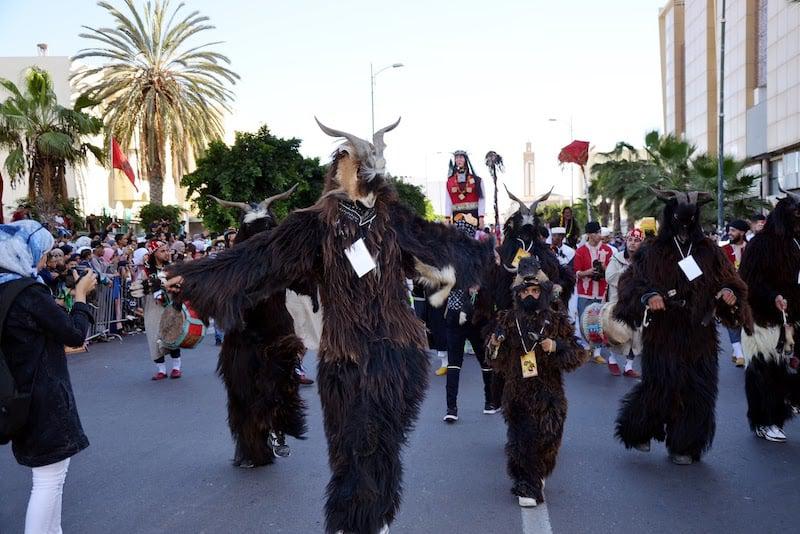
Morocco doesn’t just have festivals — it lives by them. From the Amazigh new year that opens January in the Atlas Mountains to the international film stars walking the red carpet in Marrakech each November, the country’s calendar is a year-long mosaic of music, harvests, religion, cinema, and Berber tradition. If you’re wondering when to time your trip to coincide with something genuinely unforgettable, this 2026 guide is for you.
Below you’ll find a month-by-month breakdown of the festivals worth planning a journey around — confirmed dates where available, plus the cultural context to help you choose what suits your style. We’ve also flagged the religious holidays whose timing shapes daily life across Morocco.
Why Morocco’s festival calendar is unlike any other
Morocco’s events fall into three rhythms that overlap throughout the year. Religious holidays follow the Islamic lunar calendar, so Ramadan and the two Eids shift earlier by about 11 days each Gregorian year. Agricultural moussems (seasonal pilgrimage-fairs) move with the harvest — almonds in February, roses in May, dates in October. And cultural festivals, often anchored to fixed weeks in late spring and early summer, draw international audiences for sacred music, world music, and cinema.
The result is a year in which there’s almost always something happening somewhere — but knowing which festival to centre your trip around makes all the difference.
January: Yennayer, the Amazigh New Year
Morocco kicks off the year with one of its oldest celebrations. Yennayer, the Amazigh (Berber) New Year, marks the beginning of year 2976 in the agricultural calendar and is celebrated on 13 January 2026. Since 2023 it has been an officially recognised national public holiday, reflecting the constitutional recognition of Tamazight as an official language since 2011.
When you are ready to plan, browse all our multi-day Morocco tours.
Families gather around shared dishes such as tagoula (a barley porridge) and orkimen (a slow-cooked grain and legume stew). In the Souss, Rif, and High Atlas regions, you’ll find village dances, traditional Ahidous performances, and homes opened to neighbours. It’s a quieter, more intimate festival than the summer giants — but for travellers interested in Berber culture, it’s one of the most authentic windows into Morocco’s pre-Arab heritage.
February: Almond Blossom Festival, Tafraoute
In the Anti-Atlas, the small town of Tafraoute stages Morocco’s most photogenic agricultural festival. The Almond Blossom Festival typically falls in the second week of February, when Morocco’s largest almond-producing region erupts in white and pink blossom against the granite hills.
Expect three days of Ahwash dance circles, Amazigh poetry, craft markets, and tastings of amlou — the addictive almond-argan-honey paste that’s a southern Moroccan breakfast staple. Because the festival aligns with the bloom, exact dates are confirmed only weeks in advance. If you’re booking ahead, plan for mid-February and stay flexible.
March: Eid al-Fitr and the end of Ramadan
Ramadan in 2026 begins around 17 February and ends with Eid al-Fitr on 20 March 2026. While Ramadan itself isn’t a festival, it transforms the country: daytime cities slow down, then erupt at sunset for iftar, with families breaking the fast over harira soup, dates, and chebakia pastries. Tourists are welcome — and tourist restaurants and hotels stay open as normal — but visiting during Ramadan rewards travellers who lean into the rhythm rather than fight it.
Eid al-Fitr itself is a two-day public holiday of new clothes, family visits, and sweet pastries. Many shops close for the first day; reopen the second.
May: Rose Festival of Kelaat M’Gouna
Few festivals capture Morocco’s sensory magic quite like the Rose Festival in Kelaat M’Gouna, deep in the Dades Valley. The 2026 edition runs roughly 6–9 May, with the 61st International Perfume Rose Exhibition immediately after (7–10 May).
The valley produces several thousand tonnes of Damask rose petals each spring, distilled into rose water and essential oil shipped worldwide. During the festival, the town fills with parades of rose-petal-showered floats, traditional music, the crowning of the Rose Queen, and souks selling everything from rose soaps to organic cosmetics. Kelaat M’Gouna sits at around 1,450 m elevation, about 330 km east of Marrakech — perfectly placed as a stop on a desert circuit.
Practical tip: book accommodation two to three months ahead. The town fills entirely.
Late May: Eid al-Adha
Eid al-Adha falls on 27 May 2026, the most important religious holiday of the Islamic year. Most businesses close for two to three days, transport is heavily booked in the days before, and the country shifts into a quiet, family-centred mode. If you’re travelling in late May, plan logistics carefully — but the period either side is otherwise an excellent time to visit.
June: Morocco’s music month
June is the busiest month on the cultural calendar. Three world-class festivals overlap, and choosing between them often shapes an entire trip.
Fes Festival of World Sacred Music (4–7 June 2026)
Founded in 1994, the Fes Festival of World Sacred Music is one of UNESCO-listed Fes’s flagship cultural events. The 29th edition runs 4–7 June 2026 under the theme “Fez and the Mâalemines, guardians of crafts tradition and heritage.” Performances range from Sufi chants and Gregorian choirs to Indian classical music, set against the backdrop of Bab Al Makina and intimate medina venues. It’s a more contemplative festival, drawing audiences who care about acoustics and atmosphere.
Mawazine — Rhythms of the World (19–27 June 2026)
Rabat’s Mawazine Festival is the giant: a nine-day, multi-stage event drawing several million visitors with a mix of global pop stars, African legends, and Arab music heavyweights. The 21st edition runs 19–27 June 2026, with most concerts free at outdoor stages along the Bouregreg river and on the OLM Souissi grounds. If you want the biggest production values and crowds, this is the one.
Gnaoua World Music Festival, Essaouira (25–27 June 2026)
And then there’s Gnaoua — the festival many travellers consider Morocco’s most magical. Set in the windswept blue-and-white port of Essaouira, the 27th edition runs 25–27 June 2026. Gnaoua music, with its hypnotic krakeb rhythms and trance traditions, was added to the UNESCO Representative List of the Intangible Cultural Heritage of Humanity in 2019. The festival blends master Gnaoua musicians with global jazz, blues, and African artists in fusion sets that often run until dawn. Most stages are free.
For travellers torn between the three, our team often recommends pairing Gnaoua weekend in Essaouira with the days before in Marrakech — a natural rhythm that mixes city, coast, and music.
July: National Festival of Popular Arts, Marrakech
Marrakech’s National Festival of Popular Arts celebrates its 54th edition from 4–8 July 2026, themed “Eternal Rhythms and Symbols.” More than 600 artists perform across Jemaa el-Fnaa, the El Badi Palace ruins, and outdoor squares — Ahwash dance from the Atlas, Aïta from the plains, Gnaoua, Aïssawa, equestrian Tbourida shows, and folk troupes from every region. It’s the single best place to see Morocco’s intangible folk heritage gathered in one city.
July 30 is also Throne Day, a national holiday marking King Mohammed VI’s accession in 1999. Expect official ceremonies, military parades, and evening fireworks in Rabat and Casablanca.
August: Asilah Arts Festival and the coastal moussems
August sees Morocco move to the coast. The whitewashed northern town of Asilah hosts its long-running International Cultural Festival, with mural painting, poetry readings, and concerts spilling into the medina’s painted alleyways. Further south, the Moussem of Moulay Abdellah near El Jadida draws horseback Tbourida riders in one of Morocco’s largest equestrian gatherings.
September: Imilchil Marriage Festival
High in the Middle Atlas, the village of Imilchil hosts a moussem that has captured travellers’ imaginations for generations. Held around 18–21 September 2026, the festival is rooted in Aït Hdiddou Berber tradition and remains an annual gathering for engagements, livestock trade, and community celebration. While the romantic “marriage market” framing is partly mythologised by tourism, the festival itself — with its silver jewellery, striped capes, and evening Ahidous dancing — is one of the most visually striking events in Morocco.
October: Erfoud Date Festival
Just before the desert temperatures soften, the oasis town of Erfoud celebrates its annual International Date Festival, typically held in early October. The Tafilalt region produces over a million date palms, and the three-day celebration crowns a Date Queen, hosts exhibition pavilions from oasis cooperatives across southern Morocco, and serves traditional dishes flavoured with the region’s prized mejhoul and boufeggous dates. It’s a smaller, more local-feeling festival — and an ideal pairing with a Sahara itinerary.
November: Independence Day and Marrakech Film Festival
Independence Day on 18 November commemorates Morocco’s independence from French colonial rule in 1956 and is a national public holiday.
Just two days later, the red carpet rolls out for the Marrakech International Film Festival, whose 23rd edition runs 20–28 November 2026. Founded in 2001 under the patronage of King Mohammed VI, it has become one of North Africa’s most prestigious cinema events. Public screenings on Jemaa el-Fnaa make it accessible even if you don’t have official accreditation — bring a cushion and join the crowd under the stars.
How to plan around a festival
A few practical principles, learned from years of routing trips around Morocco’s calendar:
- Book accommodation early. Festival weeks fill rooms across entire towns — Essaouira in late June, Kelaat M’Gouna in early May, Marrakech in late November. Three months out is sensible; six is safer.
- Build in buffer days. Festivals are exhausting. Plan a quiet day on either side — an Atlas day-trip, a hammam, a slow afternoon in a riad courtyard.
- Religious holidays shift. Eid dates depend on moon-sighting and may shift by a day. Confirm closer to travel.
- Pair festivals with regions, not just cities. A Rose Festival visit is far richer if you’re already on a Dades-Sahara loop. Gnaoua works beautifully as the closing chapter of a Marrakech-Essaouira week.
FAQ
What is Morocco’s biggest music festival in 2026?
By scale, it’s Mawazine in Rabat (19–27 June 2026), drawing several million attendees across multiple stages. By cultural prestige and atmosphere, many travellers prefer the Gnaoua World Music Festival in Essaouira (25–27 June 2026).
When is the Rose Festival in Morocco 2026?
The Kelaat M’Gouna Rose Festival is scheduled for approximately 6–9 May 2026, with the 61st International Perfume Rose Exhibition running 7–10 May. Exact dates are confirmed close to the event because they align with the rose harvest.
Is it OK for tourists to visit Morocco during Ramadan?
Yes. Ramadan in 2026 runs roughly 17 February to 19 March, and tourist restaurants, hotels, and tours operate normally. The atmosphere becomes quieter by day and lively after sunset. Be discreet about eating, drinking, and smoking in public out of respect.
What festival should I plan a honeymoon around?
The Gnaoua Festival in Essaouira works wonderfully — small, romantic, with seafood dinners on the ramparts and free concerts under the stars. The Rose Festival in May, paired with a desert camp, is also a beautiful choice.
Are festival events free or ticketed?
It varies. Mawazine and Gnaoua have many free outdoor stages plus some ticketed VIP shows. Fes Sacred Music is largely ticketed. The Rose, Almond Blossom, and Date festivals are free public events. The Marrakech Film Festival has free public screenings on Jemaa el-Fnaa alongside accredited industry events.
Can I combine multiple festivals in one trip?
June is the obvious window — Fes Sacred Music, Mawazine, and Gnaoua all fall within roughly three weeks, and a thoughtfully designed itinerary can include two of the three (Gnaoua plus either Mawazine or Fes) without feeling rushed.
Plan your festival trip with Moratra
Festivals are some of the most rewarding — and most logistically tricky — moments to visit Morocco. Hotels book out, transport tightens, and the right combination of festival days and rest days makes the difference between an unforgettable trip and an overwhelming one.
If you’d like help building an itinerary around any of these events, the Moratra team offers free, no-obligation planning advice. We’re locals — we know which Gnaoua afterparty is worth staying up for, which Atlas village hosts the most authentic Yennayer celebration, and which Rose Festival hotel still has rooms when everyone else is booked. Reach out here and tell us which festival is calling — we’ll handle the rest.
Also useful: our guides to the best time to visit Morocco and visiting Morocco during Ramadan.
