
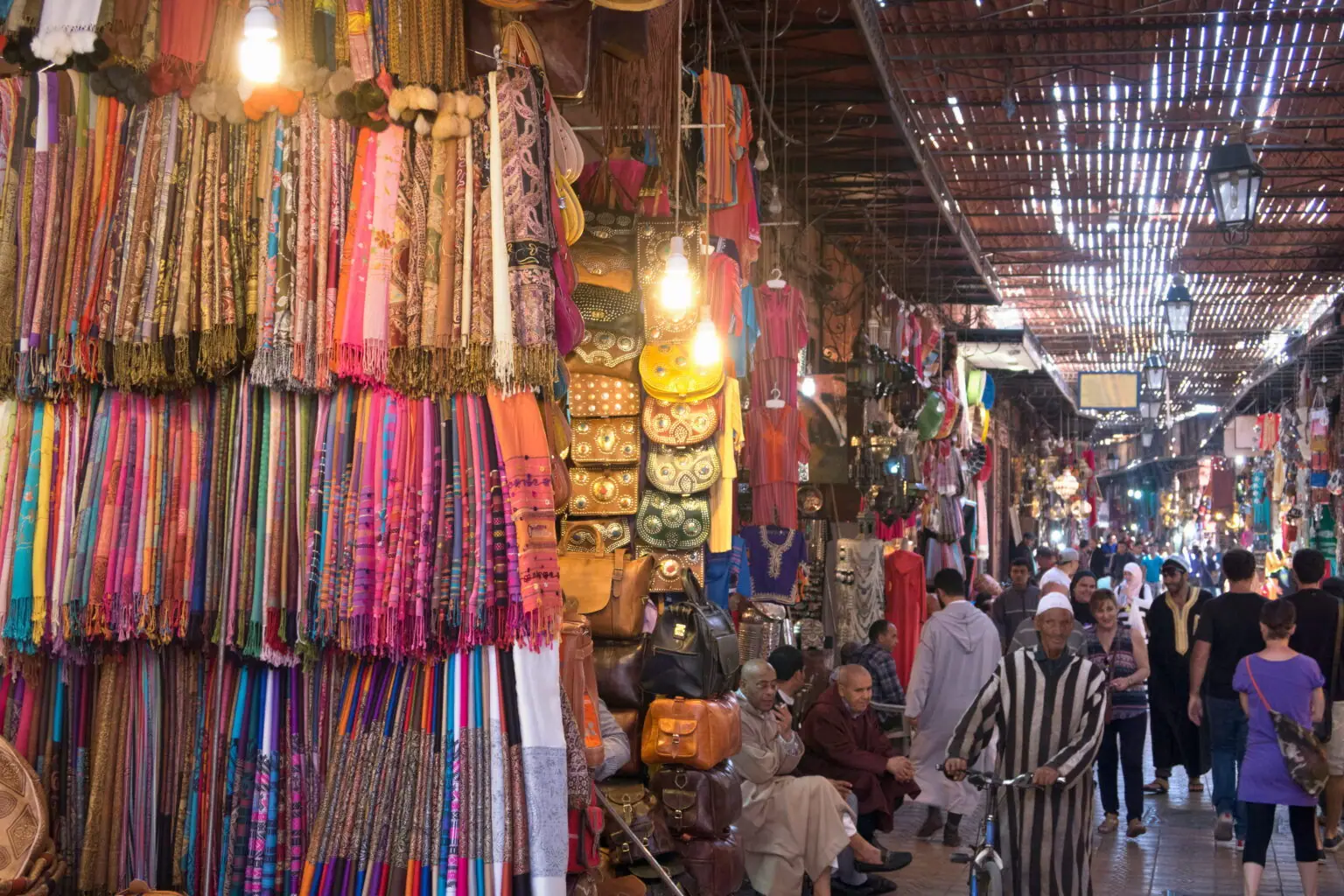
The first time you slip from the sunlight of Jemaa el-Fnaa into the shaded labyrinth of the Marrakech souks, something shifts. The air thickens with cumin and cedar, leather and orange blossom. A coppersmith’s hammer rings out two alleys away. A merchant unfurls a Berber rug in one practiced motion and meets your eye. Welcome to one of the world’s oldest living marketplaces — and one of the most rewarding shopping experiences you’ll ever have, if you know how to navigate it.
This guide is everything we wish first-time visitors knew before stepping into the medina: which souks specialise in what, what’s actually worth buying, how to haggle without offending anyone (or overpaying), how to spot quality from kitsch, and how to ship a five-foot lantern home without losing your mind.
How the Marrakech Souks Are Organised
The souks of Marrakech form a dense network of covered alleys north of Jemaa el-Fnaa, the medina’s main square. They’ve grown organically since the 11th century, when Marrakech was founded by the Almoravid dynasty and quickly became a major caravan crossroads between sub-Saharan Africa and the Mediterranean.
What’s unusual about Moroccan souks — and what makes Marrakech’s particularly fascinating — is that they’re organised by craft, not by retailer. The historic guild system grouped artisans of the same trade into the same alley, and that pattern still holds today. Walk through one section and every shop sells leather. Turn a corner and suddenly everything is brass. Another turn and you’re surrounded by spices in conical mountains.
This makes navigation easier than it looks. If you know what you want, you know roughly where to go. If you’re just wandering, follow your nose: the smell tells you what’s nearby long before the sign does.
The Main Souks: A Craft-by-Craft Map
Souk Semmarine — The Main Artery
This is the wide, covered street that funnels you in from Jemaa el-Fnaa. It’s the most touristed section of the medina and the most varied, with textiles, kaftans, slippers, lanterns, and souvenir stalls all competing for attention. Prices here are usually higher than deeper inside the medina, so consider Semmarine your orientation lap rather than your shopping destination.
To book this with a local team, see our guided medina and souks walking tour.
Souk el-Attarine — Spices and Perfumes
Walk a little further and the air changes. Souk el-Attarine is the spice and perfume souk, where pyramids of saffron, cumin, paprika, ras el-hanout, and dried rosebuds line the alley. You’ll also find natural perfumes, soaps, kohl, henna, and small vials of essential oils. Smell everything before you buy — quality varies wildly.
Souk Cherratine — Leather
For bags, belts, jackets, poufs, and traditional babouche slippers, head to Souk Cherratine. The leather here is tanned in nearby Bab Debbagh, and many shops are run by makers rather than middlemen. This is also a fairer-priced area than the leather stalls closer to Jemaa el-Fnaa.
Souk Haddadine — Metalwork
The blacksmiths’ souk. You’ll hear it before you see it: rhythmic hammering, sparks flying, men shaping iron and brass into lanterns, trays, teapots, and door knockers. This is one of the most photogenic working corners of the medina.
Souk Chouari — Woodwork
Carpenters and woodworkers cluster here, carving cedar boxes, stools, mirror frames, and inlaid thuya wood pieces from Essaouira. The smell alone is worth the visit.
Souk Zrabia (La Criée Berbère) — Carpets and Rugs
This small square deeper in the medina is the historic carpet auction area and now hosts dozens of rug shops. Berber rugs from the Atlas Mountains, kilims, and antique tribal pieces are sold here. Bring time, patience, and mint tea-drinking endurance.
The Mellah and Souk des Bijoutiers — Jewellery
The old Jewish quarter (Mellah), south of the main souks, is the traditional jewellery district. Silver Amazigh (Berber) pieces — chunky bracelets, fibula brooches, layered necklaces — are the speciality. The craftsmanship and price-to-quality ratio here are usually excellent.
What to Buy in Marrakech (and What to Skip)
Leather Goods
Bags, poufs, jackets, belts, and slippers. Real Moroccan leather has a distinct earthy, slightly tangy smell — not chemical, not perfumed. Inspect the stitching, check that the lining is properly attached, and gently flex the leather to see how it creases. If it cracks or feels plasticky, walk away.
Berber Rugs and Textiles
A real handmade Berber rug is one of the most meaningful things you can bring home from Morocco. Look at the back: a hand-knotted rug shows individual knots and slight irregularities, while a machine-made rug looks uniformly perfect. Ask about the wool source and the region (Beni Ourain, Boucherouite, Azilal, Taznakht — each has a distinct style). Expect to spend serious time and several rounds of mint tea on a real rug purchase.
Ceramics and Zellige
Tagines, bowls, plates, and small zellige tile pieces. Safi pottery is the most respected, and you’ll find pieces marked accordingly. Be honest with yourself about what’s a souvenir and what’s a serving piece — the most decorative tagines are not always food-safe.
Spices and Argan Oil
Saffron, ras el-hanout, preserved lemons, and Moroccan tea blends are wonderful gifts. Argan oil deserves special care: real cosmetic argan oil is pale gold to amber, lightly cloudy, and has a soft nutty smell — never perfumed. Pure culinary argan oil is darker and tastes nutty with a slight bitterness. It comes from southern Morocco around Agadir and Essaouira (the only place argan trees grow). Buy it in dark glass bottles, ideally from a women’s cooperative or a shop that lets you smell, taste, and ask questions.
Lanterns and Lighting
Pierced metal lanterns cast extraordinary shadows, but they’re bulky. Consider whether you can carry it home or whether you’d rather have it shipped (more on that below).
Silver Amazigh Jewellery
Real Moroccan silver is usually stamped with a small hallmark. Heavier pieces with visible handwork are the safer bet. Gemstones in tourist-area jewellery are often glass or resin — assume so unless you have reason to think otherwise.
What to Skip
Mass-produced “Aladdin lamps,” polyester scarves marketed as cashmere, “saffron” sold by the cup at suspiciously low prices (real saffron is one of the world’s most expensive spices for a reason), and anything claiming to be ivory, ancient amber, or rare animal parts. The latter is often illegal to bring home anyway.
Haggling Like a Local: A Practical Masterclass
Bargaining in Morocco is not a battle. It’s closer to a conversation, a small piece of theatre that both sides understand and, in their own way, enjoy. Refusing to haggle isn’t polite — it’s actually a missed opportunity to engage with the culture. Here’s how to do it well.
Step 1: Calibrate Your Sense of Price
Before negotiating in the souks, visit Ensemble Artisanal on Avenue Mohammed V, a government-supported craft centre with fixed prices. Walking through it for thirty minutes gives you a baseline for what good-quality leather, pottery, or rugs actually cost. You’ll haggle far better afterwards.
Step 2: Open with Respect
Greet the seller. Salam alaykum or bonjour is enough. Smile. Take a moment. Many shopkeepers will offer mint tea on bigger purchases — if you have time, accept. Tea is part of the deal, not separate from it.
Step 3: Start Low, but Reasonably
A common rule of thumb is to offer between 25% and 40% of the asking price as your first counter, and aim to settle somewhere in the middle. For everyday items, opening at a third and meeting around half is standard. For rugs and antiques, the negotiation stretches longer and the percentages are more variable.
Step 4: Know Your Walk-Away Number
Decide privately what the item is worth to you before you start negotiating, and don’t go above it. The vendor often only realises you’re serious when you genuinely begin to leave — and that’s frequently when the best price appears.
Step 5: Bundle and Pay in Cash
Buying multiple items together opens up real discounts. Cash also gives you leverage: most vendors prefer it to card and will trim the price accordingly.
Step 6: Stay Kind
You’re not trying to “win.” A good negotiation ends with both sides satisfied. Don’t haggle hard on tiny items like a single spice tin — the difference is small for you and meaningful for the vendor. And critically: never start haggling on something you don’t intend to buy. The vendor’s time is their livelihood.
Quality Checks Before You Pay
- Leather: earthy smell, no plastic feel, neat stitching, lining attached evenly.
- Rugs: look at the back for individual knots; ask the region and material; real wool warms quickly in the hand.
- Argan oil: dark glass bottle, pale gold to amber, light nutty smell, ingredient list says only Argania Spinosa Kernel Oil.
- Saffron: red threads with slightly orange tips; soak one in warm water — real saffron releases colour slowly, fakes bleed instantly.
- Silver: look for hallmarks; weight matters; ask whether stones are natural or imitation.
- Ceramics: check for hairline cracks; tap gently — quality pieces ring rather than thud.
Beyond the Souks: Modern Shopping in Marrakech
Not everyone wants to negotiate every purchase. Marrakech has a thriving modern shopping scene that complements the souks beautifully.
Gueliz, the new town, is home to concept stores like 33 Rue Majorelle, Max & Jan, and Soufiane Zarib’s gallery, all stocking curated Moroccan design at fair-but-fixed prices. Sidi Ghanem, the design district on the city’s edge, is where local designers have their workshops and showrooms — perfect if you’re after contemporary pieces with Moroccan soul. Ensemble Artisanal, mentioned earlier, is a calmer, fixed-price option for travellers who’d rather not haggle but still want quality crafts.
Many women’s cooperatives outside Marrakech, particularly around the Ourika Valley and on the road to Essaouira, sell argan oil, soaps, and textiles directly. The prices are honest, the products are pure, and the proceeds genuinely support local women.
Shipping Your Purchases Home
That four-foot brass lantern? That two-metre Berber rug? You don’t have to wedge them into your suitcase. Most established shops in the medina arrange international shipping via DHL, FedEx, or local freight forwarders. Confirm a few things in writing before you pay:
- Total cost including customs paperwork
- Estimated delivery window (usually 7–21 days for express; longer for sea freight on larger items)
- Tracking number and a clear contact person
- Insurance for higher-value items
Pay with a credit card where possible for shipping — it gives you recourse if something goes wrong. Keep all receipts and photographs of the packed item.
A Few Insider Tips
- Go in the morning. The souks are calmer, the light is gentler, and merchants often believe a first sale of the day brings luck — they may negotiate more keenly.
- Wear comfortable shoes. The medina’s stone floors are uneven and you’ll walk further than you think.
- Carry small bills. “I don’t have change” is a real obstacle for closing the deal you just agreed.
- Ask before photographing people or shops. Many sellers are happy; some aren’t. Respect the answer.
- Save your map’s pin location for Jemaa el-Fnaa. Even with a great sense of direction, the medina will turn you around.
Souks Without the Stress: Shopping with a Local Guide
If the idea of being “shown the way” through the souks by someone who actually knows the artisans appeals to you, a guided medina shopping walk can transform the experience. A good local guide knows which workshops are family-run versus middlemen, what fair prices look like that morning, and how to translate not just words but cultural cues. You’ll come home with better pieces and richer stories.
This is exactly the kind of itinerary Moratra helps travellers design — a medina walking tour paired with a curated Marrakech itinerary, plus space for the open-ended wandering that makes the souks magical in the first place. You might also enjoy our Moroccan food guide and our 3-day Marrakech itinerary as you plan. If you’d like a hand putting it all together, our team offers free, no-obligation advice on shopping, neighbourhoods, and timing.
For more options, browse all our activities in Marrakech.
FAQ: Marrakech Souks Shopping
How much should I haggle in the Marrakech souks?
A reasonable starting offer is 25–40% of the asking price, and most negotiations settle somewhere between half and two-thirds of the original price. The exact number depends on the item, the souk, and the time of day. Calibrate your expectations by visiting the fixed-price Ensemble Artisanal first.
Are the Marrakech souks safe for tourists?
Yes. The medina is generally safe during the day, with regular foot traffic and visible police presence. The most common issues are getting lost, unofficial “guides” steering you to specific shops for commission, and occasional pickpocketing in crowded spots. Keep valuables zipped away and politely decline unsolicited guidance.
What’s the best time to visit the souks?
Mid-morning (around 10:00–12:00) is ideal: the alleys are open and lively but not yet crowded, the light is beautiful, and many vendors are at their freshest and most willing to negotiate. Avoid the post-lunch heat in summer and the very last hours before closing, when energy fades.
Can I pay by card in the souks?
Some larger shops accept cards, but most smaller stalls are cash-only — and cash gives you a real haggling advantage. ATMs are easy to find around Jemaa el-Fnaa and along Rue Bab Agnaou. Bring a mix of small and medium notes.
What is genuine argan oil and how can I tell?
Authentic Moroccan argan oil comes only from southern Morocco around Agadir and Essaouira. Cosmetic argan oil is pale gold to amber, slightly cloudy, with a soft nutty scent. The label should list only Argania Spinosa Kernel Oil as ingredient. Buying from a women’s cooperative or a reputable shop (rather than a generic souvenir stall) is the safest route.
Should I hire a guide for shopping in the medina?
It’s not strictly necessary, but a knowledgeable guide saves time, helps you avoid tourist-only shops, and often pays for themselves through fairer prices. Make sure you book through a reputable local agency — official guides carry a numbered badge — rather than accepting offers from people approaching you in the street.
Plan Your Marrakech Trip with Moratra
Shopping in Marrakech is one of those experiences that rewards a little preparation. If you’d like a personalised itinerary that includes the souks, artisan workshops, the right neighbourhoods to stay in, and the small pleasures that don’t make it into most guidebooks, the Moratra team is here to help. Reach out for free, friendly advice — no pressure, just real local insight from people who love this city and want yours to be the best trip possible.
Prefer to make a craft rather than just buy one? Our guide to artisan workshops in Marrakech covers pottery, zellige and perfume-making sessions you can join.
