
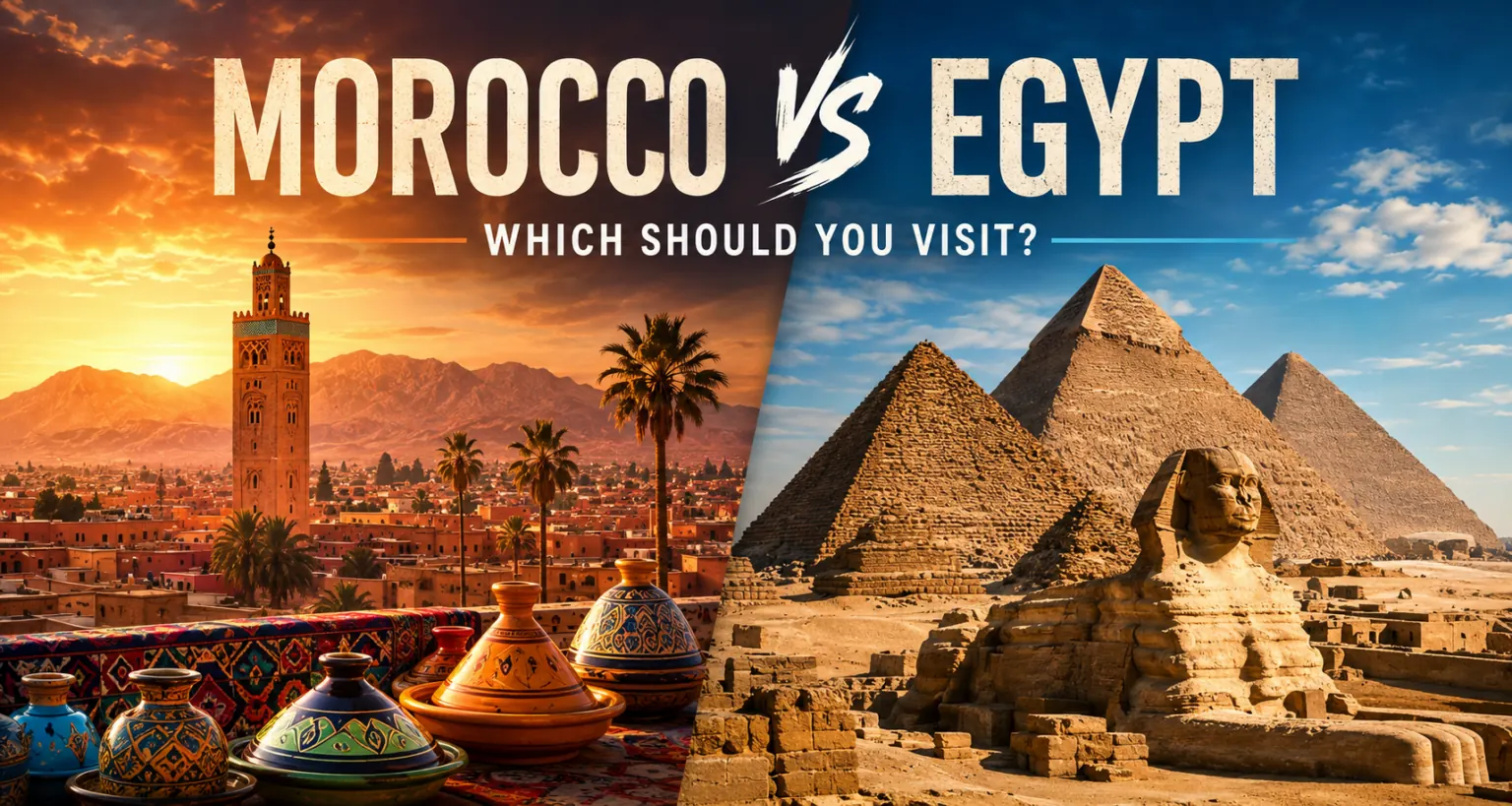
If you’re planning a once-in-a-lifetime North African trip, sooner or later the same question lands on your kitchen table: Morocco or Egypt? Both countries are spectacular. Both make people fall in love with travel all over again. And both will be talked about for years after you come home. Yet they’re remarkably different — in landscape, rhythm, food, and the way you experience their history.
This is an honest comparison written by people who plan trips to Morocco every day. We won’t pretend Morocco wins on every front (it doesn’t), and we won’t downplay what makes Egypt unforgettable. By the end of this guide, you’ll know which destination fits your travel style — and whether it’s worth combining the two.
Quick Verdict: Morocco for Variety, Egypt for Antiquity
If we had to compress 2,000 words into one paragraph: Egypt is the world’s greatest open-air history museum. Nothing on Earth compares to standing under the gaze of the Sphinx or sailing past temples on the Nile. Morocco, on the other hand, is a multi-sensory living culture — a country where you can surf an Atlantic swell at breakfast, hike Berber villages by lunch, and sleep beneath the Sahara stars by night. Egypt overwhelms you with the past. Morocco surrounds you with the present.
For most first-time North Africa travelers — especially honeymooners, families, and anyone wanting variety in a shorter trip — Morocco tends to be the easier “yes.” For ancient-history enthusiasts and bucket-list pilgrims to the Pyramids, Egypt is irreplaceable. Recent tourism numbers reflect this shift: Morocco welcomed roughly 19.8 million international visitors in 2025, edging past Egypt to become Africa’s number-one tourism destination for the second consecutive year, according to figures reported by Morocco’s Ministry of Tourism.
When you are ready to plan, browse all our multi-day Morocco tours.
History & Culture: Two Very Different Time Machines
Egypt’s cultural draw is, frankly, unmatched. The Pyramids of Giza are around 4,500 years old. The temples of Luxor and Karnak, the Valley of the Kings, Abu Simbel, and the new Grand Egyptian Museum together form a cultural archive without rival. Egypt has seven UNESCO World Heritage Sites, six cultural and one natural (Wadi al-Hitan, the famous “Whale Valley”).
Morocco’s heritage is less monumental and more lived. It’s a layered tapestry of Amazigh (Berber), Arab, Andalusian, sub-Saharan, and French influences. The country has nine UNESCO World Heritage Sites — including the medinas of Fes, Marrakech, Tetouan, Essaouira, and Meknes, plus the Roman ruins of Volubilis and the earthen ksar of Aït Benhaddou. Crucially, most of Morocco’s UNESCO medinas are still functioning neighborhoods. People live, trade, pray, and gossip inside them. You don’t observe Moroccan culture behind a museum rope; you walk through it on the way to lunch.
The honest difference: in Egypt, you stand in front of history. In Morocco, history stands beside you, pouring mint tea.
Landscapes: Concentrated vs. Linear
Egypt’s geography is, in many ways, the Nile and the desert that frames it. Around 95% of the country’s population lives along this thin green ribbon, and most travelers experience it the same way — Cairo, Aswan, Luxor, then a Red Sea resort or the western oases. The diversity is real, but it’s stretched along a long north-south axis.
Morocco’s diversity is unusually compact. In a single two-week trip, you can:
- Walk the blue alleys of Chefchaouen in the Rif Mountains
- Get lost in the 9,000+ lanes of the Fes medina
- Hike or ski in the High Atlas
- Camp on the Erg Chebbi dunes of the Sahara
- Surf or windsurf on the Atlantic at Essaouira or Taghazout
- Wander Roman mosaics at Volubilis
You can do all of that in roughly the same distance as driving from London to Edinburgh. That density of contrast is one of Morocco’s strongest cards.
Food: A Genuine Difference
This is one of the few categories where the comparison isn’t close. Egyptian cuisine is hearty and underrated — koshari, ful medames, ta’meya (Egyptian falafel), molokhia, and grilled meats are wonderful. But the variety, refinement, and global reputation of Moroccan cooking are on a different scale.
From slow-cooked tagines and Friday couscous to flaky pastilla, harira soup, msemen breakfasts, fresh argan oil, and the entire ceremony of mint tea — Moroccan food blends Berber, Arab, Andalusian, and French traditions in a way few cuisines do. UNESCO even recognized the social practice of mint tea preparation as part of intangible cultural heritage shared across Maghreb countries.
If you live to eat, Morocco wins this round comfortably.
Safety: Both Are Safer Than the Headlines Suggest
Both countries are generally safe for tourists, though both reward common sense. The independent Global Peace Index 2025 places Morocco at 85th and Egypt at 107th out of 163 countries — Morocco scores meaningfully better, though both remain in a region (MENA) that the index classifies as the world’s least peaceful overall.
For solo female travelers, both countries require awareness, but most experienced travelers report Morocco as the more relaxed of the two. Cities like Essaouira, Chefchaouen, and Marrakech are well-trafficked by independent women. Egypt is incredible but can be more intense at major sites, particularly around the Pyramids and Luxor’s West Bank, where unwanted attention is more common.
Practical reality: the most common nuisance in both countries is persistent vendors and “fake guides,” not personal danger. Booking trusted local operators dramatically reduces the friction.
Cost: Egypt Slightly Cheaper, Morocco Better Value
Let’s separate “cheap” from “good value,” because they’re not the same thing.
Egypt is the slightly more affordable country day-to-day. Budget travelers can manage on roughly $30–$50 per day, mid-range trips run $80–$150, and luxury Nile cruises and five-star resorts push past $300+ per day. Domestic flights and entrance fees to ancient sites add up faster than people expect.
Morocco sits in a similar zone but tends to be a touch higher. Budget travelers spend around $40–$70 per day, mid-range $100–$200, and luxury $250+. The reason most travelers say Morocco delivers better value: a $100/night riad in Marrakech often feels like a boutique hotel anywhere else in the world, with hand-cut zellige tiles, a plunge pool, breakfast on the terrace, and personal attention you don’t get in chain accommodation.
So the rule of thumb: Egypt is cheaper to survive, Morocco is better to live well at a comparable budget.
Getting Around: Morocco Has the Smoother Logistics
Morocco’s transport network has quietly become one of the best on the African continent. The Al Boraq high-speed train connects Tangier to Casablanca in 2 hours 10 minutes at speeds up to 320 km/h — the first high-speed rail line on the continent. Standard ONCF trains link Casablanca, Rabat, Fes, and Marrakech reliably and affordably. The CTM bus network covers everywhere the trains don’t, and grand taxis fill the gaps.
Egypt’s transport network functions but is more variable. Domestic flights (especially Cairo–Aswan/Luxor) are the most efficient way to cover the long north-south distances; sleeper trains are an iconic option but require patience. Most travelers in Egypt rely heavily on private drivers and tour transport.
For independent travelers who like to move around without an organized tour, Morocco is the noticeably easier country.
Visas & Entry: Both Are Open, Morocco Is Slightly Simpler
Both countries are tourism-friendly on paper. Roughly 70 nationalities can enter Morocco visa-free for up to 90 days, including the EU, UK, US, Canada, Australia, New Zealand, and most of Latin America. A small number of visa-exempt nationalities now also need an AEVM electronic travel authorization. Morocco has also been rolling out an e-Visa program for select countries (including India, Israel, Jordan, Thailand, and Vietnam), which has dramatically simplified entry.
Egypt offers a visa on arrival for many Western nationalities (around $25 USD, payable in cash) and a well-functioning e-Visa system. It’s also easy — just one extra step compared with Morocco for most travelers.
Best Time to Visit
Morocco shines from March to May and September to early November. Temperatures are pleasant across cities, mountains, and the desert. June to August can be brutal in Marrakech and the Sahara (45°C+), though the coast stays cooler. Winter is excellent for Marrakech and the desert at night, and the Atlas can even offer skiing.
Egypt is best between October and April, when temperatures around the Pyramids and Luxor are bearable and Nile cruises are at their most enjoyable. Summer in Upper Egypt regularly tops 40°C and turns sightseeing into an endurance event.
Who Should Choose Which?
Choose Morocco if: you want variety in one trip, you’re a foodie, you’re traveling as a couple or family, you want softer logistics, you love design and craftsmanship, you’d rather feel a culture than only observe it, or it’s your first North Africa trip.
Choose Egypt if: ancient history is the main reason you travel, you’ve dreamed of the Pyramids since childhood, you want to do a Nile cruise, you’re interested in Pharaonic civilization, or you’re a serious diver drawn to the Red Sea.
Choose both if: you have at least 12–15 days, a healthy budget, and the energy for two distinct rhythms in one trip.
Can You Combine Morocco and Egypt in One Trip?
Yes — and many travelers do. The most common combined itineraries run 13 to 15 days, typically structured as:
- Days 1–6: Egypt — Cairo (Pyramids, Egyptian Museum, Khan el-Khalili), then a 3-night Nile cruise from Luxor to Aswan, with optional Abu Simbel
- Day 7: Fly Cairo → Casablanca or Marrakech (4–5 hour flight, several daily options)
- Days 8–14: Morocco — Marrakech, Atlas Mountains, Sahara desert overnight, optional Fes or Essaouira
- Day 15: Fly home from Casablanca, Marrakech, or Tangier
This pace is intense but extremely rewarding. Anything shorter than 12 days for both countries usually means you’ll feel rushed in one of them — most often Morocco, where the contrasts deserve time.
The Honest Final Recommendation
For most travelers most of the time — especially first-timers, couples, families, foodies, and anyone who values landscape variety — Morocco is the easier “yes.” It’s accessible, diverse, photogenic in every direction, and increasingly well-organized for international travelers. The recent tourism numbers, the new airport expansions, and Morocco’s role as co-host of the 2030 FIFA World Cup all suggest the country is investing seriously in the next decade of travel.
Egypt earns its place on the bucket list through one extraordinary thing: the weight of human history concentrated along a single river. If that’s the trip of your dreams, nothing else compares.
The good news is that you don’t have to choose forever. Most travelers who fall for one end up returning to the other a few years later.
Comparing other options? See Morocco vs Turkey and Morocco vs Jordan.
Frequently Asked Questions
Is Morocco safer than Egypt for tourists?
Both countries are broadly safe for tourists. Morocco ranks higher on the 2025 Global Peace Index (85th vs. Egypt’s 107th out of 163 countries) and is generally considered more relaxed, particularly for solo female travelers. Standard precautions — avoiding deserted areas at night, using licensed taxis, dressing modestly outside resort zones — apply equally to both.
Which country is cheaper, Morocco or Egypt?
Egypt is slightly cheaper on a daily basis, with budget travelers spending around $30–$50/day vs. roughly $40–$70/day in Morocco. However, Morocco offers better value for mid-range and luxury travelers — a $100/night riad in Marrakech typically delivers more character and service than a comparable hotel in Cairo.
How many days do I need for Morocco vs Egypt?
For Egypt, 7–10 days is enough to cover Cairo, Luxor, Aswan, and a Nile cruise comfortably. For Morocco, 8–12 days lets you experience Marrakech, the Sahara desert, Fes, and either Chefchaouen or Essaouira. A combined Morocco + Egypt trip works best at 13–15 days minimum.
Are the Pyramids better than the Sahara?
They’re entirely different experiences. The Pyramids are a single, awe-inspiring monument to human ambition. The Moroccan Sahara is a multi-day immersion — camel trekking, nomadic hospitality, and some of the darkest, starriest skies on Earth. Many travelers say the Sahara experience is more emotional, the Pyramids more historical.
Do I need a visa for Morocco or Egypt?
Most Western nationalities (EU, UK, US, Canada, Australia, NZ) enter Morocco visa-free for up to 90 days. Egypt requires a tourist visa for most nationalities, but it’s easily obtainable on arrival (around $25 USD) or through Egypt’s e-Visa portal. Always check your nationality’s requirements before booking.
Is Morocco better than Egypt for families with kids?
Most family travelers find Morocco easier. Distances are shorter, the climate is gentler, food is generally more child-friendly, and activities like camel rides, pottery workshops, and riad pools suit a wider age range. Egypt is exceptional for older children fascinated by Ancient Egypt, but the heat, distances, and intensity of major sites can overwhelm younger kids.
Planning Your Morocco Trip
If Morocco wins your heart — and for many travelers it does — Moratra is here to make it unforgettable. Our team is based in Morocco, our guides are local, and our planning advice is always free, with no obligation to book. Whether you want a tailor-made Morocco holiday, a focused multi-day tour, or a quick second opinion on an itinerary you’re already drafting, just reach out. We’ll help you design a route that makes sense for your dates, your travel style, and your budget — completely free of charge.
Have questions about visiting Morocco — or about combining it with Egypt? Drop us a line and one of our local specialists will get back to you within 24 hours.
