
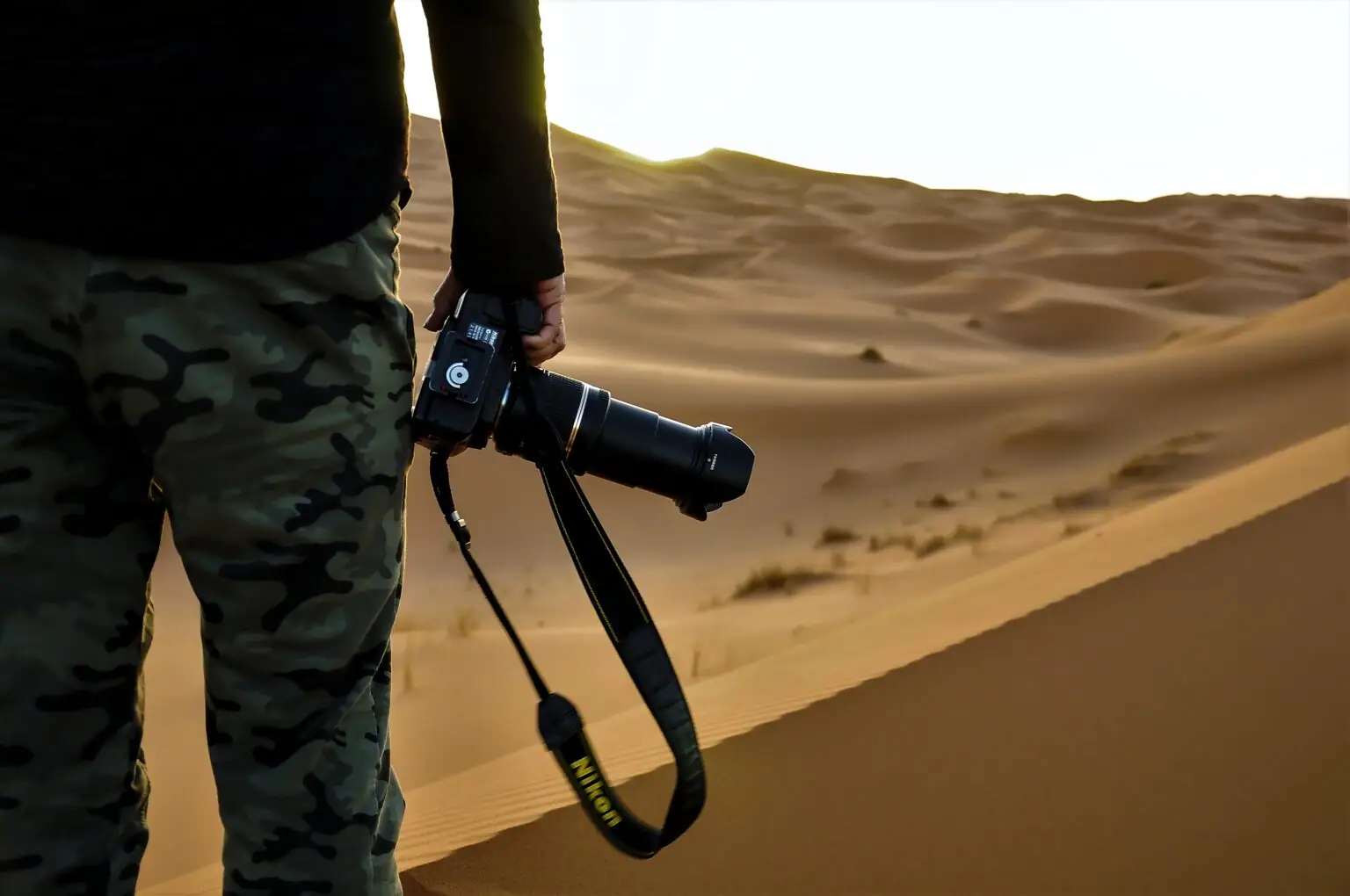
The light arrives before the sun does. Around 5:40 a.m. in Erg Chebbi, the eastern horizon turns peach, then apricot, then a clean orange that spills across the dunes like syrup. By the time the sun crests the ridge, the sand has changed color three times — and your camera has either captured it, or it hasn’t. The Sahara doesn’t wait.
This is a Sahara desert photography guide for travelers who want to come home with images worth printing — not just snapshots. We’ll cover the best photo spots in Erg Chebbi, exact timing for golden hour and astrophotography, gear that survives the sand, and a few honest tips most articles skip.
Why the Sahara Is a Photographer’s Dream
Three things make the Moroccan Sahara — specifically the Erg Chebbi dunes near Merzouga — exceptional for photographers.
The light is unusually clean. The dry air carries almost no haze, so colors stay saturated longer into the morning and afternoon than in coastal or mountain locations. Shadows are crisp, edges are defined, and the contrast between lit and unlit dune faces gives you sculptural compositions with very little post-processing.
The dunes change daily. Wind constantly resculpts the sand, so the patterns and ridgelines you photograph at sunrise won’t exist next month. Erg Chebbi rises to roughly 150 meters and stretches about 28 kilometers north to south, which means you can walk for an hour and still find a “fresh” dune face untouched by footprints.
To book this with a local team, see our three-day Merzouga tour from Marrakech.
The sky at night is among the darkest on Earth. Merzouga sits at a Bortle Class 1–2 rating, the darkest classification on the international light pollution scale. The Milky Way is visible for more than 300 nights a year, and the dust lanes inside the galactic core — usually washed out by light pollution — appear with the naked eye.
Best Photo Spots in Erg Chebbi
The Big Dune (Erg Chebbi’s Highest Point)
The tallest dune sits roughly 30 minutes’ walk southeast of most desert camps. It’s the classic “person at the summit at sunrise” composition, but the real reward is the 360-degree panorama from the top. Climb in the dark with a headlamp, arrive 20 minutes before sunrise, and shoot the ridgelines as the light slides across them.
Camel Caravan Silhouettes
Position yourself low — kneel or lie flat — and shoot the caravan from below the horizon line. This pushes the camels and riders into clean silhouette against the colored sky. Best window: the 15 minutes after the sun has cleared the dunes (sunrise) or the 15 minutes before it touches them (sunset).
Nomad Tents and Berber Camps
The traditional black-wool tents (khaima) of Sahrawi and Amazigh nomads make remarkable foreground subjects, especially when shot during the blue hour with a warm lamp glowing from inside. Always ask permission before photographing people or private camps.
Khamlia Village and the Saluki Trails
Twenty minutes south of Merzouga, the village of Khamlia offers Gnawa music sessions and authentic portrait opportunities. The mud-brick architecture against the dune backdrop creates a rare cultural-landscape composition.
Dayet Srji (Seasonal Salt Lake)
When winter rains fill it, this shallow lake reflects the dunes and — between February and April — hosts pink flamingos. It’s about 4 km west of Merzouga and most travelers miss it entirely.
Golden Hour Strategy: Sunrise vs. Sunset
Both work, but they reward different shots.
Sunrise is colder, more saturated, and almost always crowdless. The dunes glow with a pink-to-orange gradient, the air is still, and you’ll often have an entire dune face to yourself. Best for landscape, minimalism, and abstract pattern shots.
Sunset is warmer, more golden, and busier — most camp-stay travelers ride camels out for the sunset show. Best for camel caravan silhouettes, group portraits, and dramatic side-lit dune crests.
If you can only choose one, choose sunrise. Position yourself west of the dune you want lit (so the rising sun behind you hits the dune face), and arrive at least 30 minutes before official sunrise time — the pre-dawn color often beats the sunrise itself.
Astrophotography: Shooting the Milky Way
The Sahara is one of the few places where you can photograph the Milky Way without serious light-pollution filters or stacking software. Standard exposure starting points for a full-frame camera with a wide-angle lens:
- Aperture: f/2.8 or wider
- ISO: 3200 (start here, adjust to taste)
- Shutter: Use the 500 Rule — divide 500 by your focal length to get the maximum exposure before stars start to trail. A 20mm lens gives you about 25 seconds; a 14mm gives roughly 35 seconds.
- Focus: Manual focus to infinity, then back off a hair. Use live view zoomed in on a bright star to confirm.
- White balance: 3800–4200K gives a natural color cast (auto WB tends toward orange).
Best months for the galactic core: April through September, with peak visibility from June to August. The core rises in the southeast and sweeps overhead during the night.
Foreground: A single dune ridge, a lone tree, or a softly lit camp tent in the foreground turns a star photo into a story. Light-paint the foreground briefly with a warm headlamp during a 25-second exposure for a balanced composition.
Camera Gear: What to Bring (and What to Skip)
Lenses
- Wide-angle (14–24mm): Essential for landscapes and astro.
- Standard zoom (24–70mm): Workhorse for daytime dunes and portraits.
- Short telephoto (70–200mm): Compresses dune ridgelines into stacked, layered compositions — the Sahara shot most travelers underestimate.
Tripod
Bring one. A lightweight carbon-fiber tripod is enough for most setups. Press the legs deep into the sand to stabilize, and weight the center column with your camera bag if it’s windy.
Filters
A circular polarizer deepens the blue sky and cuts haze. A 6-stop ND filter lets you shoot 30-second daytime exposures of wind-blown sand for an ethereal, smoky effect.
Drone
Drones reveal the dunes’ true geometry from above. Important: Morocco requires drone import permits in advance, and unauthorized drones are routinely confiscated at customs. Check current rules with the Moroccan civil aviation authority before traveling, and never fly near military installations or Berber villages without consent.
Protecting Your Gear From Sand
Sand is fine, dry, and statically charged — it gets everywhere. Five rules that have saved countless photographers’ equipment:
- Never change lenses in open desert. Step inside a tent or vehicle, or wrap your camera in a clean cotton scarf to create a dust-shielded pocket.
- Use a UV filter as a sacrificial element on your front lens — it’s cheaper to replace than the lens glass.
- Seal everything in zip-lock bags when not shooting. Include a couple of silica packets.
- Bring a rocket blower and a soft brush — never wipe sand off a sensor or lens with a cloth (you’ll grind it in).
- Mind temperature shocks. Going from a cold desert night into a warm vehicle causes condensation inside the lens. Let gear acclimatize in a sealed bag for 20 minutes before unpacking.
Smartphone Photography Tips
You don’t need a DSLR to come home with great Sahara images. Modern phones perform remarkably well in the desert’s clean light.
- Shoot in RAW if your phone supports it (iPhone Pro, Pixel, most flagship Androids).
- Use the ultra-wide lens for sweeping dune landscapes and the 2x or 3x telephoto for compressed ridgeline shots.
- Tap and hold to lock focus and exposure, then drag the slider down to slightly underexpose — this preserves color in the sky.
- For astro: Pixel’s Astrophotography mode and iPhone’s Night mode (with a tripod or a stable rock) can capture the Milky Way with surprising detail. Expose for 30 seconds minimum.
- Avoid digital zoom — crop in post instead.
When to Visit for the Best Light
The best months for Sahara photography are October through April. Daytime temperatures are manageable (15–25°C / 59–77°F), nights are cool but not freezing, and the air is at its clearest. Summer (June–August) brings extreme heat above 45°C and frequent dust storms — challenging but rewarding for atmospheric astro work.
For a deeper seasonal breakdown, see our guide on the Sahara vs Agafay desert experiences, which compares both photography environments side by side.
Frequently Asked Questions
How many days do I need in the Sahara for serious photography?
Two nights minimum at Erg Chebbi. One night gives you a single sunset and sunrise, which leaves no margin for cloud cover or fatigue. Two nights doubles your chances and lets you shoot the same scene in different light. A 3-day desert tour from Marrakech is the standard sweet spot — see our 3-Day Merzouga Tour for the typical itinerary.
Can I bring a drone to Morocco?
Drones require advance import authorization from Moroccan customs and the civil aviation authority. Without proper permits, drones are commonly confiscated at airports and may be returned only on departure. Always verify the current regulations close to your travel date.
Is the Sahara good for Milky Way photography year-round?
The dark sky is excellent year-round (Bortle Class 1–2), but the galactic core — the brightest part of the Milky Way — is only visible from late February through October, with peak season from April to September.
What’s the best lens for desert photography?
If you can only bring one, a 24–70mm f/2.8 covers most situations. If you can bring two, add a 14–24mm wide-angle for astro and sweeping landscapes. A 70–200mm is the bonus pick for compressed ridgeline compositions that most travelers miss.
How cold does the Sahara get at night for star photography?
Winter nights (December–February) routinely drop to 0–5°C (32–41°F), occasionally below freezing. Bring layers, gloves you can shoot in, and warmth for your camera batteries (cold drains them fast — keep spares in an inside pocket).
Should I hire a local photography guide?
If it’s your first Sahara visit, yes. A local guide knows which dunes catch first light, where to position camel caravans for clean silhouettes, and which villages welcome respectful portraiture. The cost is usually modest and the time savings are significant.
Plan Your Sahara Photography Trip
Erg Chebbi rewards photographers who arrive prepared. A two- or three-night stay timed around the new moon, paired with a local guide who knows the dune geometry, will give you images you can print three feet wide.
If you’d like help building a photography-focused itinerary — timed around sunrise positions, moon phases, and camp locations chosen for unobstructed dune views — the Moratra team offers free planning advice. Tell us your gear, your travel window, and what kind of shots matter most to you, and we’ll suggest a route that fits. No obligation, no pressure — we genuinely enjoy helping photographers get to the dunes at the right hour.
Prefer the city? Book a private Marrakech photography tour with a local guide who knows the medina’s best light, angles and hidden corners.
