
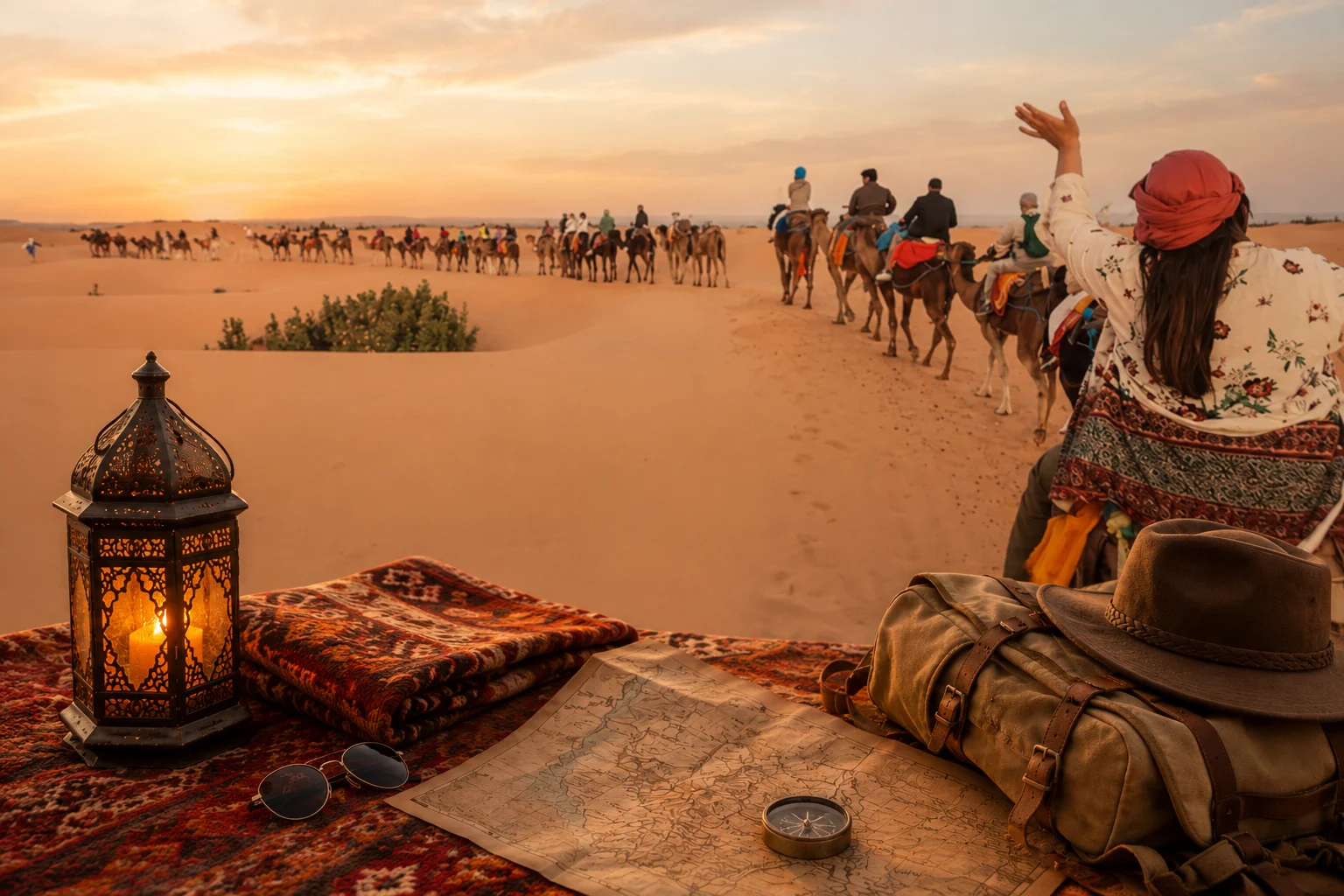
If you’ve started pricing a Sahara desert tour from Marrakech, you’ve probably seen quotes ranging from $90 to $3,000 for what looks like the same trip. That gap is real, and it’s not a scam — it reflects very different vehicles, camps, group sizes, and pacing. Here’s what you actually pay for in 2026, broken down honestly so you can read any quote and know exactly what’s missing.
Sahara desert tour cost at a glance (2026)
Here’s the realistic price band for a 3-day, 2-night Marrakech-to-Merzouga round trip, the most common Sahara itinerary. Numbers are per person, double occupancy, assuming a standard mid-season departure.
| Tour type | Per person (3 days) | What you get |
|---|---|---|
| Shared budget tour | $90–$200 | 15-seat minibus, basic Berber tent, communal meals |
| Shared standard tour | $200–$350 | Smaller group, en-suite tent, better breakfast |
| Private mid-range tour | $450–$800 | Private luxury vehicle, comfort camp, flexible stops |
| Private luxury tour | $1,200–$2,500 | Luxury camp, gourmet meals, dedicated driver-guide |
| Ultra-luxury bespoke | $2,500–$5,000+ | Private camp buyout, helicopter option, butler service |
Shared group tours listed online start at around $90–$140 for the cheapest shared 3-day departures, while typical mid-range private tours sit at $450–$800 per person, and high-end private trips with luxury camps run $1,200 and up. Those bands match what most reputable Morocco-based operators quote in 2026.
What you’re actually paying for
A Sahara tour from Marrakech isn’t a single product. It’s a bundle of six things — and the price gap between a $150 tour and a $1,500 tour comes from how each line item is sourced.
1. Transport. Marrakech to Merzouga is roughly 560 km each way, which is 9 to 10 hours of driving on the outbound leg and a similar return through the High Atlas. A budget tour uses a 15-passenger minibus that’s full. A mid-range tour uses a comfortable private vehicle. A luxury tour gives you that same vehicle but with two passengers maximum and a driver who also acts as your guide.
You can also do this with us on our Marrakech desert tour.
2. The camp. This is where the biggest spending happens. Basic Berber camps run roughly $20–$40 per person per night and offer canvas tents with shared bathrooms. Standard luxury camps charge €150–€250 per night (roughly $165–$275) for a private en-suite tent with hot shower, real bed, and dinner included. Ultra-luxury camps like those near the south face of Erg Chebbi charge €400–€800 per night with private decks, plunge bowls, and dedicated staff.
3. Meals. Tours typically include breakfast and dinner. Lunch is usually on your own at roadside restaurants in Aït Benhaddou, Ouarzazate, or Boumalne Dadès — budget 80–150 MAD ($9–$17) per meal.
4. The camel trek. A short 1-to-2-hour camel ride from the parking edge of the dunes to the camp is included in nearly every tour. A longer sunrise-and-sunset ride or a multi-night caravan costs extra.
5. Guide quality. Budget tours give you a driver who speaks workable English and points out landmarks. Mid-range tours upgrade to a driver-guide who can answer history and culture questions. Luxury tours add a separate licensed guide in addition to the driver — and the difference at Aït Benhaddou or in the Todra Gorge is dramatic.
6. Site fees and tips. Aït Benhaddou entry, the Atlas Studios tour in Ouarzazate, and the customary tips for camel handlers and camp staff are sometimes included, often not. Always ask.
Shared budget tour: $90–$300 per person
The cheapest 3-day departures advertised online start at around $90 per person and run up to about $300 for the comfortable end of the shared category. You’re sharing a minibus with up to 14 other travelers. The camp is a basic Berber-style cluster of tents — clean, safe, atmospheric, but bathrooms are shared and the mattresses are thin foam over a wood frame.
This is fine for a young, flexible traveler who treats the desert as one stop in a bigger Morocco loop. It’s painful if you have back issues, light sleep, or kids under six. Budget tours also tend to rush the photo stops — the famous “panorama” overlook in Aït Benhaddou gets a 15-minute window, not the unhurried hour the village really deserves.
Private mid-range tour: $450–$800 per person
This is the most popular tier for couples, small families, and travelers over 35. You get a private luxury vehicle with just your party inside, an air-conditioned vehicle on the long Atlas crossings, and a “comfort” camp with en-suite tents, real beds, decent linens, and reliable hot showers. The driver-guide will adjust the pacing to your appetite — extra time at the Todra Gorge if you love hiking, shorter at the rose-water cooperative if you don’t.
The per-person price drops sharply when you fill the vehicle. A private vehicle quoted at $2,400 for the trip is $1,200/person as a couple, $800/person for three, and $600/person for a family of four. That’s why agents always ask how many travelers are in your group before they quote.
Private luxury tour: $1,200–$2,500 per person
Luxury here means three upgrades. The camp moves from “comfort” to “luxury” — think Caravan Serai-style suites with private decks facing the dunes, plunge bowls, and a candlelit dinner at a single shared table under the stars. You travel in a newer, more comfortable vehicle with a dedicated driver. And a separate licensed guide joins for the Aït Benhaddou and Todra portions.
Most importantly, the itinerary stops being a fixed route. Want to skip Ouarzazate and add a fossil workshop in Erfoud? Done. Want to spend an extra night in the dunes to chase a meteor shower? Done. This is the tier where Sahara tours go from “logistics with a view” to “a quiet, memorable few days.”
Ultra-luxury and bespoke: $2,500–$5,000+ per person
At the top end, you’re buying privacy. A camp buyout (you and your party are the only guests in the camp), helicopter transfer in or out to skip one Atlas crossing, butler service, a private chef, and a sommelier-curated dinner are all possible. A small but real number of honeymooners, milestone anniversaries, and corporate retreats land here. The product exists, and at the right occasion, it’s worth it.
How group size changes the price (the real math)
Group size is the biggest single lever on price. For a full side-by-side comparison of the two ways to travel — and the 2026 cost difference — see our guide to private vs shared Sahara desert tours from Marrakech.
Private tour pricing in Morocco is almost always quoted per vehicle, then divided by traveler count. A typical mid-range private 3-day quote of $1,800 to $2,400 for the vehicle plays out like this:
- 1 solo traveler: $1,800–$2,400 (full vehicle cost falls on you)
- 2 travelers (couple): $900–$1,200 per person
- 3 travelers: $600–$800 per person
- 4 travelers (family): $450–$600 per person
- 5–6 travelers (one larger private vehicle): $300–$400 per person
This is why two couples traveling together is the sweet spot for value on a private tour. Adding a fifth and sixth person sometimes triggers a vehicle upgrade for larger groups, which adds a few hundred dollars to the base price but still drops the per-person rate.
2-day, 3-day, or 4-day — which is worth the money?
The 3-day, 2-night Marrakech–Merzouga loop is the standard for a reason: it’s the shortest itinerary that lets you actually sleep in the desert and watch a sunrise from the Erg Chebbi dunes. Our 3-day Merzouga tour guide walks the standard route hour by hour if you want to picture it before you book. The 2-day version exists, but it routes to Zagora (a smaller, lower dune field roughly 360 km from Marrakech), not Merzouga. Zagora is a fair desert experience — just not the cinematic, towering-dune Sahara most travelers picture.
The 4-day version adds an extra night in the dunes or a slower return through the Draâ Valley. If you have the time, the upgrade from 3 to 4 days is worth more than the upgrade from a standard camp to a luxury one. A second sunrise in Erg Chebbi is the photo most travelers wish they’d had — and the 4-day romantic luxury route is the version most couples don’t regret paying for.
If you only have two days available, consider a private Zagora or Agafay-plus-Zagora tour rather than rushing Merzouga in 48 hours — the Atlas drives at that pace turn into a blur.
Hidden costs nobody warns you about
The price quoted in your tour confirmation is rarely the price you’ll actually spend over three days. Plan for these extras:
- Lunches: 80–150 MAD ($9–$17) at three roadside stops
- Tips for camel handlers: 50–100 MAD per traveler (most tours don’t include this)
- Tips for the camp staff: 100–200 MAD per traveler for a 2-night stay
- Tip for the driver-guide: 200–500 MAD per traveler for a 3-day private tour
- Drinks at the camp: Alcohol is usually extra, soda and water sometimes too
- Optional add-ons: Sandboarding (~150 MAD), quad-bike hour (~400 MAD), Atlas Studios entry (~80 MAD)
- Aït Benhaddou entry: ~50 MAD (some tours include it, ask)
Realistic floor: budget another $80–$150 per traveler on top of your booked price for a 3-day tour. For luxury tours where most extras are included, $40–$70 is usually enough.
The seasons that change the price
Sahara tour prices in Morocco vary roughly 30% between low and high season. The four bands break down clearly.
High season (October, March, April): daytime temperatures sit at a comfortable 25–30°C and nights are clear and cool for stargazing. Expect a 20–30% premium over base rates, and book at least 6 weeks ahead.
Shoulder season (November, February, May): still pleasant — November and early February are mild, late May edges hot. This is the value sweet spot. Prices drop 10–15% from peak and crowds thin out.
Low season (June, July, August): daytime temperatures climb past 40°C and sometimes hit 45°C in the dunes. Many operators pause sales or steeply discount. If you can handle the heat (and the closed shoulders at midday), summer prices are 25–40% below high season.
Christmas and New Year: the price spike is sharp — typically 40–60% above base — because European families and US travelers descend simultaneously. Book in September if you want this window.
For a deeper season-by-season cost picture across all of Morocco, see our month-by-month Morocco cost guide.
How to compare two quotes that look identical
If two tour quotes are within $50 of each other and you can’t tell why one is “better,” ask the operator these six questions before you book:
1. What’s the maximum group size in the vehicle, and what’s the vehicle model and year?
2. What’s the name of the camp? (Then look up that exact camp on Booking or Google — camps trade up and down on reputation.)
3. Is the tent en-suite (private bathroom) or shared-bath?
4. Which meals are included, and which are at extra cost?
5. How long is the camel ride into the camp — and is a sunrise camel ride included or extra?
6. Is there a separate licensed guide at Aït Benhaddou, or just the driver?
A reputable operator will answer all six in writing within a few hours. If a quote stays vague after the third question, that’s the signal to keep looking.
Frequently asked questions
Is a 3-day Sahara desert tour from Marrakech worth it?
Yes, if you can spare the two long driving days at each end. The 3-day, 2-night format is the minimum that lets you reach Merzouga and Erg Chebbi — the towering Sahara dunes most travelers picture — and actually sleep in the desert rather than racing back. If your total Morocco trip is shorter than 7 days, prioritize the 3-day Sahara loop over adding a fourth city.
What’s included in a typical Sahara desert tour price?
Standard inclusions are private or shared transport from Marrakech, one night at a guesthouse along the way (usually Boumalne Dadès or Tinghir), one or two nights at a desert camp near Erg Chebbi, a sunset camel ride into the camp, dinner and breakfast at each overnight stop, and entry to Aït Benhaddou on the outbound leg. Lunches, tips, alcohol, and optional activities like sandboarding or quad rides are usually extra.
How much should I tip on a Sahara desert tour?
For a 3-day private tour, plan on roughly 200–500 MAD ($22–$55) for your driver-guide, 50–100 MAD for the camel handlers, and 100–200 MAD for camp staff over two nights. Tips are voluntary but expected in Morocco’s tourism economy, and they make a real difference to the people doing the most physical work on your trip.
Can I book a Sahara tour when I arrive in Marrakech, or should I book in advance?
You can walk into agencies on rue Mohammed V and book same-day departures, and the on-arrival price for a budget shared tour is sometimes 10–20% lower than what you’d pay online. The trade-off is real: you can’t vet the camp, the vehicle, or the guide in advance, and the very cheapest walk-in tours occasionally cancel or downgrade once they fill. For peak season (October, March, April), book at least 4 to 6 weeks ahead.
Is the Sahara desert tour safe?
Yes. Morocco’s southern desert region is politically stable, the operators are licensed and insured, and the camps near Erg Chebbi sit in a tightly clustered tourism zone with regular vehicle traffic. The realistic risks are altitude-related discomfort on the Atlas crossings, sun exposure, and cold desert nights in winter — all manageable with normal travel preparation. Solo female travelers report no widespread issues with reputable operators.
Are Sahara desert tours suitable for kids and older travelers?
Yes, with the right tour tier. Skip budget shared tours if you have kids under six or if anyone in your party has back issues — the 9-hour minibus days are punishing. A private mid-range tour with a comfortable private vehicle, en-suite tent, and flexible pacing handles both populations well. Many operators stock booster seats on request and can route you to a single-night stay if the round-trip drive is too much.
If you’d like the rest of your Morocco trip planned with the same care this guide tries to give — the right camp for your group, the right pacing through the Atlas, a driver-guide who actually knows the route — that’s what we do at Moratra. Browse our Marrakech-to-Erg-Chebbi luxury desert tour, request a quote for a custom itinerary, or just message us with a question — we’ll answer for free, no obligation. The Sahara is patient, and so are we.
Prices in this guide are 2026 indicative ranges based on public online listings, including Morocco-based private operators, plus published rates from luxury camp groups in the Erg Chebbi area. Exchange rates and individual camp pricing change continually — always confirm the final number with your operator in writing before booking. For current travel advisories, see the UK FCDO Morocco page and the US State Department Morocco country page.
