
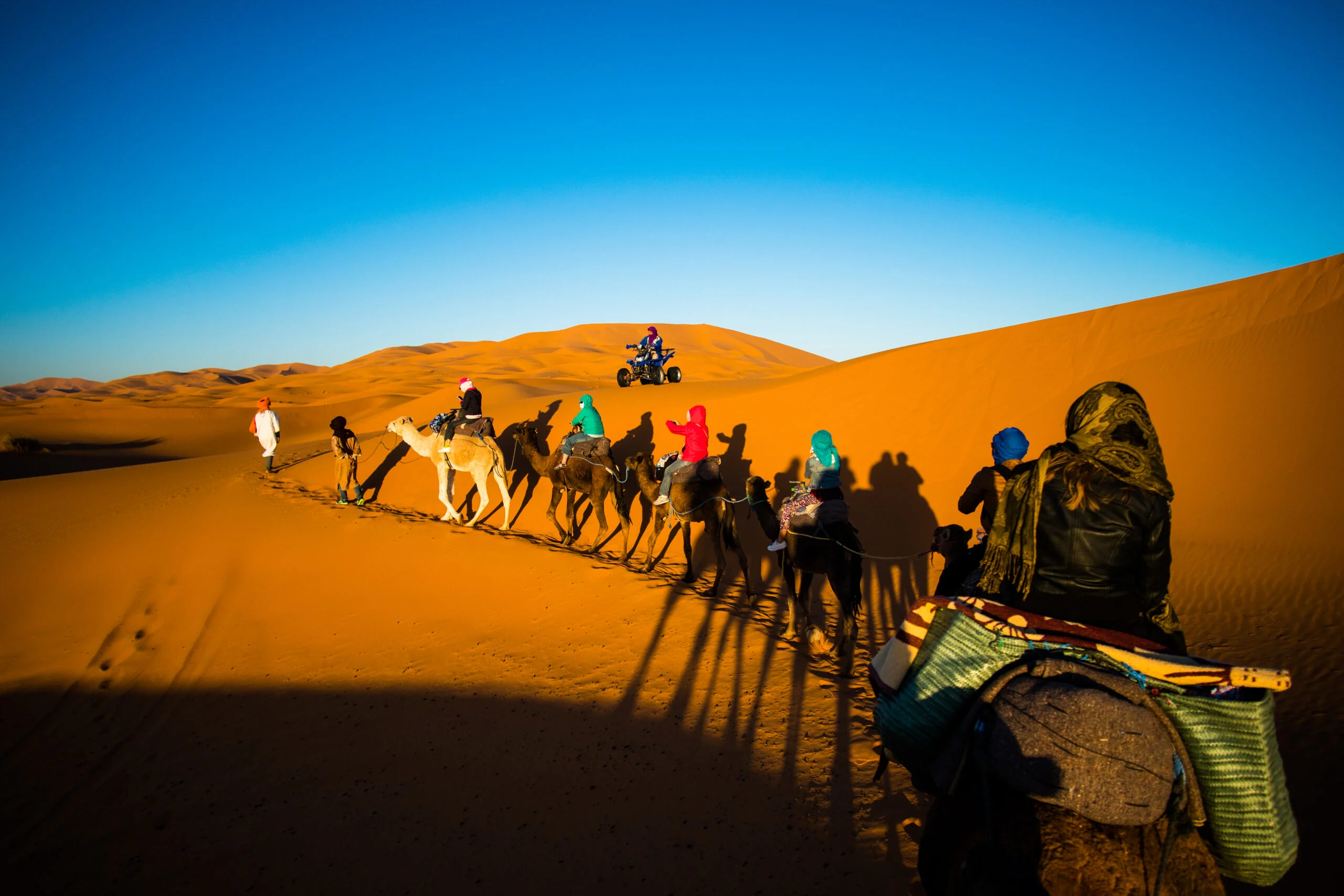
The 4-day Marrakech to Fes route across the Sahara is one of Morocco’s great overland journeys: High Atlas passes, a UNESCO-listed mud-brick ksar, two dramatic gorges, a night on the dunes of Erg Chebbi, and a final run through cedar forest into the oldest imperial city in the country. It’s also long. You’re crossing most of Morocco diagonally, and four days is honestly tight for it. This guide lays out a realistic day-by-day plan, the route on a map, the driving times you should actually expect, and an honest take on whether you should stretch it to five or six days instead.
Is 4 Days Enough for Marrakech to Fes via the Sahara?
Short answer: it’s doable, but it’s the minimum. The driving backbone alone is real. Marrakech to Merzouga (the gateway to the Erg Chebbi dunes) runs roughly 560 km and takes 9–10 hours of actual driving over the mountains, and Merzouga to Fes is about 470 km and another 7–9 hours through the Middle Atlas. That’s well over 1,000 km of road before you add a single photo stop.
Spread across four days, that means two of your days are dominated by driving. You’ll still see the headline sights, but you won’t linger. If your schedule has any give in it, the five-day version of this same route adds breathing room for the Dades and Todra gorges and a slower morning in the desert. Treat four days as the express edition: efficient, beautiful, and a little rushed.
Who is four days right for? Travelers with fixed flight dates (into Marrakech, out of Fes), couples or friends comfortable with long scenic drives, and anyone who’d rather see a lot quickly than go deep on any one stop. If you get carsick on switchbacks or you’re traveling with young kids, build in the extra day.
You can also do this with us on our 4-day Marrakech to Fes desert tour.
The Route at a Glance (with Map)
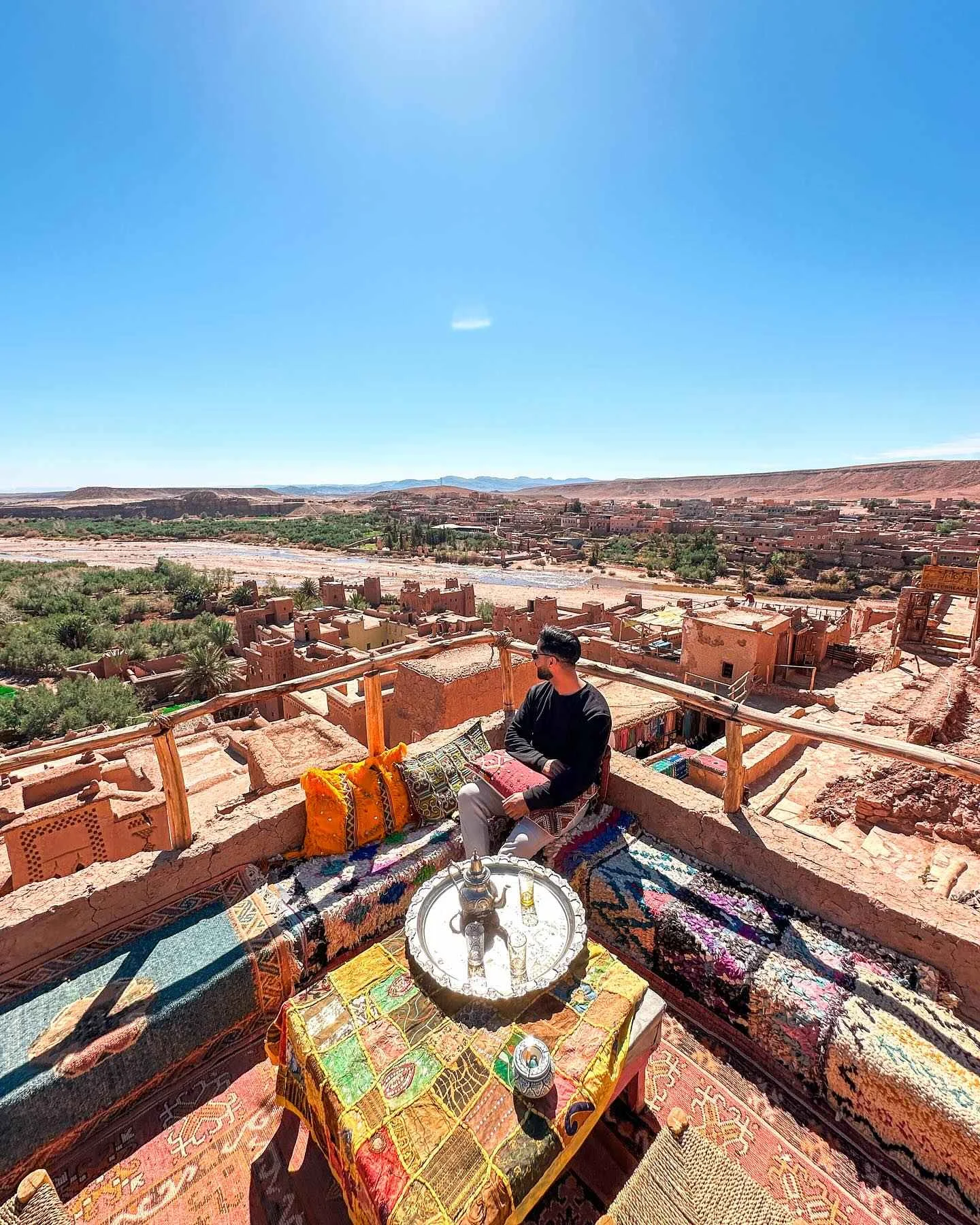
The itinerary runs one direction — Marrakech in the south-west to Fes in the north — so you never backtrack. Here’s the shape of it:
| Day | Route | Approx. driving | Sleep |
|---|---|---|---|
| 1 | Marrakech → Tizi n’Tichka → Aït Benhaddou → Ouarzazate → Dades Valley | ~6–7 hrs | Dades Valley |
| 2 | Dades Gorge → Todra Gorge → Tinghir → Erfoud → Merzouga (camel trek to camp) | ~5–6 hrs | Desert camp, Erg Chebbi |
| 3 | Sunrise on the dunes → Erfoud → Errachidia → Ziz Valley → Midelt | ~5 hrs | Midelt |
| 4 | Midelt → Azrou cedar forest → Ifrane → Fes | ~4 hrs | Fes |
Per-day distances are planning estimates that shift with your exact stops — confirm them against a live map app the week you travel, because road works on the mountain sections do change timings. The two long legs (the Atlas crossing on Day 1 and the Middle Atlas run on Day 4 plus the desert-to-Midelt stretch on Day 3) are where the hours add up.
Because the route runs one way, plan your flights to match: land in Marrakech, fly out of Fes. Both have international airports, and not doubling back is the whole point — every kilometre moves you toward the finish. One thing to settle before you go is how you’ll cover the ground. If you’re self-driving, factor in a one-way rental drop-off in a different city (rental firms charge extra for this), and book the desert camp in advance so someone’s expecting you at Merzouga. If you’d rather not drive, a private transfer or guided trip removes that planning entirely.
Day 1 — Marrakech to the Dades Valley, Over the Tizi n’Tichka
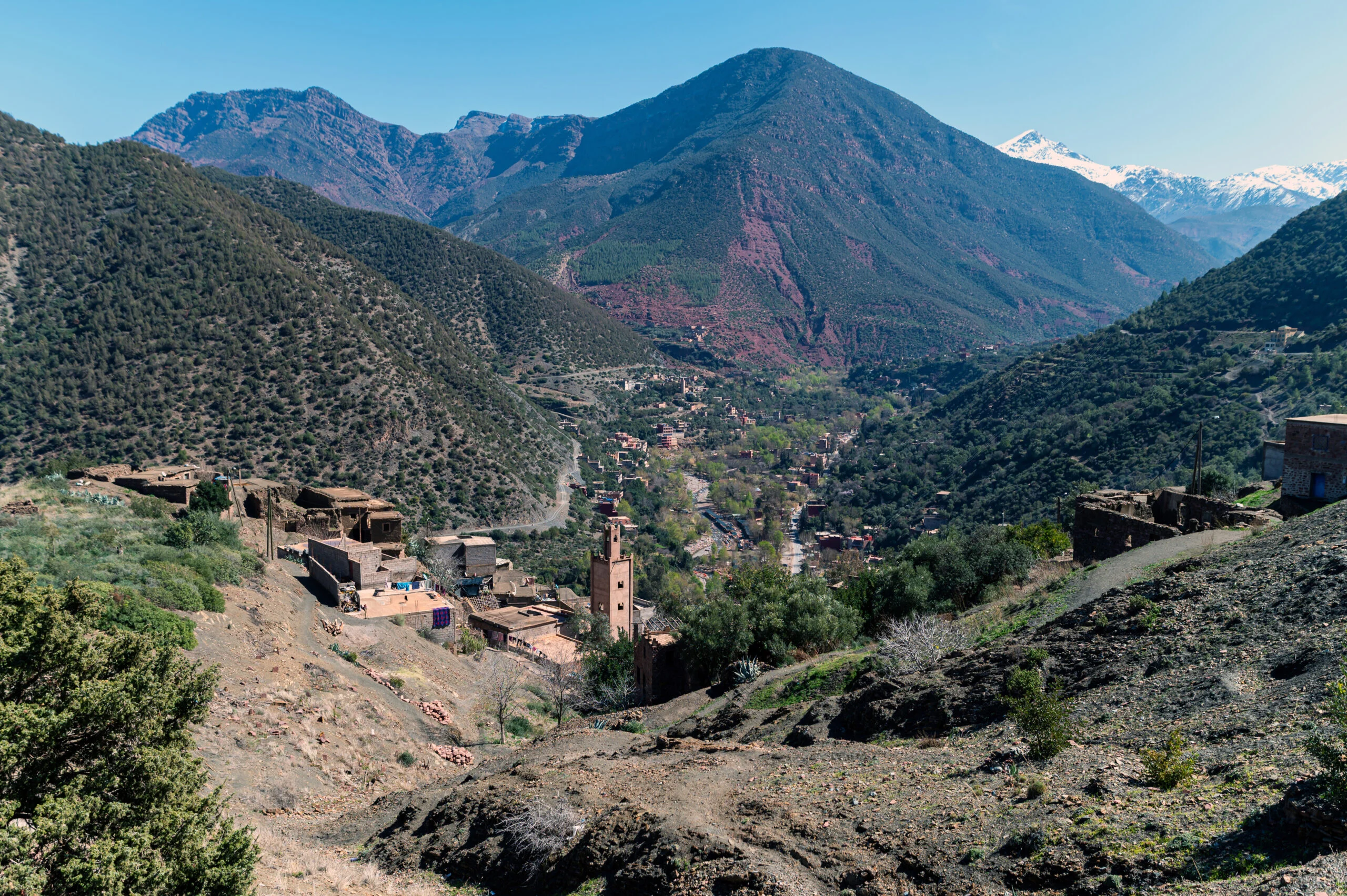
Leave Marrakech early. The first act is the Tizi n’Tichka, the highest major mountain pass in North Africa at a traditionally cited 2,260 metres (a 2022 GPS reading put it slightly lower, around 2,205 m). The road — Route Nationale 9 — is fully paved but it’s a relentless series of switchbacks, so the roughly 200 km from Marrakech to Ouarzazate eats up four hours or more once you factor in viewpoint stops and the occasional slow truck.
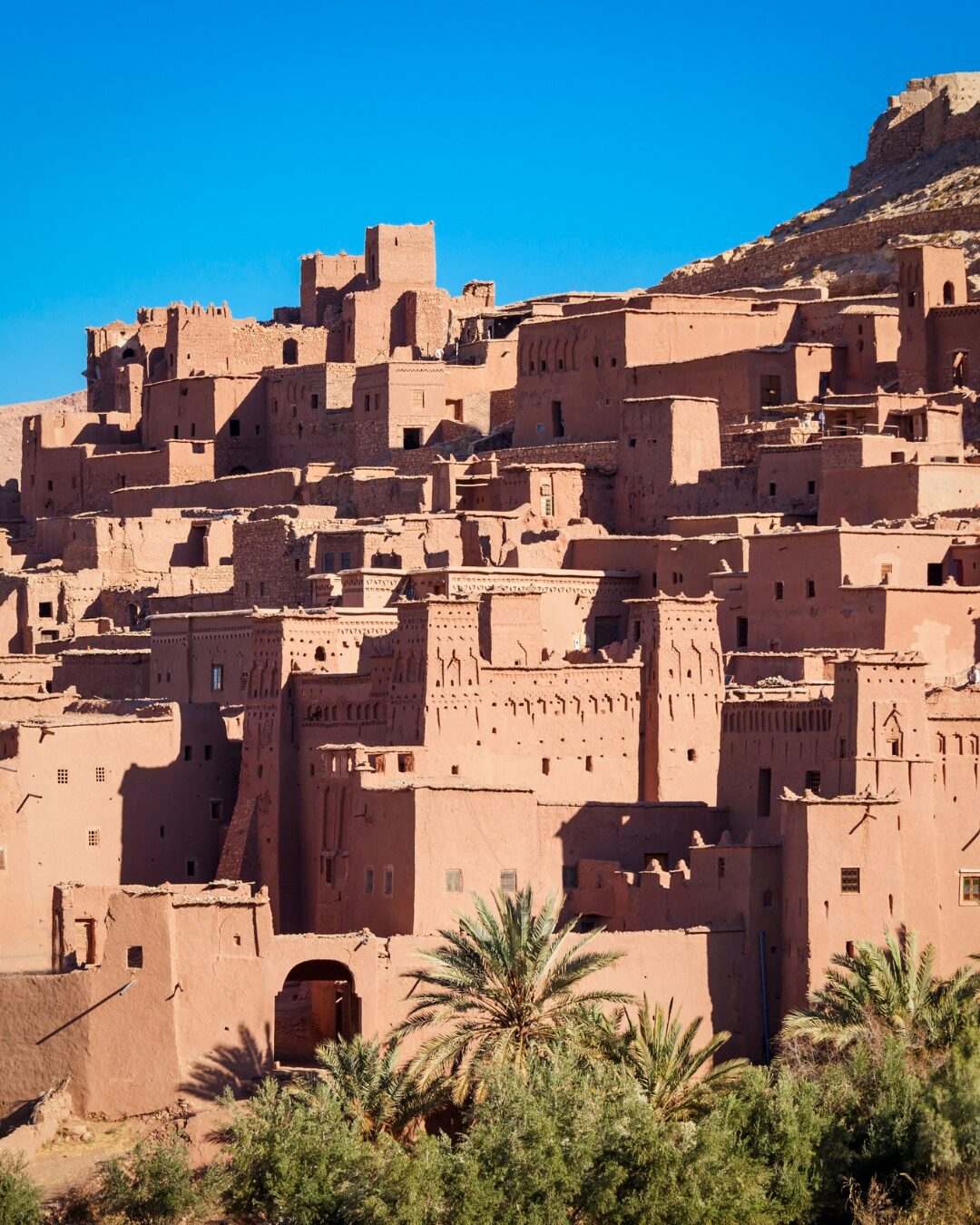
Your first major stop is Aït Benhaddou, the fortified mud-brick ksar that’s been a UNESCO World Heritage Site since 1987. It sat on the old caravan route between the Sahara and Marrakech, and you’ll recognise it instantly — it has doubled as a backdrop in more films and series than almost any location in Morocco. Give it 60–90 minutes to climb up through the ksar to the granary at the top. If you want the full history before you go, our dedicated Aït Benhaddou guide covers the layout and the best light for photos.
From there it’s a short hop to Ouarzazate, nicknamed Morocco’s “door of the desert” and long a hub for filmmaking — the town’s studios have hosted productions for decades, and the restored Taourirt Kasbah on its eastern edge is worth a quick walk-through if you have daylight to spare. Then it’s east toward the Dades Valley, where palm groves and rose-coloured kasbahs line the river beneath the “Valley of a Thousand Kasbahs.” Overnight here in a guesthouse with a terrace and a tagine. It’s a long first day, but you’ll have crossed the Atlas and reached the edge of the south, and the sky out here at night is something city travelers rarely see.
Day 2 — Two Gorges, Then the Dunes of Merzouga
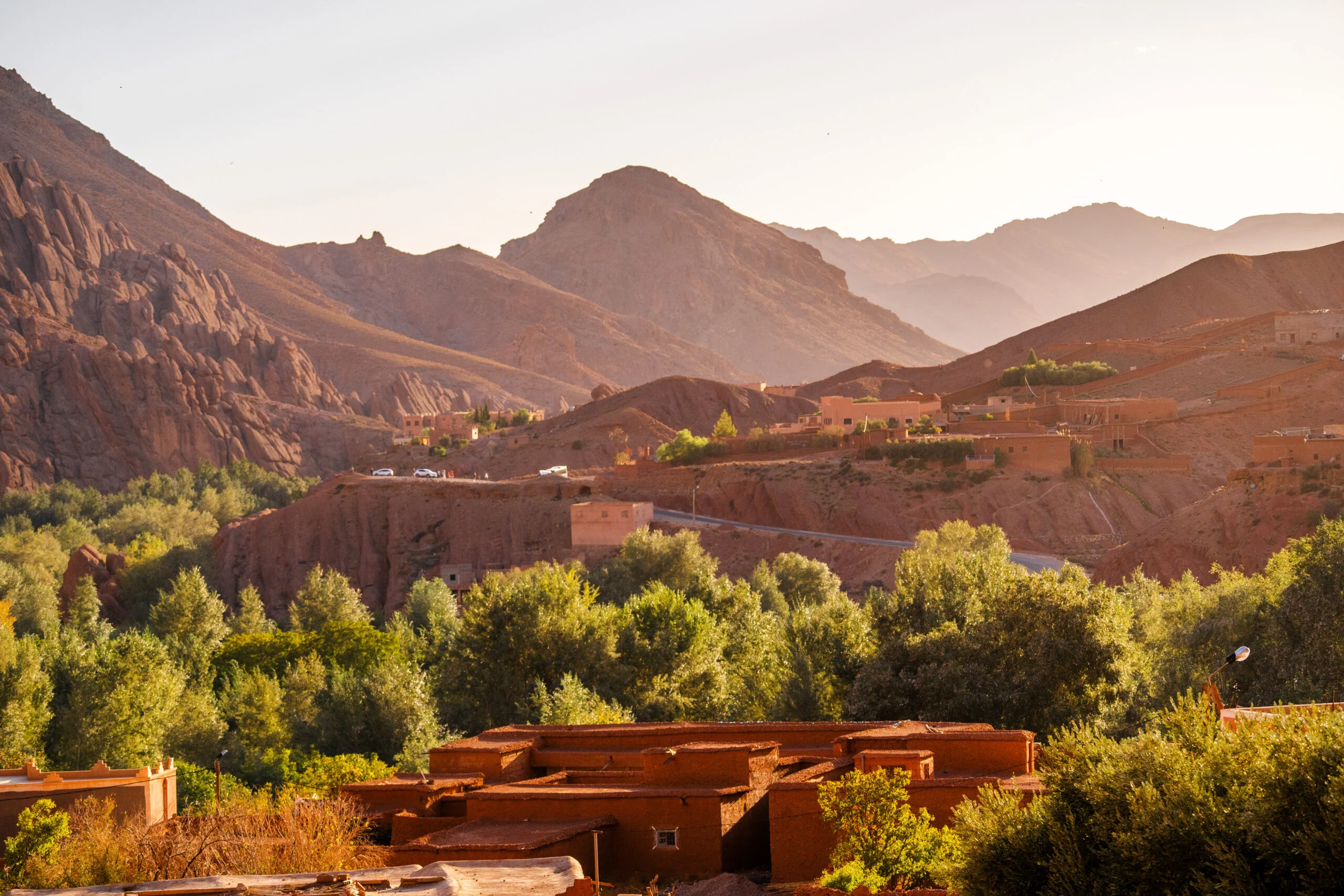
Morning is for the gorges. The Dades Gorge twists through eroded limestone — the hairpin road that climbs out of it is a photographer’s favourite — and an hour east lies the Todra Gorge, where canyon walls rise hundreds of metres on either side of a narrow river floor near the town of Tinghir. Walk the flat section between the cliffs; it’s cool, shaded and genuinely awe-inducing.
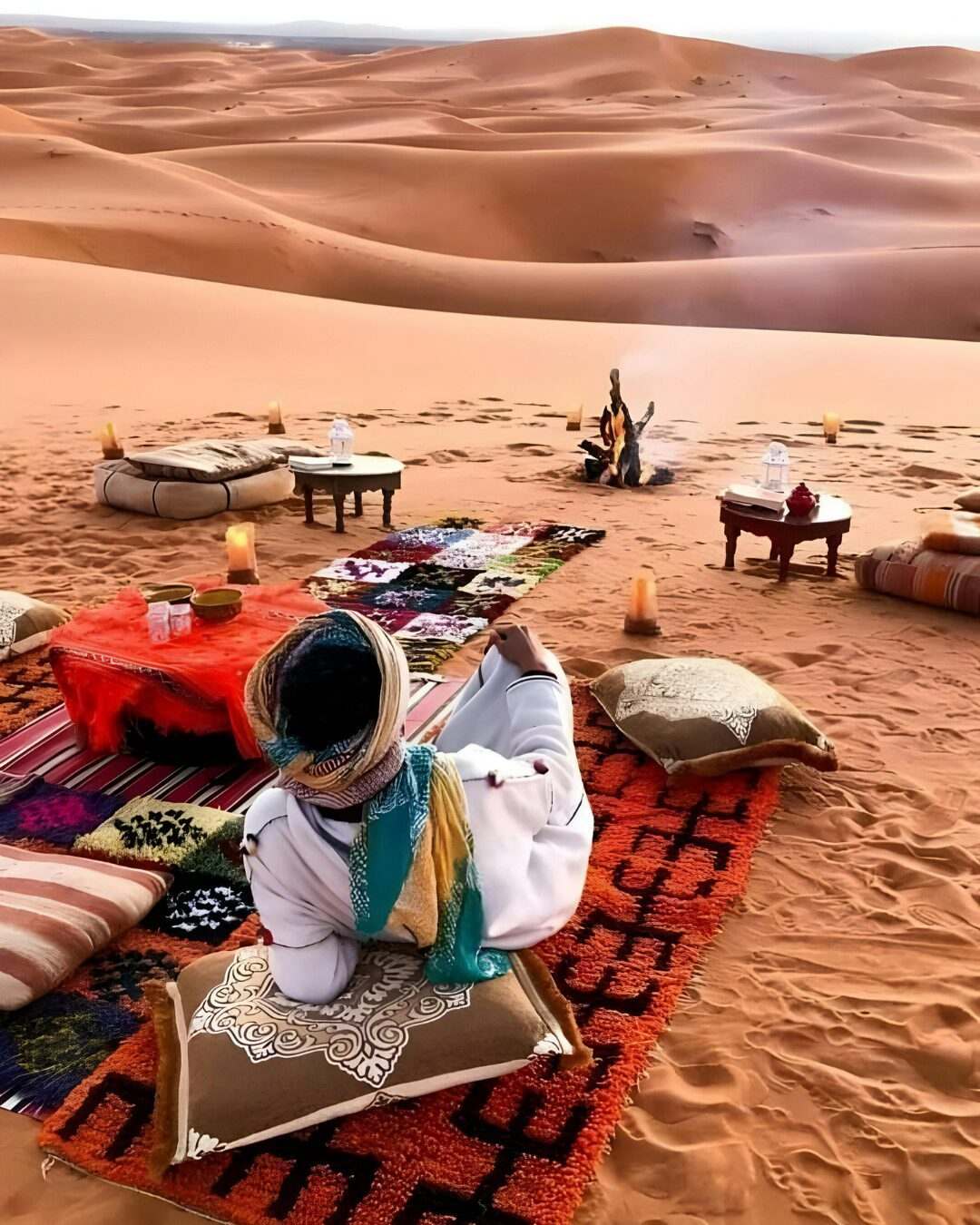
From Tinghir you push on through Erfoud and Rissani to Merzouga, the village at the foot of Erg Chebbi. These are Morocco’s tallest dunes, reaching around 150 metres and stretching roughly 28 km from north to south. Late afternoon, you’ll swap the car for a camel (or a 4×4) for the ride out to a desert camp — typically about an hour and a half across the sand. Dinner is tagine under the stars, often with drumming around a fire. The silence once the music stops is the part people remember.
Day 3 — Sahara Sunrise, Then North to Midelt
Wake before dawn. Sunrise over Erg Chebbi, with the dunes shifting from grey to deep orange, is worth the early alarm. Climb a ridge with your coffee, then trek back to Merzouga for breakfast and a shower.
Today is mostly road, and it’s a beautiful one. You’ll head north through Erfoud and Errachidia, then up the Ziz Valley — a ribbon of dense palm groves cutting through bare rock, with marked viewpoints where the whole oasis suddenly opens beneath you. Pull over at the big Ziz overlook; it’s one of the most photographed panoramas in the south and a natural place to stretch your legs. The road climbs steadily as the date palms give way to scrub and the temperature drops. The day ends in Midelt, a quiet apple-growing town at altitude between the High and Middle Atlas, where the air turns noticeably cooler. It’s an unglamorous but practical place to break the journey so Day 4 isn’t brutal — and a reminder of how much landscape Morocco packs between its famous cities.
Day 4 — Through the Middle Atlas Cedar Forest to Fes
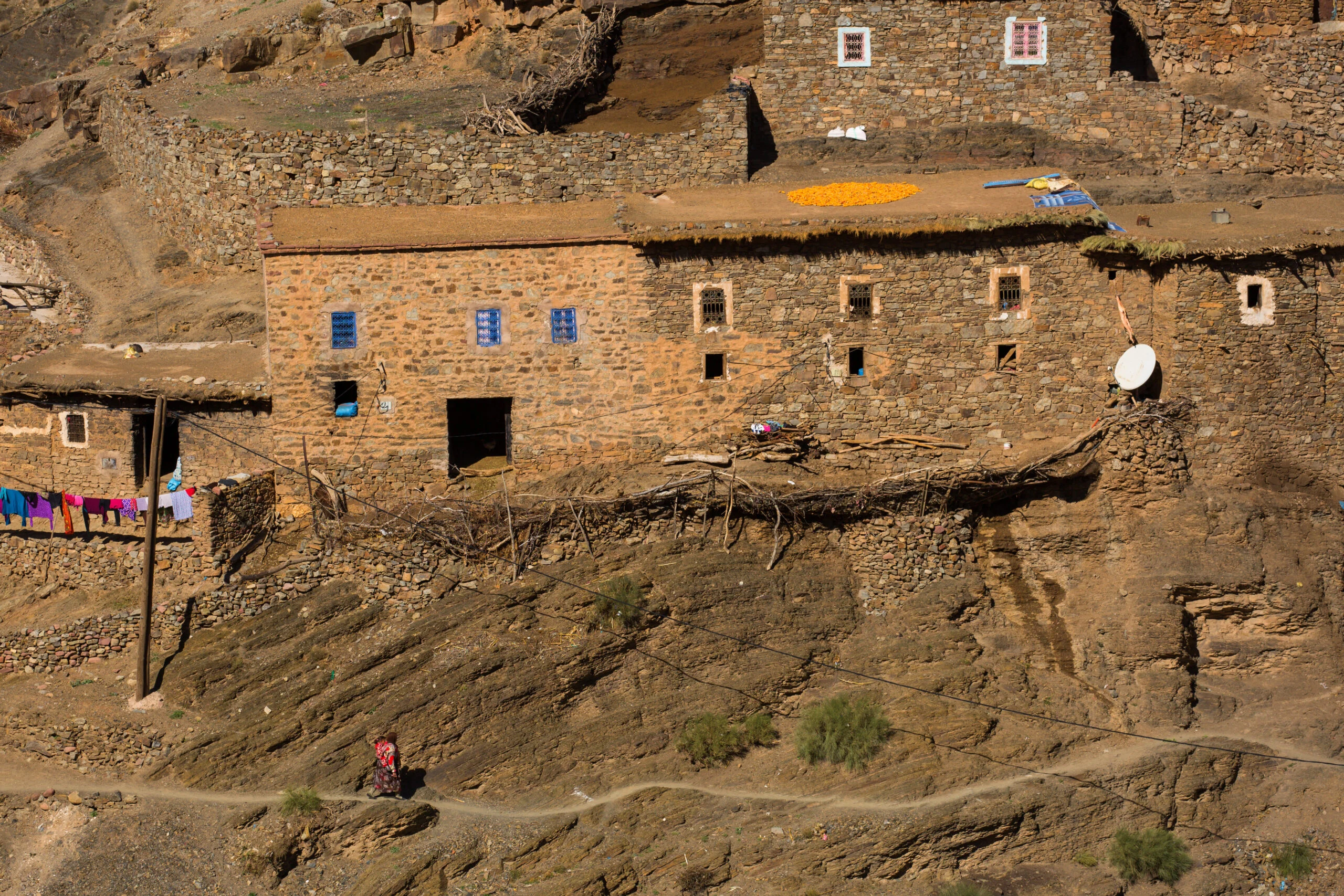
The final day is the gentlest drive and a lovely change of scenery. North of Midelt the landscape greens up as you enter the Middle Atlas. Stop near Azrou, where the cedar forest sits above 1,600 metres and is home to wild Barbary macaques — Morocco shelters around 5,000 of these monkeys, and a large share of the world’s population lives in these cedars. Keep your distance and don’t feed them; they’re wild animals, not a petting zoo.
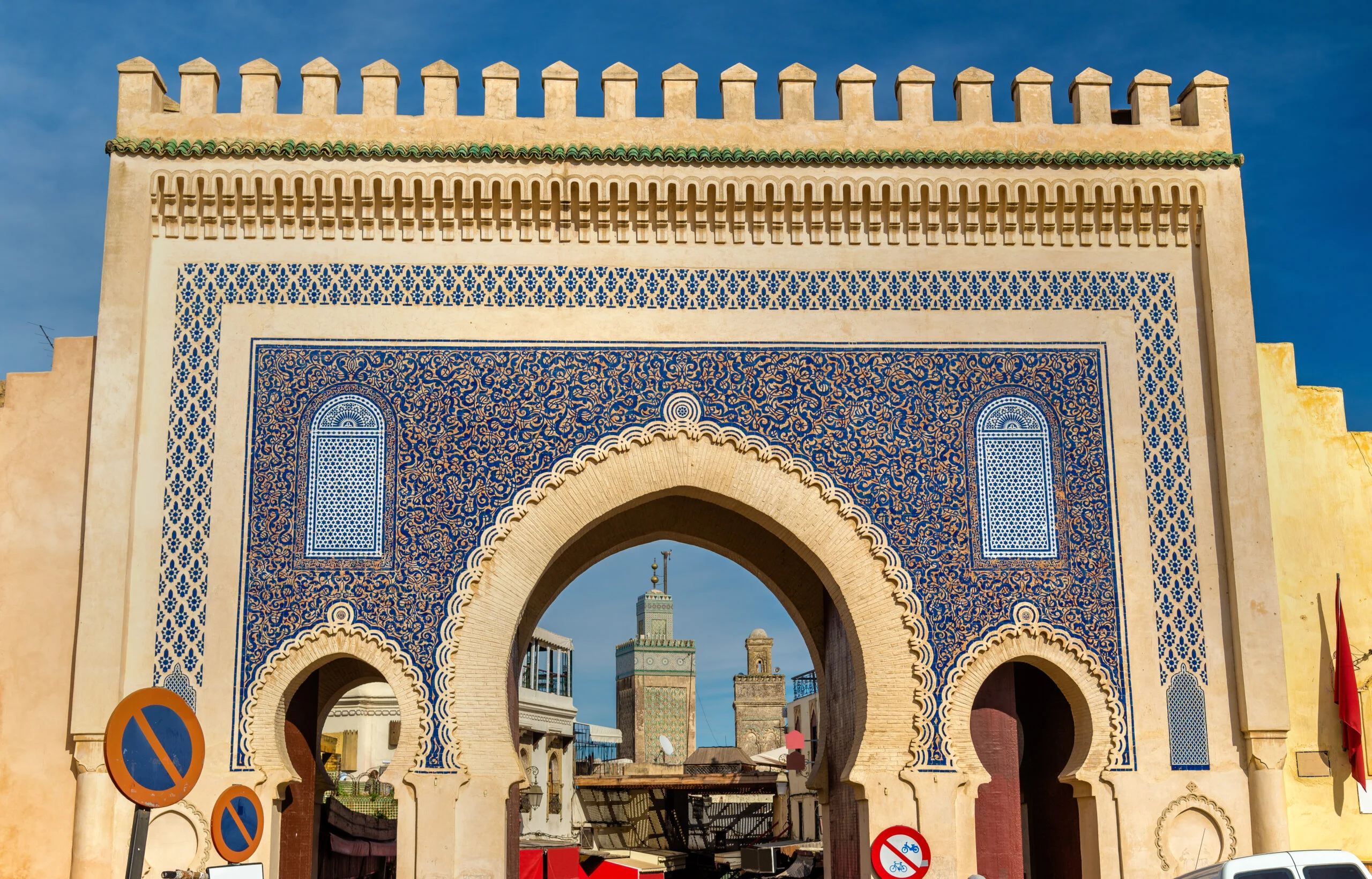
A few minutes on is Ifrane, an oddly alpine town of pitched roofs and tidy lawns that locals nickname the “Switzerland of Morocco.” From there it’s a smooth run down to Fes. Aim to arrive mid-afternoon so you have the evening to step into the medina — a UNESCO World Heritage Site whose old walled city of Fez el-Bali is one of the largest car-free urban areas in the world, founded in the 9th century and home to the venerable Al-Qaraouiyine. Pass through the blue Bab Bou Jeloud gate at dusk and you’ve earned it.
To make the most of your first evening and the day after, our Fes travel guide maps out the medina, the tanneries and where to eat without getting lost.
Self-Drive or Private Tour: Which Makes Sense?
Both work. Self-driving gives you total freedom over stops and timing, and a rental plus fuel is usually the cheaper option for two or more people. The trade-off is real, though: the Tizi n’Tichka switchbacks, mountain weather, navigating without local-language road signs, and arriving at a desert camp after dark are a lot to manage when you’re also trying to enjoy the view. Morocco drives on the right, the legal blood-alcohol limit is effectively zero, and an International Driving Permit is recommended — check the current rules on the UK government’s Morocco travel advice page before you commit.
This is exactly the kind of long, one-way, mountain-and-desert route where many travelers decide the driving isn’t worth it. With a private driver you sit back on the passes, the desert-camp logistics are handled, and you skip the rental drop-off fee for ending in a different city. At Moratra we run this corridor regularly — you can see how we structure it on our private Marrakech-to-Fes desert crossing, which covers the same arc with a driver who knows where the light is best.
What to Pack and Practical Tips
Layers matter more than you’d think. Marrakech can be hot while the Dades and Midelt are genuinely cold at night, and desert mornings are chilly before the sun does its work. Bring a warm layer even in summer. Other essentials: a scarf for sun and blowing sand, sunglasses, a power bank (camps may have limited electricity), cash in dirhams for small stops and tips, and motion-sickness tablets if you’re prone to it — the mountain roads are no joke. Fill the fuel tank whenever you see a station on Day 3; the stretches between towns are long.
Frequently Asked Questions
How long does it take to drive from Marrakech to Fes via the Sahara?
Direct, the two big legs are about 560 km from Marrakech to Merzouga (9–10 hours of driving over the High Atlas) and roughly 470 km from Merzouga to Fes (7–9 hours through the Middle Atlas). Across this four-day itinerary, with gorge and dune detours, you’ll cover well over 1,000 km in total, which is why two of the four days are driving-heavy.
Is four days enough, or should I take five?
Four days covers all the headline sights but leaves little slack — two days are dominated by long drives. If your dates allow, five days lets you slow down in the Dades and Todra gorges and enjoy a relaxed desert morning instead of rushing north. Choose four days if your flights are fixed; choose five if you’d rather not spend a holiday watching the clock.
What’s the best time of year to do this route?
Spring (March–May) and autumn (September–November) are ideal: warm days, cool nights and comfortable desert temperatures. Summer brings intense Sahara heat that can top 40°C around Merzouga, while winter is fine in the desert by day but genuinely cold at night and can bring snow to the Atlas passes, occasionally affecting the Tizi n’Tichka. Pack for big temperature swings whenever you go.
Can I do this trip without driving myself?
Yes, and many travelers do. A private driver handles the mountain switchbacks, the desert-camp transfer and the one-way logistics of ending in a different city than you started. It costs more than a self-drive rental but removes the stress of navigating long, remote stretches and arriving at camp after dark, which is why it’s a popular choice on this particular corridor.
Where do you sleep on the desert night?
You overnight at a camp in the Erg Chebbi dunes near Merzouga, reached by camel or 4×4 — usually about a 90-minute ride across the sand. Camps range from simple Berber tents with mattresses and shared facilities to private luxury setups with en-suite tents. Dinner, breakfast and evening music around a fire are standard, and sunrise over the dunes the next morning is the highlight.
Do I need a 4×4 for this route?
No. The entire driving route follows paved roads — the Tizi n’Tichka is the national highway (RN9), and the roads through the gorges, the Ziz Valley and the Middle Atlas are all sealed. A normal 2WD car handles them fine in good weather. The only off-road moment is the short transfer from Merzouga out to your desert camp, and that’s done by camel or by the camp’s own 4×4, not your rental.
If you’d like the rest of this Marrakech-to-Fes journey planned with the same care — a driver who paces the passes, a desert camp matched to your budget, and a first evening in Fes that doesn’t end lost in the medina — that’s what we do. Browse our 8-day Marrakech–Sahara–Fes–Chefchaouen tour for the unhurried version, request a quote, or simply message us with a question — we’ll answer for free, no obligation. Either way, drive safe, go slow on the switchbacks, and save the early alarm for the dunes.
Driving distances and times are planning estimates that vary with your exact route, stops and road conditions; confirm them with a live map before you travel. Travel-advisory and entry rules can change — check the official government sources linked above close to your departure date.
