
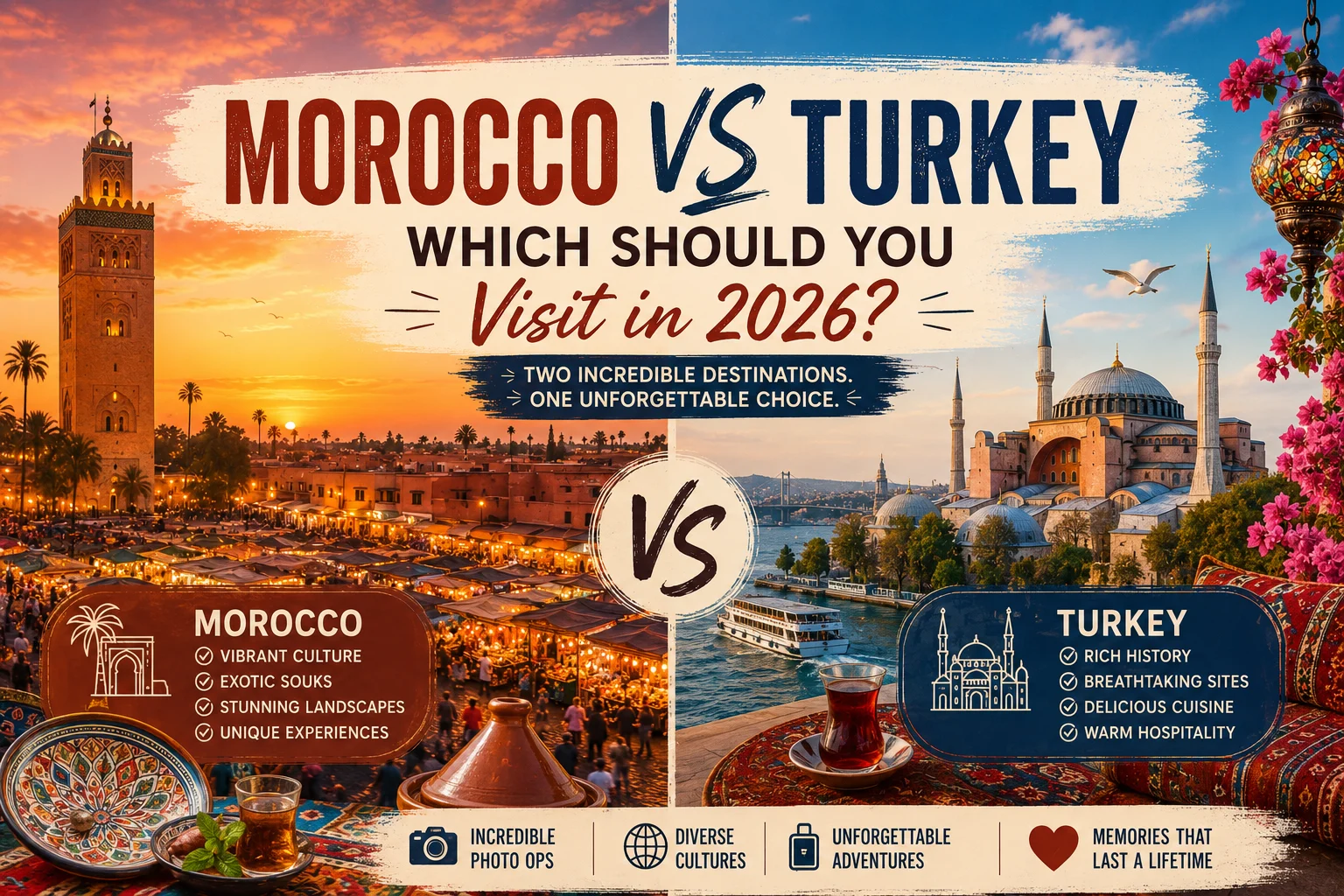
Morocco and Turkey are the two destinations most travelers shortlist when they want a trip that is exotic enough to feel like an adventure, but accessible enough not to demand a sabbatical. Both are Muslim-majority countries with imperial histories that shaped the wider Mediterranean. Both serve mint tea in tiny glasses and lay out tile work that stops you in the street. Both are far cheaper than Western Europe in 2026, and both have airports that connect easily to North America, the UK, and the Gulf. And yet they offer almost completely different trips.
This guide is for the traveler trying to choose between them — for a first big trip, a honeymoon, a two-week sabbatical, or simply the next stamp in the passport. We compare them the way a local guide would: not just attractions, but how each country actually feels on the ground, what each one costs in 2026, the food, the climate, the safety picture, and which kind of traveler each rewards. By the end you should know whether to land in Marrakech or Istanbul first — and whether a hybrid trip combining both is realistic.
The short answer: Morocco or Turkey at a glance
Pick Morocco first if you want desert landscapes, an immersive medina experience, a North African vibe with strong French and Spanish influence, a compact country you can circle in 7–14 days, and a destination where craftsmanship and slow travel are the whole point. Pick Turkey first if you want a denser hit of classical antiquity, beaches and sailing along the Aegean, a vast country that mixes Europe and Asia inside its capital, a more familiar (English-friendly) tourism infrastructure, and food that arrives in dozens of small mezze plates. The two countries can both be done in a single three-week trip, but most travelers — including the ones we talk to weekly — get more out of focusing on one and returning later for the other.
The geography that explains everything
Morocco fits into a manageable shape: roughly 710,000 square kilometers along the Atlantic and Mediterranean coasts of North Africa, with the Atlas Mountains running diagonally through the middle and the Sahara opening up to the south-east. You can drive from Tangier in the north to Merzouga at the edge of the Erg Chebbi dunes in two long days. The imperial cities — Marrakech, Fes, Meknès, Rabat — are all within a four-hour train ride of each other. This compactness is one of Morocco’s underrated advantages. You can experience snow-capped peaks, surf beaches, a Sahara camp, and a medieval medina in a single 10-day trip without rushing.
When you are ready to plan, browse all our multi-day Morocco tours.
Turkey is much larger — roughly 783,000 square kilometers spread across two continents — and forces harder choices. Istanbul alone occupies both European and Asian shores of the Bosphorus. Cappadocia, the country’s hot-air-balloon postcard, is a full hour’s flight or 10-hour drive east of Istanbul. The classical sites of the Aegean coast (Ephesus, Pamukkale, Bodrum) are another flight south. To see Turkey’s headline regions properly, you almost always fly between them. The country rewards two- or three-trip travelers more than one-shot tourists.
Morocco vs Turkey: the comparison table
| Factor | Morocco | Turkey |
|---|---|---|
| Region | North Africa, Atlantic + Mediterranean coasts | Transcontinental, between Europe and the Middle East |
| Headline experience | Sahara camp under the stars; medieval medinas | Cappadocia hot-air balloons; Istanbul old city |
| UNESCO World Heritage sites | 9 (Marrakech, Fes, Meknes, Rabat, Volubilis, Ait Ben Haddou, Essaouira, El Jadida, Tétouan) | 21 (incl. Historic Areas of Istanbul, Cappadocia, Ephesus, Troy, Hierapolis-Pamukkale) |
| Languages | Arabic + Berber (official); French widely spoken; English in tourism | Turkish (official); English common in Istanbul and coastal resorts |
| Currency | Moroccan dirham (MAD) | Turkish lira (TRY) |
| Visa for US / UK / EU | Visa-free up to 90 days | US: e-Visa required; UK + most EU: visa-free up to 90 days |
| Country size | ~710,000 km² (compact, drivable) | ~783,000 km² (large, internal flights normal) |
| Best for | Desert, craftsmanship, slow medina days, honeymoons | Antiquity, beaches, hot-air ballooning, cosmopolitan cities |
Climate: when each country is at its best
Morocco has four climates in one country. Marrakech and the south sit on the edge of the Sahara — winters are mild and sunny (daytime highs 18–22 °C in January), summers are punishing (40 °C+ from late June through August). The Atlantic coast (Essaouira, Rabat, Casablanca) is moderated by the ocean year-round and rarely uncomfortable. The High Atlas gets real snow and skiing at Oukaïmeden. The desert at Merzouga or Zagora is best between October and April; summer days in the dunes commonly exceed 45 °C. The sweet spots for a first Morocco trip are March–May and September–November.
Turkey’s climate is more European. Istanbul has a temperate, somewhat damp climate — cold rainy winters near freezing, warm summers around 28–30 °C, and beautiful shoulder seasons. Cappadocia is harsher: snow is common in winter and balloon flights are weather-dependent year-round. The Aegean and Mediterranean coasts (Bodrum, Antalya, Fethiye) have long hot summers and mild winters, with beach season running roughly May through October. If you want balloons in Cappadocia, blossoms in Istanbul, and warm enough sea to swim, target late April–May or mid-September–October.
What you actually do in each country
A typical Morocco trip is built around a slow loop. You’ll spend two or three days in Marrakech orienting yourself in the medina, sipping mint tea on a riad rooftop, and visiting the Bahia Palace, the Saadian Tombs, and the cobalt-blue Jardin Majorelle. You’ll then head south through the Atlas Mountains to Aït Benhaddou — the ksar that has appeared in Lawrence of Arabia, Gladiator, and Game of Thrones — before camping a night under the dunes of Erg Chebbi. From there many travelers cross the Middle Atlas to Fes for two days of getting deliberately lost inside the world’s largest car-free medieval city, then back to Casablanca or out via Tangier. The whole circuit is 7–14 days and gives you mountains, desert, ocean, and two imperial cities. We mapped a balanced version in our Morocco vs Egypt comparison, which surprised many readers by showing how much smaller Morocco’s logistics burden is.
A Turkey trip is usually anchored in three regions. Istanbul gets three or four days — the Hagia Sophia, the Blue Mosque, Topkapı Palace, the Grand Bazaar, and a sunset Bosphorus cruise are the headline acts, but the real charm is in the neighbourhoods (Karaköy, Balat, Kadıköy on the Asian side). Cappadocia is the second leg — typically two nights in a cave hotel near Göreme, one sunrise balloon flight, and a day exploring the painted rock churches. The third leg is either the Aegean coast for antiquity (Ephesus, Pamukkale) or the southern coast for beaches and sailing. Two weeks gives you all three without rushing.
Cost: where each country actually saves you money
Both countries are roughly 40–60 percent cheaper than Western Europe for comparable experiences in 2026, but the savings hit in different categories.
Morocco is unmatched for accommodation and food. A beautifully restored riad in the Marrakech medina, with breakfast and a plunge pool, runs roughly 800–1,500 MAD per night (€75–€140). A full tagine dinner with mint tea in a non-tourist restaurant is 80–150 MAD (€7–€14). Day-trips and guided experiences (cooking classes, hammams, day-tours into the Atlas) are notably cheaper than equivalents in Europe. Where Morocco costs more is internal logistics — long private transfers eat into a budget if you don’t pre-plan — and craftsmanship, which is intentionally not cheap because it’s still made by hand.
Turkey delivers stronger value on flights, mid-range hotels, and dining out. The Turkish lira has lost significant value in recent years against the euro and dollar, which makes restaurants and shopping feel inexpensive to visitors paying in foreign currency. A balloon flight in Cappadocia — the most-photographed experience in Turkey — typically runs $200–$300 per person, which is the single largest line item in most Turkey budgets. Internal flights between Istanbul, Cappadocia, and the coast are cheap (often under $50 one-way) but add airport-and-transfer time.
Net result: a 10-day Morocco trip and a 10-day Turkey trip land at similar totals for most mid-range couples — roughly €1,800–€3,500 per person all-in, depending on accommodation choice and tour style. Honeymoon-style luxury costs noticeably more in Morocco’s top desert camps and the Royal Mansour tier, and in Istanbul’s Bosphorus suite category in Turkey.
Food: kebab versus tagine
Both cuisines deserve far more than the clichés. Moroccan food is built around slow-cooked tagines, couscous traditionally served on Fridays, harira (the lentil-and-tomato soup eaten to break the Ramadan fast), pastilla (the layered savoury-sweet pie originally from Fes), and a culture of bread eaten with everything. Mint tea is poured from height into small glasses several times a day; it is a social ritual, not a beverage. The food scene rewards patience — the best meals are in family-run riads and small medina kitchens, not in flashy restaurants. Marrakech now has Michelin-mentioned tables, but the soul food is still the grandmother-recipe tagine.
Turkish cuisine is broader, partly because Turkey was the centre of the Ottoman Empire and pulled influences from the Balkans, the Caucasus, and the Levant. You’ll eat dozens of small mezze plates (the Turkish version of tapas), grilled kebabs in countless regional variations (Adana, Urfa, İskender, döner), pide (the boat-shaped pizza), simit (sesame bread rings sold on every street corner), and baklava that is genuinely better in Turkey than anywhere else. Turkish breakfast is a famous spread — cheeses, olives, eggs, jams, breads, sometimes for an hour. Coffee in Turkey is thick, unfiltered, served with a glass of water and often a small piece of lokum (Turkish delight).
If you eat tagine in Fes, you’ll understand Moroccan cooking. If you eat a long meze lunch on the Bosphorus, you’ll understand Turkish. Neither cuisine is replaceable by the other.
Culture and atmosphere: medina versus mosque-city
The cultural texture of a Moroccan trip is intimate. You enter walled medinas where the streets have been the same width for 800 years, where craftsmen still hammer copper and stretch leather, and where you’ll be a guest in someone’s family riad rather than a room in a hotel chain. The country has a strong French linguistic and culinary layer from the protectorate years, a Berber substrate that predates Arab arrival, and a constant Andalusian-Spanish-Jewish-Saharan mix that makes Moroccan culture a genuine crossroads. Modern Morocco is also stable and tourist-experienced — the king takes tourism seriously as a national economic pillar, and the infrastructure shows.
Turkey’s cultural texture is grander and more cosmopolitan. Istanbul straddles two continents literally; you can ferry from a European breakfast to an Asian lunch in 20 minutes. The country has Byzantine, Ottoman, and Republican layers visible in a single neighbourhood. Outside the cities you have classical Greek and Roman sites of world significance — Ephesus, Troy, Pergamon, Aphrodisias — that simply don’t have parallels in Morocco’s archaeological record. Turkey feels like Europe-plus, while Morocco feels like its own thing entirely.
Safety and the practical traveler picture
Both countries are safe by global standards in 2026, but the official advisory pictures differ. The UK Foreign, Commonwealth & Development Office’s Morocco travel advice and the US State Department’s Morocco country information page both keep Morocco at a moderate caution level. The most common traveler problems are petty pickpocketing in the Marrakech medina, faux-guide approaches, and occasional taxi-fare arguments. None of these are dangerous; they’re nuisances managed by paying attention. Solo female travelers report Morocco as generally comfortable when dressed modestly and staying in busier areas after dark.
Turkey carries slightly higher-profile advisories because of its borders with Syria and Iraq and occasional political demonstrations in Istanbul and Ankara. Tourists who stay in the standard tourism zones (Istanbul historic peninsula, Cappadocia, Aegean coast, Mediterranean coast) have no realistic security concern. The country is far more visited annually than Morocco and has a deeper professional tourism infrastructure. The practical day-to-day risks for travelers are similar to those in Morocco — pickpocketing in Sultanahmet, the occasional overcharging by a taxi or rug-shop salesman, and the standard advice to avoid demonstrations.
Who should choose which?
Choose Morocco first if you: want a desert experience that becomes a memory you carry forever, are planning a honeymoon and want secluded riad-and-camp privacy, are travelling with first-time companions who want a destination that’s exotic but easy, care about craftsmanship and slow medina days, want a compact country you can experience meaningfully in 7–10 days, or value French as a backup language. Honeymooners especially gravitate toward Morocco — our Morocco honeymoon guide walks through why and where.
Choose Turkey first if you: want to see classical antiquity at scale (Ephesus, Troy, Pergamon), prioritize a beach-and-sail component, want a hot-air-balloon sunrise as the trip’s hero moment, plan to spend most of your time in cities rather than landscapes, prefer English-friendly infrastructure, or want a destination where you can mix European-style nightlife with Ottoman history in the same day.
Choose Morocco if you’re travelling with kids. The shorter distances, predictable warm climate, riad accommodation (kids love the courtyards), camel rides in the desert, and consistent welcome to families make Morocco an underrated family-trip choice. We unpacked this in detail in our Morocco family travel guide.
Can you do both on one trip?
Yes, and it works better than most people expect — but only if you have three weeks and accept a higher-pace itinerary. The cleanest combination is to fly into Istanbul, spend four nights in Turkey (Istanbul + Cappadocia), then fly Istanbul–Casablanca direct (Turkish Airlines and Royal Air Maroc both fly this route), spend 10 nights in Morocco doing the Marrakech–desert–Fes loop, and fly home. You’ll feel the contrast strongly: Istanbul is dense and imperial, Morocco is intimate and earthen. For most travelers, however, picking one country and going deeper produces a better trip than rushing both.
Comparing other options? See Morocco vs Egypt and Morocco vs Jordan.
Frequently asked questions
Is Morocco or Turkey cheaper to visit in 2026?
The two countries land at similar mid-range totals — roughly €1,800–€3,500 per person for a 10-day trip — but the savings come in different categories. Morocco is cheaper for accommodation (especially riads), home-cooked meals, and slow experiences. Turkey is cheaper for flights, restaurant dining, and shopping thanks to the weak Turkish lira. Luxury costs noticeably more in Morocco’s top desert camps and Royal Mansour-tier hotels than in equivalent Turkish properties.
Which is better for a first trip to the Muslim world?
Both are excellent gateways. Morocco is slightly easier because the medinas are walkable, the country is compact enough to circuit in 10 days, French is widely spoken alongside Arabic, and the welcome to first-time visitors is consistent and well-rehearsed. Turkey is also accessible, especially in Istanbul where English is common and the tourism infrastructure is professional, but the country’s scale means you’ll spend more time on internal flights and less time absorbing one place.
Do US, UK, and EU citizens need a visa for Morocco or Turkey?
For Morocco: US, UK, and most EU citizens can enter visa-free for up to 90 days for tourism. Your passport needs at least three months’ validity beyond your arrival date. For Turkey: UK and most EU citizens are visa-free for up to 90 days. US citizens need an e-Visa, which is applied for online before travel through the official Turkish government portal. Always check the official sources within 30 days of your trip because policies can change.
What about hot-air balloons — does Morocco have them too?
Yes, but at a smaller scale. Marrakech has commercial sunrise balloon flights over the Jbilet hills just north of the Palmeraie, typically priced 1,500–2,500 MAD per person (€140–€235), with breakfast on landing. Turkey’s Cappadocia balloon scene is far bigger — hundreds of balloons fly on a clear morning and the volcanic-rock landscape underneath is unmatched. If a balloon flight is the photo you want, Cappadocia is the stronger choice. If you want a balloon as one element of a desert-and-medina trip, Morocco delivers fine.
Which country has better food for someone who doesn’t eat meat?
Turkey is friendlier on paper because of the meze tradition — dozens of small vegetable, legume, yogurt, and grain dishes that work as a full meal — and a deep selection of vegetable-based main courses called zeytinyağlılar. Morocco is workable but requires more communication. Vegetable tagines, harira soup, salads, and bread-based meals are universally available, but you should make it clear at every meal that you don’t eat meat (or fish, if applicable). Both cuisines accommodate vegetarians well in 2026; vegans should travel with more patience in both.
Is Morocco safer than Turkey for solo female travelers?
Both are reasonable choices and the differences are smaller than internet forums suggest. Morocco tends to feel more attention-heavy on the street — particularly in Marrakech medina — but rarely escalates to anything dangerous; locals and tourist police intervene quickly. Turkey, especially Istanbul, has a more cosmopolitan baseline and women travel solo here in large numbers without issue. The standard solo-travel advice applies in both countries: dress modestly near religious sites, avoid unmarked taxis, and trust your gut about which streets feel right at night.
When should I book if I want to visit either country in 2026?
For Morocco, book 4–6 months ahead for March–May and September–November, the peak seasons. The Christmas–New Year week and Easter week sell out 9–12 months ahead in the best riads and desert camps. For Turkey, book Cappadocia balloon flights and cave hotels 3–4 months ahead, especially for May–June and September–October. Istanbul has volume year-round and can usually be booked closer to the date. Last-minute travel is possible in both countries in winter (December–February in Morocco; January–March in Turkey) but options narrow.
The bottom line
Morocco and Turkey are both extraordinary destinations, and both deserve their place on a serious traveler’s life list. They are not interchangeable. Morocco gives you intimacy, craftsmanship, desert silence, and a country compact enough to absorb deeply in a single trip. Turkey gives you scale, antiquity, two-continent cosmopolitanism, and a hot-air-balloon morning that no other country can match. The honest answer to which to choose first is: Morocco if your trip is built around landscape, slow culture, and family-style stays; Turkey if it’s built around cities, classical history, and beach time.
If you’d like the Moroccan half of that decision planned with the same care we put into this guide — riads chosen for character, drivers who actually know the medinas, and an itinerary that breathes — that’s what we do. Browse our best Morocco tours guide for 2026, request a quote for your dates, or simply message us with a question — we’ll answer for free, no obligation. Either way, save Turkey for the next trip. The two countries are better felt one at a time.
