
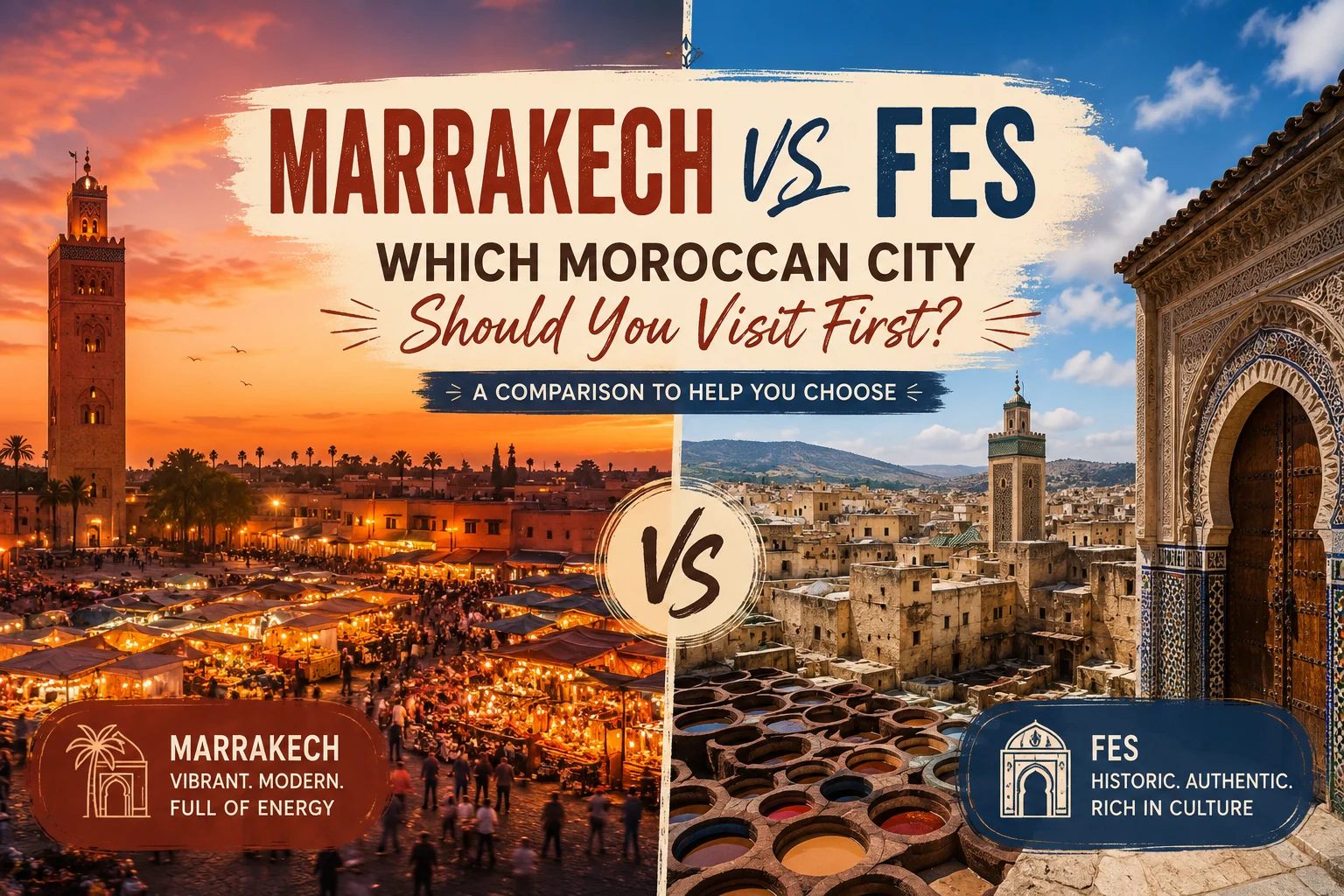
Trying to choose between Marrakech and Fes for your first trip to Morocco is one of the most common dilemmas we hear at our office in the medina. Both cities are imperial capitals, both hold UNESCO-protected medinas, and both will rearrange how you think about Moroccan culture — but they do it in entirely different ways. Marrakech moves fast, hums with theatre, and gives you the photogenic Morocco of magazines. Fes is older, quieter, more inward-looking, and rewards the patient traveler with what is arguably the best-preserved medieval city in the Arab world.
This guide compares the two cities the way a local would — not as a list of attractions, but as a question of what kind of trip you actually want. We cover the founding history, the atmosphere on the ground, what you’ll eat, how the weather differs, what each city costs in 2026, and the practical logistics of pairing them on a single itinerary. By the end you’ll know which one to fly into first — and whether you should bother with the other at all.
The short answer: Marrakech vs Fes at a glance
If you only have time to read one paragraph: choose Marrakech first if it’s your first time in Morocco, you want easy international flight connections, you’re traveling with kids or hesitant companions, or you plan to combine the city with a Sahara tour or High Atlas escape. Choose Fes first if you’ve already been to Morocco once, you care deeply about Islamic art and craftsmanship, you want a quieter and more authentic medina, or you’re a serious foodie. The two cities are 385 kilometers apart and take roughly 6.5 to 7 hours by direct train, so doing both on a single trip is very doable — and for most first-time travelers, recommended.
The founding story: a 200-year gap that explains everything
To understand why Marrakech and Fes feel so different, start with their birthdays. Fes was founded in 789 by the Idrisid dynasty and served as the kingdom’s first true capital. It reached its golden age in the 13th and 14th centuries under the Marinid sultans, when it replaced Marrakech as the seat of power and grew into one of the leading intellectual cities of the Islamic world.
You can also do this with us on our 3-day Marrakech to Fes desert tour.
Marrakech is the younger sibling — founded around 1070 by the Almoravid leader Yusuf ibn Tashfin and his cousin Abu Bakr ibn Umar as a southern command post for an empire that would eventually stretch from Senegal to Spain. The city was designed from day one as a place of power, gardens, and trade, not scholarship. That difference still shows. Fes thinks. Marrakech performs.
Both medinas have been UNESCO World Heritage Sites since 1981, but they earned the listing for different reasons. The Medina of Fez is recognized for being one of the most extensive and best-conserved historic Arab-Muslim cities anywhere in the world. The Medina of Marrakesh is celebrated as a major political, economic, and cultural capital of the Muslim west — the public-facing side of Moroccan civilization.
Marrakech vs Fes: the comparison table
| Factor | Marrakech | Fes |
|---|---|---|
| Founded | c. 1070 (Almoravid) | 789 (Idrisid) |
| City population (2024 census) | ~1.57 million (prefecture) | ~1.26 million |
| Medina size | Large, open, partly motorbike-friendly | Largest car-free urban zone on earth (~9,400 alleys) |
| Headline attraction | Jemaa el-Fnaa (UNESCO intangible heritage, 2001) | Al-Qarawiyyin University (founded 859, oldest still operating) |
| Vibe | Theatrical, sensory, polished tourism economy | Quiet, devout, craftsman-led, less curated |
| International airport | Menara (RAK) — 9.3M passengers 2024, 7th busiest in Africa | Fès–Saïs (FEZ) — Europe-only, ~126 flights/week |
| Winter weather | Mild days, cool evenings (sun reliable) | Cold, rainy, occasional Atlas snow nearby |
| Best for | First-timers, couples, families, desert combos | Second visits, foodies, history and craft lovers |
Atmosphere: theatre versus reverence
Walking into Jemaa el-Fnaa for the first time at sunset is the closest thing modern travel still offers to time-travel. Snake charmers, gnaoua musicians, henna artists, orange-juice sellers, and storytellers fill the square in a rhythm that hasn’t really changed in centuries. UNESCO recognized this exact open-air performance as a Masterpiece of the Oral and Intangible Heritage of Humanity in 2001 — the inaugural list — and added it to the formal Representative List in 2008. The square is loud, fast, occasionally pushy, and absolutely the most photographed place in Morocco for good reason.
Fes el-Bali is the opposite. The old medina contains around 9,400 alleys, most of them between 1.5 and 3 meters wide — narrower than a small car, which is precisely why nothing motorized has ever entered. You’ll hear the call to prayer carrying down stone walls older than most European cathedrals, the slap of leather being beaten at the Chouara Tannery, and donkeys carrying gas canisters past you. Tourism exists in Fes, but it has not reshaped the city the way it has reshaped Marrakech. Locals still outnumber visitors in most quarters.
If Marrakech is a show, Fes is a working medieval city that happens to let you visit. Neither is better. They’re answering different questions.
What you actually do in each city
In Marrakech, your top experiences are sensory and outdoor. You’ll wander the souks of the medina, drink mint tea on a rooftop overlooking Jemaa el-Fnaa, visit the Bahia Palace and the restored Saadian Tombs, breathe in cobalt blue at the Yves Saint Laurent–restored Jardin Majorelle, take a half-day in the Atlas Mountains or Agafay desert, and ride out the heat at a hammam. Two to three full days is enough for most first-time visitors. Our 3-day Marrakech itinerary walks through a balanced version of this loop.
In Fes, the experiences are quieter and more cerebral. You’ll spend hours getting deliberately lost inside Fes el-Bali, stop at the Bou Inania and Al-Attarine madrasas to study the green-tiled Marinid geometry up close, view (but not enter, as a non-Muslim) the Al-Qarawiyyin mosque-university founded in 859 by Fatima al-Fihri — recognized by UNESCO and Guinness as the world’s oldest continually operating educational institution — and ride a smell-conquering balcony view over the Chouara Tannery’s coloured leather pits. Add a half-day excursion to Volubilis or Meknès if you have a fourth day. The north-coast extension is a natural pairing if you keep going from Fes.
Getting there: airports and the train between them
Marrakech wins on access. Menara Airport (RAK) handled more than 9.3 million passengers in 2024 and ranked as the 7th busiest airport in Africa. You can fly direct to Marrakech from most European capitals, several Middle Eastern hubs, and — since 2024 — a handful of North American gateways. The Marrakech–Paris-Orly route alone moved 64,343 passengers in a single quarter, making it the busiest international route of any Moroccan airport.
Fes–Saïs (FEZ) is smaller and more European. Roughly 32 airports operate direct flights to Fes, almost all of them within Europe, totaling about 126 flights per week. Ryanair, Air Arabia Maroc, and Transavia dominate. Paris-Orly, Marseille, and Paris-Beauvais are the most popular routes. If you’re flying from North America, Asia, or the Gulf, you’ll almost certainly transit through Casablanca to reach Fes.
The train between the two cities is operated by ONCF and covers 385 km, typically via Casablanca or Rabat. Expect 6.5 to 7 hours for the standard route. Most travelers do this exact journey on a Marrakech-first itinerary, often with a Sahara detour in the middle. You can compare the routing options in our 7-day Morocco tour overview.
Weather: the deciding factor for many travelers
This is where the two cities diverge most sharply. Fes sits at higher elevation, with a Mediterranean climate that produces real winters — average January highs around 15 °C (50 °F) and lows near 2 °C (36 °F), with regular rain and occasional snow in the surrounding Middle Atlas. Summer is brutal: July and August highs commonly hit 35 to 40 °C (95 to 105 °F), shaded only by the medina’s narrow stone alleys.
Marrakech is hotter and drier across the board but more reliable. Winters are pleasant for sightseeing, with days in the 18 to 22 °C (65 to 72 °F) range and crisp nights. Summers are equally brutal as Fes but feel different because the city is more open and most riads have plunge pools. If you have to pick one weather window for a first trip combining both cities, March–May and September–November are nearly perfect for both. Avoid August everywhere unless heat is genuinely no issue for you.
Food and culture: where Fes quietly wins
Marrakech has the higher-end restaurant scene — Michelin-mentioned tables, rooftop fine dining, Atlas-view tasting menus — and you can eat very well in the Gueliz new town. But ask any Moroccan cook where the real food is, and the answer is Fes. The city is widely considered Morocco’s gastronomic capital. Pastilla (the layered pigeon or chicken pie dusted with cinnamon and sugar) is most authentic here. The slow-cooked tagines, the seffa, the trid, the harira during Ramadan — Fes treats them as living recipes, not tourism props.
For craftsmanship, Fes is also the source. The leather, ceramics with the famous Fes blue cobalt glaze, brass and copper work, and zellige tile cutting all originated in Fes workshops and continue there. Many Marrakech souk goods are made in Fes and shipped south. If you want to buy one serious piece on your Morocco trip, do it in Fes — and have it shipped, since Fes-Saïs has limited cargo options.
Cost and accommodation: roughly equal, with one twist
Day-to-day prices are close. Mid-range riads run 800–1,500 MAD per night in both cities (roughly €75–€140 in 2026 dirham rates), though Marrakech has a much larger luxury ceiling — five-star palaces like the Royal Mansour or La Mamounia push above 8,000 MAD per night, while Fes tops out lower. Taxis, food, and souvenirs cost about the same in both cities, except artisan goods, which are cheaper at the source (Fes).
The twist is volume. Marrakech has roughly five times more riads on the major booking platforms, so prices flex more with demand. In peak season (October–November, March–April, the Christmas/NYE window), Marrakech can spike fast while Fes stays more stable. If you’re booking last-minute, Fes is the safer city for finding a good riad at a fair price. Our Fes travel guide goes deeper on neighbourhoods and where to actually stay inside the medina versus the Ville Nouvelle.
Safety and the solo-traveler question
Both cities are statistically safe by global tourist-destination standards, but they require different street-smarts. Marrakech medina has more pickpocketing, more aggressive faux-guide attempts, and more confident scammers because tourism volume is much higher. Fes medina has fewer of those issues but is genuinely easier to get badly lost in — a real concern, not a stylistic one. The UK Foreign, Commonwealth & Development Office’s Morocco travel advice and the US State Department’s Morocco Information Page are both kept current and worth a five-minute read before your trip. Neither has Morocco above a Level 2 advisory.
Solo female travelers report being more comfortable in Fes during the day (less catcalling, more residential medina) but slightly more comfortable in Marrakech after dark (lit streets, busier squares, more visible tourist police).
Who should choose which?
Choose Marrakech first if you: are visiting Morocco for the first time, want to combine the trip with the Sahara desert or the Atlas Mountains, are bringing first-time travelers or hesitant companions, prefer warmer winter weather, need direct flights from far away, or want a city that’s been polished for visitors.
Choose Fes first if you: have been to Marrakech before and want to go deeper, are seriously interested in Islamic art, Arabic calligraphy, or medieval architecture, want the more authentic souk experience, are a foodie, prefer quieter evenings, or want to base yourself somewhere that hasn’t been completely reshaped by tourism.
Choose both — in this order — if you have 7+ days: Marrakech (3 nights) → Sahara (2 nights via Aït Benhaddou and Dadès Valley) → Fes (2 nights) → fly home from Fes. This is the classic loop, and it works because you progress from polished and easy to raw and historical, ending on the higher note.
Choosing between Moroccan cities? See Marrakech vs Casablanca and Marrakech vs Agadir.
Can you do both on one trip?
Yes, and most travelers should. The simplest combinations:
5 days (compressed): 2 nights Marrakech + overnight train or driver to Fes + 2 nights Fes. You’ll cut both cities short, but you’ll see both.
7 days (recommended): 3 nights Marrakech + 2 nights desert + 2 nights Fes. This is the version most of our travelers book.
10–14 days (full circuit): Marrakech → High Atlas → Sahara → Fes → Chefchaouen → Casablanca. The 14-day version adds Essaouira on the Atlantic and gives you proper time everywhere instead of constantly moving.
If you would rather see the road between the two cities mapped out day by day, our 4-day Marrakech to Fes itinerary via the Sahara sets out the overnight stops and the real driving times.
Frequently asked questions
Is Marrakech or Fes better for a first trip to Morocco?
For most first-time visitors, Marrakech is the better starting point. It has direct international flights from more cities, an easier learning curve for first-time travelers in a Muslim-majority country, more English-speaking guides and staff, warmer winter weather, and natural day-trip access to the Sahara and Atlas Mountains. Fes is incredible but rewards travelers who already have some Moroccan context.
How many days do I need in each city?
Three days in Marrakech and two to three days in Fes is the sweet spot. Marrakech rewards a slightly longer stay because the day-trip options (Atlas, Agafay, Essaouira, Ouzoud) are excellent. Fes is more concentrated — the medina is the experience, and two full days of walking it carefully is usually enough unless you’re going deep on craftsmanship or adding Volubilis and Meknès.
Is the train between Marrakech and Fes worth it, or should I fly?
The train is worth it for most travelers. ONCF runs a direct route (with one connection at Casablanca for most schedules) covering 385 km in about 6.5 to 7 hours. First-class is comfortable and cheap by European standards. There are no direct flights between Marrakech and Fes — flying means routing through Casablanca, which usually takes longer door-to-door than the train.
Is Fes safer than Marrakech?
Both cities are safe by global standards, but the risk profiles differ. Marrakech has more petty theft and tourist scams because tourism volume is much higher. Fes has fewer scams but is significantly easier to get lost in, which can feel unsafe even when it isn’t. The UK and US government travel advisories rate Morocco at a moderate caution level overall, with no specific warning for either city.
Which city is better for food?
Fes is widely considered Morocco’s culinary capital. Pastilla, classical tagines, seffa, and slow-cooked specialties are at their most authentic here. Marrakech has a far larger high-end restaurant scene, a stronger international fine-dining presence, and better cocktail bars in the new town. If you want to learn Moroccan cooking, take the class in Fes. If you want a tasting-menu evening, book it in Marrakech.
Are the medinas accessible for travelers with limited mobility?
Honestly, neither is easy. Both medinas have uneven cobblestones, narrow alleys, steep stairs at riad entrances, and very little wheelchair infrastructure. Marrakech is marginally more navigable because some sections allow small vehicles and ramped riads exist. Fes el-Bali is essentially impossible for wheelchair users without significant assistance. Mobility-limited travelers often base in the Ville Nouvelle in either city and visit the medina in shorter, supported segments.
Should I visit Marrakech or Fes in winter?
Marrakech, comfortably. January highs in Marrakech average 18–20 °C (65–68 °F) with reliable sunshine, while Fes is roughly 8 to 10 degrees colder and gets meaningful rain. If you’re traveling in December, January, or February and want to stay warm, Marrakech is the clear winner. Save Fes for spring or autumn when its medieval medina is comfortable for long walks.
The bottom line
Marrakech and Fes are not competing cities — they are complementary chapters of the same story. Marrakech is the public face of Morocco: bold, sensory, photogenic, deliberately welcoming to visitors. Fes is the private face: scholarly, devout, craftsman-led, quietly proud. The travelers who fall most in love with Morocco are usually the ones who visit both.
If you’d like the rest of your Morocco trip planned with the same care we put into this guide — riads chosen for character, drivers who actually know the medinas, and an itinerary that breathes — that’s what we do. Have a look at our Marrakech-and-Fes tour options, request a quote tailored to your dates, or just message us with a question — we’ll answer for free, no obligation. Either way: take the train at least one direction. The view of the Middle Atlas as you climb out of Casablanca toward Fes is one of the quiet pleasures of Moroccan travel.
