
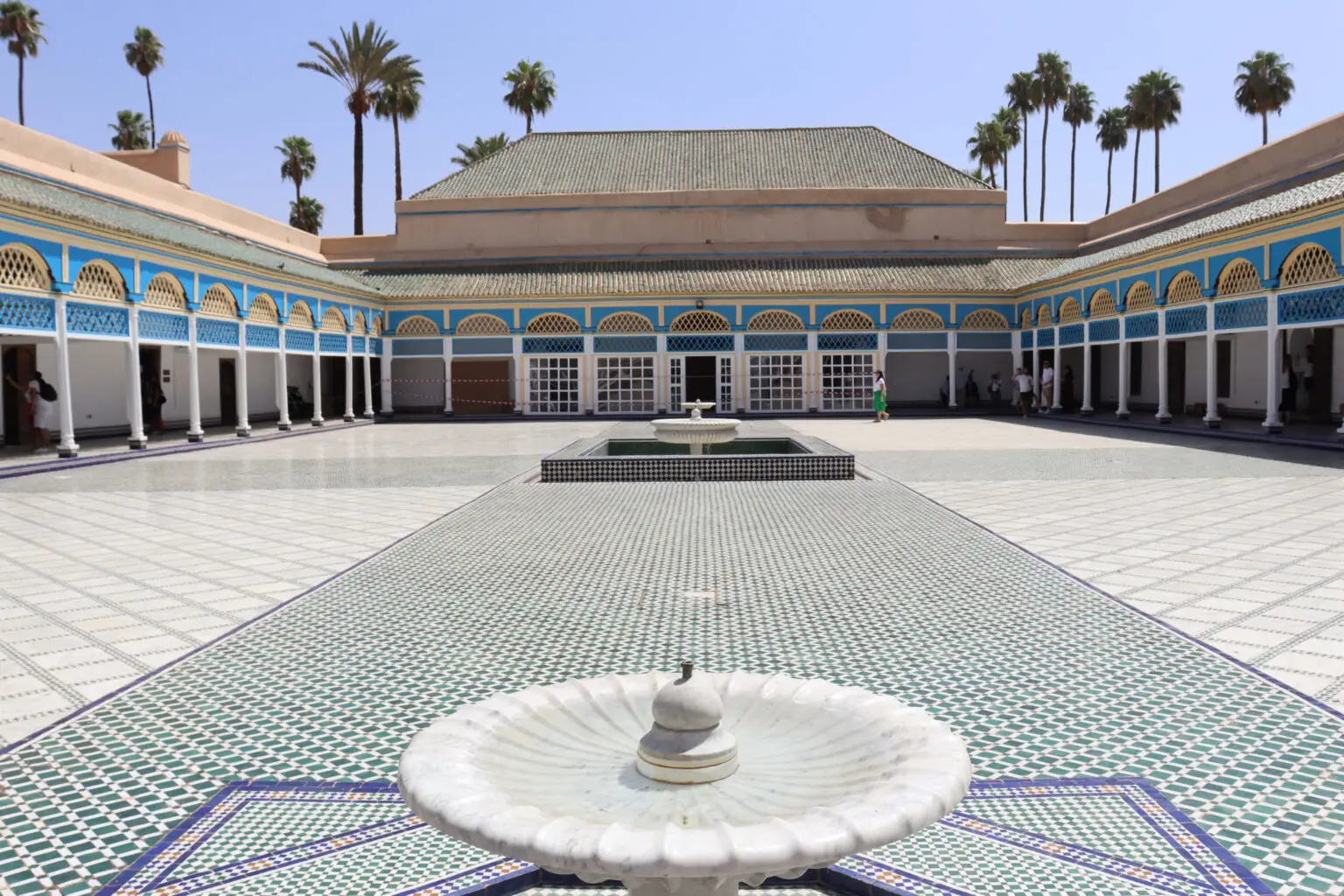
The Bahia Palace is a 19th-century vizier’s residence in the medina of Marrakech, built in stages between the 1860s and 1900. It holds about 150 rooms set around marble courtyards and riad gardens, and it is best known for its painted cedar ceilings. For travellers, it is the clearest window into how the country’s most powerful officials lived just before the French Protectorate.
Who built the Bahia Palace, and when?
The palace was the work of a father and his son. Si Musa, often written Si Moussa, served as chamberlain and then grand vizier under Sultan Muhammad ibn Abd al-Rahman, who reigned from 1859 to 1873. He began the palace in the 1860s, and an inscription in the Grand Riad dates its two main halls to 1866–67.
His son, Ahmad ibn Musa, known as Ba Ahmed, was chamberlain to Sultan Moulay Hassan I. When the young Abdelaziz took the throne in 1894, Ba Ahmed became grand vizier and the effective ruler of Morocco. He enlarged his father’s house piece by piece, buying land as it became available, until his death in 1900.
The palace stands just north of the Mellah, the old Jewish quarter. Its growth reshaped the surrounding streets, which is why it fits so well into a guided medina and souks walking tour.
What does Bahia mean?
In Arabic, al-Bahia means “the Brilliant”. It was reportedly also the name of Ba Ahmed’s favourite wife. Guides love this story, but it is best treated as tradition rather than firm record.
The name suits the building. Open courtyards, pale marble and coloured glass keep the rooms full of light.
The palace was also built almost entirely on one level. One explanation is that Ba Ahmed, described as stout, found stairs difficult. The few upper rooms you see today, such as the apartment above the Small Riad, were added later by Madani el-Glaoui.
What happened to the palace after Ba Ahmed died?
Ba Ahmed’s death in 1900 ended the palace’s golden age almost overnight. Within hours, Sultan Abdelaziz reportedly ordered it looted for valuables, which is why most rooms are bare today. In 1908, Madani el-Glaoui took control and used it to entertain foreign guests.
In 1912, under the new French Protectorate, it became the Marrakech residence of the resident-general, Lyautey. After independence, King Mohammed V used it as a royal residence, and under King Hassan II it passed to the Ministry of Culture, which opened it to visitors. The King still occasionally receives dignitaries or hosts events here.
| Date | Event |
|---|---|
| 1859–1873 | Reign of Muhammad ibn Abd al-Rahman; Si Musa serves as chamberlain, then grand vizier |
| 1866–67 | Inscription dates the Grand Riad halls built by Si Musa |
| 1873–1894 | Reign of Sultan Hassan I, with Ba Ahmed as his chamberlain |
| 1894 | Abdelaziz becomes sultan; Ba Ahmed becomes grand vizier and starts expanding the palace |
| 1896–97 | Grand Courtyard and Salle d’Honneur completed |
| 1898 | Private apartment built for Lalla Zaynab, Ba Ahmed’s first wife |
| 1900 | Ba Ahmed dies; the palace is looted and becomes royal property |
| 1908 | Madani el-Glaoui takes control and adds an upper floor to some parts |
| 1912 | Becomes the Marrakech residence of the French resident-general, Lyautey |
| 1985 | The Medina of Marrakesh, including the palace, is inscribed by UNESCO |
| September 2023 | Damaged in the earthquake; reopened to visitors in October 2023 |
How big is the Bahia Palace?
The main palace complex covers almost 2 hectares and holds about 150 rooms. You will often see a figure of 8 hectares online, but that does not describe the building you walk through today. The 2-hectare figure is the one given in scholarly sources.
The original estate did reach further. Ba Ahmed laid out a vast private park to the east, with a large water basin, reached from the palace by a bridge over the street. That land began as a Saadian-era garden called the Arsat Ben Chegra, and stables and a mosque with a minaret stood on the south side.
The plan feels like a maze because it grew in stages rather than to one design. If courtyard gardens are your thing, our Marrakech gardens guide pairs well with this visit.
What should you see inside?
The route leads from the entrance garden through the newer southern courtyards to the oldest garden in the north. Look out for these highlights:
- The Small Riad (Petit Riad), a square garden split by two crossing walkways, where one room served as Ba Ahmed’s council chamber.
- The Grand Courtyard, or Cour d’Honneur, measuring 50 by 30 metres and paved with Italian Carrara marble.
- The painted wooden galleries around it, which lead to some 80 rooms believed to have housed Ba Ahmed’s harem.
- The Salle d’Honneur at the courtyard’s east end, a 20-by-8-metre hall with some of the best ceiling paintings in the palace.
- The private apartment Ba Ahmed built in 1898 for his first wife, Lalla Zaynab.
- The Grand Riad, the oldest part, where trees planted in the 19th century still shade the garden.
The Salle d’Honneur is dated by inscription to 1896–97 and was probably the last major addition to the palace.
What makes the decoration so special?
The palace is famous above all for its surfaces. Cedar ceilings are painted with bright floral patterns, while walls carry carved stucco with Arabic inscriptions, geometric designs, arabesques and muqarnas. Floors mix marble with zellij, the cut-tile mosaic seen across Morocco.
Ba Ahmed sourced materials from all over the country. Marble came from Meknes, cedar from the Middle Atlas and tiles from Tetouan, and artisans were hired from many regions.
The architect was Muhammad ibn Makki al-Misfiwi, a native of Safi who lived from 1857 to 1926. To place these techniques in a wider story, read our Moroccan architecture guide before you go. You will spot the same craft traditions in riads and mosques all over the medina.
Was the Bahia Palace damaged in the 2023 earthquake?
Yes. The earthquake of 8 September 2023 caused cracks in the palace and a partial collapse in the Grand Riad and the Menzah, an upper floor. These details come from the palace’s curator, Hanane Labchir.
The palace reopened about one month after the quake, following emergency repairs. By 9 October 2023, the Bahia Palace, Badi Palace and Saadian Tombs were open again. Minister of Youth, Culture and Communication Mohamed Mehdi Bensaid oversaw the reopening.
A longer restoration programme followed the emergency work. Expect some scaffolding or closed corners while repairs continue.
How long should you allow, and when should you go?
The route is linear, so you cannot get lost, but the detail rewards slow looking. Allow enough time to sit in the Grand Riad and study at least one ceiling properly.
A visit to the Bahia Palace usually takes about one to one and a half hours. At the time of writing, the Ministry of Culture’s ticket page lists visiting hours of 9 am to 5 pm, and a ticket costs 100 dirhams for foreign adults and 50 dirhams for foreign children aged 7 to 13. Moroccan and resident adults pay 30 dirhams.
Here is our tip as a Marrakech-based team: arrive at opening time or in the later afternoon. Mid-morning tends to be busiest, and the courtyards feel very different when they are quiet. Bring some dirhams in cash, and check the day’s opening hours, since the palace still hosts official events.
A good guide changes the visit, because the rooms are empty and the stories live in the walls. Ba Ahmed’s brother Si Sa’id built his own palace just to the north, Dar Si Said, now a museum and an easy next stop.
Is the Bahia Palace worth visiting?
Yes, especially on a first trip to Marrakech. The palace lies inside the Medina of Marrakesh, which UNESCO inscribed as a World Heritage site in 1985. Government figures counted 410,141 visitors between January and April 2019.
Few places show late 19th-century Moroccan craft so completely in one building. The empty rooms surprise some visitors, but the ceilings, tiles and gardens more than fill them.
To build the palace into a wider day, browse all our activities in Marrakech, or ask us anything — we answer for free, with no obligation.
Sources and further reading
- UNESCO World Heritage Centre: Medina of Marrakesh
- Ministry of Culture of Morocco: Bahia Palace tickets
- Wikipedia: Bahia Palace
- Maroc.ma: Historic monuments in Marrakech undergo post-earthquake rehabilitation
- Morocco World News: Historical sites in earthquake-hit areas reopen for visitors
Frequently asked questions
Is the Bahia Palace a royal palace?
Not originally. It was built as a private residence for two grand viziers, Si Musa and his son Ba Ahmed, rather than for a sultan. It became royal property only after Ba Ahmed died in 1900.
After independence, King Mohammed V used it as a royal residence before it passed to the Ministry of Culture under King Hassan II. Today it is a public monument, though the King still occasionally uses it to receive foreign dignitaries or host events.
Why are the rooms of the Bahia Palace empty?
Within hours of Ba Ahmed’s death in 1900, Sultan Abdelaziz reportedly ordered the palace looted for its valuables. Furniture, carpets and movable treasures were taken and never returned.
What survives is the architecture itself: painted ceilings, carved stucco, zellij and marble floors. That makes the palace a lesson in decoration rather than a furnished period house. It is also why a knowledgeable guide adds so much, since objects no longer tell the stories.
Who designed the Bahia Palace?
The architect was Muhammad ibn Makki al-Misfiwi, originally from Safi, who was born in 1857 and died in 1926. He worked for Ba Ahmed, whose expansion ran from 1894 to 1900.
Craftsmen came from across Morocco, with marble from Meknes, cedar from the Middle Atlas and tiles from Tetouan. The oldest section, the Grand Riad, predates this work and belongs to Si Musa’s building of the 1860s.
Is the Bahia Palace open after the 2023 earthquake?
Yes. The palace reopened to visitors in October 2023, about a month after the earthquake of 8 September 2023.
The building did suffer real damage, including cracks and a partial collapse in the Grand Riad, and restoration work followed. Some areas may be behind scaffolding or temporarily closed, so stay flexible about which rooms you will see on the day.
Is the Bahia Palace a UNESCO World Heritage site?
Not on its own. The palace lies within the Medina of Marrakesh, which UNESCO inscribed on the World Heritage List in 1985. The listing covers the historic city as a whole, founded by the Almoravids in 1070–72.
In practice, that protection extends to the Bahia Palace and its neighbourhood. It shares the listing with other medina landmarks such as the Badi Palace and the Saadian Tombs.
