
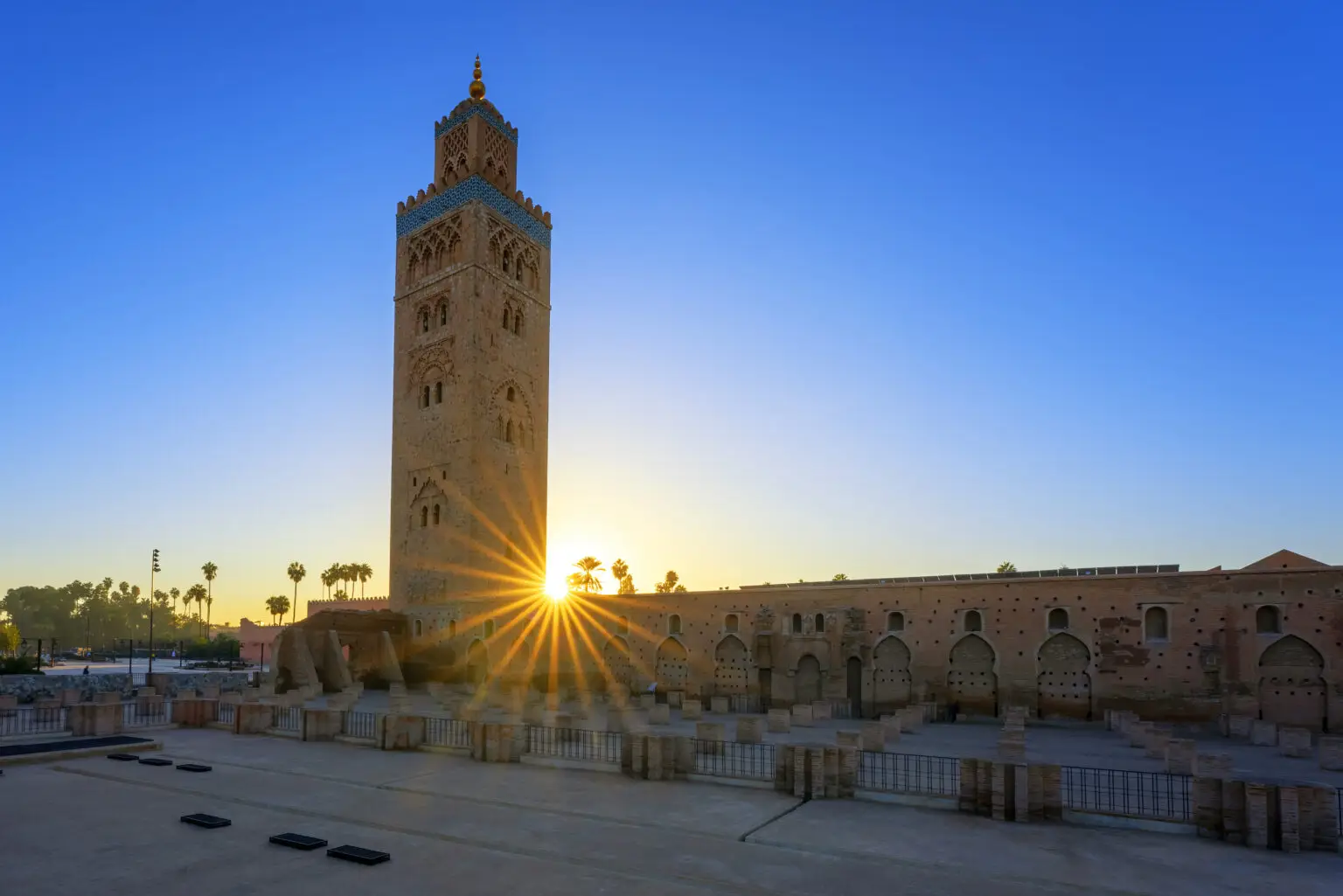
The Koutoubia Mosque is the great Almohad mosque of Marrakech and the city’s best-known landmark. Its 77-metre minaret has stood over the medina since the 12th century. The Almohad dynasty built it, and its tower became the model for great minarets in Rabat and Seville. This guide covers its history, its architecture and how to visit it with respect.
Who built the Koutoubia Mosque, and when?
The Almohad caliph Abd al-Mu’min founded the first mosque in 1147, right after he took Marrakech from the Almoravids. The city fell in April 1147, after a siege of several months. The new mosque rose next to the former Almoravid palace.
A second, larger mosque soon followed, built alongside the first. According to an account by Ibn Tufayl, reported by the historian al-Maqqari, work began in May 1158 (Rabi’ al-Thani 553 AH). The first Friday prayer was held in September of the same year (Sha’ban 553 AH).
The mosque you see today is this second building. It is a natural stop on a guided medina and souks walking tour, since it sits at the edge of the old city’s busiest streets.
Why are there two mosques side by side?
The most popular explanation concerns the qibla, the direction of prayer towards Mecca. Abd al-Mu’min reportedly found that the first mosque was misaligned by Almohad standards. Historians also suggest other motives, such as a growing population or the wish for a grander building.
Modern measurements add a twist. The first mosque faces an azimuth of about 154°, while the second faces about 159° or 161°. The true qibla from Marrakech is about 91°, nearly due east, so both buildings point far south of Mecca.
The two mosques differ by only 5 to 7 degrees, and the newer one actually sits further from the true direction. The ruins of the first mosque still lie on the esplanade beside the standing building. Remains of the Ksar al-Hajar, the Almoravid stone fortress built in 1070, were also uncovered on its northern side.
Why is it called the booksellers’ mosque?
The name comes from the Arabic word kutubiyyin, which means “booksellers”. It reflects the bookselling trade that once filled the nearby souk.
The streets at the foot of the mosque were once a busy book market. As many as 100 book vendors are said to have worked around its base. The stalls have long gone, but the name stayed with the building. That is why many English guides call it the Booksellers’ Mosque.
You will see two spellings on maps and in books: Koutoubia and Kutubiyya. They are simply two ways of writing the same Arabic name in Latin letters. Both refer to the same mosque.
How tall is the Koutoubia minaret?
The minaret reaches 77 metres including its spire. UNESCO’s listing for the Medina of Marrakesh, inscribed in 1985, calls it a “matchless minaret of 77 metres” and “the symbol of the City”.
The main shaft alone is 55.68 metres tall, on a square base of 12.81 metres per side. That gives a height-to-width ratio of slightly over 5 to 1, which marked a shift in minaret design in the Maghreb. The tower is built in sandstone rubble masonry.
Inside, six rooms are stacked one above another. A wide internal ramp climbs to the top, reportedly wide enough for the muezzin to ride a horse. A local ordinance bans high-rise buildings nearby, so the tower still dominates the skyline.
What details should you look for on the minaret?
The stonework rewards a slow look from the gardens. The minaret was once covered in pink Marrakshi plaster, but restorers removed it in the 1990s to expose the original stone. Here is what to spot:
- Blind arch panels that differ on each of the four faces.
- A top tier of four intersecting polylobed arches, identical on every side.
- A band of white and green tiles near the top of the shaft.
- Stepped merlons crowning the main shaft, like battlements.
- The small lantern tower and its finial of copper spheres, the largest about 2 metres across.
Local legend says the spheres are pure gold. In fact they are made of copper plating riveted together.
How did the Koutoubia shape other Almohad towers?
Historians still debate who completed the minaret. Some sources credit Abd al-Mu’min, who reigned until 1163. Others credit Ya’qub al-Mansur, who ruled from 1184 to 1199, and many date its completion to around 1195.
Its proportions and decoration became the Almohad standard. The Hassan Tower in Rabat, begun in 1191 under Ya’qub al-Mansur, was modelled on the Koutoubia minaret, like the Giralda of Seville. The Giralda was commissioned in 1171 and finished on 10 March 1198, when its finial was added.
The Hassan Tower was never completed and stands at 44 metres today. Our Moroccan architecture guide explains the arches, tiles and plaster work you will meet across the country.
What are the key dates in the Koutoubia’s history?
This timeline gathers the main events.
| Date | Event |
|---|---|
| 1070 | Almoravids build the Ksar al-Hajar stone fortress on the site |
| 1137 | Work begins in Córdoba on the minbar ordered by Ali ibn Yusuf |
| April 1147 | Almohads capture Marrakech; Abd al-Mu’min founds the first mosque |
| May to September 1158 | Second mosque built; first Friday prayer in Sha’ban 553 AH |
| c. 1195 | Minaret likely completed; attribution debated |
| 1962 | Minbar leaves the mosque; later displayed at El Badi Palace |
| 1985 | Medina of Marrakesh inscribed as a World Heritage Site |
| 8 September 2023 | Magnitude 6.8 earthquake damages the mosque |
| March 2024 | Mosque reopens after renovation work |
Where is the Koutoubia’s famous minbar today?
The mosque once held a celebrated carved wooden pulpit, or minbar. The Almoravid ruler Ali ibn Yusuf ordered it from a Córdoba workshop for his grand mosque in Marrakech. Production began in 1137 and is thought to have taken seven years.
After the Almohad conquest of 1147, the minbar moved to the new Koutoubia. It stayed there until 1962. It is now on public display at the El Badi Palace, the Saadian palace begun in 1578.
The minbar stands 3.86 metres tall and 3.46 metres long. An international team from the Metropolitan Museum of Art partly restored it in 1996 and 1997. It is well worth adding to your day if you enjoy craftsmanship.
Can non-Muslims visit the Koutoubia?
The Koutoubia is an active mosque, and non-Muslims are not allowed inside the prayer hall. Everyone is welcome to enjoy the exterior, the esplanade and the gardens around it, which are open public space.
A rose garden lies to the west and south of the mosque. On the same esplanade you will find the Koubba of Lalla Zohra, a small white domed building, and the low ruins of the first mosque.
The mosque stands about 200 metres west of Jemaa el-Fnaa, so the two pair naturally. Our Jemaa el-Fnaa guide covers the square in detail. Around the mosque, dress modestly and avoid photographing people at prayer.
Was the Koutoubia damaged in the 2023 earthquake?
Yes. On 8 September 2023, an earthquake of magnitude 6.8 struck the region and damaged the mosque. Cracks were reported in the minaret, though the tower did not fall.
The mosque reopened in March 2024 after renovation work was completed. UNESCO’s 2024 state of conservation report for the Medina of Marrakesh refers to the consolidation work undertaken for the Koutoubia Mosque.
For visitors, the result is reassuring. The minaret still frames the skyline as it has for over 800 years, and the gardens are open to stroll.
What is the best time to see it?
The minaret looks different through the day. Soft morning and late-afternoon light warms the sandstone, and the mosque is floodlit at night. Here are our tips for a good visit:
- Come early in the morning for quiet gardens and clear photos.
- Return at dusk, when the call to prayer rings out and the lights come on.
- Be discreet around the Friday midday prayer, the main congregational prayer of the week.
- Walk around all four sides to compare the different arch patterns.
- Carry water and a hat in summer, when Marrakech afternoons get very hot.
A tip from our team on the ground: skip the busy avenue side and step into the rose garden on the west side. The minaret fills the frame without traffic, and in late afternoon the sun lights its western face.
The Koutoubia is the best first stop for understanding Marrakech, because it tells the story of two dynasties in one place. Pair it with the square, the souks and the palaces to see how the city grew around it. You can browse all our activities in Marrakech, or ask us anything — we answer for free, with no obligation.
Sources and further reading
- UNESCO World Heritage Centre: Medina of Marrakesh
- Wikipedia: Kutubiyya Mosque
- Wikipedia: Minbar of the Kutubiyya Mosque
- Wikipedia: Marrakesh
- Wikipedia: Ishaq ibn Ali
Frequently asked questions
How tall is the Koutoubia Mosque minaret?
The minaret is 77 metres tall including its spire, a figure UNESCO uses in its World Heritage listing for the Medina of Marrakesh. The main square shaft measures 55.68 metres, on a base of 12.81 metres per side. A ban on high-rise buildings nearby keeps it the dominant feature of the skyline.
Who built the Koutoubia Mosque?
The Almohad caliph Abd al-Mu’min founded the first mosque in 1147, after capturing Marrakech that April. He then built the current, second mosque in 1158, with the first Friday prayer held in September of that year. The minaret’s builder is debated. Some sources name Abd al-Mu’min, while others credit Ya’qub al-Mansur, and many date its completion to around 1195.
Can tourists go inside the Koutoubia Mosque?
Non-Muslims cannot enter the prayer hall, because the Koutoubia is an active mosque. Visitors of any faith can walk around the outside, explore the esplanade and relax in the gardens. The ruins of the first mosque lie on the same esplanade. Dress modestly and avoid photographing worshippers.
How far is the Koutoubia from Jemaa el-Fnaa?
The mosque stands about 200 metres west of Jemaa el-Fnaa, so the walk takes only a few minutes. The minaret makes an easy landmark for finding your way. Many visitors pair them: the gardens in the morning, and the square in the evening, when its food stalls and performers are at their liveliest.
Are the balls on top of the minaret made of gold?
No. Legend says they are gold, and one story claims a ruler’s wife melted her jewellery to make one as penance for breaking her Ramadan fast. In fact the spheres are made of copper plating riveted together. The largest measures about 2 metres in diameter, so they look small only because the tower is so tall.
Where can I see the Koutoubia’s original minbar?
The 12th-century minbar is on display at the El Badi Palace in Marrakech. It was made in Córdoba for the Almoravid ruler Ali ibn Yusuf, with work starting in 1137. It moved to the Koutoubia after 1147 and stayed there until 1962. A team from the Metropolitan Museum of Art partly restored it in 1996 and 1997.
