
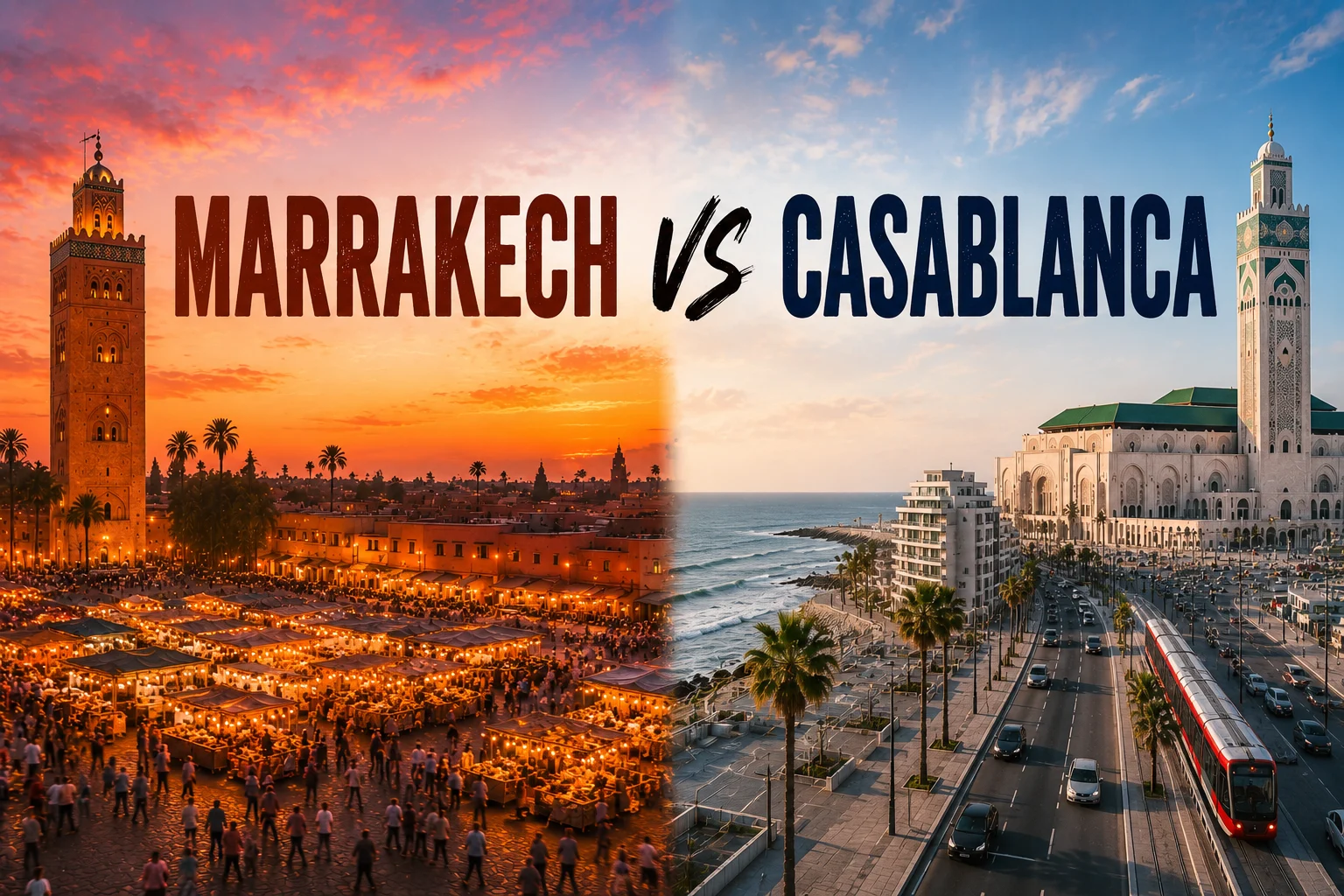
Marrakech ou Casablanca est la décision la plus discrètement importante que prend un voyageur qui découvre le Maroc, et celle sur laquelle la plupart des guides se trompent. Sur une carte, elles ressemblent à des villes sœurs ; sur place, elles ne le sont pas. L’une est une capitale impériale millénaire, pensée pour les voyageurs. L’autre est le moteur économique du pays, pensé pour les Marocains. Les deux valent le détour, mais une seule vaut votre voyage, selon ce que vous venez chercher.
Ce guide est la version que je donnerais à un ami, mise à jour pour 2026 avec les derniers chiffres de recensement et de trafic aérien. Pas de remplissage, pas de fausse équivalence, et pas question de prétendre que Casablanca a une médina qui vaut le détour quand Marrakech se trouve à trois heures de train. Entrons dans le vif du sujet.
La réponse en 30 secondes
Si vous disposez d’une semaine ou moins au Maroc et que c’est votre première visite : commencez par Marrakech. C’est elle que les voyageurs viennent chercher au Maroc, et c’est pour elle qu’ils font le voyage : la médina, les souks, les riads, la porte d’entrée vers l’Atlas et le Sahara. N’ajoutez Casablanca que si vous y atterrissez (c’est le cas de la plupart des voyageurs internationaux) ou si la mosquée Hassan II est incontournable pour vous.
Si vous disposez de deux semaines ou que vous revenez au Maroc, curieux de découvrir sa facette moderne : passez une journée complète à Casablanca, puis repartez. La ville se savoure lors d’une visite courte et ciblée, pas pendant une semaine.
Si vous voyagez pour affaires, pour une correspondance ou pour un week-end sur la côte, Casablanca est la bonne base ; Marrakech serait un mauvais choix.
Marrakech ou Casablanca en un coup d’œil
Voici la comparaison que la plupart des gens recherchent vraiment, présentée simplement. Les chiffres proviennent du recensement marocain de 2024 (HCP) et des statistiques de trafic aéroportuaire 2024 publiées par l’ONDA.
| Caractéristique | Marrakech | Casablanca |
|---|---|---|
| Population de la ville | ≈ 1,15 million | Plus grande ville du Maroc |
| Population de la région (HCP 2024) | Marrakech-Safi : 4,89 millions | Casablanca-Settat : 7,69 millions |
| Ambiance | Impériale, sensorielle, basse, médina à parcourir à pied | Moderne, tournée vers les affaires, côte atlantique, tours |
| Idéal pour | Premières visites, couples, combinés avec le désert, voyages photo | Amateurs d’architecture, voyageurs d’affaires, combinés plage + ville |
| Aéroport principal (trafic 2024) | Menara : 9,3 millions de passagers | Mohammed V : le plus grand hub du Maroc |
| Statut UNESCO | Médina inscrite au patrimoine mondial depuis 1985 | Centre-ville du XXe siècle sur la liste indicative de l’UNESCO |
| Site phare | Jemaa el-Fna + médina | Mosquée Hassan II |
| Potentiel comme base d’excursions | Élevé : porte d’entrée vers le Sahara, l’Atlas, Essaouira, Ouarzazate | Faible : la plupart des circuits partent d’ailleurs |
| Durée de séjour idéale | 3 à 5 jours | 1 jour, parfois 2 |
L’ambiance réelle de Marrakech
Marrakech, c’est le Maroc des cartes postales, et les cartes postales sont en dessous de la réalité. La médina fortifiée est un site du patrimoine mondial de l’UNESCO inscrit en 1985, et c’est toujours une vieille ville vivante et active : ateliers de cuir à côté des maisons de thé, un millier d’étals d’épices, des ânes prioritaires sur votre taxi. Le minaret de la Koutoubia domine tout, entre terre cuite et vert palmier. En fin d’après-midi, l’air sent la fleur d’oranger et la viande grillée.
Si vous souhaitez que nous l’organisions pour vous, découvrez notre circuit de 10 jours au Maroc depuis Casablanca.
Le cœur de la ville est Jemaa el-Fna, la grande place sur laquelle s’ouvre la médina. L’UNESCO l’a reconnue comme chef-d’œuvre du patrimoine oral et immatériel de l’humanité, une distinction culturelle rare réservée aux traditions vivantes. Le jour, c’est un marché de jus de fruits avec conteurs et charmeurs de serpents. Au crépuscule, elle se transforme en une immense aire de restauration en plein air d’une centaine d’étals, entre fumée et appel du muezzin. Il n’existe rien de comparable ailleurs au Maroc. Et sans doute nulle part ailleurs dans le monde.
Au-delà de la place, Marrakech est petite. L’essentiel de ce que vous êtes venu voir tient dans un triangle que l’on parcourt à pied en trois jours : le palais de la Bahia, les tombeaux saadiens, le Jardin Majorelle (à quelques minutes de taxi, dans la ville nouvelle), les tanneries et les souks qui rayonnent depuis la place. Ajoutez une journée dans les contreforts de l’Atlas ou un hammam de luxe, et vous avez une introduction presque parfaite au Maroc.
La contrepartie : Marrakech est intense. Il y fait chaud en été, c’est bondé en haute saison, et les souks sont faits pour marchander, pas pour flâner. Ceux qui détestent cette pression peuvent passer un moment difficile. Ceux qui s’y prêtent ne se remettent jamais tout à fait du plaisir qu’ils y ont pris.
L’ambiance réelle de Casablanca
Casablanca est la ville où vivent les Marocains. C’est un port atlantique, la capitale économique du pays, au cœur de la région Casablanca-Settat et de ses 7,69 millions d’habitants (HCP 2024), la plus grande concentration urbaine du Maroc. La célèbre médina existe, mais elle est petite, surtout résidentielle, et n’a qu’une fraction de la taille et du spectacle de celle de Marrakech. L’essentiel de la ville date du XXe siècle : avenues, immeubles, tramway, circulation.
Ce que Casablanca possède bel et bien , et que Marrakech n’a pas, ce sont deux choses qui valent la traversée du pays :
La première, c’est la Mosquée Hassan II, la deuxième plus grande mosquée en activité d’Afrique. Sa salle de prière accueille 25 000 fidèles et l’esplanade qui l’entoure 80 000 de plus, soit une capacité totale de 105 000 personnes selon la Fondation de la Mosquée Hassan II. Son minaret de 210 mètres est le plus haut édifice religieux d’Afrique et l’un des plus hauts du monde. C’est la seule grande mosquée du Maroc ouverte aux non-musulmans, lors de visites guidées organisées par la Fondation selon un horaire fixe, avec un billet adulte étranger actuellement à 140 dirhams.
Le deuxième, c’est le quartier Art déco du centre-ville, le quartier moderniste franco-marocain du début du XXe siècle, le long du boulevard Mohammed V et autour de la place Mohammed V. Il figure actuellement sur la liste indicative du patrimoine mondial de l’UNESCO sous le nom « Casablanca, ville du XXe siècle », une reconnaissance de l’un des ensembles urbains Art déco et néo-mauresques les plus cohérents au monde. Si l’architecture vous intéresse, c’est une vraie raison de venir.
La Corniche, la promenade du front de mer qui part vers l’ouest depuis la mosquée, est là où les Casablancais eux-mêmes passent leurs week-ends. On y trouve les meilleurs restaurants de fruits de mer de la ville, des vues sur l’océan et une atmosphère plus proche de Lisbonne ou de Tel-Aviv que de Marrakech.
Les sites phares, côte à côte
Le moyen le plus rapide de savoir quelle ville vous convient est de regarder ce que proposent vraiment leurs attractions principales.
Marrakech vous offre Jemaa el-Fna au coucher du soleil, les souks de la médina, le palais de la Bahia (une résidence de vizir du XIXe siècle dont les stucs et les zelliges redéfiniront votre idée de la beauté), les tombeaux saadiens (mausolées royaux du XVIe siècle), les jardins Majorelle et Yves Saint Laurent, la médersa Ben Youssef et, à 90 minutes de voiture, les contreforts du Haut Atlas. C’est dense, à parcourir à pied, et visuellement saisissant dans le meilleur sens du terme. Le détail complet, avec les horaires et l’ordre des visites, se trouve dans notre guide des meilleures choses à faire à Marrakech .
Casablanca vous offre la mosquée Hassan II (la pièce maîtresse), le centre-ville Art déco, la Corniche, la petite ancienne médina, la cathédrale du Sacré-Cœur (une église Art déco désacralisée qui se visite) et le Morocco Mall à l’extrémité ouest. Avec un itinéraire bien pensé, cela fait une longue journée satisfaisante. Pas une semaine satisfaisante. Pour un regard plus approfondi sur ce que propose la ville, notre avis honnête sur l’intérêt de visiter Casablanca passe en revue chaque site avec un vrai verdict.
Cuisine : où mangerez-vous le mieux ?
C’est la comparaison surprise. Les deux villes ont leurs points forts, et ce ne sont pas les mêmes.
Marrakech est la spécialiste de l’expérience marocaine la plus romantique : tajine et pastilla dans la cour d’un riad éclairée aux bougies, menu dégustation dans un restaurant comme Nomad ou La Maison Arabe, méchoui d’agneau tiré des fours de la médina et jus d’orange de la place à moins d’un euro. La nourriture des étals nocturnes de Jemaa el-Fnaa est inégale, mais inoubliable quand on trouve le bon (cherchez ceux où des locaux sont attablés et commandez la merguez grillée ou la harira).
Casablanca est la meilleure ville du Maroc pour les fruits de mer. Point final. Les restaurants de plage de la Corniche et des adresses historiques comme Le Cabestan ou À ma Bretagne servent de la dorade et du vivaneau grillés arrivés le matin même. Les bistrots de la ville, héritage de son passé français, font mieux la cuisine fusion franco-marocaine que n’importe quelle adresse de Marrakech. Si vous mangez peu de viande et adorez le poisson, vous préférerez Casablanca à table.
Où loger
À Marrakech, la réponse est un riad. Un riad est une maison traditionnelle à patio transformée en petite maison d’hôtes : généralement quatre à dix chambres autour d’une cour à ciel ouvert avec fontaine, souvent avec un toit-terrasse. Séjourner dans un riad de la médina coûte de 40 à 400 euros la nuit, et c’est l’une des vraies raisons pour lesquelles on tombe amoureux de Marrakech. Il existe des hôtels corrects dans la Ville Nouvelle, mais vous passeriez à côté de l’essentiel.
À Casablanca, la réponse est un hôtel. Il n’y a pas de riads traditionnels dignes de ce nom : le caractère de la ville est moderne. Les chaînes internationales le long de la Corniche et au centre-ville (Hyatt, Sofitel, Four Seasons) sont bien tenues, de standing affaires et pratiques pour la mosquée et l’aéroport. Il existe des hôtels de charme dans le quartier des Habous. Comptez 70 à 250 euros pour une chambre confortable de milieu de gamme.
Budget : ce que vous dépenserez vraiment
Les deux villes sont abordables selon les standards européens ou nord-américains. La différence, c’est de savoir où va l’argent.
À Marrakech, l’hébergement coûte moins cher à qualité égale (une belle chambre de riad avec vue sur le patio coûte 80 à 150 euros la nuit ; l’équivalent dans les meilleurs hôtels de Casablanca est plutôt de 120 à 220 euros). Les repas dans la médina vont de 5 euros à un stand à 40 euros dans un restaurant de riad haut de gamme. Les souks permettent de dépenser facilement beaucoup en tapis, cuir et céramiques si vous les laissez faire.
À Casablanca, les hôtels et les dîners de fruits de mer sont plus chers ; le transport est moins cher, car la ville dispose de petits taxis et d’un tramway réellement utilisable. Un budget quotidien raisonnable pour un voyage confortable de milieu de gamme est de 100 à 180 euros par personne à Marrakech, et de 130 à 220 euros par personne à Casablanca.
Météo : quand chaque ville est à son meilleur
Les deux villes ont des climats nettement différents, et cela doit guider le choix de vos dates.
Marrakech a un climat chaud, sec et continental. En été, les journées atteignent régulièrement 38 à 40 °C et peuvent monter plus haut ; en hiver, les journées sont douces et agréables, avec des maximales un peu en dessous de 20 °C, avec des nuits fraîches. Les meilleurs mois vont de mars à mai et de septembre à novembre : chaud sans être étouffant, avec de longs après-midi dorés. De juin à août, la médina reste praticable à l’aube et au crépuscule, mais la mi-journée est éprouvante. Décembre et janvier sont calmes et bon marché, mais froids selon les standards marocains.
Casablanca a un climat atlantique, plus doux toute l’année. L’océan maintient les températures estivales autour de 25 °C et les hivers au-dessus de zéro. L’été (de juin à septembre) est la haute saison de la ville : la Corniche et les plages s’animent. L’hiver apporte pluie et ciel gris, mais jamais d’extrêmes. Si vous voyagez en juillet ou en août et ne supportez pas la chaleur de Marrakech, Casablanca devient un vrai argument.
Aller de l’une à l’autre
Les deux villes sont distantes d’environ 240 kilomètres. L’ONCF, l’opérateur ferroviaire marocain, assure la liaison Al Atlas entre elles environ toutes les heures, avec un temps de trajet d’environ 2 h 38 et des billets en seconde classe généralement sous les 150 dirhams. Le train à grande vitesse Al Boraq ne dessert pas actuellement ce corridor : il relie Casablanca à Tanger via Kénitra, sur une ligne distincte de 323 kilomètres, même si une extension vers Marrakech a été annoncée.
Par l’autoroute A7, le trajet prend environ 2 h 30 ; les transferts privés coûtent de 80 à 130 euros l’aller simple. Beaucoup de voyageurs font d’abord Marrakech, puis prennent le train vers le nord jusqu’à Casablanca pour repartir de l’aéroport Mohammed V. C’est une combinaison simple et efficace.
Quelle ville pour qui ?
Voici la logique de choix, en termes simples.
Premier voyage au Maroc : Marrakech, sans hésitation. C’est l’expérience que les voyageurs viennent chercher et la meilleure base pour tout ce que le Maroc offre d’autre : désert, Atlas, côte, villages berbères.
Couples et jeunes mariés : Marrakech. Les riads, les dîners sur les toits, la proximité des camps de luxe du Sahara, les excursions dans l’Atlas. Casablanca n’est pas romantique de la même manière.
Familles avec de jeunes enfants : Surtout Marrakech pour l’aventure sensorielle, mais la Corniche, les plages et le Morocco Mall de Casablanca apportent une vraie variété. Une répartition 4-3 (quatre jours à Marrakech, trois sur la côte) fonctionne bien.
Voyageurs solo, femmes comprises : Les deux villes sont sûres et se parcourent à pied en journée. Marrakech est plus enrichissante socialement, car la médina est pleine d’autres voyageurs et il est facile de rejoindre des activités en groupe (cours de cuisine, hammams, excursions à la journée).
Voyageurs d’affaires et participants à des congrès : Casablanca, évidemment. L’essentiel de la vie des entreprises, de la banque et des services consulaires du Maroc se passe ici. Marrakech, c’est pour le week-end après les réunions.
Passionnés d’architecture et de design : Les deux, et c’est la seule catégorie où la réponse est vraiment à égalité. Marrakech pour le patrimoine islamique et andalou ; Casablanca pour les bâtiments Art déco et néo-mauresques de l’époque coloniale.
Amateurs de plage : Ni l’une ni l’autre, à proprement parler : Marrakech est dans les terres, et les plages de Casablanca sont urbaines, au sable gris. Si la plage est une priorité, associez l’une ou l’autre ville à Essaouira ou Agadir.
La meilleure option : les combiner
Pour la plupart des voyageurs disposant d’une semaine ou plus, la bonne réponse n’est pas Marrakech ou Casablanca, mais Marrakech et une journée à Casablanca, avec le désert entre les deux.
Un itinéraire réaliste de 7 jours : arrivée à Mohammed V, train direct pour Marrakech (ne gaspillez pas vos premières 24 heures de décalage horaire à Casablanca), trois jours dans la ville rouge : notre itinéraire de 3 jours à Marrakech est un modèle qui fonctionne : faites ensuite une boucle de 3 jours dans le Sahara jusqu’à Merzouga et retour via Aït Benhaddou, puis prenez le train du matin pour Casablanca et consacrez une demi-journée à la mosquée et au quartier Art déco avant votre vol du soir. Avec dix jours, vous pouvez ajouter Fès ou Essaouira. Avec deux semaines, vous pouvez vraiment prendre votre temps.
Vous hésitez entre les villes marocaines ? Voir Marrakech ou Fès et Marrakech ou Agadir.
Questions fréquentes
Marrakech est-elle meilleure que Casablanca pour les touristes ?
Pour la plupart des touristes qui viennent pour la première fois, oui. Marrakech offre la médina, les souks, les riads, la proximité du désert et des montagnes de l’Atlas, et cette expérience sensorielle concentrée qui définit le voyage au Maroc. Casablanca est plus utile comme ajout d’une journée pour la mosquée Hassan II et l’architecture Art déco que comme destination principale. L’exception, ce sont les voyages d’affaires, pour lesquels Casablanca est clairement la meilleure base.
Faut-il atterrir à Casablanca ou à Marrakech ?
Choisissez l’aéroport qui offre le meilleur tarif et la meilleure correspondance pour votre trajet. Mohammed V, à Casablanca, est le principal hub international du Maroc, avec davantage de liaisons long-courriers. Marrakech Menara a accueilli 9,3 millions de passagers en 2024 et dispose de nombreuses liaisons européennes. Si vous arrivez à Casablanca, prenez directement le train ONCF pour Marrakech (environ 2 h 38) plutôt que de passer votre premier jour à Casa : votre décalage horaire mérite la médina, pas un quartier d’affaires.
Combien de jours faut-il prévoir à Casablanca ?
Une journée complète suffit à la plupart des voyageurs, deux jours au maximum. L’expérience phare est la visite guidée de la mosquée Hassan II, qui dure environ une heure. Ajoutez une balade dans le centre-ville Art déco, un déjeuner sur la Corniche et une flânerie dans l’ancienne médina, et vous aurez une journée bien remplie. Aller au-delà de deux jours n’a de sens que pour les passionnés d’architecture ou les séjours d’affaires.
Combien de jours faut-il prévoir à Marrakech ?
Trois journées complètes sont idéales pour une première visite, et cinq jours sont parfaits si vous voulez ajouter une excursion dans l’Atlas ou à Essaouira. Une journée ne suffit pas : la médina mérite à elle seule une demi-journée, plus une soirée à part pour Jemaa el-Fna. Deux jours sont un minimum serré qui convient aux courtes escales. Au-delà de cinq jours, l’intérêt diminue, sauf si vous utilisez Marrakech comme base pour le Sahara ou d’autres excursions.
Casablanca est-elle sûre pour les touristes ?
Casablanca est généralement sûre pour les touristes en journée, y compris la Corniche, les abords de la mosquée et le quartier Art déco du centre-ville. Les précautions urbaines habituelles s’appliquent : les petits vols et les pickpockets existent dans les zones animées comme l’ancienne médina et autour de la gare. Il est déconseillé de marcher seul tard le soir dans les quartiers moins centraux. Le Foreign Office britannique et le Département d’État américain classent tous deux le Maroc dans une catégorie de risque faible, sans avertissement particulier concernant Casablanca.
Existe-t-il un train à grande vitesse entre Marrakech et Casablanca ?
Pas pour le moment. La ligne à grande vitesse marocaine Al Boraq ne relie que Casablanca et Tanger, sur un corridor dédié de 323 kilomètres. La liaison Casablanca–Marrakech est assurée par le train intercités classique Al Atlas, qui parcourt les 240 kilomètres en 2 h 38 environ, avec des départs à peu près toutes les heures. Le Maroc a annoncé une extension du réseau Al Boraq vers le sud jusqu’à Marrakech, mais cette ligne n’est pas encore en service.
Peut-on combiner Marrakech et Casablanca en un seul voyage ?
Oui, et la plupart des voyageurs devraient le faire. L’itinéraire classique consiste à atterrir à Casablanca, prendre le train le jour même pour Marrakech (la médina sert de première impression), passer trois à cinq jours à explorer Marrakech et ses environs en excursions, puis revenir à Casablanca pour une journée avant le vol retour. La liaison ferroviaire rend cela presque sans effort. Ajouter une boucle dans le Sahara depuis Marrakech au milieu en fait un premier itinéraire au Maroc presque parfait.
Si vous souhaitez que le reste de votre voyage au Maroc soit préparé avec le même soin (un chauffeur privé, un riad choisi avec soin dans le bon quartier de Marrakech, une nuit dans le Sahara dans un vrai camp de luxe plutôt que dans une tente pour touristes), c’est ce que nous faisons. Découvrez notre circuit privé dans le désert au départ de Marrakech, demandez un devis, ou écrivez-nous simplement posez-nous une question : nous vous répondrons gratuitement, sans engagement. Dans tous les cas, faites un excellent premier voyage. Le Maroc récompense les voyageurs qui prennent leur temps, et vous avez déjà commencé en vous posant la bonne question.
Sources : Haut-Commissariat au Plan (HCP), Recensement général de la population et de l’habitat 2024 ; Office national des aéroports (ONDA), statistiques de trafic 2024 ; Fondation de la Mosquée Hassan II ; Centre du patrimoine mondial de l’UNESCO ; conseils aux voyageurs pour le Maroc du Foreign, Commonwealth & Development Office britannique et du Département d’État américain. Les liens externes s’ouvrent dans un nouvel onglet.
