
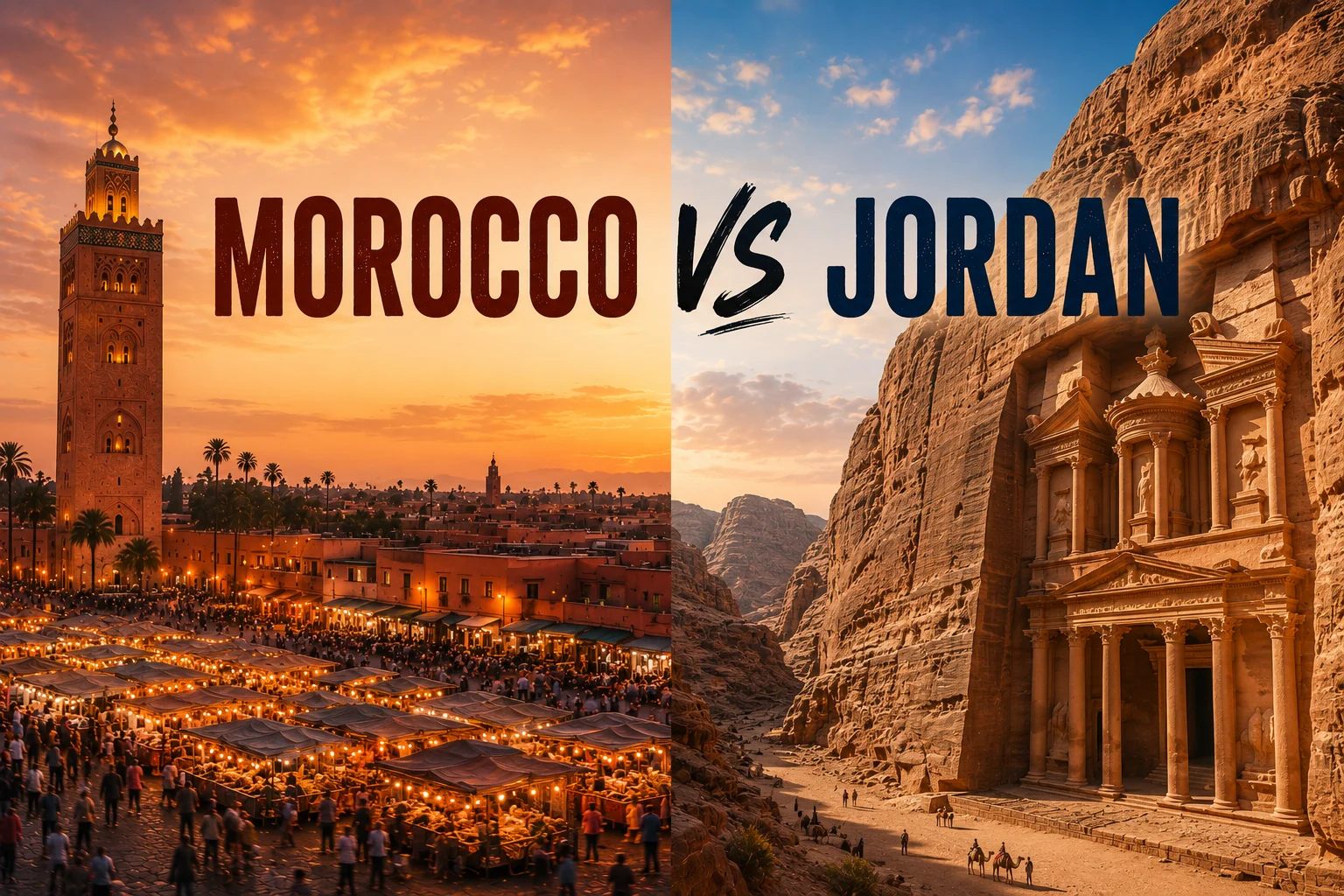
Deux pays, deux grands déserts, deux civilisations anciennes taillées à même le grès. Le Maroc et la Jordanie partagent un héritage arabe, une hospitalité ancrée dans le thé à la menthe et des paysages qui semblent venir d’une autre planète. Les voyageurs les comparent souvent — généralement parce qu’ils n’ont qu’un seul grand voyage Moyen-Orient / Afrique du Nord en tête et juste assez de congés pour un seul pays.
Alors, lequel choisir vraiment ? Après des années passées à accompagner des voyageurs au Maroc — et après avoir vu des dizaines de clients hésiter entre la Jordanie et nous — voici la comparaison honnête, sans baratin commercial et sans la non-réponse « les deux sont géniaux ! » que les blogs de voyage adorent.
En bref : en 2026, pour la plupart des voyageurs, le Maroc l’emporte sur l’accessibilité, le coût, les avis de sécurité actuels et la durée du voyage. La Jordanie l’emporte sur une expérience bien précise : Pétra, une rencontre archéologique unique dans une vie, qui n’a tout simplement pas d’équivalent au Maroc. La version détaillée se trouve ci-dessous.
Le tableau récapitulatif rapide
| Facteur | Maroc | Jordanie |
|---|---|---|
| Population | ~36,8 millions (recensement HCP 2024) | ~11,6 millions (Banque mondiale 2024) |
| Arrivées de touristes (2024) | 17,4 millions (+20 % en glissement annuel) | 6,1 millions (−3 % en glissement annuel) |
| Visa pour US/UK/UE/CA/AU | Sans visa jusqu’à 90 jours | Visa à l’arrivée 40 JOD (~56 $) ou gratuit avec le Jordan Pass (3 nuits minimum) |
| Sites du patrimoine mondial de l’UNESCO | 9 (tous culturels) | 7 (6 culturels, 1 mixte) |
| Désert emblématique | Erg Chebbi (champ de dunes d’environ 28 km, Merzouga) | Wadi Rum (zone protégée de 74 000 ha) |
| Site archéologique phare | Ksar d’Aït Benhaddou, ruines romaines de Volubilis | Pétra (cité nabatéenne taillée dans la roche) |
| Littoral | ~1 800 km sur l’Atlantique et la Méditerranée | ~27 km sur la mer Rouge (Aqaba) |
| Vol d’entrée typique (depuis l’Europe) | 3 à 4 heures, nombreuses options low-cost | 4 à 5 heures, principalement des compagnies traditionnelles |
| Monnaie (référence mai 2026) | 1 USD ≈ 9,2 dirhams (MAD) | 1 USD ≈ 0,71 dinar (JOD, indexé sur l’USD) |
| Coût d’entrée équivalent à Pétra | Aït Benhaddou gratuit ; Volubilis ~70 MAD (~8 $) | Pétra 50 JOD/jour (~70 $) pour les visiteurs hébergés sur place |
| Conseil aux voyageurs du FCDO britannique (état en mai 2026) | Aucun avertissement contre les zones touristiques | Déconseille tout voyage sauf essentiel |
Cette dernière ligne compte beaucoup en 2026 et mérite sa propre section.
La situation sécuritaire en 2026 — à lire en premier
Une décision de voyage ne se résume pas à la beauté d’un pays. Elle dépend aussi de la validité de votre assurance, du maintien de vos vols et de ce que dit votre ministère des Affaires étrangères.
Quand vous êtes prêt à organiser votre voyage, parcourez tous nos circuits dans le désert marocain.
As of this writing, the UK Foreign, Commonwealth & Development Office advises against all but essential travel to most of Jordan, and against all travel to within 3 km of the Syrian border. The advisory cites regional tensions and intermittent airspace disruption at Queen Alia International Airport in Amman. The full, current notice is published at the UK government’s Jordan travel advice page and is updated as the situation evolves. A live FCDO advisory of this nature typically invalidates standard UK travel insurance for non-essential trips — meaning a delay, cancellation, or medical incident could land on you personally.
En revanche, ce même FCDO britannique ne maintient aucun avis équivalent contre les voyages touristiques vers les destinations phares du Maroc : Marrakech, Fès, l’Atlas, la côte et les routes du Sahara relèvent toutes du niveau standard « prendre les précautions habituelles ». Le Département d’État américain maintient pour le Maroc un avis de niveau 2 « faire preuve d’une vigilance accrue », le même niveau qu’il applique à la France, à l’Italie et à l’Espagne. Vous pouvez vérifier les deux sur travel.state.gov for Morocco and the FCDO page above.
C’est le facteur le plus important en 2026 pour les voyageurs qui hésitent entre les deux pays. Si l’avis change, votre calcul change avec lui — vérifiez toujours les deux sources dans les 72 heures précédant votre réservation.
Les sites phares — Pétra et Aït Benhaddou (et pourquoi ce n’est pas la bonne comparaison)
Petra is in a league of its own. The Nabataean rock-cut city was inscribed by UNESCO in 1985 and described by the agency as one of the most precious cultural properties of human heritage. The walk through the Siq — a 1.2 km natural sandstone gorge — opening onto the Al-Khazneh (“Treasury”) façade is one of those experiences that earns its hype. At its first-century peak, Petra had an estimated 20,000 inhabitants and sat at the heart of the incense trade routes between Arabia and the Mediterranean. There is nothing like it in Morocco.
Morocco’s archaeological offerings are different in kind, not lesser in worth. Aït Benhaddou, a fortified ksar of earthen clay along the old Marrakech-to-Sahara caravan route, has been UNESCO-listed since 1987 and is one of the most photographed mudbrick villages on earth (you have likely seen it in Gladiator, Game of Thrones, ou La Momie). Volubilis, near Meknes, holds some of the best-preserved Roman mosaics in North Africa. The medinas of Fes (1981) and Marrakech (1985) are living UNESCO sites — meaning real people still live in 1,200-year-old urban fabric, not behind a ticket booth.
Si vous rêvez d’« un seul monument antique à couper le souffle », la Jordanie l’emporte. Si vous recherchez « deux semaines de richesse culturelle cumulée, médina après médina, kasbah après kasbah », c’est le Maroc qui gagne.
Les deux déserts — Erg Chebbi et Wadi Rum
C’est la comparaison sur laquelle la plupart des voyageurs se concentrent, et c’est aussi la plus serrée.
Wadi Rum is a 74,000-hectare protected area in southern Jordan, inscribed by UNESCO in 2011 as one of the rare “mixed” cultural-and-natural sites. It is a sandstone-and-granite valley landscape — towering cliffs, narrow gorges, natural arches, and 25,000 ancient rock carvings spread across 12,000 years of human occupation. It was Lawrence of Arabia’s stage during the Arab Revolt. It is also where Hollywood films The Martian, Dune, et Star Wars: The Rise of Skywalker. The atmosphere is monumental, hard-edged, almost Martian.
Erg Chebbi, near Merzouga in southeastern Morocco, is a different desert entirely. It’s a sea of soft orange sand dunes roughly 28 km north-to-south and 5–7 km east-to-west, with crests rising to about 160 m. There are no cliffs, no arches, no rock carvings — just shifting dunes that change color through the day, Berber nomads who still tend camels in the surrounding hammada, and a horizon that goes on forever. The atmosphere is rounded, romantic, almost liquid.
Choisissez le Wadi Rum si vous aimez la géologie, les paysages spectaculaires et l’esthétique cinématographique du grès. Choisissez l’Erg Chebbi si vous voulez les dunes classiques du Sahara, des balades à dos de chameau plus longues et la culture villageoise des Berbères Aït Khebbach, qui vivent autour des dunes depuis des siècles. Les coûts diffèrent aussi : une nuit dans un camp bédouin du Wadi Rum coûte généralement 60 à 120 JOD par personne (85 à 170 $). Une nuit de luxe comparable à l’Erg Chebbi revient à 80 à 180 USD par personne dans le haut de gamme des camps avec lesquels Moratra travaille, et nettement moins dans le cadre d’un circuit standard.
Le coût du voyage — les vrais chiffres
Le Maroc est nettement moins cher que la Jordanie, surtout une fois additionnées les grandes expériences phares.
The most concrete example: Petra entry alone is 50 JOD ($70) for one day if you are staying overnight in Jordan, rising to 60 JOD ($85) for three consecutive days. Day-trippers without an overnight stay in Jordan pay 90 JOD ($127) for one day. By contrast, Morocco’s headline sites are mostly free (Aït Benhaddou, the Jemaa el-Fnaa, every medina) or charge 70–100 MAD (~$8–$11) for a Volubilis or a Bahia Palace entry. Across a typical two-week trip, this difference compounds into several hundred dollars per person.
The Jordan Pass softens the visa-plus-attractions math: at 70–80 JOD ($99–$113) it bundles your visa, Petra entry, and 40+ other sites, and is the single best deal in Jordan for travelers staying three nights or more. You must buy it online before you arrive. The official price tiers are on the Jordan Pass packages page.
Le coût quotidien (repas, transport, hôtel milieu de gamme) se situe environ ainsi :
- Maroc milieu de gamme : $70–$120 per person per day, including a comfortable riad, restaurant meals, and shared transfers.
- Jordanie milieu de gamme : $110–$170 per person per day, including a 3-star hotel, restaurant meals, and shared transfers.
- Maroc haut de gamme : $200–$400 per person per day, palace-style riads and private drivers.
- Jordanie haut de gamme : $300–$550 per person per day, Dead Sea resorts and Petra-area Movenpick-class hotels.
Si votre voyage est une grande dépense ponctuelle et que votre budget est figé, le Maroc vous offre généralement plus de jours, plus de nuits dans des hébergements vraiment beaux et plus de flexibilité.
Combien de temps prévoir — et comment faire les deux
Jordan is geographically small. The classic loop — Amman, Jerash, Madaba, the Dead Sea, Petra, Wadi Rum, Aqaba — fits comfortably into 7 to 9 days. Beyond that, you are repeating yourself or padding the trip with the Red Sea coast. Many travelers find Jordan a perfect one-week add-on to a larger Middle East itinerary (Egypt, Israel in calmer years, the Gulf).
Le Maroc est environ quatre fois plus grand en superficie et compte quatre ou cinq « régions » de voyage distinctes qui méritent chacune leur propre temps. Marrakech et le Sud (Sahara, Atlas, Aït Benhaddou) demandent une semaine à eux seuls. Fès et le Nord impérial en demandent une autre. La côte atlantique (Essaouira, Casablanca, El Jadida) prend trois ou quatre jours. Tanger, Chefchaouen et les montagnes du Rif, trois de plus. Un vrai voyage au Maroc dure de 10 à 18 jours ; un aperçu rapide, de 5 à 7. Nous détaillons les combinaisons de régions dans our Morocco tour collection.
Certains voyageurs tentent de faire les deux pays en un seul voyage via Le Caire ou Istanbul. Nous le déconseillons sauf si vous disposez de trois semaines pleines et d’une tolérance inhabituelle aux journées de transit. Les deux pays méritent des voyages séparés.
Climat et meilleure période pour visiter
Les climats se ressemblent dans la forme — étés chauds, hivers frais, deux belles fenêtres aux mi-saisons — mais les amplitudes diffèrent.
Morocco’s coastal cities stay mild year-round (15–25 °C / 59–77 °F in Casablanca and Essaouira). Marrakech bakes to 38–42 °C (100–108 °F) in July and August but is delightful from March through May and October through November. The Sahara is best from October to early April; midsummer dune temperatures regularly exceed 45 °C (113 °F).
Jordan is hotter in the desert and colder in the highlands. Amman and Petra sit at altitude (around 800–950 m) and see snow in January. Wadi Rum is brutally hot in summer (often 40 °C / 104 °F+) and cold at night in winter (around freezing). Best windows: late March to mid-May, and mid-September to early November.
Sweet-spot months that work well for both countries: April and October. If you are choosing a Sahara-focused Morocco trip specifically, our guide to Sahara desert tours from Morocco covers the seasonal nuances in detail.
Cuisine, hospitalité et texture du quotidien
Les deux pays ont une culture d’hospitalité chaleureuse, ancrée dans la famille. Les textures diffèrent.
Moroccan cuisine is more varied and more vegetable-forward: tagines, couscous on Fridays, harira soup, pastilla, slow-cooked mechoui lamb, plus an Atlantic seafood scene in Essaouira and Casablanca that Jordan simply cannot offer. Tea culture is mint-and-sugar Berber-style.
Jordanian cuisine sits in the broader Levantine family: mansaf (the national dish — lamb, jameed yogurt sauce, rice), maqlouba, mezze of hummus and labneh, falafel from Hashem in Amman, kunafa for dessert. It is excellent, just smaller in repertoire than Morocco’s.
Hospitality structure is similar. In both countries, a guest is sacred. Locals will offer tea to strangers, point lost tourists three streets out of their own way, and refuse tips on the first pass. The differences are linguistic: Morocco is bilingual (Arabic + French nationally, English commonly in tourism), while Jordan is monolingual Arabic with English in tourist-facing roles only.
Pour chaque type de voyageur
Premier voyage dans le monde arabe : Morocco. Easier visa, easier flights, easier language situation (French helps if you have any), and gentler price curve. If you also want to weigh Morocco against another classic Arab destination, our comparatif Maroc contre Égypte covers that one too.
Passionné d’archéologie : Jordan, if the FCDO advisory eases. Petra alone justifies the trip.
Voyageur centré sur le désert : Slight edge to Morocco — longer dune fields, more developed camp infrastructure at Erg Chebbi, and you can combine the Sahara with imperial cities in a single loop. Wadi Rum wins on raw drama.
Famille avec enfants de 6 à 12 ans : Morocco. More variety per day, friendlier walking distances in the medinas, easier food options for picky eaters.
Photographe : A near-tie. Wadi Rum and Petra are unbeatable subjects. Morocco offers a wider range of subjects across one country (medinas, mountains, desert, coast, mosques, kasbahs).
Voyageuse seule : Both countries are workable with normal MENA-region preparation. Morocco has more visible solo female travelers and a more developed riad-and-hammam ecosystem suited to solo trips.
Budget inférieur à 1 500 $ par personne pour 10 jours : Morocco, comfortably. The same budget in Jordan stretches more thinly.
La conclusion honnête
Si vous devez en choisir un seul en 2026, choisissez le Maroc. L’avis actuel du FCDO sur la Jordanie est décisif pour tout voyageur dont l’assurance dépend de ce classement, et les calculs prix-par-expérience et profondeur-par-voyage penchent eux aussi en faveur du Maroc. La Jordanie est un pays que nous aimons et recommandons — lorsque la situation régionale se stabilisera et que l’avis reviendra à « vigilance accrue », Pétra à elle seule vaudra le voyage. D’ici là, la bonne décision est le Maroc maintenant, la Jordanie plus tard.
If you are deciding which Morocco itinerary makes sense — Sahara-focused, imperial-cities-focused, or a full grand loop — our circuit luxe Marrakech-Erg Chebbi is the most popular starting frame for travelers who would otherwise have gone to Jordan for the desert. Pair it with two or three nights in the Marrakech medina at either end and you have the trip.
Vous comparez d’autres destinations ? Voir Maroc ou Turquie et Maroc ou Égypte.
FAQ
Le Maroc est-il plus sûr que la Jordanie en 2026 ?
According to the UK FCDO and US State Department advisories current as of May 2026, yes — Morocco carries no advisory against tourist travel to its mainstream destinations, while Jordan carries a UK advisory against all but essential travel to most of the country due to regional tensions. Always verify both advisories within 72 hours of booking, because the picture can change either way. Once Jordan’s advisory eases, the safety gap effectively closes — both countries have strong tourism-policing infrastructure in normal periods.
La Jordanie ou le Maroc est-il moins cher pour deux semaines ?
Morocco, by a meaningful margin. Across a two-week trip, midrange Morocco travel runs roughly $1,000–$1,700 per person before flights, while equivalent Jordan travel runs $1,500–$2,400 per person before flights. The difference compounds at every line item — accommodation, attraction entry (Petra alone is $70/day), meals, and especially internal transfers. A Jordan Pass at 70–80 JOD helps recover some of the gap if you stay three nights or more in Jordan.
Puis-je voir le Sahara marocain si j’ai déjà vu Wadi Rum ?
Yes, and many travelers do exactly this. They are fundamentally different deserts. Wadi Rum is sandstone-and-granite mountain terrain with film-set drama. Morocco’s Erg Chebbi is a classic dune-sea Sahara — soft, rolling, orange-pink, with camel-train romance and Berber nomad culture in the surrounding hammada. If Wadi Rum left you wanting “real” sand dunes, the Sahara in Morocco delivers that specifically.
Quel pays a la meilleure cuisine, le Maroc ou la Jordanie ?
Subjective, but the wider answer is Morocco — purely because Moroccan cuisine has a broader repertoire (tagines, couscous, pastilla, harira, mechoui, Atlantic seafood, plus French-bakery influence in the cities). Jordanian food is part of the wider Levantine tradition (mansaf, mezze, mediterranean grills) and is excellent, just narrower. If you have eaten Lebanese, Syrian, or Palestinian food before, Jordanian food will feel familiar. Moroccan food will not.
Faut-il parler arabe pour visiter le Maroc ou la Jordanie ?
No, in either country. Morocco is widely bilingual — French is taught in schools and used in tourism, hospitality, and government, and English is common in tourist-facing roles in Marrakech, Fes, and the coast. Jordan is monolingual Arabic at the population level, but English is used in hotels, restaurants, and at major sites like Petra and Wadi Rum. Learn five or six polite phrases (salaam alaikum, shukran, la shukran for “no thank you”) and you will be welcomed in both countries.
Combien de jours faut-il pour chaque pays ?
Jordan is satisfying in 7 to 9 days, covering Amman, Jerash, the Dead Sea, Petra, Wadi Rum, and Aqaba. Beyond that you are padding. Morocco needs at least 10 days to do justice — 14 to 18 days is the sweet spot for travelers who want to combine the imperial cities, the Sahara, and the Atlantic coast. If you only have 5 to 7 days for Morocco, focus on Marrakech-plus-Sahara or Fes-plus-Chefchaouen, and save the rest of the country for a return trip.
Currency, advisory, and pricing details in this guide reflect publicly available figures as of May 2026. Always verify with the UK FCDO, US State Department, and official tourism authorities (Visit Petra, the Moroccan National Tourist Office) within 72 hours of booking. Moratra has no commercial relationship with Jordan tourism operators; the Jordan recommendations here are based on the same Tier-1 sources cited throughout.
If you’d like the rest of your Morocco trip planned with the same honest care — from a Marrakech riad chosen for its courtyard light to a Sahara camp where the staff actually remember your name on night two — that’s what we do. Browse our circuit luxe Marrakech-Erg Chebbi, demandez un devis, ou écrivez-nous simplement posez-nous une question — we’ll answer for free, no obligation. Either way: take the trip that fits your year, not the one the algorithm is pushing this week.
