
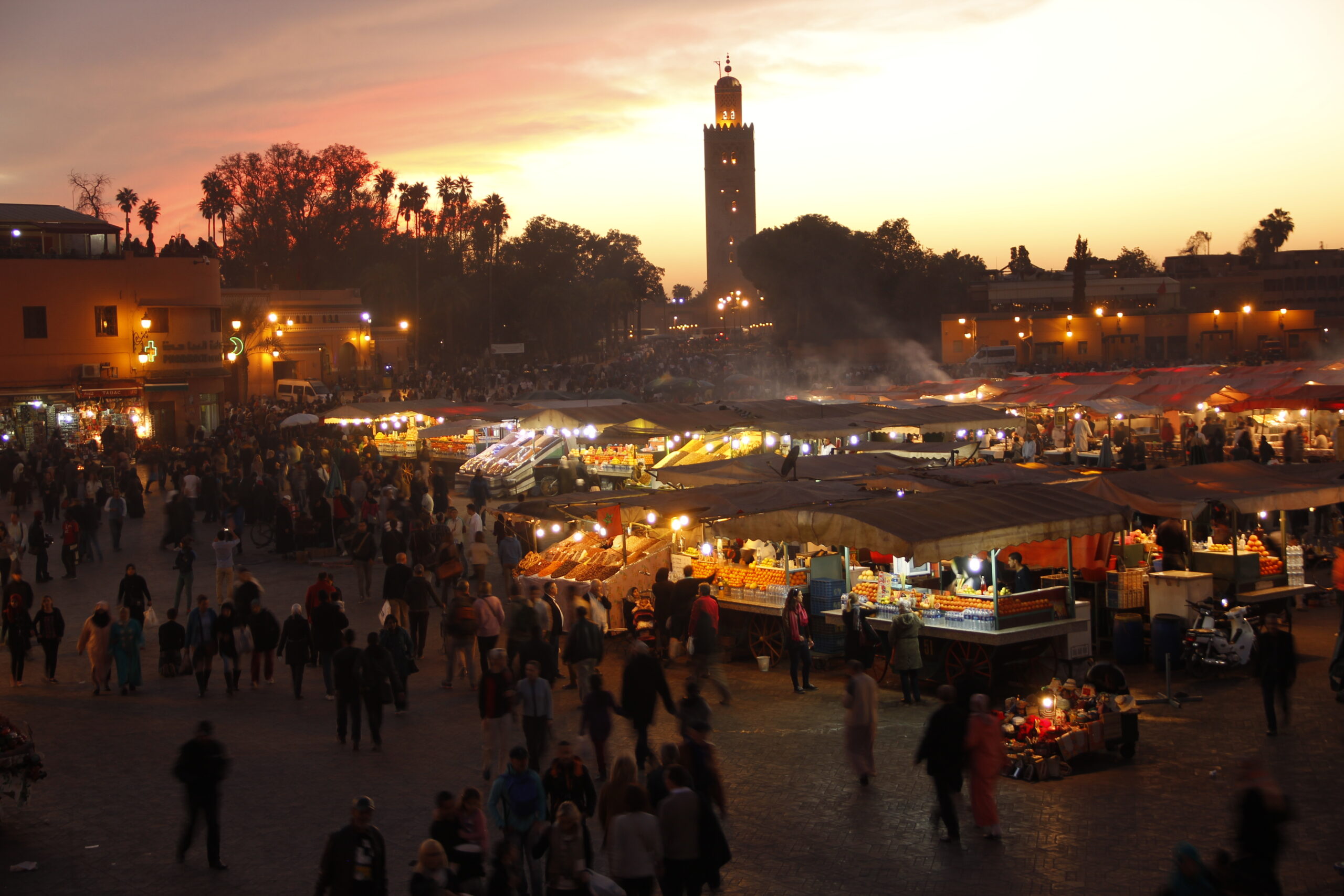
Jemaa el-Fnaa is the main square at the heart of Marrakech’s medina, and the city’s liveliest gathering place. By day you meet orange-juice sellers, henna artists and water carriers in bright costumes. After sunset it fills with food stalls, musicians and storytellers. This local guide covers what to do, what to eat, and the hassles to sidestep.
What is Jemaa el-Fnaa, and why is it a UNESCO site?
Jemaa el-Fnaa is a large open square in the old walled city of Marrakech. It has served as a market and meeting place for centuries. In 2001, UNESCO proclaimed its cultural space a Masterpiece of the Oral and Intangible Heritage of Humanity, and it joined the Representative List of the Intangible Cultural Heritage of Humanity in 2008.
The reason is the halqa: the circles of storytellers, musicians and performers who keep an oral tradition alive. The travel writer Tahir Shah has called the square “the greatest show on Earth.” To have the history and the layout explained on the ground, it helps to see it on a guided medina and souks walking tour, which usually lasts between two and four hours.
What can you do in Jemaa el-Fnaa during the day?
Daytime is the calmer face of the square. Orange-juice carts line the middle, and vendors sell dried fruit, nuts and cheap souvenirs. You will see water sellers, called guerrab, in fringed red costumes with brass cups, plus henna artists and snake charmers working the crowds.
It is a good time for photos and for getting your bearings, because the space is open and less crowded than at night. The square is also the doorway to the markets, so it pairs naturally with a wander through the souks that spread north of it. Late afternoon, from a rooftop café, is the sweet spot: you get shade, a mint tea, and a clear view of the stalls arriving.
What is Jemaa el-Fnaa like at night?
Night is when the square earns its reputation. According to The Marrakech Society (January 2026), the first food stalls start wheeling into place around 5:30 p.m., with more than a hundred assembled by 6:30. The energy peaks between roughly 8 and 11 p.m.
As the light drops, smoke rises from the grills and lanterns flick on. Gnaoua musicians play the three-stringed guembri, acrobats build human pyramids, and storytellers hold small crowds in Darija and Amazigh. That storytelling tradition is fading, so hearing it is a real moment. It is loud, smoky and a little chaotic, in the best way.
What should you eat at the Jemaa el-Fnaa food stalls?
Eat where the crowd is thickest and the turnover is fast. The grill stalls do skewers of lamb and chicken, merguez sausage, and plates of grilled vegetables with bread. For something bolder, try harira soup, babbouche (snails in a spiced broth), or bouzelouf, slow-cooked sheep’s head that locals prize. Finish with fresh orange juice or a glass of mint tea, known locally as “Berber whiskey.”
Travel publication AFAR points visitors to numbered stalls such as the orange-juice cart “#13” and the fish stall “#14.” If you would rather taste with a local who knows the good stalls from the tourist traps, our evening street food tour in Marrakech runs about 2.5 to 3 hours and starts from $60 per person.
| Jemaa el-Fnaa by day | Jemaa el-Fnaa at night | |
|---|---|---|
| Atmosphere | Open, calmer, hot | Packed, smoky, electric |
| Main draws | Juice carts, henna, snake charmers, souvenirs | Food stalls, musicians, storytellers, acrobats |
| Food | Orange juice, dried fruit, snacks | Grills, harira, snails, sheep’s head |
| Best for | Photos, orientation, shade breaks | Dinner, performances, the full spectacle |
Which scams and hassles should you avoid?
Nothing here is dangerous, but the square is worked hard by vendors. A few patterns come up again and again, well documented by Morocco blog MarocMama and by local guides.
- The henna grab. A woman takes your hand and starts drawing before you agree, then asks for 200 dirhams or more. Black henna can also irritate skin. Keep your hands to yourself, or use a licensed henna café where designs start around 50 dirhams.
- Snake charmers and monkeys. Step into the circle or point a camera, and you owe money, often 100 to 200 dirhams. There are real animal-welfare concerns here, so many travellers simply keep their distance.
- Photos of performers. Anyone you photograph will expect payment, usually 10 to 20 dirhams and up. Agree the amount first, or do not raise your phone.
- Food-stall extras. Small dishes you did not order may land on your table and appear on the bill. Confirm prices before you sit, wave off extras, and check the total.
- “It’s closed, this way.” A stranger says the square or a souk is shut and offers to guide you, then steers you to shops for commission. Ask for an official badge, or keep walking.
What should you expect to pay in the square?
Prices at the stalls are low, but they are negotiable and rarely posted, so a rough guide helps. The figures below draw on The Marrakech Society and MarocMama; treat them as typical, not fixed.
| Item | Typical price | Note |
|---|---|---|
| Fresh orange juice | 5–20 dirhams | Confirm the price as you order |
| Bowl of harira soup | 10–15 dirhams | A cheap, filling starter |
| Full food-stall meal | 40–80 dirhams / person | Grills, sides and bread |
| Photo with a performer | 10–20 dirhams+ | Agree before you shoot |
| Henna at a licensed café | from ~50 dirhams | Safer than a square vendor |
Carry small dirham notes. Stalls do not take cards, and “no change” is a common way to round your bill up.
When is the best time to visit Jemaa el-Fnaa?
Come at dusk. Arriving around 6 p.m. lets you watch the square transform from a rooftop café, then head down as the stalls fire up. The Marrakech Society rates 8 to 9:30 p.m. for peak atmosphere and fresh food, and 10:30 p.m. to midnight for a quieter, more local feel.
On our own medina and food walks, we time the square for early evening, then take small groups a few minutes off the main plaza to the stalls locals actually use, where prices are clearer and the cooking is just as good. If you only have one night in Marrakech, spend part of it here after dark.
How do you visit Jemaa el-Fnaa comfortably and respectfully?
The square is safe and heavily policed, but it is intense, and petty theft and pushy vendors are the real risks. Keep your phone in a front pocket, leave passports and spare cash at your riad, and carry only what you need. A firm, friendly “la, shukran” (no, thank you) ends most approaches.
Be honest with yourself about the animal acts, too: the snakes and monkeys raise welfare concerns, and you can enjoy the square fully without funding them. For more on tipping, dress and getting around, see our Marrakech travel tips. Go with a little patience and a sense of humour, and the square is a joy.
Jemaa el-Fnaa rewards a little preparation: see it at dusk, eat where it is busy, and agree prices before you commit. If you would like a local to show you the square and the streets around it, browse all our activities in Marrakech, or ask us anything — we answer for free, with no obligation.
Frequently asked questions
Is Jemaa el-Fnaa worth visiting?
Yes. It is the symbolic heart of Marrakech and a UNESCO-listed cultural space, and the night market is a genuine spectacle rather than a staged show. Visit at dusk to see it at its best, and treat it as one stop rather than the whole trip.
Is Jemaa el-Fnaa safe at night?
Generally yes. The square is busy and patrolled well into the night. The main issues are pickpockets in the crush and persistent vendors, so keep valuables secure and be ready to say no. Solo travellers and families both visit comfortably.
How much does it cost to eat at the food stalls?
A full meal is typically 40 to 80 dirhams per person, according to The Marrakech Society (2026), with soups and juices costing only a few dirhams. Confirm prices before you sit, and refuse any small dishes you did not order.
Do you have to pay to take photos?
Walking through and enjoying the square is free. Photographing performers, snake charmers or henna artists is not: they will ask for money, usually 10 to 20 dirhams or more. Agree the amount first, or take your photos from a rooftop café instead.
What is the best time of day to go?
Early evening. Arrive around 6 p.m. to watch the food stalls set up, then stay for the 8 to 9:30 p.m. peak. Daytime is quieter and good for photos, but the square only comes fully alive after dark.
