
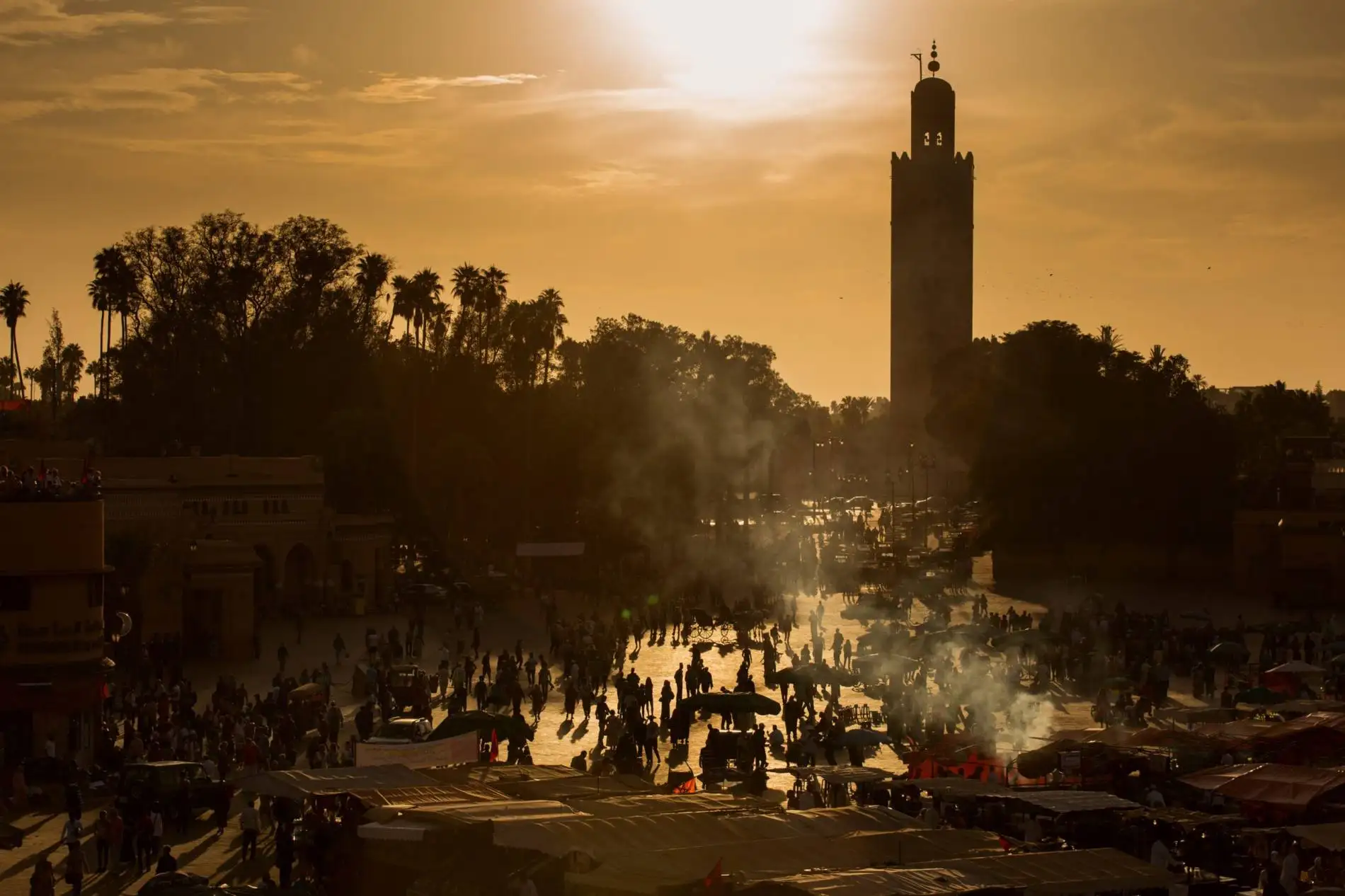
Marrakech rewards travelers who arrive prepared. The Red City packs a thousand years of imperial history, a UNESCO-listed medina, the world’s most theatrical public square, and a culture that runs on rhythms most first-timers don’t know to listen for. Get those rhythms right and the city opens up. Miss them and you’ll spend half your trip mildly lost, mildly overcharged, and mildly anxious about whether you’re being polite.
Below are the 15 tips a Marrakech-based guide would actually tell you over mint tea — updated for 2026, written for travelers who want to enjoy the city, not just survive it. They cover money, dress, etiquette, transport, photography, food and the small social codes that make the difference between feeling like a tourist and feeling like a welcome guest.
The 15 essential do’s and don’ts at a glance
If you read nothing else, read this list. The full explanation for each one is below.
- Do carry small dirham notes — most transactions are cash and small.
- Don’t drink the tap water — stick to sealed bottled or filtered water.
- Do dress with respect, especially in the medina.
- Don’t photograph people, especially women, without explicit permission.
- Do learn five French or Arabic phrases — it transforms how you’re treated.
- Don’t follow anyone who offers to “show you the way” unprompted.
- Do negotiate at the souks — but do it kindly and with a smile.
- Don’t enter active mosques unless you are Muslim (one famous exception below).
- Do tip in cash, in small notes, often.
- Don’t assume taxi drivers will use the meter — agree the price first.
- Do plan your day around the five daily prayers.
- Don’t drink alcohol in the street — it’s legal but discouraged outside licensed venues.
- Do stay in a riad inside the medina, at least for a couple of nights.
- Don’t rush the food — the slow tagines and slow-poured tea are the point.
- Do pack layers — Marrakech swings 20 °C between night and afternoon.
Each one matters. Here’s the why behind every single one.
1. Do carry small dirham notes
The Moroccan dirham (MAD) is what locals call a closed currency — you can’t legally take meaningful amounts in or out of the country, and most exchanges happen at airports, banks, or licensed bureaux inside Morocco. ATMs are widely available in Marrakech and almost always dispense 100- and 200-dirham notes. The problem: very little of daily life in the medina costs 200 dirhams. A taxi across town, a glass of fresh orange juice on Jemaa el-Fnaa, a pastry, a public toilet, a small tip — all of these expect coins or 10–50-dirham notes.
Break your big notes early in the day at a café, a riad, or a supermarket. Keep a pouch of small change separate from your main wallet. Trying to pay a 7-dirham petit taxi fare with a 200 will produce either a long wait while the driver finds change, or a quiet shrug and a worse exchange rate than you’d like. For more on practical money handling on the ground, our Morocco currency and tipping guide goes deeper.
When you are ready to plan, browse all our activities in Marrakech.
2. Don’t drink the tap water
Marrakech’s tap water is treated and is generally fine for brushing teeth, but the mineral content and the local microbiome differ enough from what most visitors are used to that drinking it from the tap is a fast route to a stomach you’ll regret. Sealed bottled water is sold everywhere — small shops (called hanouts), supermarkets, hotels, and pharmacies all stock it. A 1.5-liter bottle is inexpensive and easy to carry. If you want to reduce plastic, bring a filter bottle rated for bacteria and protozoa; refill at your riad.
Also be sensible with ice in informal venues, with raw salads washed in unknown water, and with fresh juice from very small stalls if you’re newly arrived. By day three, most travelers can handle anything. On day one, ease in.
3. Do dress with respect, especially in the medina
Morocco is a Muslim country, and Marrakech is a working city, not a beach resort. Nothing is “banned” for tourists, and you will see everything from full-coverage local women to European visitors in vest tops, but the more skin you cover, the more comfortably you’ll move through the medina, the souks, and religious neighborhoods. A practical baseline that works for almost any traveler: shoulders covered, knees covered, no see-through fabrics. Linen trousers, a light long-sleeve top, a scarf you can throw over your head if you peek into a shrine — all easy, all cool in the heat.
In Gueliz, La Mamounia, the rooftop bars, and the resort hotels, anything goes. In the medina at midday in July, your skin will thank you for the long sleeves anyway. Our deeper guide on what to wear in Marrakech breaks it down by season and by neighborhood.
4. Don’t photograph people without asking
This is the single most common etiquette mistake tourists make in Marrakech — and the one that causes the most friction. Moroccan culture treats personal image with care. Many people, especially women and older men, simply do not want to be photographed by strangers. The water-sellers in their fringed red costumes on Jemaa el-Fnaa, the snake-charmers, the henna artists — almost all of them work for tips and will expect a payment if you photograph them. Agree the price first, in dirhams, before you raise the lens. Twenty to fifty dirhams is fair for a posed shot.
For everyone else: ask first. A polite gesture toward your camera with raised eyebrows is universally understood. If they wave it off, lower the camera and smile. Do not photograph children without parental permission. Do not photograph inside mosques. Do not photograph police, military installations, or the royal palace gates beyond what’s clearly allowed.
5. Do learn five phrases in French or Darija
Morocco’s official languages are Arabic and Tamazight (Berber), with French still widely used in commerce, education, and tourism. In Marrakech you can absolutely get by in English in the main tourist zones. But the moment you greet a shopkeeper with “Salam alaikum” instead of “hello,” you become someone different in their eyes — a guest, not a target. Learn these five:
- Salam alaikum — peace be upon you (universal greeting)
- Shukran — thank you
- La, shukran — no, thank you (the politest “I’m not buying”)
- Bshhal hada? — how much is this? (Darija)
- Bslama — goodbye
If French feels easier, “Bonjour, ça va?” works almost everywhere. Pronunciation will be imperfect; it doesn’t matter. The effort is the message.
6. Don’t follow anyone who offers to “show you the way”
The medina of Marrakech is a UNESCO World Heritage site for good reason — its layout has been more or less unchanged since the 12th century, with hundreds of unmarked alleys, dead ends, and shifting souks. It is also the natural habitat of the unsolicited “guide”: a young man or boy who notices you looking confused, asks where you’re going, and walks you there — and then expects payment, sometimes aggressive payment, at the end.
The polite firm answer is “La, shukran”, eye contact, no slowing down. If someone is already walking with you, stop, stand still, and refuse to keep moving until they leave; following you only works if you keep walking. If you are genuinely lost, step into a shop or a café and ask the owner. They have nothing to gain from misleading you and everything to gain from your goodwill. A licensed official guide will carry a metal badge and identification — you can hire one through your riad, and it’s worth it for a half-day medina tour.
7. Do haggle at the souks — kindly
Haggling in Marrakech’s souks is not optional, it is the entire commercial culture. The sticker price is the opening bid, not the final price. The expected dance: the seller names a number well above what they’ll accept, you counter at roughly a third, you meet somewhere in the middle. A lamp marked at 800 dirhams probably sells for 350–450. A leather bag marked at 1,500 probably sells for 700–900.
The crucial part most visitors miss: this is supposed to be enjoyable. Smile. Joke. Accept the mint tea if it’s offered. If you’re not interested at the seller’s lowest price, walk away politely — this is normal, and they may call you back with a better one. If they don’t, the price was honest. Never haggle for something you don’t actually want, never haggle aggressively, and never haggle in front of staple-food shops, pharmacies, or modern stores — those are fixed-price.
8. Don’t enter active mosques as a non-Muslim
Morocco follows a long-standing convention that working mosques are reserved for Muslims. This is religious courtesy, not hostility, and travelers who try to push past it cause quiet offence. Almost all of Marrakech’s mosques — including the iconic Koutoubia, whose minaret you’ll see from everywhere in the city — are off-limits to non-Muslim visitors. You can admire them from outside as long as you like. The minaret of the Koutoubia, with its 12th-century Almohad architecture, is itself worth a visit and a slow lap of the gardens around it.
The famous exception is the Hassan II Mosque in Casablanca, which runs guided tours for non-Muslims outside prayer times — but that’s a different city. Inside Marrakech, the closest you can come is the Ben Youssef Madrasa, a former Quranic school that is open to all visitors and is one of the most beautiful pieces of Islamic architecture in the country.
9. Do tip in cash, often, in small notes
Tipping in Morocco is constant, small, and very normal. It is not a percentage-of-bill American-style tip; it is a flow of small acknowledgments throughout the day. A few practical anchors that locals use:
- Restaurants: 10% is generous; rounding up is standard.
- Café waiters: a few dirhams for a coffee, 5–10 for a meal.
- Riad housekeeping: 20–30 dirhams per day, left in the room.
- Riad staff who carry your bags: 10–20 dirhams.
- Petit taxi: round up to the nearest 5 or 10.
- Public toilet attendants: 2–5 dirhams.
- A guide for a half-day in the medina: 100–200 dirhams on top of the agreed fee.
Tip in dirhams, not in foreign currency — euros and dollars are difficult for staff to use. Have small notes ready. The cumulative effect of generous, frequent tipping is enormous: you will get warmer service, better tables, and surprise extras for very little money.
10. Don’t assume the taxi meter will be on
Marrakech has two taxi types: petits taxis (small, beige, for trips inside the city, max three passengers) and grands taxis (larger, often Mercedes sedans, for longer or shared trips). Both are required by law to use a meter for in-city journeys, and during the day most petits taxis will, especially if you ask. After dark, near the airport, near major hotels, and any time the driver senses a tourist who doesn’t know better, the meter mysteriously breaks.
The fix is simple: agree on the price before you get in. A petit taxi across the medina is typically 20–40 dirhams during the day; airport to the medina is around 100–150 dirhams (more at night, when there’s a legal night surcharge). If the driver names a number wildly above that, smile, say “La, shukran”, and try the next one. Ride-hailing apps like Careem and inDrive operate in Marrakech and remove the negotiation entirely if you prefer.
11. Do plan your day around the five daily prayers
Marrakech runs on the rhythm of five daily prayers — Fajr (dawn), Dhuhr (midday), Asr (afternoon), Maghrib (sunset), and Isha (night). Each is announced by the muezzin’s call from every mosque in the city, and the city briefly shifts: small shops close for ten or fifteen minutes, taxi traffic thins, the souks slow down. None of this affects you directly, but two of them are worth planning around.
Friday Dhuhr — the noon prayer on Friday — is the major weekly congregational prayer, and many shops, banks, and small businesses close for one to two hours from about 12:30 to 14:00. Don’t plan errands or appointments in that window on a Friday. Maghrib, sunset, is the most beautiful moment in the city, especially on the rooftops of Jemaa el-Fnaa as the call to prayer rolls across the medina; build at least one rooftop sunset into your trip.
12. Don’t drink alcohol in the street
Alcohol is legal in Morocco and widely available in Marrakech — at licensed restaurants, hotels, riads with bar licenses, the Carrefour and Marjane supermarkets in Gueliz, and a handful of dedicated wine shops. What is not done is open-street drinking. You’ll see no one walking through the medina with a beer; doing so yourself is rude and conspicuous. Drink at the rooftop bars in Gueliz or your riad’s terrace. Buy a bottle of Moroccan wine — the country has a small but respectable wine industry centered around Meknès — and enjoy it in your room.
One related note: during Ramadan (Morocco’s next Ramadan begins around 7 February 2027) most bars and many restaurants serve no alcohol to anyone, even tourists, until after Maghrib, and the few that do operate behind closed doors. If you’re traveling during Ramadan, the experience is genuinely beautiful — but plan your drinking and your daytime eating accordingly.
13. Do stay in a riad inside the medina
A riad is a traditional Moroccan house built around an open central courtyard — usually with a small fountain, citrus trees, intricate zellige tilework, and rooftop terraces. Sleeping inside one, behind a heavy wooden door in a quiet alley of the medina, is one of the genuine joys of visiting Marrakech and something modern hotels cannot replicate. The contrast — the noise and energy of the souks during the day, the silence and starlight of the riad at night — is the experience.
Reputable riads range from very affordable boutique stays to some of the most luxurious accommodations in North Africa. Most include a generous Moroccan breakfast and can arrange airport transfers, hammam appointments, cooking classes, and licensed guides. If your trip is longer than four nights, a popular structure is two or three nights in a medina riad, then a couple of nights in Gueliz or at a resort outside the city for the pool. For carefully vetted upscale options, browse our curated luxury Morocco tours — every itinerary is built around a hand-picked riad or palace stay.
If a hammam is on your list, our guide to the best hammams and spas in Marrakech compares the neighbourhood bathhouses with the riad spas.
14. Don’t rush the food
Moroccan food is slow on purpose. A proper tagine is cooked for hours over low heat, the spices reducing into the meat and the dried fruit and the preserved lemon until the whole thing collapses at the touch of a spoon. Mint tea is poured from height, then back into the pot, then poured again, three times, until the foam is right. Ordering a tagine and expecting it in fifteen minutes is like ordering a Sunday roast and asking for it in a takeaway box.
Three things every visitor should try at least once: a slow lamb-and-prune tagine at a quiet restaurant, the Friday couscous (traditionally eaten on Friday after the noon prayer, with seven vegetables on top), and breakfast on a medina rooftop with msemen (flaky square pancake), baghrir (the thousand-hole spongy pancake), olive oil, honey, and fresh orange juice. For street food on Jemaa el-Fnaa, ease in: stalls 1–15 are touristy but safe; the busy locals’ stalls further into the square are often better and just as safe — pick one with high turnover.
15. Do pack layers — and check the season
Marrakech sits at the foot of the Atlas Mountains, on the edge of a semi-arid plain. The temperature swings hard between night and day, especially in spring and autumn, and it varies enormously by month. A summer afternoon in July can hit the mid-40s °C; a winter night in January can drop near freezing in the riad courtyard. Most travel-friendly months are March–May and September–November, when daytime sits comfortably in the 20s °C and the evenings are mild.
Whatever month you visit, pack: light layers for daytime, a warm layer for early mornings and evening rooftops, sturdy walking shoes for the medina’s uneven cobbles, sunscreen, a hat, and a scarf that doubles as a head covering when needed. For a month-by-month breakdown of weather, festivals, and prices, see our pillar guide on the best time to visit Marrakech.
Quick reference: do’s and don’ts in one table
| Topic | Do | Don’t |
|---|---|---|
| Money | Carry small dirham notes | Rely on cards alone |
| Water | Drink sealed bottled or filtered | Drink from the tap |
| Dress | Cover shoulders and knees in the medina | Wear beachwear in town |
| Photos | Ask first; pay performers | Photograph people, police, or palaces uninvited |
| Language | Greet in Arabic or French | Default to loud English |
| Directions | Ask shopkeepers | Follow unsolicited “guides” |
| Souks | Haggle with a smile | Haggle aggressively or for items you don’t want |
| Mosques | Admire from outside; visit Ben Youssef Madrasa | Enter active mosques as a non-Muslim |
| Tipping | Tip in dirhams, often, in small notes | Tip in foreign currency |
| Taxis | Agree the price first | Assume the meter is on |
| Prayers | Plan around Friday lunchtime | Schedule errands during major prayers |
| Alcohol | Drink at licensed venues or your riad | Drink in the street |
| Stay | Spend at least two nights in a medina riad | Skip the medina experience entirely |
| Food | Eat slowly; try the Friday couscous | Rush a tagine |
| Packing | Layers, sturdy shoes, scarf | One-temperature wardrobe |
A quick word on safety
Marrakech is, by international travel-advisory standards, a comparatively safe destination — both the UK Foreign, Commonwealth & Development Office (FCDO travel advice for Morocco) and the US State Department (U.S. Department of State Morocco information page) classify Morocco at their lower travel-advisory tiers and note that most visitors have trouble-free trips. The most common issues for tourists are petty: pickpocketing in crowded areas, scams from unsolicited guides, occasional aggressive vendors. Violent crime against tourists is uncommon. Solo female travelers do report verbal hassle in some areas; dressing modestly and walking confidently helps. For the full picture, our standalone guide on whether Marrakech is safe to visit goes into recent updates and neighborhood-level detail. (Always check your own government’s most recent travel advice before booking.)
Frequently asked questions about Marrakech travel tips
What should I avoid doing as a tourist in Marrakech?
The four big avoidable mistakes are: drinking tap water, photographing people without asking and without paying performers, following unsolicited “guides” through the medina, and being aggressive when haggling. Each one is easy to fix with a small adjustment in habit. Beyond those, avoid wearing very revealing clothing in the medina, drinking alcohol on the street, entering active mosques as a non-Muslim, and trying to push business through the Friday lunchtime prayer window. None of these are punishable; all of them mark you out as a tourist who doesn’t know the codes, which makes the whole trip harder than it needs to be.
Is Marrakech safe for solo female travelers?
Yes, with caveats. Solo women travel to Marrakech in large numbers every year and most report a positive trip. The main issue is verbal attention — comments, persistent vendors, occasional unwanted approaches — rather than physical danger. Strategies that work well: stay inside the medina in a riad with 24-hour staff, dress modestly, walk with purpose and don’t make extended eye contact with strangers, use registered taxis after dark, and avoid empty alleys late at night. The Gueliz neighborhood and the modern hotel zones are very relaxed. Our deeper guides on solo female travel in Morocco and Marrakech safety cover specifics.
How much cash should I bring to Marrakech for a week?
It depends entirely on your travel style, but a useful midrange anchor for a week of mostly cash spending — meals at mid-range restaurants, taxis, tips, souk purchases, a guided tour or two, the odd hammam — is somewhere in the range of 250–400 euros (or equivalent) per person, exchanged into dirhams in-country. Luxury travelers staying at five-star riads will spend much more on extras and tips; budget travelers eating local and walking everywhere will spend much less. Cards are widely accepted in upscale restaurants, hotels, and modern shops in Gueliz, but the medina runs on cash. Withdraw from ATMs as you go rather than carrying a week’s worth in your bag.
Do I need a visa to visit Marrakech?
For most Western travelers, no. Citizens of the United States, the United Kingdom, the European Union, Canada, Australia, New Zealand and many other countries can enter Morocco visa-free for tourist stays of up to 90 days, with a passport valid for at least six months beyond the date of entry. Always check your specific nationality’s current requirements with the Moroccan consulate or your home foreign office before traveling, as policies are updated periodically. For full details, see our standalone guide on Morocco visa requirements.
What is the best time of year to visit Marrakech?
Spring (March to early May) and autumn (mid-September to November) are the most comfortable, with daytime temperatures usually in the high teens to high twenties °C and cool evenings. Winter (December to February) is mild during the day and can be cold at night, with occasional rain — but it’s also low-season pricing and uncrowded medina. Summer (June to August) is hot, often above 38 °C in the city, and demands a riad with a pool and a slower pace. Most travelers find March–May and September–November the sweet spot. Our full month-by-month breakdown is in the best time to visit Marrakech guide.
Can I drink alcohol in Marrakech?
Yes, in licensed venues. Most upscale hotels, many restaurants in Gueliz, rooftop bars, and riads with the appropriate licence serve beer, wine, and spirits, including the small but respectable Moroccan wines from the Meknès region. Supermarkets such as Carrefour and Marjane in the modern parts of the city also sell alcohol. What is not done is drinking openly in the medina or in the street. During Ramadan, daytime alcohol sales pause for everyone — plan accordingly if you visit during the holy month.
Closing notes — and how Moratra can help
The single thing that turns a Marrakech trip from “interesting” to “unforgettable” is preparation matched with relaxation: knowing the codes well enough that you don’t have to think about them, and then forgetting them and just being in the city. The 15 tips above are the codes. Use them as a quiet checklist on your first morning, then put the list away.
One last practical tip: sort your mobile data before you arrive. Our guide to the best eSIM and SIM card options for Morocco covers prices, coverage and how to get online the moment you land.
If you’d like the rest of your Morocco trip planned with the same care — a vetted riad in the medina, a private licensed guide who actually knows the alleys, a luxury Sahara camp under the stars, transfers and timing handled — that’s what we do. Browse our tailor-made luxury Morocco tours, request a quote, or simply message us with a question — we’ll answer for free, no obligation. If Marrakech is your gateway to a longer trip, our companion guide for first-time travelers to Morocco is the natural next read. Either way: take your time, drink the mint tea, smile when you haggle, and let the city show you what it does best.
This guide was last refreshed in May 2026. Always cross-check current travel advisories, visa rules, and seasonal guidance with your own government’s foreign office before you travel.
Planning what to actually book? See all Marrakech tours & excursions in one place and pick what fits your dates.
