
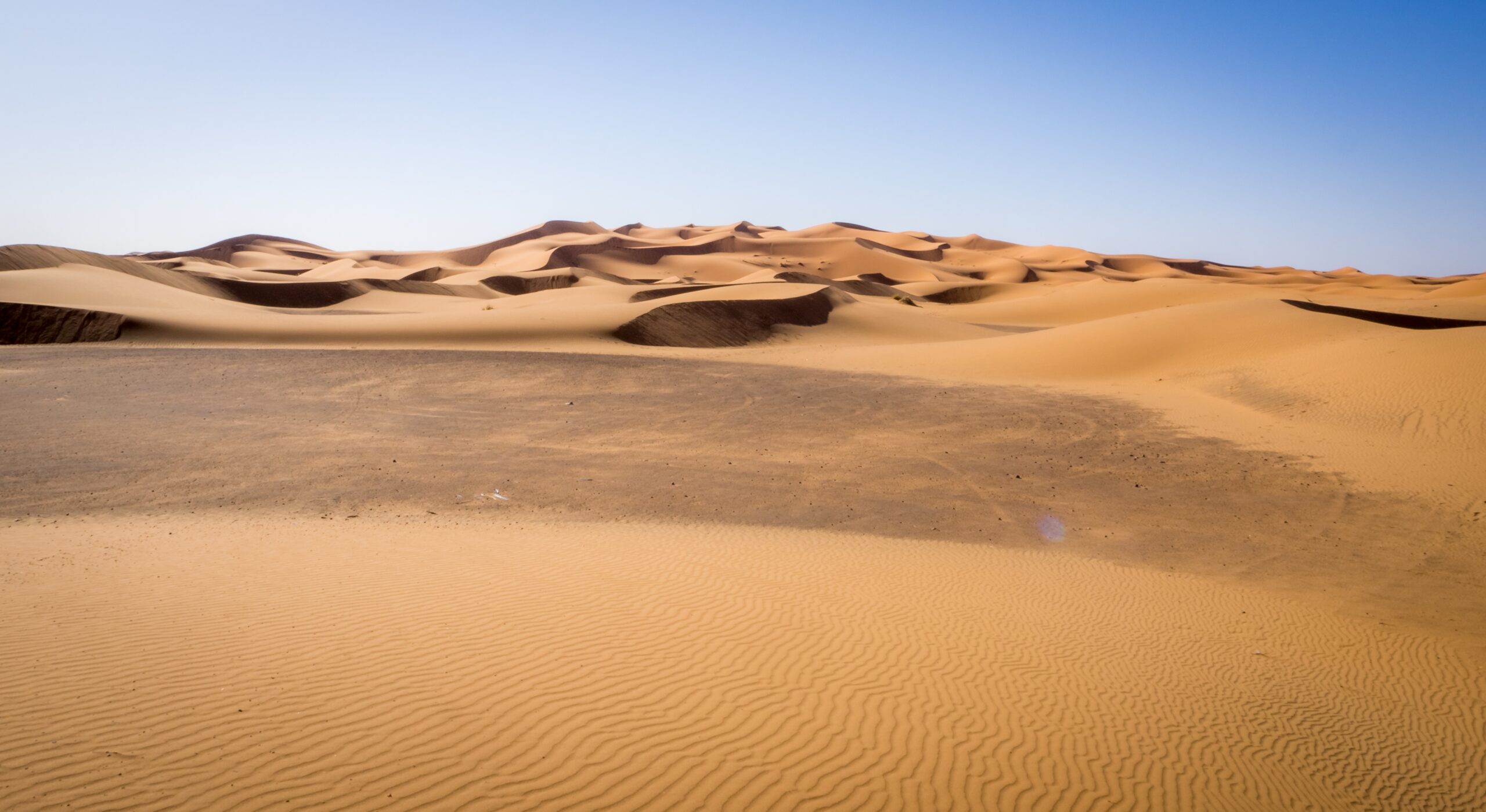
A Fes to Merzouga desert tour is the one-way Sahara crossing that links Morocco’s imperial north with the golden dunes of Erg Chebbi, so you travel the desert once and never retrace your route. Most travellers cover it in three to six days, sleep at least one night in a desert camp, and finish in a different city from the one where they started. It rewards planning more than speed.
What exactly is a one-way Fes to Merzouga desert tour?
A one-way tour is a line, not a loop. Instead of returning to your start city, you cross the country in a single direction and see fresh ground every day. The desert leg centres on Merzouga, the small village on the western edge of the Erg Chebbi dune sea, whose crests rise to about 150 metres above the surrounding gravel plain.
You can run it north to south as a Fes-to-Merzouga trip, or south to north as a Marrakech-to-Fes crossing that stops at the same dunes. We build both as private, door-to-door routes, with pickup at your riad, your own private vehicle and driver, and a drop-off in the other city. Our eco-friendly six-day desert tour is the slowest, most immersive version.
Which direction should you travel — Marrakech to Fes, or Fes to Merzouga?
The honest answer depends on your flights. If you land in Marrakech and fly home from Fes, run it south to north; if you arrive in Fes, do the reverse. Neither direction is “better” scenically, because you pass the same three landscapes: mountains, gorges, and dunes.
Distances are long either way, so pace matters more than route. From Fes, Merzouga is around 470 km, or seven to nine hours of driving; from Marrakech it is roughly 560 km and nine to eleven hours. Splitting that over two travel days beats one marathon push, which is why our Marrakech to Fes in three days crossing builds in a desert night as the fastest complete option.
How do the main crossing options compare?
Length is the real decision. A shorter trip covers more kilometres per day and gives you one desert night; a longer trip trades driving hours for gorges, valleys, and a second night under the stars. This table lays the choices side by side.
| Crossing | Direction | Days / nights | Desert nights | Best for |
|---|---|---|---|---|
| Three-day crossing | Marrakech → Fes | 3 days / 2 nights | 1 | The fastest one-way link between the two cities |
| Four-day crossing | Marrakech → Fes | 4 days / 3 nights | 1 | More time in the Dades and Todra gorges |
| Six-day tour | Fes → Merzouga | 6 days / 5 nights | 1–2 | A slower, eco-focused loop deep into the south |
If you want a fixed daily plan before you commit, our four-day Marrakech to Fes desert tour maps every stop, and the day-by-day itinerary with a map shows the exact driving hours.
One-way crossing or round trip — which is better value?
A round trip from Marrakech returns you to your start, which suits travellers flying in and out of the same city. A one-way crossing costs a little more in logistics, because the driver returns without you, but it saves a full day of backtracking and lets you fly home from a second city.
The rule of thumb is simple. If your flights use one city, a round trip is tidier; if you arrive and leave from different cities, the crossing turns transit time into sightseeing instead of a repeat of the road you already drove. For most people combining Marrakech and Fes in one trip, one-way wins on both time and variety.
What does the drive between Fes and Merzouga actually look like?
The northern approach climbs quickly out of Fes into the Middle Atlas. You pass Ifrane, a tidy hill town with alpine roofs, and cedar forests where Barbary macaques sit by the road. After Midelt the land dries out and the Ziz Valley opens into a long green ribbon of date palms below red cliffs.
The last stretch runs through Erfoud and Rissani, the old caravan towns that supplied the Sahara trade. Merzouga sits just beyond them on the western lee of the dunes, so the sand appears suddenly after hours of flat hammada. It is a long day, which is exactly why breaking the drive with an overnight makes the crossing enjoyable rather than exhausting.
Coming the other way, from Marrakech, the drive crosses the High Atlas over the Tizi n’Tichka pass, then follows the Dades and Todra gorges before joining the same desert road near Erfoud. It is a different first half, but the finish at the dunes is identical. Either approach gives you mountains, gorges, and sand in a single unbroken line.
How many days do you really need for the Sahara crossing?
There is no single right length, but three honest options cover most travellers:
- Three days. The efficient minimum. You get one full desert night and the headline sights, but the driving days are full and there is little slack for detours.
- Four days. The sweet spot for most first-timers. An extra day buys the Dades or Todra gorges and a calmer pace, without adding a week to your trip.
- Six days. For travellers who want the desert to sink in. You add a second night near the dunes, more time in the valleys, and room to slow down.
If the desert itself is your priority rather than the city-to-city link, compare this with our three-day Merzouga desert tour guide, which returns to Marrakech instead of crossing to Fes.
What is a night in the Erg Chebbi desert camp like?
The camp night is the reason the crossing exists. You leave the vehicle at the edge of the dunes in late afternoon and ride a camel, or walk, over the sand as the light turns orange. Camps range from simple Berber tents to private suites with real beds and hot showers.
Dinner is usually a tagine under the stars, followed by drums around a fire and a sky with almost no light pollution. Most guests wake before dawn to climb the nearest ridge for sunrise, when the dunes shift from grey to deep gold. Nights are cold from November to February, so pack a warm layer even in summer.
What is included, and what should you pack?
On the crossings we run, any private tour covers your private luxury vehicle and English-speaking driver, fuel, and the desert camp with dinner and breakfast. Camel rides at the dunes and a local guide for the Fes medina are easy to add. Lunches, drinks, and tips are usually left out so you keep control of each day’s spending.
Packing is straightforward once you plan for big temperature swings. A few essentials make the long drive and the desert night far more comfortable:
- A warm layer and a light scarf, because nights near the dunes are cold and blown sand is constant.
- Comfortable closed shoes for travel days, plus sandals for the sand itself.
- A power bank, as charging points thin out once you leave the towns.
- Cash in dirhams for lunches, souvenirs, and tips along the route.
Because it is a private trip, start times and stops flex around you. Tell your driver if you would rather linger in the Ziz Valley or reach camp early for sunset, and the plan bends to fit.
Is the one-way crossing worth booking ahead?
Yes, and increasingly so. Morocco drew 17.4 million visitors in 2024, a 20% rise over the year before, and the good desert camps near Erg Chebbi fill fast in spring and autumn. Fatim-Zahra Ammor, Morocco’s Minister of Tourism, said “this record of 17.4 million testifies to the sizable progress made by our country,” and the pressure is clearest exactly where you want to sleep — beside the dunes.
Because the route ends in a different city, the logistics matter too. We hold your dates with a 50% deposit and take the balance 5 days before departure, the deposit is fully refundable within 24 hours (conditions apply), and we drop you at your Fes riad or the airport so you are never stranded at the end of a one-way line. You can request your one-way crossing with your dates and group size, and we send a fixed quote before anything is confirmed.
What are the two endpoints — Fes and the Sahara — really like?
Fes is the cultural anchor. Its walled medina, listed by UNESCO in 1981 and founded between 789 and 808 AD, is one of the world’s largest car-free urban areas and rewards a full day of getting pleasantly lost. Give yourself at least one night there rather than treating it as a drop-off point.
The Sahara is the opposite kind of place: empty, quiet, and vast. Between them lie the gorges and oases that make the drive worthwhile. Seen back to back over a few days, the contrast is the whole point of a one-way crossing rather than a there-and-back tour.
Plan your Fes to Merzouga crossing
A one-way desert tour is the cleanest way to see northern Morocco and the Sahara without doubling back, and it suits trips from three days to six. Browse all our Morocco desert tours to compare routes, then tell us your arrival and departure cities so we can shape the crossing around your flights. If you are unsure which direction or length fits, ask us anything — we answer for free, with no obligation.
Frequently asked questions
Is the Fes to Merzouga tour really one-way?
Yes. You start in one city and finish in another, with the Erg Chebbi dunes in the middle, so you never repeat a stretch of road. That is the main advantage over a round trip that returns to its start.
How long is the drive from Fes to Merzouga?
It is about 470 km and takes seven to nine hours of driving. We split it across two days with a desert night in between, so no single day feels like a marathon.
Can I do the crossing in reverse, from Marrakech to Fes?
Yes, and it is very common. Marrakech to Fes via Merzouga covers the same dunes and gorges in the opposite direction; the best choice usually comes down to which city you fly into and out of.
How many nights do I spend in the desert?
Shorter crossings include one night at an Erg Chebbi camp, while the six-day tour can include two. One night is enough for sunset, stargazing, and sunrise; a second lets the pace slow right down.
When is the best time for the Sahara crossing?
Spring (March to May) and autumn (September to November) are the most comfortable, with warm days and cool nights. Summer middays are very hot, and winter nights near the dunes drop close to freezing, so pack layers.
