
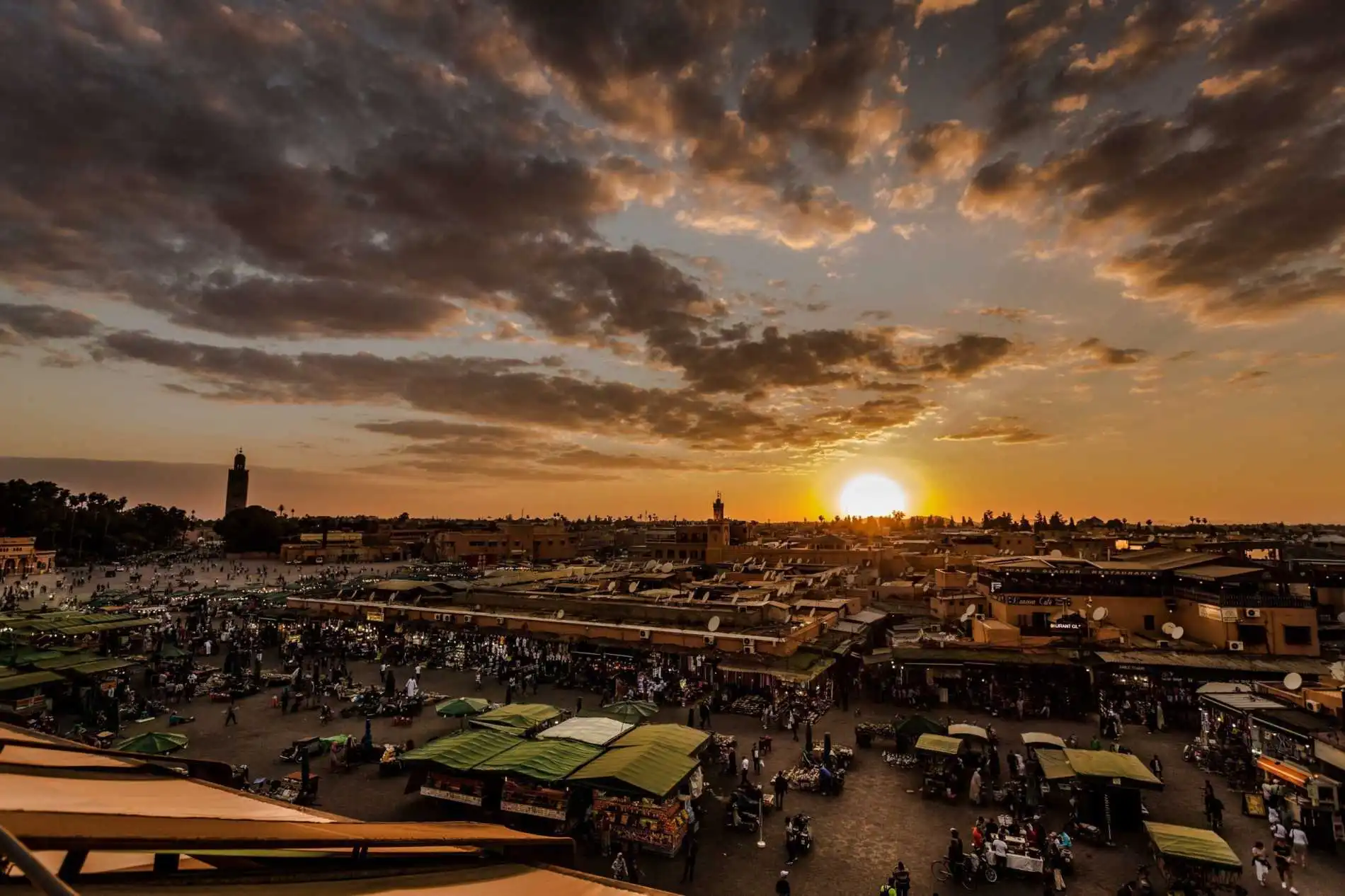
Réponse courte : oui, Marrakech est sûre pour les touristes en 2026 — sensiblement plus sûre que ne le supposent beaucoup de voyageurs internationaux, avec un petit nombre de risques spécifiques faciles à éviter une fois qu’on les connaît. Réponse longue : une ville d’un million d’habitants n’est jamais uniformément sûre ni uniformément dangereuse, et ce que « sûr » signifie pour une voyageuse seule dans la médina à minuit n’est pas la même chose que pour une famille à Hivernage à midi. Ce guide décrit la réalité de 2026 — ce que disent les avis officiels, ce que rapportent les voyageurs, les arnaques à surveiller, et comment profiter de la ville sans cette anxiété de fond qui gâche tant de premiers voyages.
C’est une mise à jour de notre guide de longue date sur la sécurité à Marrakech, avec les niveaux d’avis actuels, une note sur le séisme d’Al Haouz de 2023 (et ce qu’il signifie aujourd’hui), et les huit problèmes de sécurité les plus courants accompagnés de stratégies pratiques pour chacun.
Le verdict 2026 en un paragraphe
Both the UK Foreign, Commonwealth & Development Office (FCDO travel advice for Morocco) and the US Department of State (U.S. Department of State Morocco information page) place Morocco at the lower end of their travel-advisory tiers. Both note that most visitors have a trouble-free trip. Violent crime against tourists is uncommon. The most common issues are petty — pickpocketing in crowded areas, scams from unsolicited guides, aggressive vendors, occasional verbal hassle for women. The Moroccan government has invested heavily in tourism security since the early 2010s, including a visible police presence in tourist zones and a dedicated tourist police unit (Brigade Touristique) in Marrakech that wears distinctive uniforms and speaks English and French. None of this means Marrakech is risk-free; it means the risks are predictable and manageable. Always check your own government’s most recent travel advisory before booking, as guidance is updated periodically.
Ce qui a changé ces deux dernières années
Trois sujets sur lesquels les voyageurs s’interrogent en 2026 et qui ne se posaient pas il y a cinq ans :
Le séisme d’Al Haouz de septembre 2023
On 8 September 2023, a magnitude 6.8 earthquake struck the Al Haouz province about 70 kilometers southwest of Marrakech, causing significant damage and loss of life in High Atlas mountain villages. Inside the city of Marrakech itself, damage was relatively limited — most of the medina and modern Gueliz are structurally intact, and tourism returned to near-normal levels within months. Three sections of the old city walls and a small number of older buildings sustained damage and have been progressively restored. In 2026, no part of central Marrakech is closed to visitors for earthquake-related reasons. Trips into the High Atlas (Imlil, Toubkal trekking, Ourika Valley day trips) operate normally; some specific villages have been rebuilt and others are still in progress. If you are going on a multi-day Atlas trek in 2026, ask your tour operator which villages are on the route and what their current status is — reputable operators will know in detail.
Si vous souhaitez que nous l’organisions pour vous, découvrez notre visite guidée à pied de la médina et des souks.
Une croissance touristique record
Morocco passed 17 million international visitors in 2024 and continued to grow into 2025 and 2026, with Marrakech receiving the largest share. Two practical effects on safety: the city is busier than ever (good for ambient safety in tourist zones, slightly worse for pickpocket density in Jemaa el-Fnaa), and police presence in tourist areas has been visibly increased. The medina at peak hours can feel like a high-tourist European city — busy, lively, mostly safe, occasionally annoying.
Paiements par carte et VTC
Five years ago Marrakech was almost entirely cash. In 2026, card payment is accepted at most upscale restaurants, all major hotels, and many modern shops in Gueliz. Ride-hailing apps (Careem, inDrive, and InDriver among the most active) operate across the city — useful safety tool late at night, removes the taxi-negotiation friction. The medina still runs on cash. ATMs are widely available and reliable.
Ce que « sûr » signifie réellement à Marrakech
La sécurité en voyage a trois niveaux, qu’il faut séparer quand on demande « Marrakech est-elle sûre » :
- Violent crime contre les touristes : faible. Les violences de rue gratuites, les agressions ou les vols à main armée visant des visiteurs étrangers sont rares. Les deux principaux avis aux voyageurs occidentaux jugent ce risque comparable, voire inférieur, à celui de nombreuses villes du sud de l’Europe.
- Petty crime: présent et à prendre au sérieux. Les vols à la tire existent sur la place Jemaa el-Fna, dans les souks et à l’arrivée à l’aéroport. Des vols à l’arraché depuis des scooters ont été signalés dans les ruelles étroites de la médina, même si ce n’est pas la norme.
- Scams and hassle: common, mostly non-violent, easy to defuse once recognized. This is where most first-time visitors lose money or get rattled. The eight most common types are covered below.
People who arrive expecting a beach-resort sterility will find Marrakech intense. People who arrive expecting Marrakesh to be dangerous will be confused by how relaxed it usually is. The honest middle: it’s a working North African city with a lively centuries-old commercial culture; behave with normal urban awareness and you will be fine. Our companion guide on conseils de voyage pour Marrakech covers the broader etiquette codes that overlap with safety.
Les huit problèmes de sécurité les plus fréquents — et comment les éviter
1. Les vols à la tire dans les zones bondées
Jemaa el-Fnaa au coucher du soleil, le souk des épices un samedi après-midi, et la zone juste à l’extérieur de Bab Agnaou sont les trois endroits où les pickpockets sont les plus actifs dans la médina. La technique est la même que dans n’importe quelle ville touristique : une distraction (un vendeur qui vous tire vers son étal, un groupe d’enfants, quelque chose qu’on « renverse » soudainement) suivie d’une main dans votre sac ou votre poche arrière. Portez votre portefeuille dans une poche avant ou un sac en bandoulière porté devant vous. N’emportez pas votre passeport dans la médina — laissez-le dans le coffre du riad et gardez-en une copie. Retirez de petites sommes plus souvent plutôt qu’une semaine de cash d’un coup.
2. Le « guide » non sollicité
Vous verrez cela dans l’heure qui suit votre arrivée. Un jeune homme vous voit consulter une carte, s’approche, vous demande où vous allez et commence à marcher avec vous. À destination — ou, plus souvent, ailleurs qu’il a choisi — il réclame un paiement, parfois agressivement. La technique fonctionne parce que les touristes se sentent polis ou coupables et n’osent pas refuser. La solution : refuser le contact dès le départ : “La, shukran” (no thanks), eye contact, keep walking. If someone is already walking with you, stop, stand still, refuse to move until they leave. If you genuinely need directions, step into a shop or café and ask the owner — they have no stake in misleading you. For a real guide, your riad can book a licensed one carrying an official metal badge.
3. L’arnaque du tampon au henné
A woman approaches in Jemaa el-Fnaa with a syringe-style applicator and stamps a small henna design on your hand or wrist before you’ve agreed to anything. She then demands payment, often a much larger amount than the design is worth. The henna sometimes contains black henna with paraphenylenediamine (PPD), which can cause severe allergic reactions on skin. The fix is simple: keep your hands closed, in your pockets, or behind your back when walking through the square, especially the henna-artist area on the eastern side. If someone stamps you anyway, the design wears off in 2-3 days; pay nothing, leave promptly. Reputable henna artists work seated at their stalls, show prices in advance, and use natural reddish-brown henna.
4. Les vendeurs insistants et la « technique du suivi »
Walking through the souks, a vendor pulls you toward a stall, places merchandise in your hand, follows you down the alley repeating prices. The aim is to get you to a point where backing out feels embarrassing. The fix is to never accept items into your hand until you’re seriously interested, never break stride for a vendor calling out, and to use “La, shukran” firmly and keep moving. If a vendor is genuinely aggressive — physically blocking your path, raising voice — say “Brigade Touristique” loudly. The mention of tourist police is almost always enough to defuse the situation.
5. Le harcèlement verbal envers les femmes
This is the most consistent quality-of-life issue for female visitors, especially solo travelers and women dressed in clothing read as “tourist.” The hassle is overwhelmingly verbal — comments, persistent vendor attention, occasional follow-on-the-street — rather than physical danger. It is also overwhelmingly concentrated in the medina; Gueliz and the hotel zones are largely free of it. Strategies that work: dress modestly (shoulders, knees covered), wear sunglasses, walk with purpose, avoid extended eye contact with strangers, ignore catcalls without engaging, and use the line “Hashouma” (shame, used as a social rebuke) if someone crosses a line. Our deeper guide on solo female travel in Morocco covers this in detail.
6. Surfacturation et compteur non enclenché dans les taxis
Taxis are not a safety risk in Marrakech — they’re a fairness risk. Petits taxis are required by law to use a meter, and during the day most will. At night, near the airport, and any time the driver senses a tourist, the meter mysteriously breaks. Agree the price before you get in: a petit taxi across the medina is typically 20–40 dirhams, airport to medina around 100–150 dirhams during the day. If the number quoted is wildly above that, smile, refuse, try the next car. Ride-hailing apps (Careem, inDrive) eliminate the issue entirely. After dark, especially for women traveling alone, using an app is the cleaner choice.
7. Les arnaques de change et de distributeurs
Two patterns to watch. First, an unsolicited “exchange” near tourist exits: someone offers a great rate and palms a fold of low-denomination notes underneath the apparent stack. Use bank ATMs (CIH Bank, Attijariwafa, Banque Populaire are the most common) or licensed bureaux only — never street exchanges. Second, ATM “skimmer” devices have been reported occasionally; use machines inside bank lobbies rather than free-standing street ATMs after hours. Cover the keypad when entering your PIN.
8. Vol de sac à scooter dans les ruelles étroites
Less common than the other issues on this list, but it has happened, and the medina geometry — narrow alleys with motorbike traffic — makes it possible. Carry your bag on the wall side, not the street side. Use a cross-body bag rather than a shoulder bag. Don’t have your phone visibly in hand while walking, especially after dark in quieter alleys. None of this is paranoid; it’s the same rule that applies in Naples or Barcelona.
La sécurité quartier par quartier
| Quartier | À quoi ressemble le quartier | Sécurité de jour | Sécurité de nuit |
|---|---|---|---|
| Médina (vieille ville) | Animée, intense, pleine de touristes et de locaux | Très élevée | Élevée dans les axes principaux ; évitez les ruelles plus calmes seul tard le soir |
| Gueliz (ville nouvelle) | Moderne, tracé colonial français, larges boulevards, cafés | Très élevée | Très élevée — la zone la plus détendue de la ville la nuit |
| Hivernage | Hôtels de luxe, quartier de La Mamounia, résidentiel | Très élevée | Très élevée — calme, bien éclairé, zones hôtelières |
| Palmeraie | Zone de resorts et villas au nord de la ville | Très élevée | Très élevée, mais isolée — utilisez des transports déclarés |
| Sidi Ghanem | Quartier industriel et d’ateliers d’artisans | Élevée aux heures d’ouverture | Activité limitée — ne pas y errer seul après la tombée de la nuit |
| Mellah (quartier juif) | Coin atmosphérique et moins touristique de la médina | Élevée | Plus calme que la médina principale ; en groupe préférable tard le soir |
Spécifiquement pour les voyageuses seules
Solo female travelers come to Marrakech in large numbers every year and most report a positive trip. The safety picture has three layers. Physical danger: low. Verbal hassle: real, particularly in the medina, mostly manageable with the strategies above. Practical strategy: stay inside the medina in a riad with 24-hour staff (most do); use ride-hailing apps after dark; tell your riad where you’re going and when you expect back if you go on an evening walk; carry a working phone with a local SIM or roaming; dress in a way that doesn’t make you the most-visible foreigner on the street. The Gueliz neighborhood is essentially as relaxed as any modern European city. Many solo women travelers describe the medina as wonderful by day and worth being more selective about by night — that’s a fair summary.
Sécurité nocturne, alcool et bars sur les toits
Marrakech’s nightlife is real and largely safe — concentrated in licensed venues in Gueliz, Hivernage, and the rooftop bars across the city. The rule from earlier in the guide stands: don’t drink alcohol in the street (legal but rude), and don’t walk through unfamiliar medina alleys alone after midnight. Returning to your riad late at night, take a taxi or ride-hailing car to the closest medina gate rather than trying to navigate dark alleys. Most riad owners will arrange a member of staff to meet you at the gate if you message ahead. During Ramadan (Morocco’s next Ramadan begins around 7 February 2027) the night street energy shifts entirely — quieter days, lively evenings after Maghrib, restaurants busy until midnight.
Santé et réalités médicales
Marrakech dispose d’hôpitaux publics et d’un secteur de cliniques privées en plein essor. Pour les touristes, les principales cliniques privées (Polyclinique du Sud, Clinique Internationale Marrakech, Polyclinique Atlas) prennent en charge la plupart des besoins des visiteurs étrangers et acceptent les assurances internationales avec accord préalable. Pour un problème mineur (maux de ventre, toux légère, égratignure), une pharmacie suffit généralement ; les pharmacies de Marrakech sont bien approvisionnées et les pharmaciens parlent généralement français. Une assurance voyage incluant le rapatriement médical est recommandée pour tout trek dans les montagnes de l’Atlas ou toute excursion dans le Sahara. L’eau du robinet est traitée, mais sa teneur en minéraux est suffisamment différente pour que les visiteurs se sentent généralement mieux avec de l’eau en bouteille scellée les premiers jours. Les moustiques ne sont pas un vecteur de maladie significatif à Marrakech même, mais ils peuvent être gênants en été dans les riads à patio ouvert.
Référence rapide : à faire et à éviter en matière de sécurité
| Sujet | À faire : | À éviter : |
|---|---|---|
| Cash | Withdraw smaller amounts; front pocket or cross-body | Carry a week’s worth at once |
| Passport | Lock in riad safe; carry a copy | Carry the original through the medina |
| Guides | Hire a licensed guide via your riad | Follow anyone who offers help unsolicited |
| Henna | Sit at a real stall with visible pricing | Let anyone stamp your hand on the move |
| Vendors | “La, shukran” + keep walking | Take items into your hand if not interested |
| Taxis | Agree the price first; use apps after dark | Get in without a price agreed |
| Money exchange | Bank ATM or licensed bureau only | Accept street exchanges |
| Walking | Cross-body bag on the wall side; head up; phone away | Wander dark medina alleys alone late |
| Women specifically | Dress modestly; sunglasses; ignore catcalls | Engage with verbal harassment |
| Emergencies | 112 for emergencies; have riad’s number saved | Wait — go to the nearest hotel or pharmacy |
Numéros d’urgence à enregistrer avant votre arrivée
- 112 — pan-European-style emergency number (works for police, ambulance, fire)
- 190 — police
- 15 — ambulance / medical emergency
- 177 — gendarmerie (outside city limits)
- Your country’s embassy or consulate — look up the Rabat or Casablanca contact
- Your travel insurer’s 24-hour assistance line
Enregistrez-les sur votre téléphone avant de voler et notez-les sur un papier dans votre sac. La couverture réseau est fiable à Marrakech mais pas toujours parfaite dans les riads aux murs épais ou dans les vallées reculées de l’Atlas.
Questions fréquentes sur la sécurité à Marrakech
Marrakech est-elle sûre pour les voyageuses ?
Oui, avec quelques précautions. Le danger physique pour les femmes est faible et comparable à celui de nombreuses villes européennes ; le problème persistant est le harcèlement verbal dans la médina : remarques, vendeurs insistants, parfois quelqu’un qui vous suit dans la rue. La plupart des voyageuses solo trouvent l’expérience gérable avec quelques habitudes : tenue discrète (épaules et genoux couverts), lunettes de soleil, marcher d’un pas décidé, ignorer les interpellations sans y répondre, utiliser des applications de VTC après la tombée de la nuit et séjourner dans un riad avec du personnel 24 h/24. Guéliz et l’Hivernage sont aussi détendus que n’importe où ailleurs. La médina est magnifique de jour et mérite d’être abordée avec un peu plus de discernement la nuit, mais elle est loin d’être dangereuse.
Marrakech est-elle sûre à visiter après le séisme de 2023 ?
Oui. Le séisme d’Al Haouz de septembre 2023 a causé d’importants dégâts dans les villages de montagne au sud-ouest de Marrakech, mais des dégâts limités dans la ville elle-même. En 2026, le centre de Marrakech fonctionne normalement — le niveau touristique égale ou dépasse celui d’avant le séisme, et les portions endommagées des remparts et un petit nombre de bâtiments anciens ont été progressivement restaurés. Les visites du Haut Atlas (Imlil, Toubkal, Ourika) se déroulent normalement ; renseignez-vous auprès de votre tour-opérateur sur l’état actuel des villages spécifiques de votre itinéraire, car certains sont encore en reconstruction et d’autres sont pleinement opérationnels. Aucune partie du centre de Marrakech n’est fermée aux visiteurs pour des raisons liées au séisme.
La médina de Marrakech est-elle sûre la nuit ?
The main medina arteries — Jemaa el-Fnaa, the route between major gates, the main souk axes — stay lively until late and are populated enough to feel safe through about midnight. The quieter side alleys, especially in the residential quarters far from Jemaa el-Fnaa, are best avoided alone after dark. Practical strategy: return to your riad by taxi or ride-hailing app dropped at the nearest gate, and either walk the last short stretch in busier alleys or ask the riad to meet you. Travelers in groups of two or more report no issues; solo travelers, especially women, are generally more selective.
Quelles sont les arnaques les plus courantes à Marrakech ?
Les quatre grandes arnaques : le « guide » non sollicité qui vous accompagne quelque part puis réclame un paiement, le tampon de henné apposé sans demander, le vendeur insistant qui vous met une marchandise dans la main et vous suit, et le taxi qui « n’a pas de compteur ». Aucun n’est dangereux physiquement ; tous visent à soutirer de l’argent aux touristes qui ne connaissent pas encore les codes locaux. La parade est la même dans chaque cas : un « La, shukran » poli mais ferme, tôt et souvent, refuser de ralentir le pas pour les approches non sollicitées, fixer le prix du taxi avant de monter, et ne jamais laisser le henné, les bijoux ou la marchandise toucher votre main avant d’avoir décidé d’acheter. En 48 heures, la plupart des visiteurs repèrent ces schémas facilement.
Est-il sûr de manger de la street food à Marrakech ?
Généralement oui, avec des choix raisonnables. Les étals de Jemaa el-Fnaa le soir sont sûrs au sens où ils cuisent à feu vif devant vous, mais les stands touristiques de première ligne (numérotés environ 1 à 15) ne sont pas nécessairement ceux où mangent les locaux — les stands plus fréquentés au fond de la place servent souvent une meilleure nourriture avec un niveau de sécurité comparable. Choisissez les stands où ça tourne beaucoup ; tagines fraîchement cuisinés, viandes grillées et soupe harira sont des valeurs sûres. Méfiez-vous des salades crues lavées à l’eau inconnue dans vos 48 premières heures. Évitez les stands déserts à une heure d’affluence. Les pharmacies vendent des sels de réhydratation à bas prix si votre estomac réagit à du nouveau.
Dois-je voyager à Marrakech avec une assurance voyage ?
Oui, toujours. Une assurance voyage complète couvrant les frais médicaux et le rapatriement est recommandée pour tout séjour au Maroc. Les raisons habituelles s’appliquent (retards de vol, bagages perdus, annulation), et quelques raisons propres au Maroc s’y ajoutent. Les treks dans les montagnes de l’Atlas et les excursions dans le désert du Sahara vous éloignent de plusieurs heures du grand hôpital le plus proche, et les principales cliniques privées de Marrakech acceptent les assurances internationales avec accord préalable. Vérifiez que votre police couvre le trekking en altitude si vous allez près du Toubkal (4 167 mètres). La conduite et le scooter au Maroc ajoutent un risque que certaines polices standard excluent : lisez les petites lignes.
Notes de clôture — comment profiter de Marrakech sans anxiété de fond
L’erreur que commet la plupart des primo-visiteurs est de traiter la sécurité à Marrakech comme une question binaire. Elle ne l’est pas. C’est une ville qui récompense les voyageurs qui lisent les codes locaux, s’habillent avec respect, font preuve d’une vigilance urbaine normale, et logent dans un riad avec des gens qui connaissent les ruelles. Les voyageurs qui font cela ont, en moyenne, un voyage merveilleux et sans complication. Ceux qui arrivent en s’attendant soit à une bulle de resort, soit à une médina de film noir, sont ceux qui se sentent secoués. La réalité se situe entre ces deux images, et bien plus proche du confortable que la plupart des gens ne le pensent.
If you’d like the rest of your Morocco trip designed with the same care for the practical safety details — a vetted riad with 24-hour staff, a private licensed guide on the days you want one, transfers handled, a Sahara excursion with a reputable operator who knows the route — that’s what we do. Browse our circuits privés dans le désert au départ de Marrakech, request a quote for a tailored itinerary, ou écrivez-nous simplement posez-nous une question — we’ll answer for free, no obligation. If this is your first Moroccan trip, our companion guides on first-time Morocco tips et conseils de voyage pour Marrakech are the natural next reads. For solo women specifically, solo female travel in Morocco goes into the nuance this guide can only summarize. And for everything that goes on your body, the practical packing piece is at comment s'habiller à Marrakech.
This guide was last refreshed in May 2026 and reflects publicly available travel-advisory guidance as of that date. Always check your own country’s most current Morocco travel advisory before booking — guidance is updated periodically and individual situations vary. The information here is intended as general orientation, not as a substitute for the most recent official advisory or for advice from a qualified travel-medicine practitioner.
