
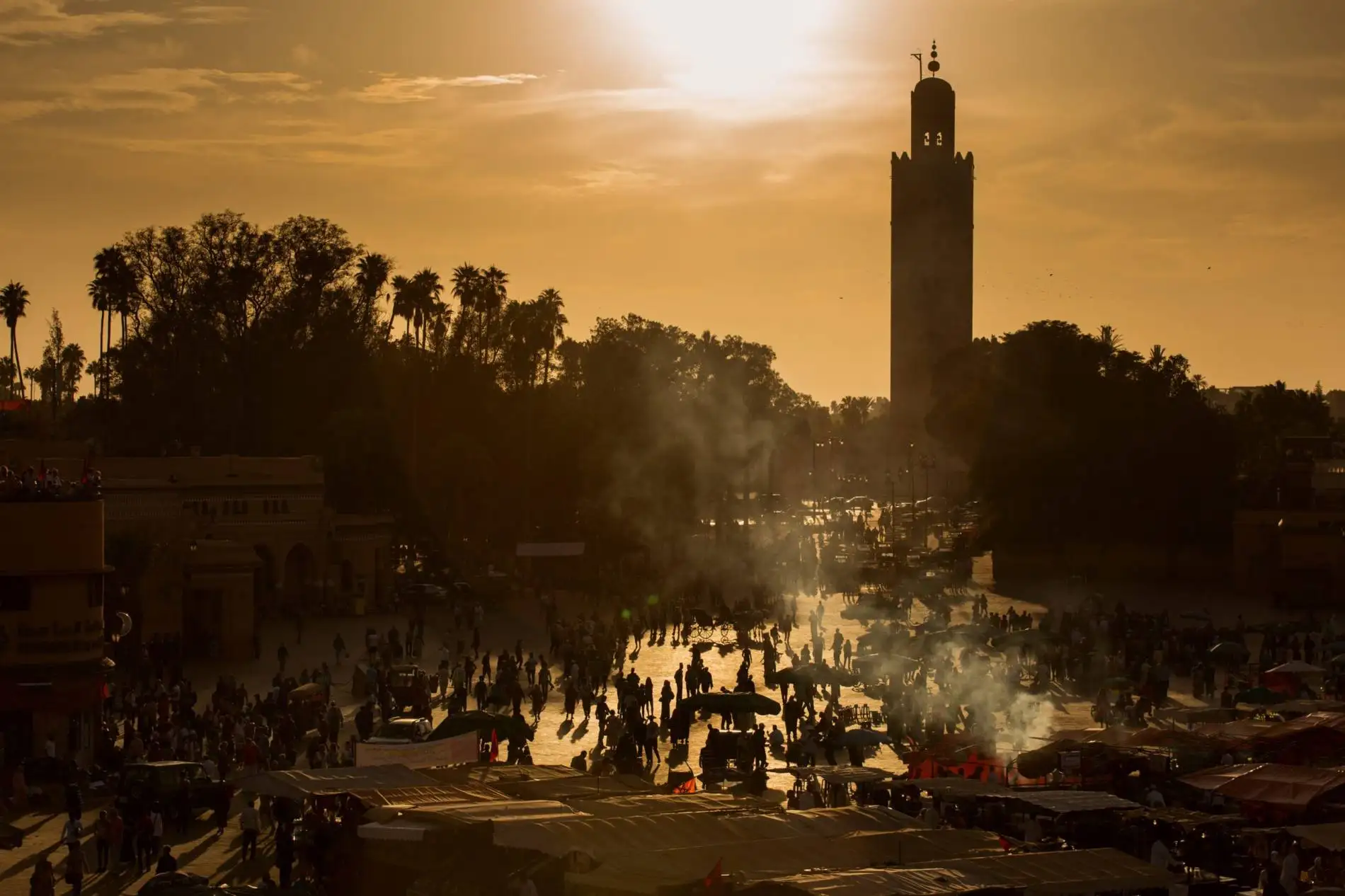
Marrakech récompense les voyageurs qui arrivent préparés. La Ville rouge concentre mille ans d’histoire impériale, une médina classée à l’UNESCO, la place publique la plus théâtrale du monde, et une culture qui suit des rythmes que la plupart des nouveaux venus ne savent pas écouter. Saisissez ces rythmes et la ville s’ouvre à vous. Ratez-les et vous passerez la moitié de votre voyage légèrement perdu, légèrement arnaqué, et légèrement anxieux à l’idée de mal faire.
Voici les 15 conseils qu’un guide marrakchi vous donnerait vraiment autour d’un thé à la menthe — mis à jour pour 2026, écrits pour les voyageurs qui veulent profiter de la ville, pas seulement y survivre. Ils couvrent l’argent, la tenue, l’étiquette, les transports, la photographie, la cuisine et les petits codes sociaux qui font la différence entre se sentir touriste et se sentir invité bienvenu.
Les 15 essentiels à faire et à éviter, en un coup d’œil
Si vous ne lisez rien d’autre, lisez cette liste. L’explication complète de chacun est en dessous.
- À faire : ayez toujours des petites coupures en dirhams — la plupart des transactions se font en espèces et pour de petits montants.
- À éviter : buvez l’eau du robinet — tenez-vous-en à l’eau en bouteille scellée ou filtrée.
- À faire : habillez-vous avec respect, surtout dans la médina.
- À éviter : photographiez les gens, en particulier les femmes, sans autorisation explicite.
- À faire : apprenez cinq phrases en français ou en arabe — cela transforme la façon dont on vous traite.
- À éviter : suivez quelqu’un qui propose de « vous montrer le chemin » sans qu’on lui demande.
- À faire : négociez dans les souks — mais faites-le gentiment et avec le sourire.
- À éviter : entrez dans une mosquée active sauf si vous êtes musulman (une exception célèbre plus bas).
- À faire : laissez un pourboire en espèces, en petites coupures, souvent.
- À éviter : supposez que les chauffeurs de taxi utiliseront le compteur — mettez-vous d’accord sur le prix d’abord.
- À faire : organisez votre journée autour des cinq prières quotidiennes.
- À éviter : boire de l’alcool dans la rue : c’est légal, mais mal vu en dehors des établissements autorisés.
- À faire : logez dans un riad à l’intérieur de la médina, au moins quelques nuits.
- À éviter : précipitez la nourriture — les tagines mijotés et le thé versé lentement font tout l’intérêt.
- À faire : prévoyez des couches — Marrakech varie de 20 °C entre la nuit et l’après-midi.
Chacun compte. Voici la raison derrière chaque conseil.
1. À faire : ayez toujours des petites coupures en dirhams
Le dirham marocain (MAD) est ce que les locaux appellent une monnaie fermée — you can’t legally take meaningful amounts in or out of the country, and most exchanges happen at airports, banks, or licensed bureaux inside Morocco. ATMs are widely available in Marrakech and almost always dispense 100- and 200-dirham notes. The problem: very little of daily life in the medina costs 200 dirhams. A taxi across town, a glass of fresh orange juice on Jemaa el-Fnaa, a pastry, a public toilet, a small tip — all of these expect coins or 10–50-dirham notes.
Break your big notes early in the day at a café, a riad, or a supermarket. Keep a pouch of small change separate from your main wallet. Trying to pay a 7-dirham petit taxi fare with a 200 will produce either a long wait while the driver finds change, or a quiet shrug and a worse exchange rate than you’d like. For more on practical money handling on the ground, our guide des devises et des pourboires au Maroc goes deeper.
Quand vous êtes prêt à organiser votre voyage, parcourez toutes nos activités à Marrakech.
2. À éviter : ne buvez pas l’eau du robinet
L’eau du robinet à Marrakech est traitée et généralement convenable pour se brosser les dents, mais sa teneur minérale et le microbiome local diffèrent suffisamment de ce à quoi la plupart des visiteurs sont habitués pour qu’en boire au robinet soit un raccourci vers un estomac que vous regretterez. L’eau en bouteille scellée se vend partout — les petites épiceries (appelées hanouts), supermarkets, hotels, and pharmacies all stock it. A 1.5-liter bottle is inexpensive and easy to carry. If you want to reduce plastic, bring a filter bottle rated for bacteria and protozoa; refill at your riad.
Soyez aussi prudent avec les glaçons dans les établissements informels, les salades crues lavées à l’eau inconnue, et les jus de fruits frais des tout petits étals si vous venez d’arriver. Au troisième jour, la plupart des voyageurs peuvent tout supporter. Le premier jour, allez-y doucement.
3. À faire : habillez-vous avec respect, surtout dans la médina
Le Maroc est un pays musulman, et Marrakech est une ville qui travaille, pas une station balnéaire. Rien n’est « interdit » aux touristes, et vous verrez de tout, des Marocaines en couverture intégrale aux Européennes en débardeur, mais plus vous couvrez la peau, plus vous vous déplacerez confortablement dans la médina, les souks et les quartiers religieux. Une base pratique qui marche pour presque tout le monde : épaules couvertes, genoux couverts, pas de tissus transparents. Pantalon en lin, haut léger à manches longues, foulard que vous pouvez jeter sur la tête si vous jetez un œil dans un sanctuaire — tout est facile, tout est frais sous la chaleur.
In Gueliz, La Mamounia, the rooftop bars, and the resort hotels, anything goes. In the medina at midday in July, your skin will thank you for the long sleeves anyway. Our deeper guide on comment s'habiller à Marrakech breaks it down by season and by neighborhood.
4. À éviter : ne photographiez pas les gens sans demander
C’est l’erreur d’étiquette la plus courante que les touristes commettent à Marrakech — et celle qui crée le plus de friction. La culture marocaine traite l’image personnelle avec soin. Beaucoup de gens, en particulier les femmes et les hommes plus âgés, ne veulent tout simplement pas être photographiés par des inconnus. Les porteurs d’eau dans leurs costumes rouges à franges de Jemaa el-Fnaa, les charmeurs de serpents, les artistes du henné — presque tous travaillent au pourboire et attendront un paiement si vous les photographiez. Mettez-vous d’accord sur le prix d’abord, en dirhams, avant de lever l’objectif. Vingt à cinquante dirhams sont corrects pour une photo posée.
Pour tous les autres : demandez d’abord. Un geste poli vers votre appareil photo avec un haussement de sourcils est universellement compris. S’ils refusent d’un signe de la main, abaissez l’appareil et souriez. Ne photographiez pas les enfants sans la permission parentale. Ne photographiez pas à l’intérieur des mosquées. Ne photographiez ni la police, ni les installations militaires, ni les portes du palais royal au-delà de ce qui est clairement autorisé.
5. À faire : apprenez cinq phrases en français ou en darija
Les langues officielles du Maroc sont l’arabe et le tamazight (berbère), avec le français encore largement utilisé dans le commerce, l’éducation et le tourisme. À Marrakech, vous pouvez tout à fait vous débrouiller en anglais dans les principales zones touristiques. Mais dès que vous saluez un commerçant avec “Salam alaikum” instead of “hello,” you become someone different in their eyes — a guest, not a target. Learn these five:
- Salam alaikum — peace be upon you (universal greeting)
- Shukran — merci
- La, shukran — no, thank you (the politest “I’m not buying”)
- Bshhal hada? — how much is this? (Darija)
- Bslama — goodbye
Si le français vous est plus facile, “Bonjour, ça va?” fonctionne presque partout. La prononciation sera imparfaite ; cela n’a pas d’importance. L’effort, c’est le message.
6. À éviter : ne suivez personne qui propose de « vous montrer le chemin »
La médina de Marrakech est classée au patrimoine mondial de l’UNESCO pour de bonnes raisons — son tracé est resté à peu près inchangé depuis le XIIe siècle, avec des centaines de ruelles non balisées, des impasses et des souks mouvants. C’est aussi l’habitat naturel du « guide » non sollicité : un jeune homme ou un garçon qui vous voit perdu, vous demande où vous allez, vous y conduit — puis réclame un paiement, parfois agressivement, à l’arrivée.
The polite firm answer is “La, shukran”, eye contact, no slowing down. If someone is already walking with you, stop, stand still, and refuse to keep moving until they leave; following you only works if you keep walking. If you are genuinely lost, step into a shop or a café and ask the owner. They have nothing to gain from misleading you and everything to gain from your goodwill. A licensed official guide will carry a metal badge and identification — you can hire one through your riad, and it’s worth it for a half-day medina tour.
7. À faire : marchandez dans les souks — mais avec courtoisie
Marchander dans les souks de Marrakech n’est pas optionnel, c’est toute la culture commerciale. Le prix affiché est l’ouverture des enchères, pas le prix final. La danse attendue : le vendeur annonce un chiffre bien au-dessus de ce qu’il acceptera, vous proposez environ un tiers, vous vous retrouvez quelque part au milieu. Une lampe affichée à 800 dirhams se vend probablement entre 350 et 450. Un sac en cuir affiché à 1 500 se vend probablement entre 700 et 900.
The crucial part most visitors miss: this is supposed to be enjoyable. Smile. Joke. Accept the mint tea if it’s offered. If you’re not interested at the seller’s lowest price, walk away politely — this is normal, and they may call you back with a better one. If they don’t, the price was honest. Never haggle for something you don’t actually want, never haggle aggressively, and never haggle in front of staple-food shops, pharmacies, or modern stores — those are fixed-price.
8. À éviter : n’entrez pas dans une mosquée en activité si vous n’êtes pas musulman
Le Maroc suit une convention de longue date selon laquelle les mosquées en activité sont réservées aux musulmans. C’est une courtoisie religieuse, pas une hostilité, et les voyageurs qui tentent de passer outre causent une offense silencieuse. Presque toutes les mosquées de Marrakech — y compris l’emblématique Koutoubia, dont le minaret se voit de partout en ville — sont interdites aux visiteurs non musulmans. Vous pouvez les admirer de l’extérieur autant que vous voulez. Le minaret de la Koutoubia, avec son architecture almohade du XIIe siècle, vaut à lui seul une visite et un tour lent des jardins qui l’entourent.
The famous exception is the Hassan II Mosque in Casablanca, which runs guided tours for non-Muslims outside prayer times — but that’s a different city. Inside Marrakech, the closest you can come is the Ben Youssef Madrasa, a former Quranic school that is open to all visitors and is one of the most beautiful pieces of Islamic architecture in the country.
9. À faire : laissez un pourboire en espèces, souvent, en petites coupures
Au Maroc, le pourboire est constant, petit, et tout à fait normal. Ce n’est pas un pourcentage à l’américaine ; c’est un flux de petites reconnaissances tout au long de la journée. Quelques repères pratiques utilisés par les locaux :
- Restaurants : 10 % est généreux ; arrondir au supérieur est la norme.
- Serveurs de café : quelques dirhams pour un café, 5 à 10 pour un repas.
- Ménage du riad : 20 à 30 dirhams par jour, laissés dans la chambre.
- Personnel du riad qui porte vos bagages : 10 à 20 dirhams.
- Petit taxi : arrondissez au 5 ou 10 supérieur.
- Préposés aux toilettes publiques : 2 à 5 dirhams.
- Un guide pour une demi-journée dans la médina : 100 à 200 dirhams en plus du tarif convenu.
Tip in dirhams, not in foreign currency — euros and dollars are difficult for staff to use. Have small notes ready. The cumulative effect of generous, frequent tipping is enormous: you will get warmer service, better tables, and surprise extras for very little money.
10. À éviter : ne supposez pas que le compteur du taxi sera enclenché
Marrakech has two taxi types: petits taxis (small, beige, for trips inside the city, max three passengers) and grands taxis (larger, often Mercedes sedans, for longer or shared trips). Both are required by law to use a meter for in-city journeys, and during the day most petits taxis will, especially if you ask. After dark, near the airport, near major hotels, and any time the driver senses a tourist who doesn’t know better, the meter mysteriously breaks.
The fix is simple: agree on the price before you get in. A petit taxi across the medina is typically 20–40 dirhams during the day; airport to the medina is around 100–150 dirhams (more at night, when there’s a legal night surcharge). If the driver names a number wildly above that, smile, say “La, shukran”, and try the next one. Ride-hailing apps like Careem and inDrive operate in Marrakech and remove the negotiation entirely if you prefer.
11. À faire : organisez votre journée autour des cinq prières quotidiennes
Marrakech runs on the rhythm of five daily prayers — Fajr (dawn), Dhuhr (midday), Asr (afternoon), Maghrib (sunset), and Isha (night). Each is announced by the muezzin’s call from every mosque in the city, and the city briefly shifts: small shops close for ten or fifteen minutes, taxi traffic thins, the souks slow down. None of this affects you directly, but two of them are worth planning around.
Friday Dhuhr — the noon prayer on Friday — is the major weekly congregational prayer, and many shops, banks, and small businesses close for one to two hours from about 12:30 to 14:00. Don’t plan errands or appointments in that window on a Friday. Maghrib, sunset, is the most beautiful moment in the city, especially on the rooftops of Jemaa el-Fnaa as the call to prayer rolls across the medina; build at least one rooftop sunset into your trip.
12. À éviter : ne buvez pas d’alcool dans la rue
Alcohol is legal in Morocco and widely available in Marrakech — at licensed restaurants, hotels, riads with bar licenses, the Carrefour and Marjane supermarkets in Gueliz, and a handful of dedicated wine shops. What is not done is open-street drinking. You’ll see no one walking through the medina with a beer; doing so yourself is rude and conspicuous. Drink at the rooftop bars in Gueliz or your riad’s terrace. Buy a bottle of Moroccan wine — the country has a small but respectable wine industry centered around Meknès — and enjoy it in your room.
Une remarque à ce propos : pendant le ramadan (le prochain ramadan au Maroc commence vers le 7 février 2027), la plupart des bars et de nombreux restaurants ne servent d’alcool à personne, pas même aux touristes, avant la prière du Maghreb, et les rares qui le font opèrent portes closes. Si vous voyagez pendant le ramadan, l’expérience est vraiment belle, mais organisez en conséquence vos consommations d’alcool et vos repas en journée.
13. À faire : logez dans un riad à l’intérieur de la médina
Un riad is a traditional Moroccan house built around an open central courtyard — usually with a small fountain, citrus trees, intricate zellige tilework, and rooftop terraces. Sleeping inside one, behind a heavy wooden door in a quiet alley of the medina, is one of the genuine joys of visiting Marrakech and something modern hotels cannot replicate. The contrast — the noise and energy of the souks during the day, the silence and starlight of the riad at night — is the experience.
Les riads réputés vont des séjours de charme très abordables à certains des hébergements les plus luxueux d’Afrique du Nord. La plupart incluent un copieux petit-déjeuner marocain et peuvent organiser les transferts aéroport, les rendez-vous au hammam, les cours de cuisine et les guides agréés. Si votre séjour dépasse quatre nuits, une formule prisée consiste à passer deux ou trois nuits dans un riad de la médina, puis quelques nuits à Guéliz ou dans un resort hors de la ville pour profiter de la piscine. Pour des options haut de gamme soigneusement sélectionnées, parcourez nos circuits de luxe sélectionnés au Maroc — every itinerary is built around a hand-picked riad or palace stay.
Si un hammam figure sur votre liste, notre guide des meilleurs hammams et spas de Marrakech compare les bains de quartier et les spas de riad.
14. À éviter : ne précipitez pas la cuisine
Moroccan food is slow on purpose. A proper tagine is cooked for hours over low heat, the spices reducing into the meat and the dried fruit and the preserved lemon until the whole thing collapses at the touch of a spoon. Mint tea is poured from height, then back into the pot, then poured again, three times, until the foam is right. Ordering a tagine and expecting it in fifteen minutes is like ordering a Sunday roast and asking for it in a takeaway box.
Three things every visitor should try at least once: a slow lamb-and-prune tagine at a quiet restaurant, the Friday couscous (traditionally eaten on Friday after the noon prayer, with seven vegetables on top), and breakfast on a medina rooftop with msemen (flaky square pancake), baghrir (the thousand-hole spongy pancake), olive oil, honey, and fresh orange juice. For street food on Jemaa el-Fnaa, ease in: stalls 1–15 are touristy but safe; the busy locals’ stalls further into the square are often better and just as safe — pick one with high turnover.
15. À faire : prévoyez des couches — et vérifiez la saison
Marrakech s’étend au pied des montagnes de l’Atlas, en bordure d’une plaine semi-aride. Les températures varient fortement entre le jour et la nuit, surtout au printemps et en automne, et changent énormément d’un mois à l’autre. Un après-midi de juillet peut atteindre près de 45 °C ; une nuit d’hiver en janvier peut approcher le gel dans la cour du riad. Les mois les plus propices au voyage sont mars-mai et septembre-novembre, quand les journées affichent agréablement entre 20 et 30 °C et que les soirées sont douces.
Whatever month you visit, pack: light layers for daytime, a warm layer for early mornings and evening rooftops, sturdy walking shoes for the medina’s uneven cobbles, sunscreen, a hat, and a scarf that doubles as a head covering when needed. For a month-by-month breakdown of weather, festivals, and prices, see our pillar guide on the guide approfondi de la meilleure période pour Marrakech.
Référence rapide : tout ce qu’il faut faire et éviter dans un seul tableau
| Sujet | À faire : | À éviter : |
|---|---|---|
| Argent | Carry small dirham notes | Rely on cards alone |
| Eau | Drink sealed bottled or filtered | Drink from the tap |
| Tenue | Cover shoulders and knees in the medina | Wear beachwear in town |
| Photos | Ask first; pay performers | Photograph people, police, or palaces uninvited |
| Langue | Greet in Arabic or French | Default to loud English |
| Itinéraires | Ask shopkeepers | Follow unsolicited “guides” |
| Souks | Haggle with a smile | Haggle aggressively or for items you don’t want |
| Mosquées | Admire from outside; visit Ben Youssef Madrasa | Enter active mosques as a non-Muslim |
| Pourboires | Tip in dirhams, often, in small notes | Tip in foreign currency |
| Taxis | Agree the price first | Assume the meter is on |
| Prières | Plan around Friday lunchtime | Schedule errands during major prayers |
| Alcool | Drink at licensed venues or your riad | Drink in the street |
| Hébergement | Spend at least two nights in a medina riad | Skip the medina experience entirely |
| Cuisine | Eat slowly; try the Friday couscous | Rush a tagine |
| Bagages | Layers, sturdy shoes, scarf | One-temperature wardrobe |
Un mot rapide sur la sécurité
Marrakech is, by international travel-advisory standards, a comparatively safe destination — both the UK Foreign, Commonwealth & Development Office (FCDO travel advice for Morocco) and the US State Department (U.S. Department of State Morocco information page) classify Morocco at their lower travel-advisory tiers and note that most visitors have trouble-free trips. The most common issues for tourists are petty: pickpocketing in crowded areas, scams from unsolicited guides, occasional aggressive vendors. Violent crime against tourists is uncommon. Solo female travelers do report verbal hassle in some areas; dressing modestly and walking confidently helps. For the full picture, our standalone guide on whether Marrakech is safe to visit goes into recent updates and neighborhood-level detail. (Always check your own government’s most recent travel advice before booking.)
Questions fréquentes sur les conseils de voyage à Marrakech
Que dois-je éviter de faire en tant que touriste à Marrakech ?
Les quatre grandes erreurs évitables sont : boire l’eau du robinet, photographier les gens sans demander et sans payer les artistes, suivre des « guides » non sollicités dans la médina, et marchander de manière agressive. Chacune se corrige facilement avec un petit ajustement d’habitude. Au-delà, évitez les vêtements très découverts dans la médina, l’alcool dans la rue, l’entrée des mosquées en activité si vous n’êtes pas musulman, et toute démarche commerciale durant la prière du vendredi midi. Aucune n’est punissable ; toutes vous marquent comme un touriste qui ignore les codes, ce qui rend tout le voyage plus difficile qu’il ne devrait l’être.
Marrakech est-elle sûre pour les voyageuses seules ?
Yes, with caveats. Solo women travel to Marrakech in large numbers every year and most report a positive trip. The main issue is verbal attention — comments, persistent vendors, occasional unwanted approaches — rather than physical danger. Strategies that work well: stay inside the medina in a riad with 24-hour staff, dress modestly, walk with purpose and don’t make extended eye contact with strangers, use registered taxis after dark, and avoid empty alleys late at night. The Gueliz neighborhood and the modern hotel zones are very relaxed. Our deeper guides on solo female travel in Morocco et Marrakech safety cover specifics.
Combien d’espèces dois-je apporter à Marrakech pour une semaine ?
It depends entirely on your travel style, but a useful midrange anchor for a week of mostly cash spending — meals at mid-range restaurants, taxis, tips, souk purchases, a guided tour or two, the odd hammam — is somewhere in the range of 250–400 euros (or equivalent) per person, exchanged into dirhams in-country. Luxury travelers staying at five-star riads will spend much more on extras and tips; budget travelers eating local and walking everywhere will spend much less. Cards are widely accepted in upscale restaurants, hotels, and modern shops in Gueliz, but the medina runs on cash. Withdraw from ATMs as you go rather than carrying a week’s worth in your bag.
Ai-je besoin d’un visa pour visiter Marrakech ?
Pour la plupart des voyageurs occidentaux, non. Les ressortissants des États-Unis, du Royaume-Uni, de l’Union européenne, du Canada, d’Australie, de Nouvelle-Zélande et de nombreux autres pays peuvent entrer au Maroc sans visa pour des séjours touristiques allant jusqu’à 90 jours, avec un passeport valable au moins six mois après la date d’entrée. Vérifiez toujours les exigences actuelles pour votre nationalité auprès du consulat marocain ou de votre ministère des affaires étrangères avant de partir, car les politiques sont mises à jour périodiquement. Pour tous les détails, consultez notre guide dédié sur Morocco visa requirements.
Quelle est la meilleure période de l’année pour visiter Marrakech ?
Spring (March to early May) and autumn (mid-September to November) are the most comfortable, with daytime temperatures usually in the high teens to high twenties °C and cool evenings. Winter (December to February) is mild during the day and can be cold at night, with occasional rain — but it’s also low-season pricing and uncrowded medina. Summer (June to August) is hot, often above 38 °C in the city, and demands a riad with a pool and a slower pace. Most travelers find March–May and September–November the sweet spot. Our full month-by-month breakdown is in the best time to visit Marrakech guide.
Puis-je boire de l’alcool à Marrakech ?
Oui, dans les établissements autorisés. La plupart des hôtels haut de gamme, beaucoup de restaurants à Gueliz, les bars sur les toits et les riads disposant de la licence adaptée servent bière, vin et spiritueux, y compris les petits mais respectables vins marocains de la région de Meknès. Les supermarchés Carrefour et Marjane des quartiers modernes vendent aussi de l’alcool. Ce qui ne se fait pas : boire à découvert dans la médina ou dans la rue. Pendant le Ramadan, la vente d’alcool en journée est suspendue pour tout le monde — prenez-le en compte si vous visitez pendant le mois saint.
Notes de clôture — et comment Moratra peut vous aider
La seule chose qui transforme un voyage à Marrakech de « intéressant » à « inoubliable » est la préparation alliée à la détente : connaître les codes assez bien pour ne plus avoir à y penser, puis les oublier et simplement être dans la ville. Les 15 conseils ci-dessus sont les codes. Utilisez-les comme une liste discrète le premier matin, puis rangez-la.
Un dernier conseil pratique : réglez vos données mobiles avant d'arriver. Notre guide sur les meilleures options d'eSIM et de carte SIM pour le Maroc présente les prix, la couverture et comment vous connecter dès l'atterrissage.
Si vous souhaitez que le reste de votre voyage au Maroc soit organisé avec le même soin (un riad sélectionné dans la médina, un guide privé agréé qui connaît vraiment les ruelles, un camp de luxe dans le Sahara sous les étoiles, les transferts et les horaires pris en charge), c’est notre métier. Parcourez nos circuits de luxe sur mesure au Maroc, demandez un devis, ou écrivez-nous simplement posez-nous une question — we’ll answer for free, no obligation. If Marrakech is your gateway to a longer trip, our companion guide for first-time travelers to Morocco is the natural next read. Either way: take your time, drink the mint tea, smile when you haggle, and let the city show you what it does best.
This guide was last refreshed in May 2026. Always cross-check current travel advisories, visa rules, and seasonal guidance with your own government’s foreign office before you travel.
Planning what to actually book? See all Marrakech tours & excursions in one place and pick what fits your dates.
