
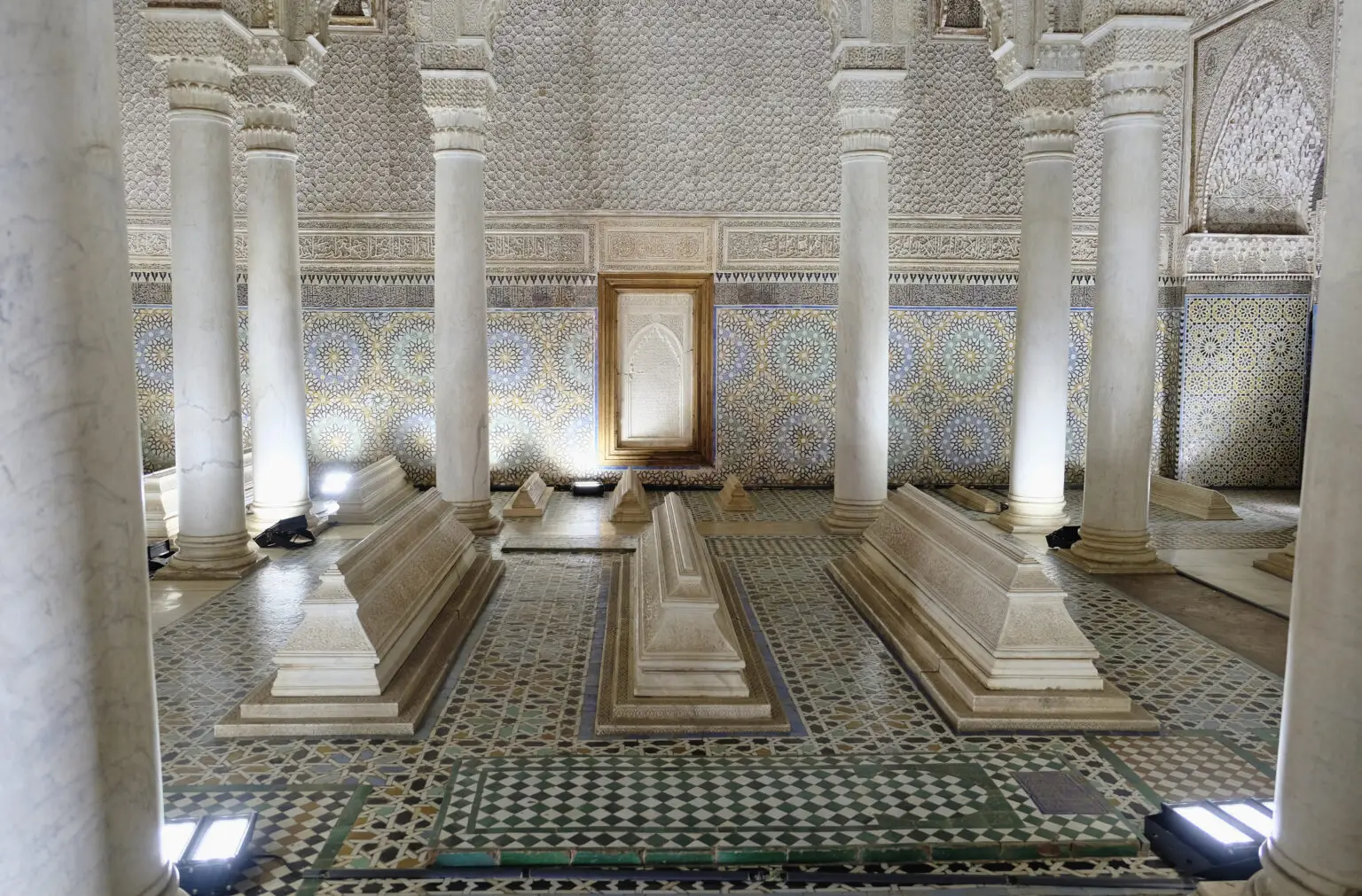
The Saadian Tombs are the royal necropolis of the Saadi dynasty, set against the Kasbah Mosque in the southern kasbah quarter of Marrakech. Sultans, princes, wives and courtiers lie here beneath carved cedar, stucco, zellij tilework and Italian Carrara marble. Sealed off under the Alaouites and opened to the public only after 1917, the tombs are among the finest surviving examples of Saadian court art in Morocco.
Who built the Saadian Tombs, and when?
The ground was a burial site before the Saadians arrived. The Marinid sultan Abu al-Hasan was buried here temporarily in 1351. His remains were later moved to Chellah, near Rabat.
The Saadian chapter begins with Muhammad al-Shaykh, sultan of Morocco from 1549. He was assassinated on 23 October 1557 by Ottoman soldiers acting on the orders of Hasan Pasha. His son Abdallah al-Ghalib, who reigned from 1557 to 1574, built the first mausoleum over his father’s grave.
The great expansion came under Ahmad al-Mansur, who ruled from 1578 to 1603. He enlarged the eastern mausoleum and added a new western building intended for his own burial. Many travellers see the tombs as one stop on a guided medina and souks walking tour, which helps place the kasbah within the wider old city.
Who is buried in the Saadian Tombs?
The complex holds 56 tombstones carved as marble epitaphs called mqabriyas. Another hundred or so graves are marked simply with multicoloured tiles. That makes more than 150 burials in total, well beyond the figure of about 60 often quoted for the dynasty’s members.
The eastern mausoleum contains the tomb of Muhammad al-Shaykh and that of his son Abdallah al-Ghalib, who died in 1574. When al-Mansur’s mother, Lalla Mas’uda, died in 1591, he had her buried in the same chamber as his father.
Al-Mansur himself lies at the centre of the Chamber of the Twelve Columns, buried there in 1603. His son Moulay Zidan followed in 1627, and Sultan Abd al-Malik II in 1631. The garden between the mausoleums holds rows of simpler graves of servants, courtiers and lesser royals.
What is the Hall of Twelve Columns?
The Chamber of the Twelve Columns is the heart of al-Mansur’s western mausoleum. It measures 10 metres per side and rises 12 metres high. Twelve columns of Carrara marble surround the central space where al-Mansur lies.
Above them sits a cedar wood ceiling shaped like a square dome and covered in a star pattern. A transitional band of carved wooden muqarnas, the honeycomb-like vaulting of Islamic architecture, sits below the cupola. Carved stucco and zellij tile mosaics complete the decoration.
The western mausoleum dates to between 1591 and 1598, or before 1603 at the latest. It has three rooms, from south to north: the Chamber of the Mihrab, a prayer room; the Chamber of the Twelve Columns; and the Chamber of the Three Niches. The whole building measures 15 by 23 metres.
Why were the tombs hidden for centuries?
The Saadi dynasty ruled Morocco until 1659. The Alaouites who replaced them had little reason to honour their rivals. Moulay Isma’il, who ruled from 1672 to 1727, plundered the Saadian palaces and sealed off the necropolis.
The closure of the tombs is dated to 1677, in the late 17th century. Moulay Isma’il built a wall around the tombs, leaving only a small passage from the Kasbah Mosque. It is said that he could not bring himself to desecrate a burial site, so he walled it up instead.
The contrast with El Badi Palace is striking. That palace was demolished and stripped on his orders, while the tombs survived behind their wall. Cut off from the surrounding streets, the necropolis fell out of use until the 20th century.
How were the tombs rediscovered in 1917?
In 1917 the tombs were “rediscovered” by the Service des Beaux-Arts, Antiquités et Monuments historiques. The quotation marks matter, because the site had been isolated rather than truly lost. From 1917 onward, the Service carried out a careful restoration.
The popular version of the story involves the air. In this account, aerial photographs of Marrakech, commissioned under the French Resident General Hubert Lyautey, revealed the hidden complex. Treat this as the well-known account rather than settled scholarship.
The restoration also opened the site to the general public for the first time. Today the tombs sit inside the Medina of Marrakesh, which UNESCO inscribed as a World Heritage Site in 1985. UNESCO’s description names the Saadian Tombs among the medina’s notable monuments.
When was each part of the tombs built?
The necropolis grew over several centuries, from a single grave beside an Almohad mosque to a walled royal cemetery. The key dates are set out below.
| Year | Event |
|---|---|
| 1185–1190 | Almohad ruler Yaqub al-Mansur builds the Kasbah Mosque |
| 1351 | Marinid sultan Abu al-Hasan temporarily buried on the site |
| 1557 | Muhammad al-Shaykh assassinated on 23 October and buried here |
| 1557–1574 | Abdallah al-Ghalib builds the first (eastern) mausoleum |
| 1591 | Lalla Mas’uda dies; work on the western mausoleum begins |
| 1603 | Ahmad al-Mansur buried in the Chamber of the Twelve Columns |
| 1677 | Necropolis closed under Moulay Isma’il |
| 1917 | “Rediscovery” and restoration by the Service des Beaux-Arts |
| 1985 | Medina of Marrakesh inscribed on the World Heritage List |
What else can you see nearby?
The tombs lie on the south side of the Kasbah Mosque, also known as the Moulay al-Yazid Mosque. The Almohad ruler Yaqub al-Mansur built it in 1185–1190. It is still used for prayer, so non-Muslims are not permitted inside.
El Badi Palace stood along the northern edge of the same kasbah. Ahmad al-Mansur began it in December 1578 and completed it in 1593, probably funded by the Portuguese ransom paid after the Battle of the Three Kings. Moulay Isma’il ordered it demolished around 1707–08, and today it survives as a ruin.
Seeing the palace and the tombs together shows both sides of Saadian ambition: the public showpiece and the private resting place. Our Moroccan architecture guide explains the zellij, stucco and cedar techniques you will spot in both.
How do you avoid the queue?
The site is compact, and the bottleneck is the Chamber of the Twelve Columns. You view it from an opening at its edge, not from inside, so visitors queue for a turn at that doorway. This opening, in the eastern wall, was originally only a window.
Today you reach the tombs through a narrow passage that leads in from the west, with the Kasbah Mosque standing just to their north. A visit to the Saadian Tombs usually takes 20 to 30 minutes, plus any time spent queuing for the Chamber of the Twelve Columns.
- Arrive at opening time, 9 am, before the site fills up.
- Go straight to the Twelve Columns queue first, then see the eastern mausoleum and garden.
- If you miss the morning, try late afternoon, after 3 pm.
- Choose a weekday where you can, as weekends are generally busier.
- Bring a zoom lens or phone zoom for the muqarnas ceiling, which you see from a distance.
A tip from our team on the ground in Marrakech: after the tombs, walk on to El Badi Palace rather than heading straight back to the main square. The two sites tell one Saadian story, and the palace’s open-air ruins are a welcome contrast after the tombs’ narrow passages.
How much does a ticket cost, and when is it open?
Visitor guides updated in 2026 list the entrance fee at 100 dirhams for foreign adults. This rate has reportedly applied since June 2024, with 50 dirhams for children aged 7 to 13. Older guides still quote 70 dirhams, so expect to pay the higher rate.
All the guides we checked agree the site opens daily at 9 am. Closing times are listed as 5 pm by some guides and 6 pm by others, so plan to arrive well before late afternoon. Expect shorter hours during Ramadan.
How do the tombs fit into a Marrakech trip?
The Saadian Tombs fit neatly into a morning in the kasbah, alongside El Badi Palace and the Kasbah Mosque. For a wider plan, our 3-day Marrakech itinerary shows how to combine them with the souks and gardens. You can also browse all our activities in Marrakech, or ask us anything — we answer for free, with no obligation.
Sources and further reading
- UNESCO World Heritage Centre: Medina of Marrakesh
- Archnet: Saadian Tombs
- Wikipedia: Saadian Tombs
- Wikipedia: Kasbah Mosque (Marrakesh)
- Wikipedia: Mohammed al-Shaykh
Frequently asked questions
How many people are buried in the Saadian Tombs?
The complex holds 56 tombstones marked with carved marble epitaphs, plus another hundred or so graves marked with multicoloured tiles. The figure of about 60 that many guides quote counts only members of the dynasty.
Another estimate gives a similar picture, with around 66 Saadian princes and over 100 members of the royal household, including courtiers, chancellors and wives. The simpler garden graves belong to servants, courtiers and lesser royals.
Can you go inside the Chamber of the Twelve Columns?
No. Visitors look into the chamber from an opening at its edge, which was originally a window in the eastern wall.
This protects the marble, stucco and cedar inside, but it also creates the queue that builds through the morning. The view is good, so you will not miss much. A camera or phone with zoom helps you capture the muqarnas and the star-patterned ceiling.
Who sealed the Saadian Tombs?
The Alaouite sultan Moulay Isma’il, who ruled from 1672 to 1727, sealed off the necropolis. The closure is dated to 1677, in the late 17th century.
He built a wall around the tombs, leaving only a small passage from the Kasbah Mosque. He had the nearby El Badi Palace demolished, but the tombs themselves were spared.
When were the Saadian Tombs rediscovered?
In 1917, during the French protectorate. The rediscovery is credited to the Service des Beaux-Arts, Antiquités et Monuments historiques, which then restored the site and opened it to the public for the first time.
The widely told story is that aerial photographs revealed the tombs. It makes a good anecdote, but the official restoration work is the better-documented part of the story.
Can non-Muslims visit the Saadian Tombs?
Yes. The tombs are a historic monument open to all visitors with a ticket. The neighbouring Kasbah Mosque is different: it is still used for prayer, and non-Muslims are not permitted inside, as with other mosques in Morocco.
Dress modestly at the tombs out of respect, since this remains a burial site, and keep voices low in the narrow passages.
