
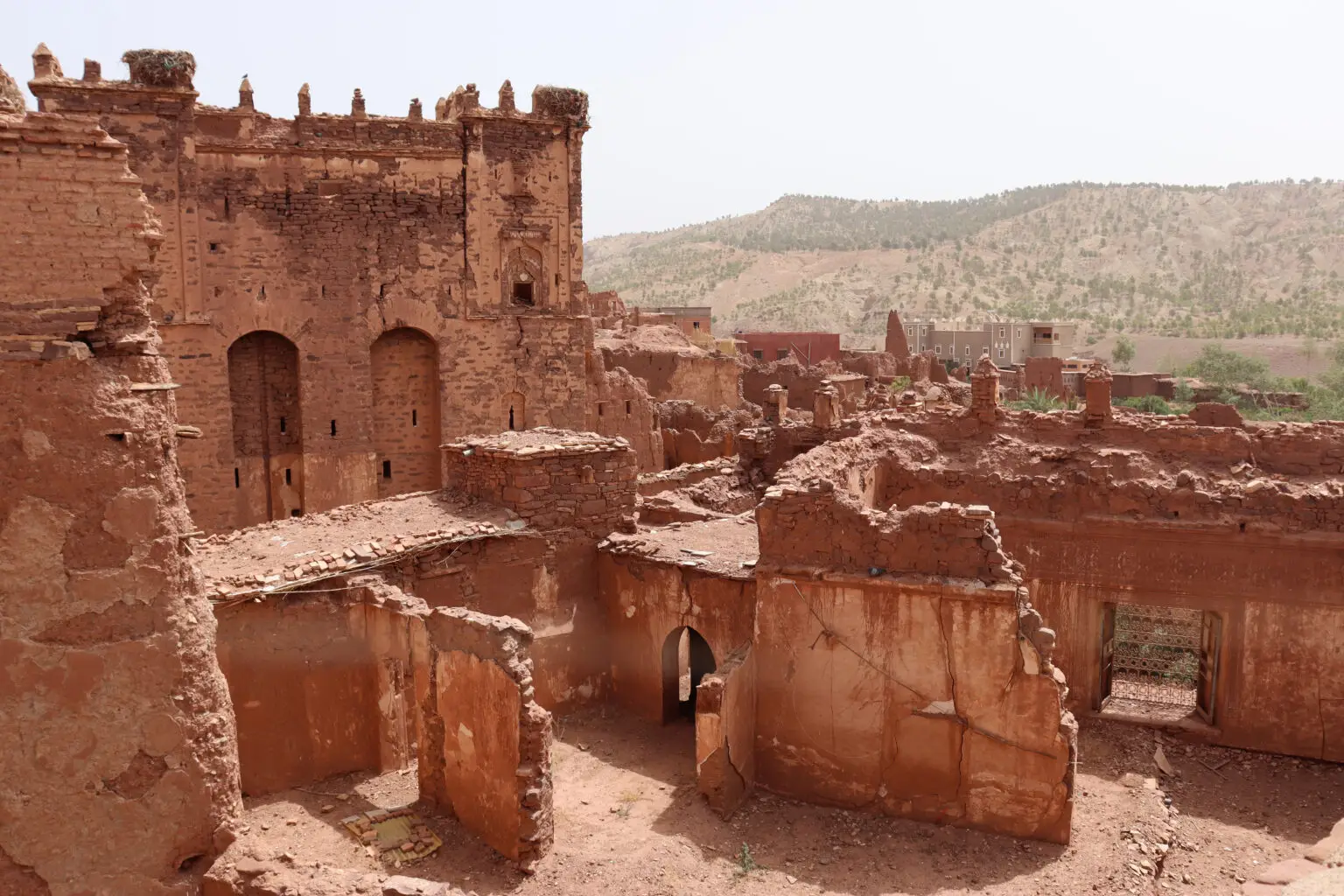
The Telouet Kasbah is the ruined palace of the Glaoui family, the clan that controlled much of southern Morocco from the late 1800s until independence in 1956. It stands at about 1,800 metres in the High Atlas, beside the old caravan route between the Sahara and Marrakech. Behind its eroding earthen walls survive some of the finest painted ceilings and zellij tilework in the country.
Where is the Telouet Kasbah?
Telouet lies in the north of Ouarzazate Province, on the southern flank of the High Atlas. It lies about 80 km northwest of Ouarzazate and about a three-hour drive from Marrakech. The kasbah stands at an elevation of 1,800 metres (5,900 ft).
The village sits on the former caravan route from the Sahara over the Atlas to Marrakech. That position explains the whole story. The family’s control of the olive, saffron and salt trades came from the kasbah’s placement on the caravan trails.
If you are comparing all our Morocco desert tours, note that the road from Marrakech to the Sahara crosses the Tizi n’Tichka pass. The Telouet turn-off lies only a few kilometres beyond it. The kasbah is therefore a detour of about 20 km each way from the main road, not a separate expedition.
Who built the Telouet Kasbah?
Construction started in 1860 under the head of the Glaoui clan. That man was Mohammed ben Hammou, known as Tibibit, the caid (local governor) of Telouet.
The work took about five years. It reportedly involved some 300 craftsmen brought from many parts of Morocco, including Fes.
The result was never a single castle. The family headquarters was a vast complex of buildings. Tibibit died on 4 August 1886, leaving a strong mountain base to his sons. Over the next 70 years, they turned it into the seat of the most powerful family in southern Morocco.
Who were the Glaoui, the Lords of the Atlas?
The family came from the Imezouaren lineage of the Ait Telouet, a clan of the southern Glaoua. English readers know them through Gavin Maxwell’s 1966 history Lords of the Atlas: The Rise and Fall of the House of Glaoua, 1893–1956.
After Tibibit died in 1886, his eldest son held power briefly and died the same year. Leadership then passed to another son, Madani El Glaoui, with his younger brother Thami as khalifa, or deputy.
The breakthrough came in November 1893. Sultan Moulay Hassan I, returning from an expedition to the Tafilalt, was caught by winter weather in the High Atlas and stayed 25 days at Telouet. Madani supplied the royal army, and the sultan rewarded him with a Krupp cannon and modern rifles. Madani was appointed Minister of War in August 1907 and Grand Vizier in May 1908, both under Sultan Moulay Hafid. He died in 1918.
What happened to Thami El Glaoui?
Thami El Glaoui was born at Telouet in 1879. He became Pasha of Marrakesh in 1912 and held the post until 1956. After Madani’s death in 1918, the French made Thami head of the family ahead of Madani’s sons.
From Marrakesh he ran a network of southern kasbahs and trade routes. His alliance with the French Protectorate reached its peak in 1953. On 20 August 1953, French authorities sent Sultan Mohammed V into exile, first to Corsica and later to Madagascar. Thami is widely regarded as the chief instigator of that deposition.
The tide turned quickly. On 8 November 1955, Thami knelt in submission before Mohammed V, who forgave him. The sultan returned from exile on 16 November 1955. Thami El Glaoui died in Marrakesh on 23 January 1956, during his night prayers, in the year Morocco regained its independence.
Telouet Kasbah timeline
| Date | Event |
|---|---|
| 1860 | Construction of the kasbah begins |
| 1879 | Thami El Glaoui born at Telouet |
| 4 August 1886 | Death of Mohammed ben Hammou (Tibibit) |
| November 1893 | Sultan Moulay Hassan I stays 25 days at Telouet |
| August 1907 | Madani named Minister of War by Moulay Hafid |
| May 1908 | Madani promoted to Grand Vizier |
| 1912 | Thami becomes Pasha of Marrakesh |
| 1918 | Madani dies; Thami leads the family |
| 20 August 1953 | Mohammed V forced into exile |
| 23 January 1956 | Thami El Glaoui dies in Marrakesh |
| 1957 | The palace is confiscated |
| 2010 | Restoration work underway |
| 2023 | Damage in the Marrakesh–Safi earthquake |
Why was the Telouet Kasbah abandoned?
The fall was political, not military. In 1957, after Morocco formally gained independence, the palace was confiscated. The Glaoui family’s wealth and palaces across the country were seized at the same time.
The complex was abandoned only in 1956. The palace is now owned by the village council. Earthen buildings need constant maintenance, and without it most of the complex has slumped into ruin.
There has been some care. Restoration work was underway in 2010, and a suite of ornate reception rooms on an upper floor has been fully restored. The palace, including that restored section, was damaged in the 2023 Marrakesh–Safi earthquake. Conditions on site can change, so confirm current access locally before you set out.
What will you see inside the kasbah?
From the outside, Telouet looks like a melting hillside of mud brick. Inside the restored rooms, the contrast is startling. You will see zellij tilework, carved stucco and painted cedar-wood ceilings with colourful motifs.
The decoration blends the classical Andalusi-Moroccan style of the imperial cities with local Atlas traditions. Craftsmen from Fes carried that urban vocabulary into the mountains. The result is a fusion of Andalusian and Berber designs in stucco, painted cedar and zellige.
Look up as much as around you. The ceilings, ornate windows and narrow corridors are the highlights. Many rooms are in a state of decay, so watch your step. For background on these techniques elsewhere in the country, see our Moroccan architecture guide.
How do you get to Telouet from Marrakech?
Most visitors drive the N9 from Marrakech over the Tizi n’Tichka. The French military built this road along the old caravan trail in 1936. The sign at the summit reads 2,260 metres, though GPS puts the pass at about 2,205 metres.
- Leave Marrakech on the N9 toward Ouarzazate and climb into the High Atlas.
- Cross the Tizi n’Tichka pass and continue south.
- Take the signposted Telouet turn-off, about 6 km south of the pass.
- Follow the side road for roughly 20 km to the village.
- Park near the kasbah and pay the small entry fee to the site keepers.
A practical tip from our Marrakech team: start early and do not treat the Tichka as a fast road. Hairpins, heavy lorries and slow climbs make online journey times look optimistic. In winter, check the mountain weather the evening before you travel.
Is the Ounila Valley road worth it?
Yes, if you are continuing towards Ouarzazate. From Telouet, the P1506 runs down the Ounila Valley to Aït Benhaddou. It was finally paved in 2011 and still sees relatively little traffic.
The valley extends for about 40 km from the Kasbah of Telouet to Aït Benhaddou. It passes earthen villages such as Anemiter, about 12 km from Telouet, and Tamdaght. The road drops off a plateau into a long, oasis-lined ravine.
The road suits a regular two-wheel-drive car, although floods and storm damage can affect it. Ask locally after heavy rain. At the bottom of the valley, the fortified village of Aït Benhaddou makes a natural next stop; our Ouarzazate and Aït Benhaddou guide covers it in detail.
Telouet rewards travellers who give it time and a little context. Read about the Glaoui first, drive the Tichka slowly, and take the Ounila Valley down rather than doubling back. If you would like a Marrakech-based team to shape that route around your own pace, browse our private Morocco tours or ask us anything — we answer for free, with no obligation.
Sources and further reading
- History Hit: Telouet Kasbah
- Wikipedia: Telouet Kasbah
- Wikipedia: Thami El Glaoui
- Wikipedia: Madani El Glaoui
- Wikipedia: Mohammed V of Morocco
- Wikipedia: Tizi n’Tichka
- Open Library: Lords of the Atlas, by Gavin Maxwell
Frequently asked questions
Is the Telouet Kasbah open after the 2023 earthquake?
The palace, including its restored reception rooms, was damaged in the 2023 Marrakesh–Safi earthquake. Access to individual rooms can change as repairs and safety checks progress. Before you travel, ask your guide, driver or accommodation in the area about the current situation. Plan the day so that the drive and the Ounila Valley are worthwhile even if part of the interior is closed.
How much does it cost to visit?
A local co-operative runs the site and charges a modest entry fee. Fees change, so carry small notes and coins in Moroccan dirhams rather than relying on cards. There are a few places to eat at the site and small hotels nearby. A local guide can bring the empty rooms to life with stories of the family and the caravan trade.
Who was Thami El Glaoui?
Thami El Glaoui was born at Telouet in 1879 and served as Pasha of Marrakesh from 1912 to 1956. He led the family after his brother Madani died in 1918. He supported the French deposition of Mohammed V in August 1953, then submitted to the returning sultan on 8 November 1955. He died in Marrakesh on 23 January 1956.
Can you visit Telouet as a day trip from Marrakech?
It is possible, but it makes a long day. The drive takes about three hours each way, and the Tichka road deserves an unhurried pace. Many travellers prefer to continue down the Ounila Valley to Aït Benhaddou and spend the night near Ouarzazate. That way the kasbah becomes part of a journey south rather than a rushed return trip.
What is the best book about the Glaoui family?
The classic account in English is Gavin Maxwell’s Lords of the Atlas: The Rise and Fall of the House of Glaoua, 1893–1956, first published in 1966. Its date range opens in 1893, the year Sultan Moulay Hassan I stayed at Telouet, and closes in 1956, the year of Thami’s death. Reading it before your visit adds real depth to the empty halls.
